research task summaries
stuff you should know
HA + M → MA + H2
HA + MCO3 → MA + CO2 +H2O
HA + MOH → MA + H2O
conjugate acid-base pairs: differ by one hydrogen. will be opposite in nature and strength. Ka x Kb = Kw = 10^-14
pKa + pKb = 14
HA + H2O → A- + H3O+
HB +H2O → B+ + OH-
Ka = [H+] [A-] / [HA}
A STRONG ACID has a pKa < -1.74
Kb = [B+] [OH-] / [BOH]
a strong base is just group one metals, or fully soluble
amphriprotic: can act as proton acceptor/donator eg. sodium hydrogen carbonate (Na+/HCO3-) or potassium dihydrogen phosphate (K+/H2PO4-)
strong acid/base: will completely ionise, single arrow. to determine % ionisation: convert pH to [H], divide by molarity, x 100
weak acid/base: incompletely ionised, will reach equilibrium when a certain number H ions released, double arrow
| strong | weak | |
|---|---|---|
| acid | HCl, HNO3, H2SO4 | H2CO3, CH3COOH, HF, C6H8O7 |
| base | NaOH, KOH, Ba(OH)2, Na2O | NH3, CH3NH2 |
monoprotic acid: only one proton
diprotic eg. sulfuric acid: two stages. first stage will fully ionise, Ka = large. second stage partially, Ka = so small we ignore. if diprotic molar ratio will be 2:1 ie. half the acid molecules will be required to neutralise
triprotic eg. phosphoric (H3PO4) , boric (H3BO3): three stages, increasingly weak. Ka=multiply the three
effect of dilution on pH: strong acid, eg. 10x dilution will increase pH by one unit. for weak acids, pH will not increase as much, consider equilibrium expression
to calculate effects of dilution/mixing calculate limiting reagent/how much will be left
dissolution process is exothermic!!!
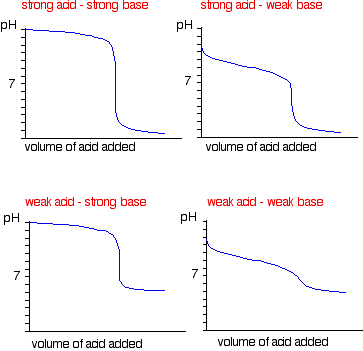
pH/conductivity curves
pH
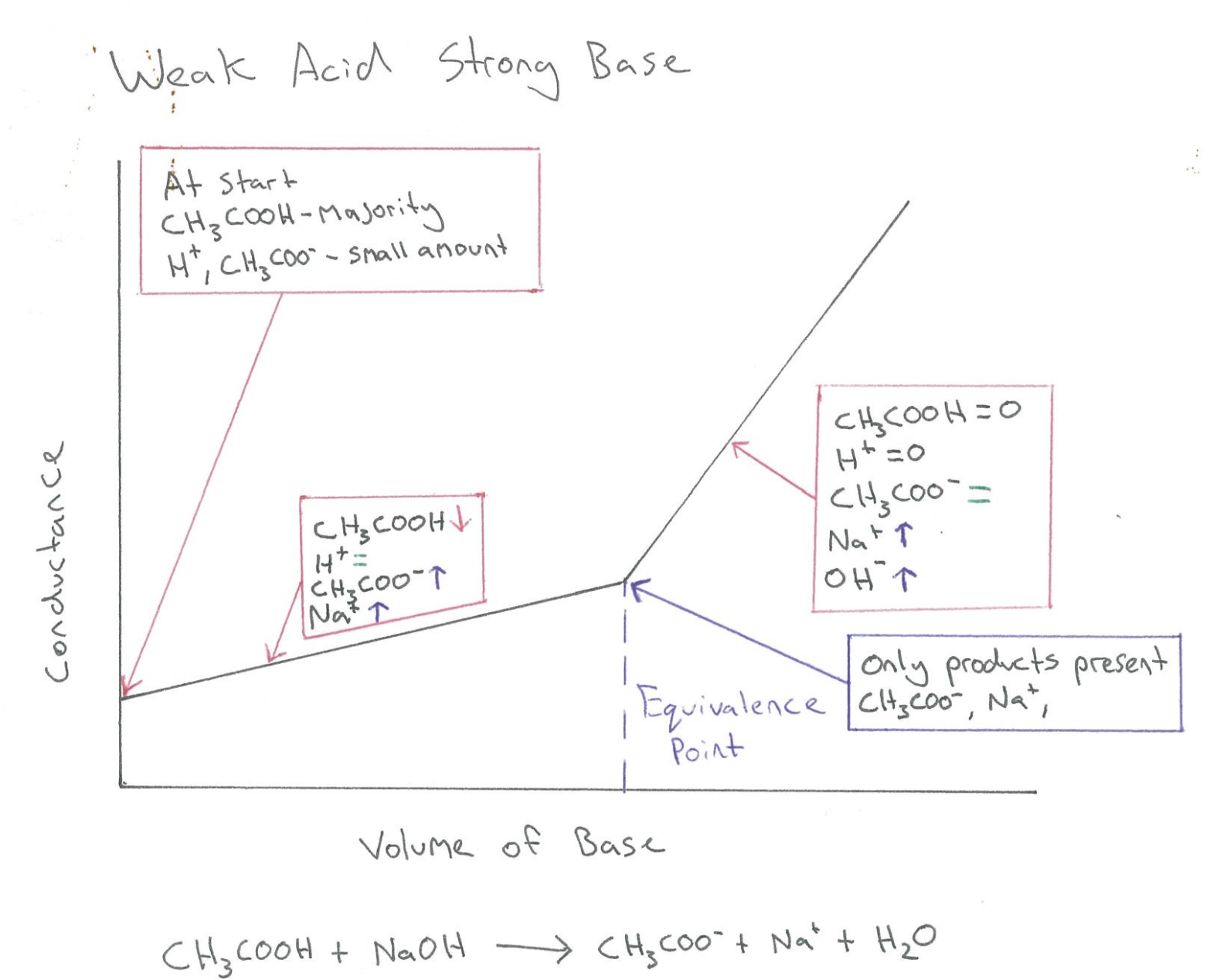
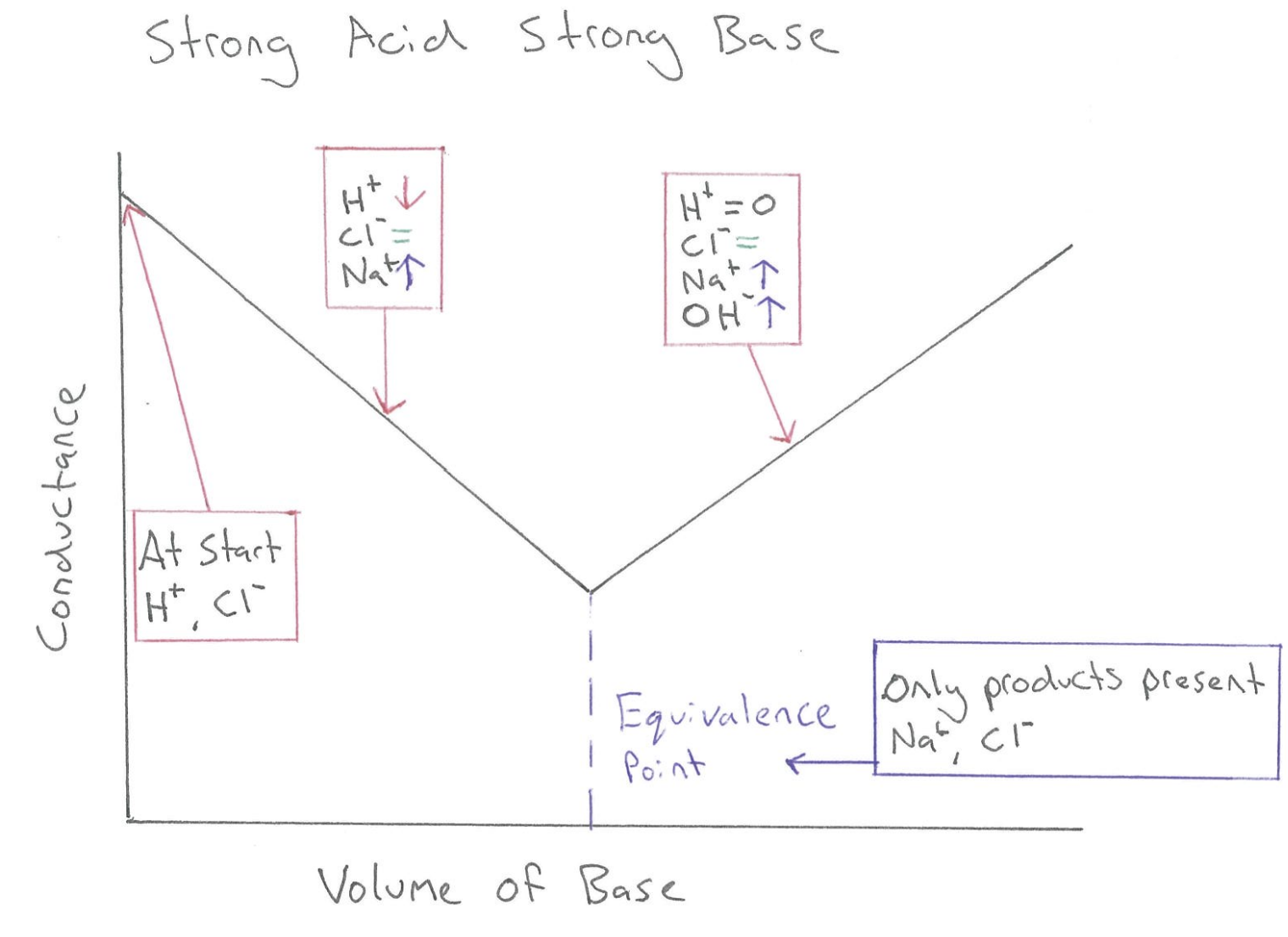
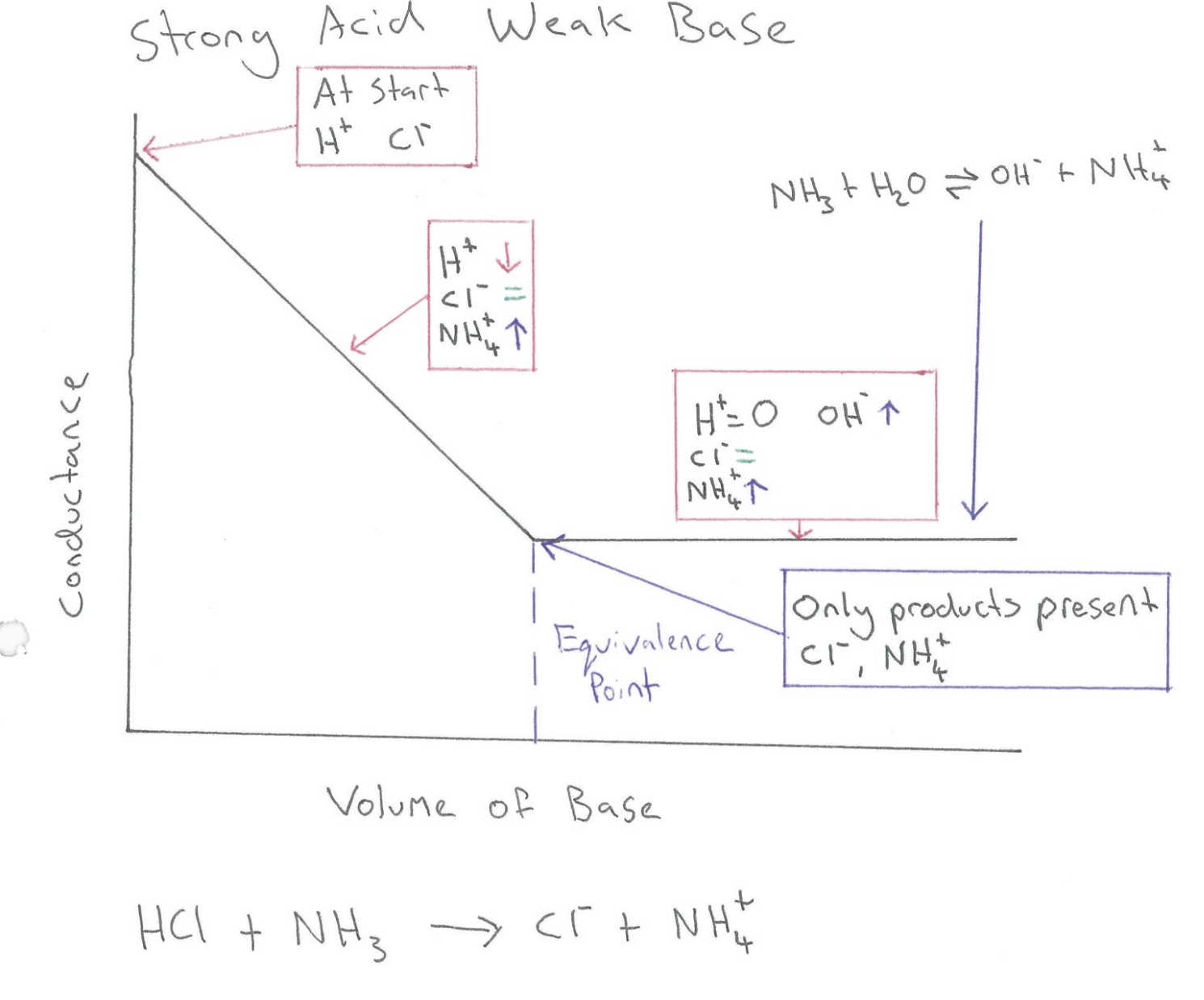
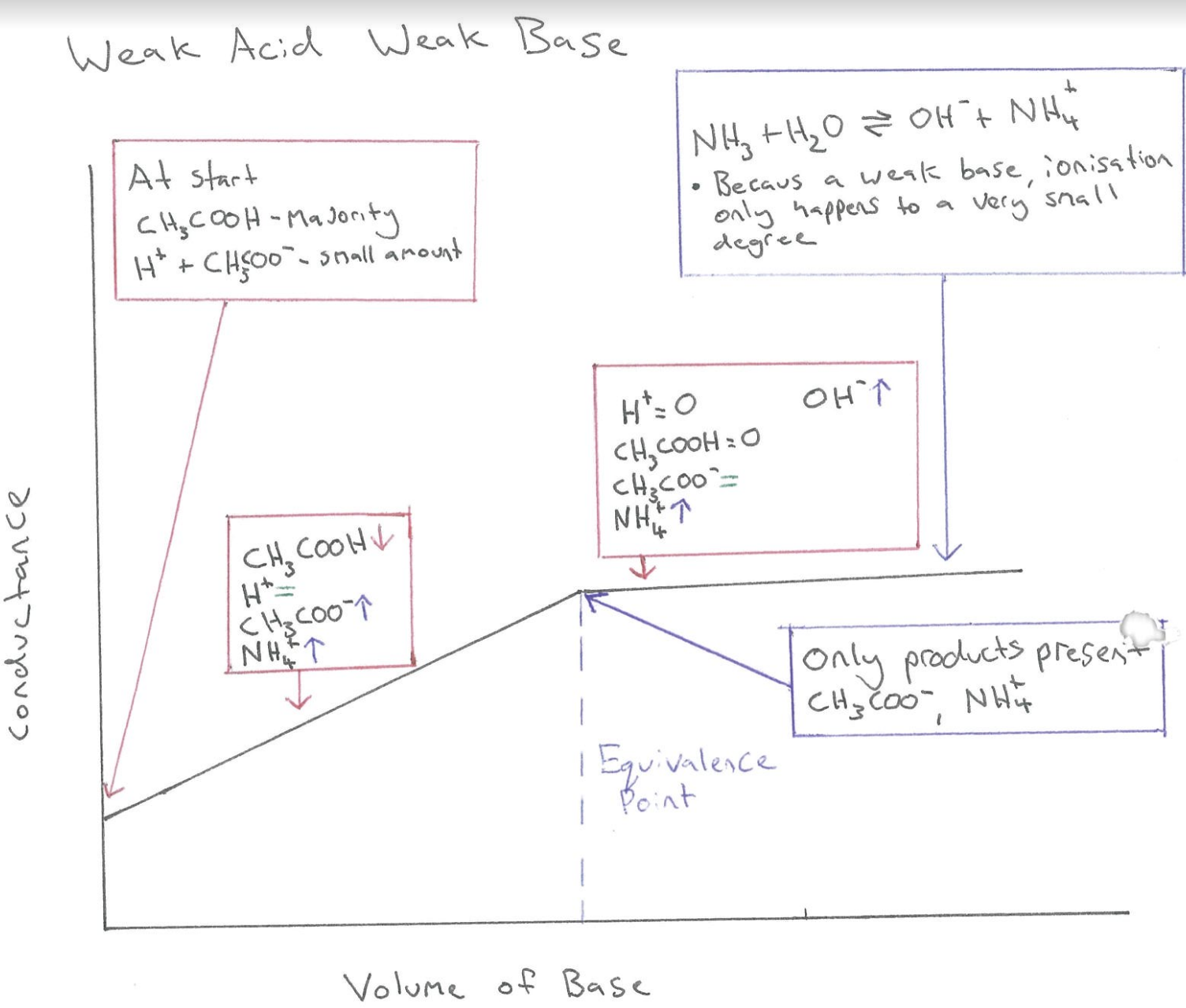
conductivity curves: conductivity relies on free ions. used when turbid/can’t detect colour change/very dilute
aboriginal peoples: yellow clay alkaline, neutralise stomach acid, soap tree acidic and therefore supress bacteria growth
isotactic: all on one of the hydrocarbon chain
syndiotactic: pendant groups have a regular, alternating pattern
atactic: random
titration facts
primary standard: used in volumetric analysis. must be of such high purity and stability that it can be used to prepare a solution of accurately known concentration. must be:
- available in analytical grade quality, with known composition
- high molar mass (reduce error in weighing)
- chemically stable, unaffected by air when weighing
- can’t be hygroscopic (absorb water), efflorescent (release water) or deliquescent (absorb water from surroundings and dissolve in it)
- must be readily soluble in water
HCl not suitable releases fumes and loses HCl gas, sulfuric acid hygroscopic, sodium hyroxide deliquescent
secondary standards: concentrations have been determined using primary standards
conical flask: water only, burette: solution
solution placed in titration flask = whichever is easier to see endpoint
equivalence point: present in equivalent mole ratio and completely reacted. occurs at midpoint of vertical section of curve
end point: colour change
mistakes: avoidable errors
systematic errors: constant bias that can’t be eliminated. unsuitable indicator, inaccurately calibrated pipette, faulty balance
random errors: no pattern. issues with reading meniscus, judging between two scale lines, pin pointing colour change etc
indicators
acid-base indicators normally a weak organic acid or base that will dissociate in aqueous solution finding an equilibrium therefore should only add a few drops eg. methyl orange
HInd (red) +H2O → Ind (yellow) + H3O
| indicator | indicator in acid form | pH range of colour change | indicator in base form | use |
|---|---|---|---|---|
| methyl orange | red | 3.1-4.4 | yellow | strong acid + weak base |
| bromothymol blue | yellow | 6.0-7.6 | blue | strong acid + strong base |
| phenolphthalein | colourless | 8.3-10.0 | bright pink | weak acid + strong base |
back titration: two stage
- reactant of unknown concentration is reacted with an excess of a reactant of known concentration
- the amount of the second reactant (standard solution) remaining unreacted is determined via a second titration
soaps and detergents
general structure and properties of soap and detergent (anionic, cationic and non-ionic) molecules
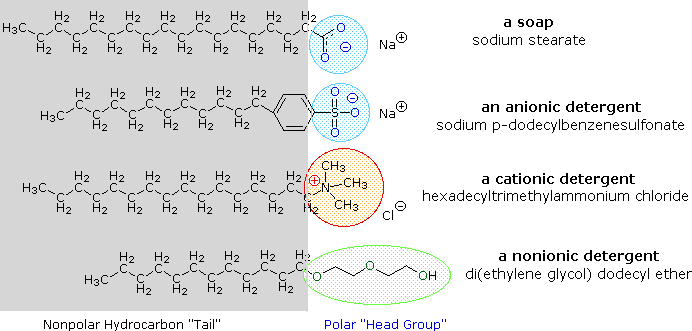
soap: the metal salt of a fatty acid (a long chain carboxylic acid). long hydrocarbon chain with a caboxylate ion
produced via saponification: triglyceride (fat/oil) + alkali (NaOH/KOH) → glycerol + soap (Na or K salt of fatty acid)
saponification is the hydrolysis of a fat or oil in sodium/potassium hydroxide to form a fatty acid which then reacts with the sodium/potassium hydroxide to orm the salt of the fatty acid = salt
hydrocarbon chain is non-polar/hydrophobic, and is attracted to other non-polar substances through dispersion forces.
the ionic head is polar due to the presence of the carboxylate ions/hydrophilic attracted to water through ion-dipole forces and/or hydrogen bonds
as salts of weak acids, soaps are converted by mineral acids into free fatty acids:
C17H35COONa + HCl → C17H35COOH (s) +NaCl
produce scum, therefore ineffective
detergents: have a long hydrocarbon chain, but at the end of the molecule there is a different group such as -SO3-Na+ (instead of the -COO-Na+ group in soap)
originally created in response to lack of fats during ww1.
unlike soaps, detergents are suitable for use in hard water. hard water contains concentrations of Ca and Mg between 20-180 ppm. calcium and magnesium ions bond with the carboxylate ions of soap to form a solid precipitate known as scum. this reduces number of soap ions available to form micelles, reducing effectiveness of soap as a cleaning agent.
2RCOO- + Mg2+ → (RCOO)2Mg (s)
detergents don’t form scum as their calcium/magnesium salts are more water soluble. however effectiveness is still reduced
Four main types:
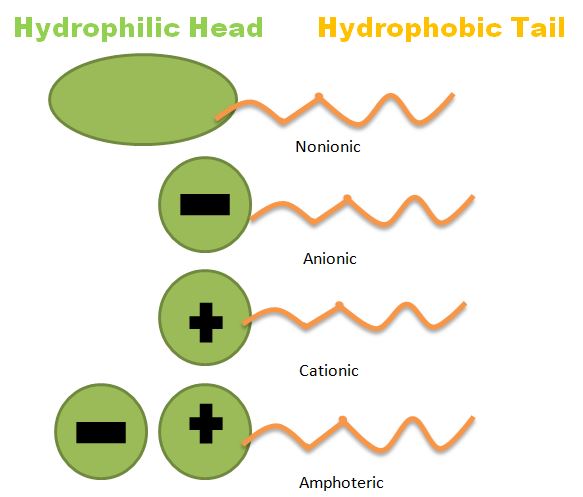
- anionic: like soaps, have a negatively charged hydrophilic polar head eg. SO3-. most widely used in high foaming cleaning products such as laundry powders and shampoos. suitable for hard water.
- cationic: have a positively charged hydrophilic polar head eg. a positively charged alkyl ammonium ion. positive attracts to negatively charged substrates like hair/fabrics. hydrocarbon tails gives substrate a slippery feel, so they are used as selective conditioning agents, but not for surface cleaning. also function as germicides, as ammonium ions disrupt the cell walls of some pathogens
- non-ionic: do not have a negatively or positively charged head, rather a functional group like a hydroxyl or carboxylic acid as their hydrophilic polar head. used for cleaning where sudsing would interfere with machine function.
- zwitterionic/amphoteric: have a hydrophilic head consisting of both cationic and anionic centres in equal amounts = zero net charge
the mode of action and uses of soaps and detergents
for the cleaning processes, surface tension of water must be reduced so it spreads out and wets the surface to be cleaned. surfactants break apart H-bonding between water molecules.
soaps/detergents are emulsifiers as the non-polar, hydrophobic tail is miscible with grease allowing it to be carried by water
micelle = hydrophobic tails group together away from the polar water molecules. hydrophilic heads face outwards and are surrounded by water molecules
- soap molecules surround dirt/grease on a surface, with tails embedded into grease
- hydrophilic heads bond with surrounding water with ion-dipole forces
- when agitated, water molecules pull on the soap molecule through the ion-dipole which lifts the grease/dirt away from the surface, allowing more soap molecules to surround the dirt = micelle
- each micelle is surrounded by negatively charged heads so they repell each other/don’t aggregate. due to their small size, micelles remain suspended in the water forming an emulsion and do not resettle.
- when wash water is drained, micelles are drained as well
- amphipathic
societal impact
- reduced spread of infection
- can dry and irritate skin
- early detergents contaoned phosphate, causing eutrophication/algal blooms
- early detergents produced long lasting foam
- detergents take a long time to biodegrade
addition polymers
the monomers, structures quality, properties and uses of the following addtion polymers:
polymers: long chain macromolecules formed when many smaller monomers join by covalent bonds
monomer: a low molecular weight molecules that is capable of forming at least two covalent bonds, one with each neighbouring molecule
many polymers are carbon based due to fact carbon is able to form strongly bonded straight and branched chains
addition polymerisation:
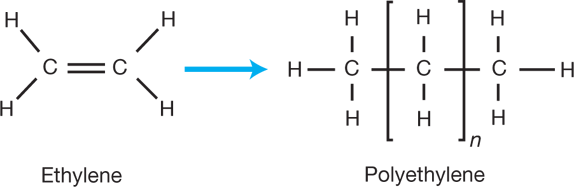
each monomer must include a double or triple bonded carbon (unsaturated) as this is site of reaction. the polymer backbone will only contain carbon. during polymerisation there is no loss of any atom/byproducts produced. therefore addition poymers can be recognised by noting that the polymer has the same empirical formula as the monomer, but
a higher molecular mass
strucuture of polymer molecules and intra and intermolecular bonding alther the properties
| crystallinity | crystalline regions: due to orderly arrangement, polymer chains are closer together so intermolecular forces are stronger = greater rigidity, higher softening, higher melting points, greater density, opaque appearance, resistance to air, water, chemicals, non-permeableamorphous: chains are tangled/disordered. large gaps means intermolecular forces are weaker = more flexibility, lower softening and melting points, transparency, lower density, permeable in polymer production, ratio of crystalline and amorphouse regions can be controlled |
|---|---|
| branching | less branching = crystalline more branching = amorphous |
| chain length | controlled by conditions and proportions of chemicals used in polymerisation process.for a given type of polymer, the longer the chain length and the smaller the differences in chain length, the higher the melting point and the harder the polymer. long chains make softened polymer more viscous and difficult to extrude |
| side group or pendant group | putting a bigger side group into a linear chain restricts the ability of the polymer chains to move and causes the material to become more rigid. bulky side groups reduce the ability of polymer chains to move, they increase their Tg (glass transition temperature/the temperature above which polymer chains move around easily and the polymer is pliable) |
| cross-linking | linear chains are linked together through strong covalent or ionic bonds to form a more rigid two or three dimensional structuremore cross-linking = more rigid polymer |
| intramolecular bonding | most of syntehtic polymers with carbon backbones are strong covalent bonds, therefore stable and non-biodegradablepolymers with carbon backbones require an oxidation process for biodegradation to occur. carbon in conventional polymers takes considerably longer to degrade, as microorganisms struggle to access carbon due to polymer structure |
thermoplastics: contain hydrogen, dipole-dipole or dispersion forces between chains. when heated, these are overcome and polymers soften. don’t burn as strong covalent bonds remain between carbon molecules eg. cling wrap, plastic shopping bags
thermoset: bonds between polymers are strong covalent. can decompose/burn. eg. bowling balls, saucepan handles, light switches
elastomers: occasional cross links. can stretch but return to original shape eg. tyres
polyethylene (PE)
non-polar C-H and C-C covalent bonds = non-polar polymer molecule. strong C-C and C-H bonds = no free electrons. only cross-linked polyethylene thermoset. Cross-linking the polyethylene also enhances the chemical and oil resistance at elevated temperatures eg. saucepan handle
| low density polyethylene (LDPE) | high density polyethylene (HDPE) | |
|---|---|---|
| structure and bonding | high degree of branching, packs randomly, less dispersion forces | minimal chain branching, high degree of crystallinity and dispersion forces |
| related properties | soft flexible, more transparent, insoluble in water (no H bonds or dipole-dipole), chemically inert and electrically insulating, lower melting point (160) | higher melting point (240), higher tensile strength, denser, more rigid, opaque, insoluble, chemically inert, electrically insulating |
| related uses | water bottles, cling wraps, shopping bags, soft plastic toys, laminating film for cartons, wire and cable insulation | garbage bins, buckets, fuel tanks, detergent bottles, food storage containers |
polyvinyl chloride (PVC)

monomer = vinyl chloride (common name) or chloroethane (systematic name)
produces randomly orientated chlorine molecules along the chain. high degree of branching = amorphous, although unusually rigid. this is because chlorine is highly electronegative, so creates a polar C+-Cl- bond. these dipole-dipole forces add to dispersion forces between chains, holding polymer chains together strongly. large Cl atom also restricts ability of chain to ‘flop’ = rigid
plasticisers: small molecules inserted between polymer chains to hold them further apart/weaken intermolecular forces between chains. more plasticiser = more flexible. plasticised PVC is difficult to recycle because when heated, the plasticiser decomposes into compounds that destroy polymer structure
heat stabilisers and uv inhibitors can also be added to make heat/uv resistant
| rigid pvc | plasticised pvs | |
|---|---|---|
| structure and bonding | strong intermolecular, no free electrons, overall minority of polar bonds, 57% inorganic element content (chlorine) | same, but plasticisers in between |
| related properties | rigid, higher melting and boiling than PE, poor conductor of electricity, repells water, difficult to ignite/when burnt release chlorine atoms that inihibit combustion | more flexible, easier to handle |
| related uses | construction material eg. guttering, water drainage, sewage pipes, home cladding. insulation coating on electric wires, flooring (eg vinyl tiles) | gardening hoses, water pipes, raincoats, shower curtains, fake leather products |
polystyrene (PS)
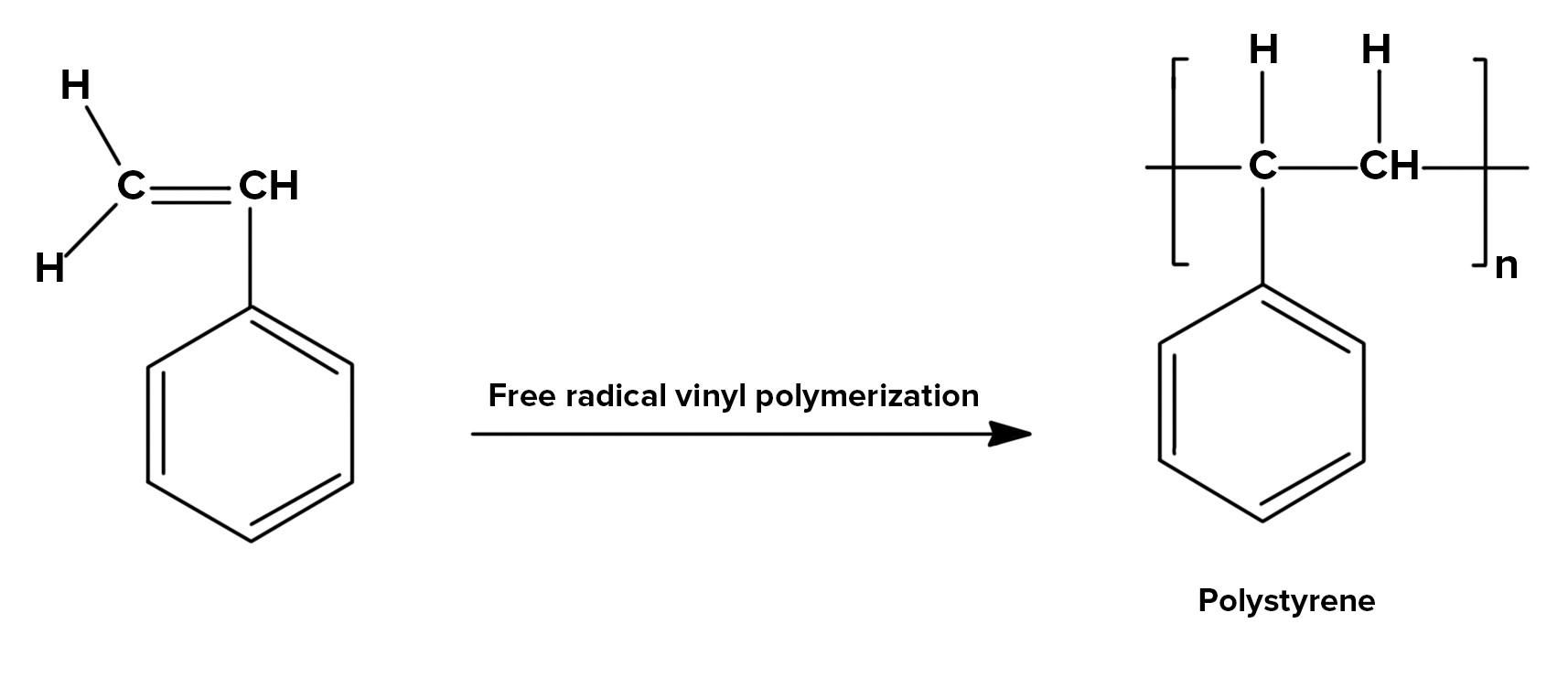
ethenyl benzene.benzene ring orientated randomly along the chain. mainly amorphous due to the way the rings stick out from the chain and their large size. dispersion forces only forces between chains, strengthened by the bulky C6H5 group. also prevent chain ‘flopping’ = chain stiffening. generally clear, rigid and brittle, readily softened/moulded when heated.
syndiotactic polystyrene far stronger, but more brittle. more expensive than atactic polystrene.
| crystal/extruded polystyrene | expanded polystyrene | |
|---|---|---|
| structure and bonding | large benzene group makes most stiffened of common. bulky C6H5 group increases dispersion forces, strong c-c and c-h bonds increase stability | pentane gas is bubbled through the styrene mixture during polymerisation, solidifies as a spongy material, with trapped air |
| related properties | very rigid, electrical insulator, heat resistant | actual polymer still hard but trapped air gives polystyrene its softness, lightness, shock abdsorbance, also makes it a good thermal insulator |
| uses | screw driver handles, DVD cases, high quality furniture, casing for hair dryers, computers and kitchen appliances. suitable for car batteries. | foam drink cupes, bean bag filler, foam packing materials, takeaway food containers |
polytetrafluoroethylene/teflon (PTFE)

similar to polyethylene, except with fluorine atoms in place of ALL hydrogen atoms.
| polytetrafluoroethylene | |
|---|---|
| structure and bonding | PTFE chains pack closely and fairly crystalline. chains are rod-like and lie closely together like pencils. therefore very strong dispersion forces due to packing. fluorine highly electronegative, symmetrical so no net dipole, each molecule negative/repulsedno chemical bonding as C-F bond too strong, dispresion forces with other molecules weak due to lack of effective contact. fluorine has lone pairs of electrons, for unknown reason doesn’t form hydrogen bonds. |
| related properties | strong, tough, high melting point (335C), non-stick, repells hydrophobic and hydrophilic as no method for particles to attach themselves, very low coefficient of friction, chemically inert |
| uses | pipe thread sealant, non-stick coating on skis and cookware, protect pipes carrying reactive and corrosive chemicals, coating on machinery and artificial body parts as restrict ability of pathogens to adhere |
condensation polymers
condensation polymerisation: occurs with the elimination of a small molecule such as H2O or HCl, and the creation of a new functional group
due to loss of a small molecule, monomer and polymer have different chemical and empirical formulae
polymer backbone has atoms other than carbon, and must contain two functional groups
the monomers, structures, properties and uses of the following condensation polymers:
nylon 6,6 (polyhexamethylene adipamide)
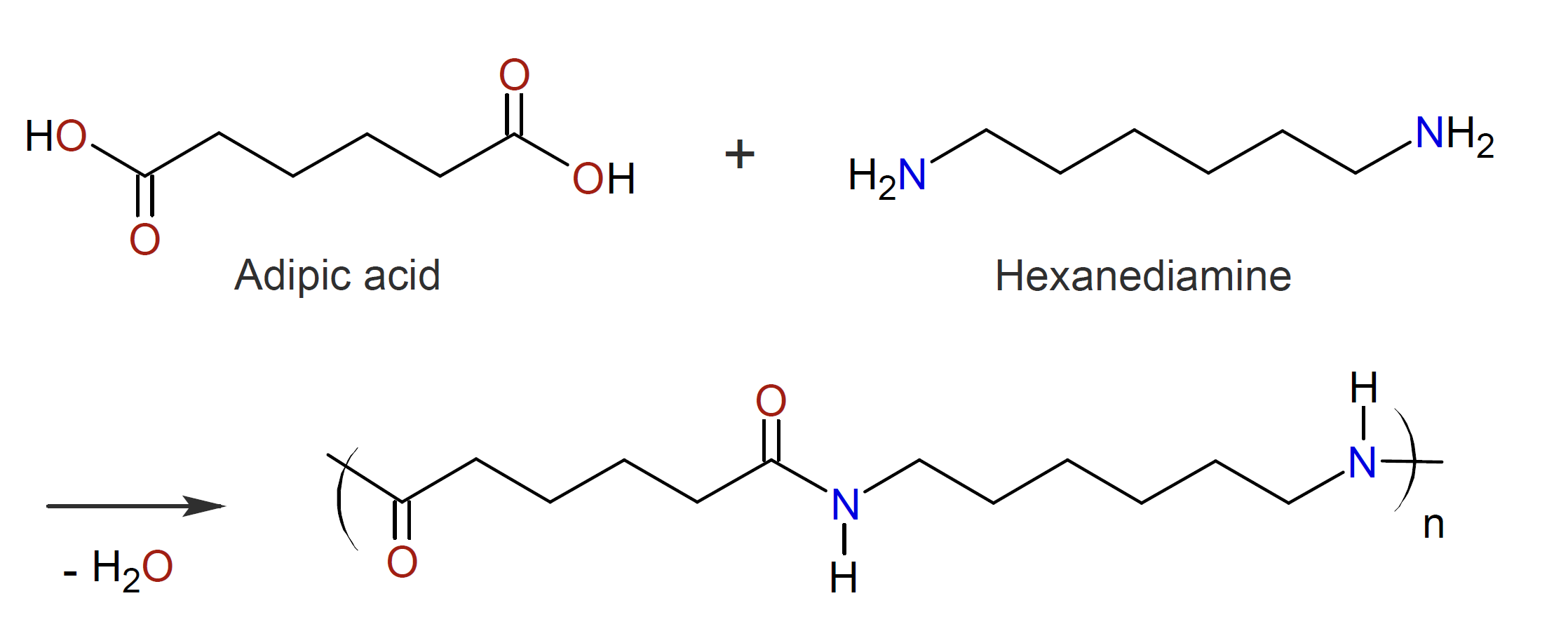
hexanedioic acid/adipic acid + 1, 6 hexamethylene diamine/hexanediamine form amide linkages. n is the total number of each of the two monomers in the polymer, 2n-1 is the number of water molecules released. not biodegradable even though structure similar to natural polymers. difficult to recycle, when heated forms hazardous smoke eg. containing nitrous oxide.

| nylon 66 | |
|---|---|
| structure and bonding | the slightly negative O atom of the carbonyl group in one chain is hydrogen bonded to the slightly positive H atom of the amine group in another polymer chain. symmetrical backboneextent of polymerisation is also very high (ie. large number of monomer units in each chain)neglible scope for H-bonding with water, as already extensive very close packing of chains |
| related properties | rigid, tough, high melting point (260C), ductile, increases crystallinity to almost 100%, high tensile strength, high elasticity, absorbs little water/considered waterproof, difficult to dye but maintains stain |
| uses | parachutes, ropes, fishing line, guitar strings, swimwear, coloured stockings |
polyethylene terephthalate (PET)
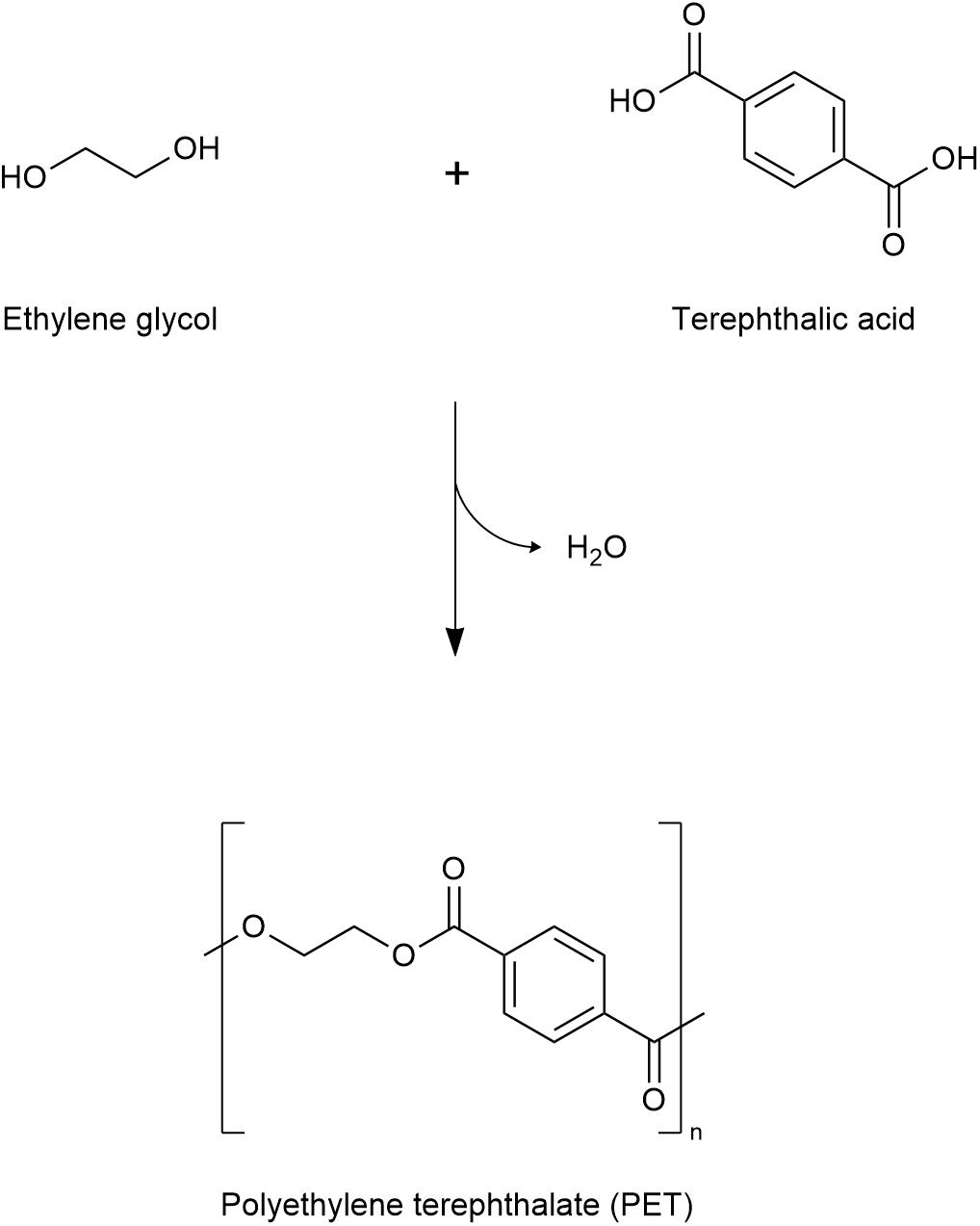
ethane 1,2 diol + bezene 1,4 diocacid OR dicarboxylic acid (carboxylic acid with benzene ring) + diol form ester linkages. water is eliminated due to reaction between OH of carboxylic acid and H atom on the alcohol. non biodegradable, easily recycled due to low softening temperature.
| PET | |
|---|---|
| structure and bonding | strong dipole-dipole forces between neighbouring carbonyl groups in molecular chains, large benzene ring = chain stiffening, ordered arrangement of the polymer chains when molten PET is stretched |
| related properties | high tensile strength, notable stiffness, strength, high melting point, chemically inert, lightweight (due to amorphous regions). aromatic ring allows delocalisation of electrons, impermeable to water. can be hydrolysed by acids/bases by breaking ester linkages, very lightweight |
| uses | molecules in one direction = fibre for carpet, clothing, quilts, resistant to wrinkling, parachutestwo directions = film, containers/jarsthree directions = packaging items eg. polyester bottles |