Collision in two dimension
1. Types of Collisions
🔹 Elastic Collision
Momentum is conserved
Kinetic energy is conserved
Objects bounce apart
Common with particles, pucks, atoms
🔹 Inelastic Collision
Momentum is conserved
Kinetic energy is NOT conserved
Some energy → heat, sound, deformation
🔹 Perfectly Inelastic Collision
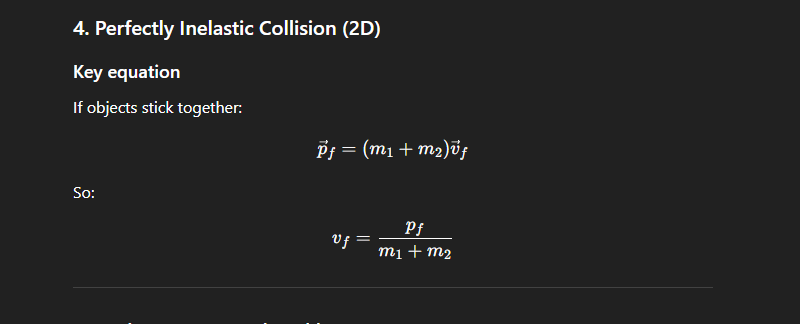
Objects stick together
Move with a common final velocity
Momentum conserved, KE not conserved
5. Important Insight (Inelastic Case)
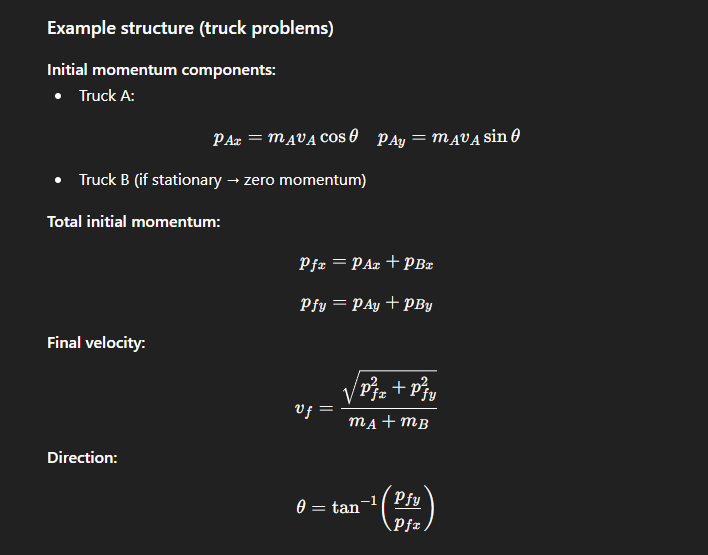
Direction after collision is set by the net momentum vector
If one truck is stationary, final direction = direction of the moving truck
Only speed changes, not momentum direction
6. Elastic Collisions in Two Dimensions
What is conserved:
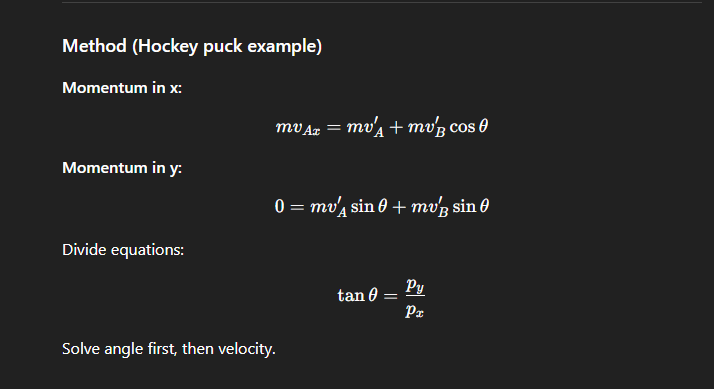
Momentum (x and y)
Kinetic energy
For identical masses:
Velocities after collision are perpendicular
Angles after collision add to 90°
7. Exam-Level Patterns to Memorize
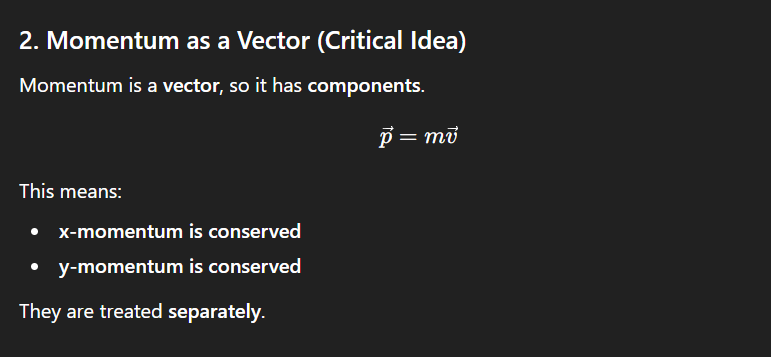
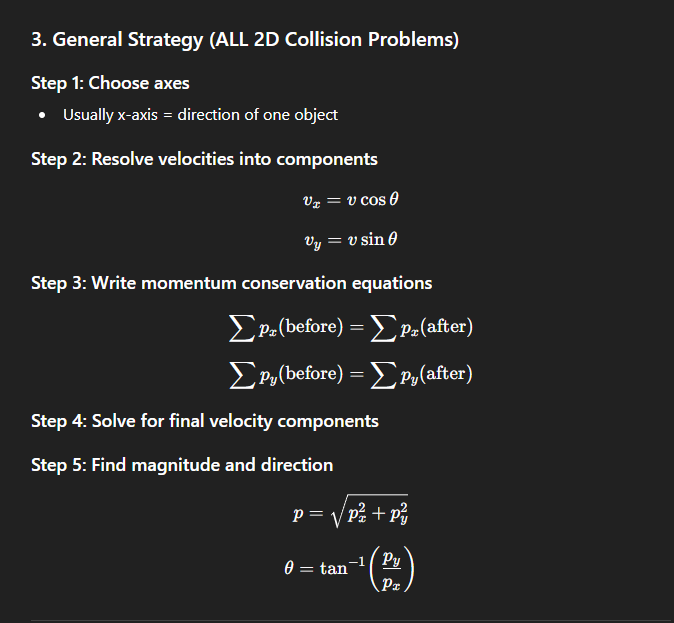
Momentum problems → components
Sticking together → perfectly inelastic
Identical masses + elastic → 90° separation
Stationary object → initial momentum = 0
Direction comes from vector sum, not intuition
8. One-Sentence Lock-Ins
Momentum is conserved in each direction separately
In 2D collisions, always split into x and y
Perfectly inelastic = same final velocity
Elastic collisions conserve both momentum and kinetic energy