Chapter 9 - Work, Energy and Power
9.1 Energy and Work
Energy
Energy - capacity to cause change
Mechanical energy - energy that a body possess due to its position or motion (kinetic and potential)
Kinetic energy - energy associated with motion

Potential Energy - the position of objects relative to one another or within fields.

Unit of Energy
Joule (J)
1J is the equivalent to the energy needed to lift 1kg mass through a height of 0.1 meters
1 kj = 1000 J
1 MJ = 1 000 000 J
Work
Work is being done to an object when … a force acts on an object and causes energy to be transferred or transformed
Quantifying work
W = fs
W - Work in Joules (J)
F - Force in newtons (N)
s - displacement in the direction of force (m)
∴ W = △E (work causes a change in energy)
Work is a scalar unit and has no direction like energy
Work and Friction
Energy change is not always obvious
Ideal situation there is no friction. All work would be transformed into kinetic energy
Real situation there is friction. Some work done would become heat and sound (or others) due to friction and rest would be kinetic
Limiting situation the force (work) is equal to friction. Kinetic energy would not change. All work is wasted (sound and heat)
Displacement change is dependant on overcoming friction force
A force with no work
Force applied to an object but the object does not move, means no work is done to the object
There may be energy transformations to get force on the object, but no work is done to that object
Work is done only if the net force causes a movement of one body in relation to other bodies
Work and Displacement at an Angle
W = Fs cosθ
Where θ is the angle between the force (F) and the displacement (s)


Force-Displacement Graphs
Illustrates the way a force changes with displacement


Elastic objects like springs obeys a relationship called Hooke’s law.
Hooke’s Law - describes how the more you stretch a spring, the greater the froce is required to keep stretching it.
Calculating Work from a Force-Displacement Graph
Work = calculates from the area beneath.

6 × 4 = 24 squares
Each square is 5 N x 0.2m = 1J
24 × 1 = 24J
9.2 Kinetic Energy
Definition
Kinetic energy (Ek) is the energy an object possesses due to its motion.
Any moving object has kinetic energy (e.g. truck, cheetah, atoms).
Important for analysing collisions, safety (cars), and many real-life situations
Kinetic Energy Equation
Ek=1/2mv2
Ek =kinetic energy (Joules, J)
m = mass (kg)
v = speed/velocity (m s⁻¹)
Note: Kinetic energy is a scalar quantity.
Work-Energy Theorem
Work done on an object equals the change in its kinetic energy:
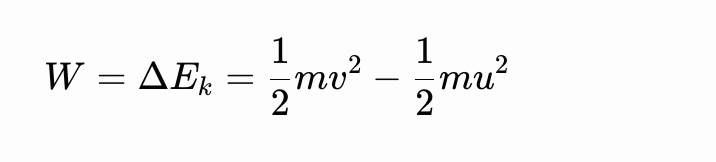
Where u = initial velocity, v = final velocity.
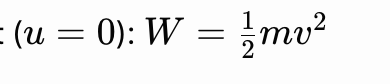
If object starts from rest →
Key Concepts
Kinetic energy depends on mass and velocity squared (velocity has a much greater effect).
Units must be in SI: mass in kg, velocity in m/s.
Negative work (e.g. brakes) causes a decrease in kinetic energy.
9.3 Elastic and Inelastic Collisions
Collisions Overview
Collisions occur when two or more objects interact and exchange momentum and energy.
In all collisions: Total momentum is conserved (from Chapter 8).
However, kinetic energy may or may not be conserved.
Elastic Collisions
Both momentum and kinetic energy are conserved.
No kinetic energy is lost to other forms (heat, sound, deformation).
Total Ek before collision = Total Ek after collision.
Objects bounce off each other with no permanent deformation.
Rare in everyday life — occur in ideal cases such as:
Collisions between atoms or subatomic particles.
Nearly elastic collisions in billiards/snooker/pool (very little energy lost).
Inelastic Collisions
Momentum is conserved, but kinetic energy is not.
Some (or all) kinetic energy is transformed into:
Heat
Sound
Permanent deformation (bending/crushing)
Most real-world collisions are inelastic.
Perfectly Inelastic Collisions
Objects stick together after collision (maximum loss of kinetic energy).
Common in car crashes where vehicles lock together.
Key Comparison
Type | Momentum Conserved? | Kinetic Energy Conserved? | Typical Examples |
|---|---|---|---|
Elastic | Yes | Yes | Billiard balls, atomic collisions |
Inelastic | Yes | No | Car crashes, ball hitting player |
Perfectly Inelastic | Yes | No (maximum loss) | Vehicles locking together |
Analysing a Collision (Standard Method)
Use conservation of momentum to find final velocity(s):

Calculate total kinetic energy before:

Calculate total kinetic energy after.
Compare:

Extension – Billiards & Spin
Billiard collisions are very close to elastic.
Top spin or back spin adds rotational kinetic energy, which can make the ball behave differently (e.g. follow or draw shots).
Summary Tip:
Momentum is always conserved in collisions.
Kinetic energy is only conserved in elastic collisions.
In real life, most collisions are inelastic because energy is “lost” to heat, sound, and deformation. Always check KE before vs after to classify the collision.
9.4 Gravitational Potential Energy
Definition
Gravitational potential energy (Eg) is the energy an object has due to its position in a gravitational field.
It is the amount of work done against gravity to move an object to a higher position.
Depends on the object’s mass, height, and the strength of the gravitational field.
Gravitational Potential Energy Equation

Eg = gravitational potential energy (J)
m = mass (kg)
g = gravitational field strength (9.80 N kg⁻¹ or m s⁻² on Earth)
Δh = change in height (m)
Note:
Eg is measured relative to a chosen reference level (usually ground level where Eg=0).
If an object is below the reference level, Eg is negative.
Key Concepts
Gravitational potential energy is a scalar quantity.
Work done against gravity is stored as gravitational potential energy.
When the object falls, gravitational potential energy is converted into kinetic energy (and vice versa).
The formula assumes a constant gravitational field (valid near Earth’s surface).
Reference Level
The zero point for gravitational potential energy can be chosen anywhere (e.g. ground, table, floor).
Must be consistent within a problem.
Objects below the reference level have negative Eg.
Worked Example Tips

Always use consistent units: mass in kg, height in m, g = 9.80.
Only the mass being lifted contributes to the change in Eg E_g Eg (e.g. ignore the weightlifter’s own mass if only the bar is lifted).
Answers usually required to 2 or 3 significant figures.
Extension – High Jump
High jumpers use the Fosbury Flop technique to keep their centre of mass as low as possible.
This means they can clear the bar while gaining less gravitational potential energy.
9.5 Law of Conservation of Energy
Mechanical Energy
Mechanical energy (Em) = sum of kinetic energy and gravitational potential energy.

Useful for analysing falling objects, projectiles, pendulums, etc.
Law of Conservation of Energy
Energy cannot be created or destroyed, only transformed from one form to another.
In a closed system with no external work or significant losses (e.g. friction, air resistance), total mechanical energy is conserved:

Common transformations: Eg↔Ek
Key Examples
Falling object: Gravitational potential energy converts to kinetic energy.
Bouncing ball: Some energy lost to heat/sound/deformation → height decreases with each bounce.
Pendulum: Eg highest point ↔ Ek at lowest point.
Using Conservation of Mechanical Energy
For a falling object (neglecting air resistance):

Final speed depends only on height (not mass).
Efficiency of Energy Transformations
Real processes are never 100% efficient.
Efficiency (η) measures how much input energy becomes useful output:
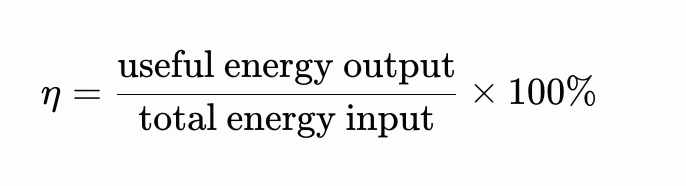
Most devices lose energy as heat/sound.
Table of Common Efficiencies (approximate):

Important Notes
In real situations, mechanical energy is often not perfectly conserved due to friction, air resistance, sound, and heat.
Total energy in the universe is always conserved, but useful mechanical energy decreases.
Coefficient of Restitution (COR): Measures “bounciness” of a ball (higher COR = more elastic bounce).
Summary Tip
For ideal cases (no friction/air resistance): Use Em E_m Em conserved to solve for velocity or height easily.
Always check whether friction or other losses are negligible.
In collisions: Momentum is always conserved; mechanical energy is conserved only in elastic collisions.
9.6 Power
Definition
Power (P) is the rate at which work is done or energy is transferred/transformed.
It tells us how quickly energy is being used or converted.
Power Equations
Basic definition:

P = power (Watts, W)
W or ΔE = work done or energy transferred (J)
Δt = time taken (s)
Force-velocity form (when moving at constant speed):

F = applied force (N)
vav= average velocity (m s⁻¹)
Unit:
1 Watt (W) = 1 J/s = 1 J s⁻¹
Key Concepts
Same amount of work can be done with different power depending on time taken.
Example: Running up stairs vs walking up stairs → same work (W=mgh , but runner has higher power.
Power is a scalar quantity.
In real situations, power is often used to overcome friction, air resistance, or gravity.
Important Notes
When an object moves at constant speed, the applied force equals the opposing force (e.g. friction).
1 horsepower (hp) ≈ 750 W (historical unit, not used in calculations).
Worked Example Approach
Calculate work done (W=Fs or W=mgh ).
Use P = W / Δt
Or directly use P=Fv when force and constant speed are given.
Summary Tip
Power measures how fast work is done.
High power = energy transferred quickly.
Common units: Watts (W), kilowatts (kW), megawatts (MW).