L8: Deformation
Learning Objectives:
Understand how much of the deformation energy is dissipated.
95- 99% is emitted as heat
Explain how some energy is stored in microstructure, and relate this to a defect density.
Dislocations, GBs, and other defects
Be able to argue a few reasons why deformation can localise within the microstructure.
(1) cell formation (2) compatibility requirements (e.g., hard particles, GBs)
Recognize some special features in deformed structures and the influence of deformation mechanism.
-Twin formation, typically in HCP
-Partial dislocations, typically in FCC with low SFE
Understand how much of the deformation energy is dissipated:
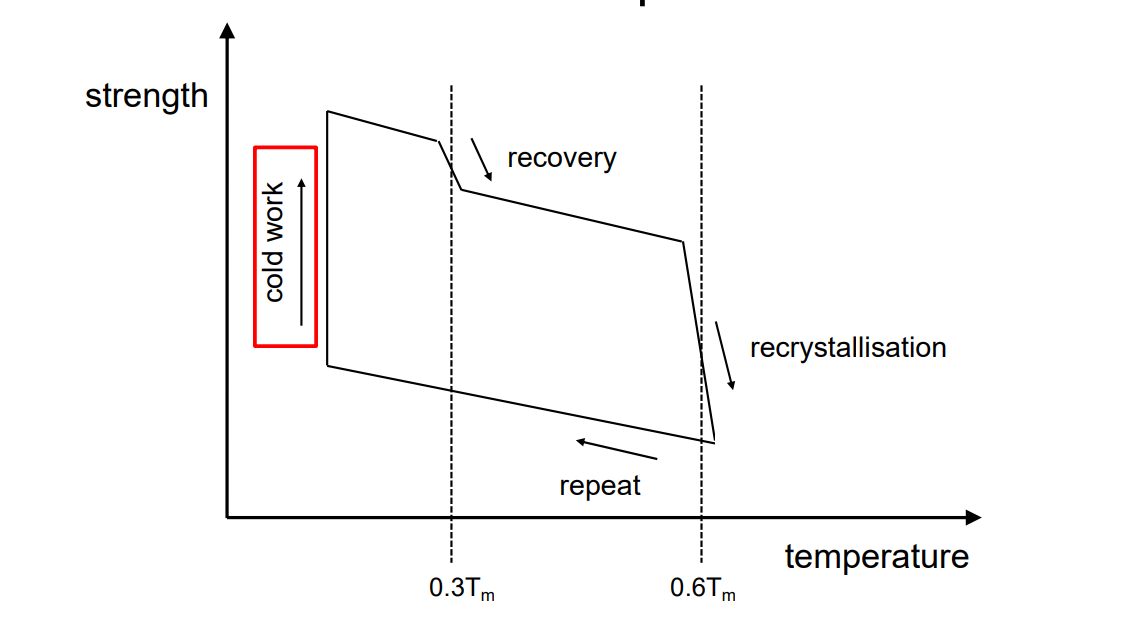
During cold deformation, most of the energy (95-99%) is dissipated as heat due to processes like dislocation movement, which involves overcoming energy barriers. Only a small fraction (1-5%) of the deformation energy is stored in the material as new dislocations and increased grain boundary area.
Explain how some energy is stored in microstructure, and relate this to a defect density:
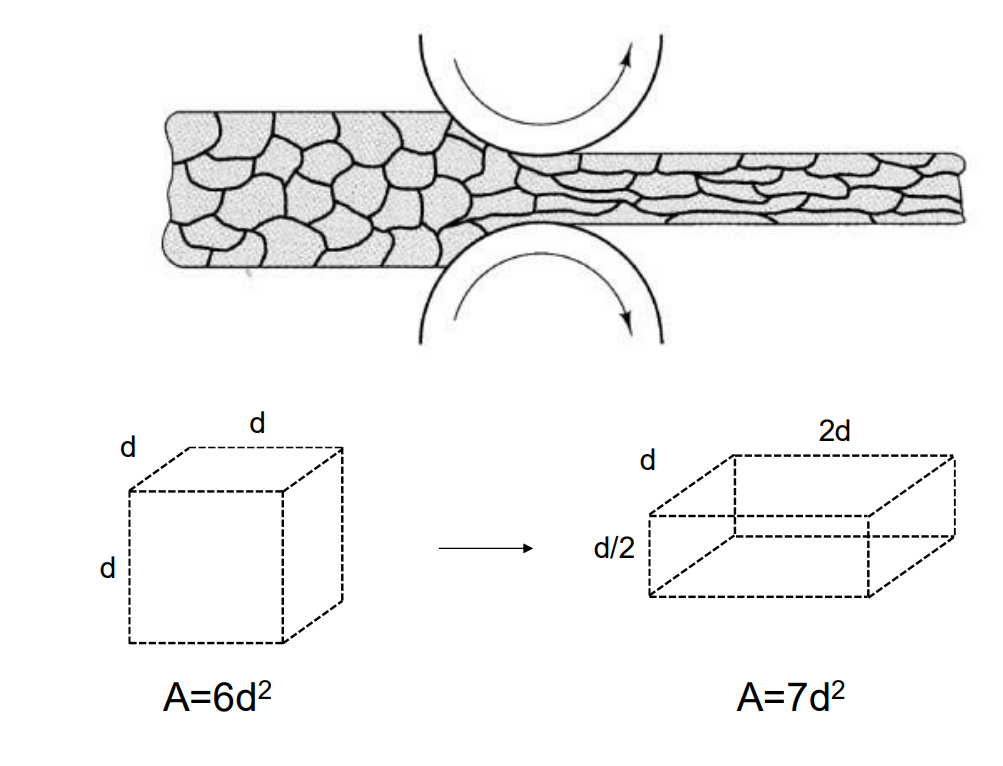
The stored energy is primarily in the form of dislocations and increased grain boundary area.
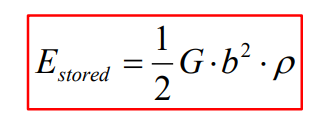
The energy stored in dislocations can be estimated using the dislocation density (ρ), which is the total length of dislocation lines per unit volume. The stored energy is given by:
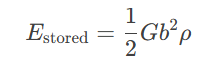
where G is the shear modulus and b is the Burgers vector. The dislocation density increases during deformation, leading to strengthening.
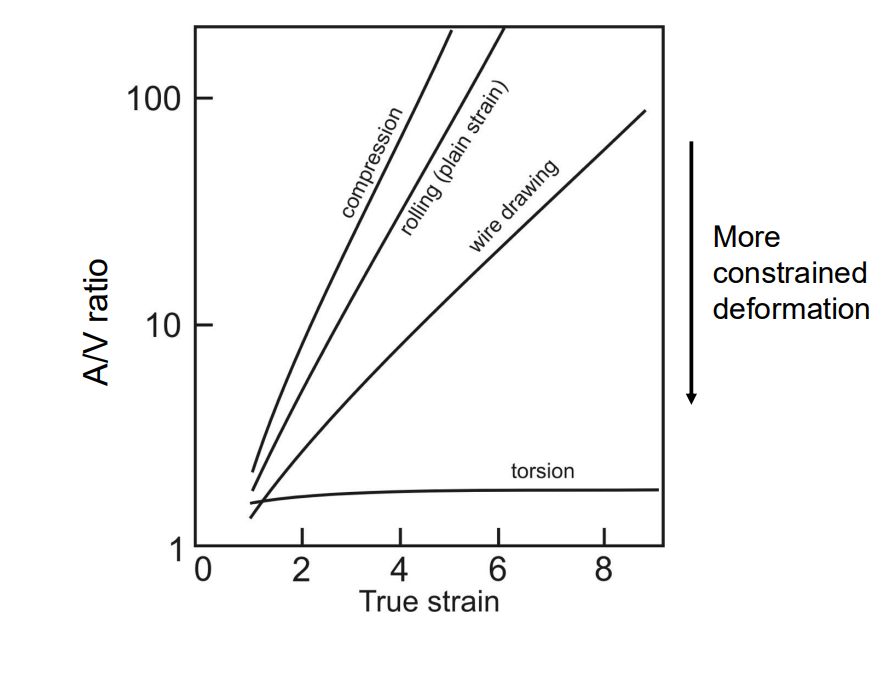
Be able to argue a few reasons why deformation can localise within the microstructure:
Deformation tends to localize due to:
Grain boundary constraints: Deformation near grain boundaries must be coordinated with neighbouring grains, leading to inhomogeneous deformation.
Formation of deformation bands: Within grains, deformation can concentrate in bands (e.g., kink bands, shear bands) where the crystal orientation changes.
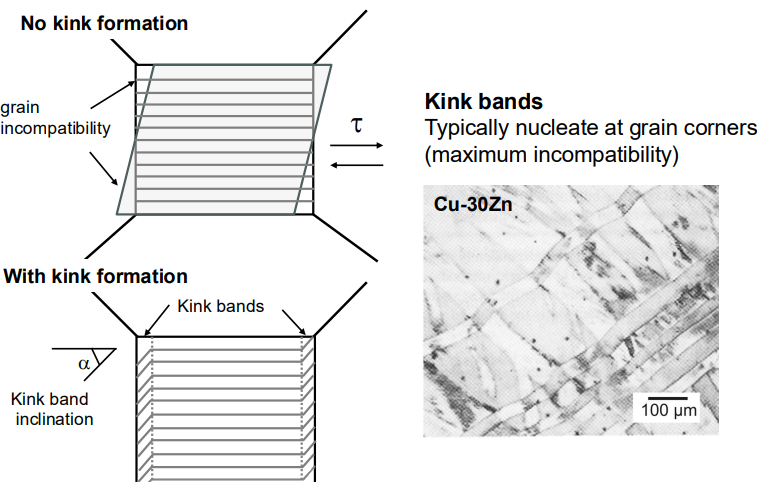
Slip and twinning mechanisms: Different deformation mechanisms (slip or twinning) can lead to localized deformation, especially in materials with low stacking fault energy, where dislocations dissociate into partials, forming stacking faults and twins.
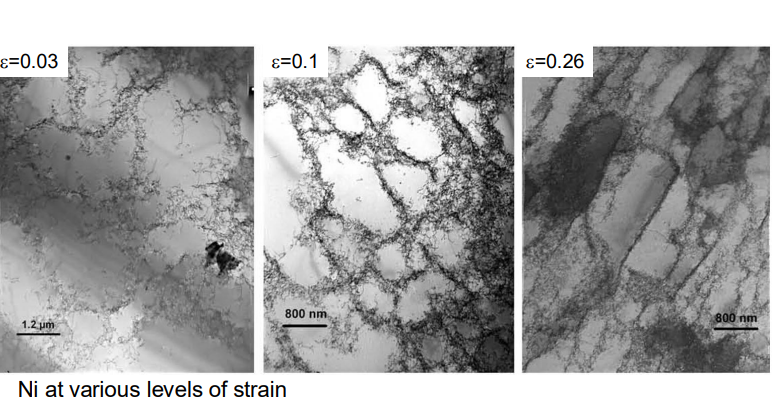
Aggregation of dislocations into cells
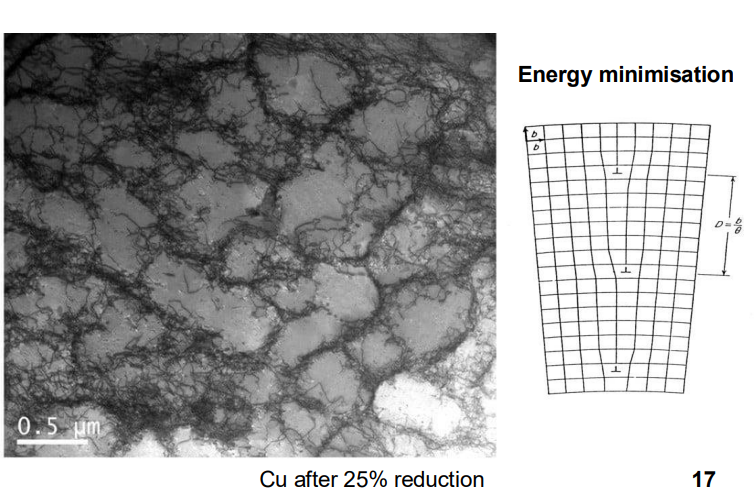
Effect of strain on the dislocation cells
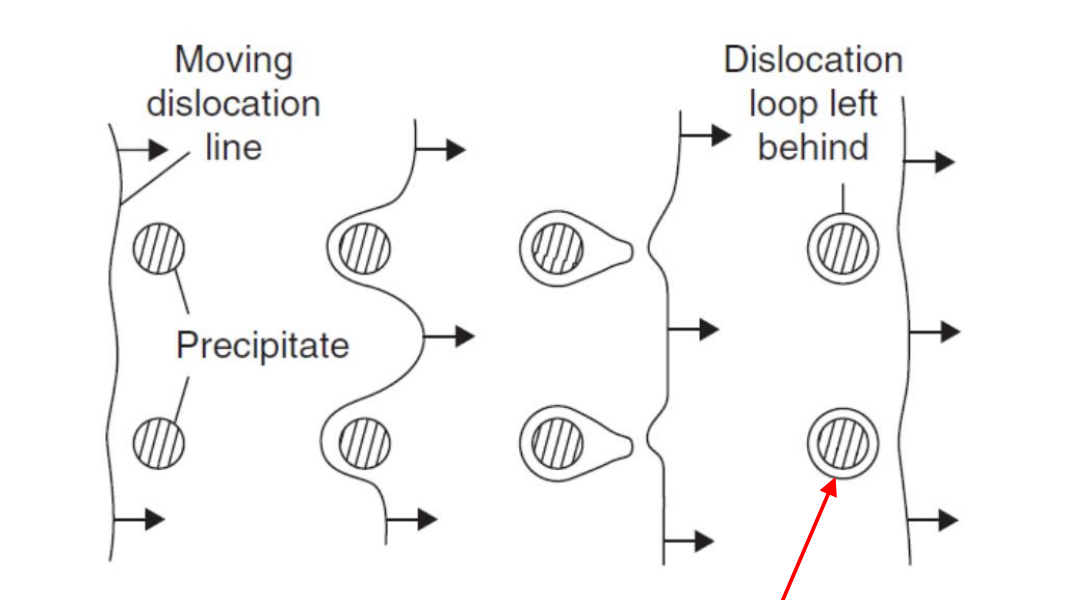
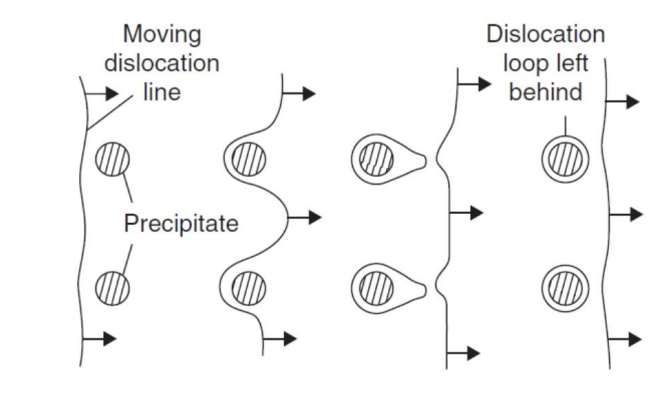
Deformation localised around hard particles
Recognize some special features in deformed structures and the influence of deformation mechanism:
Role of Crystal Structure and Slip Systems:
- Crystal Structure: The deformation mechanism in metals is heavily influenced by their crystal structure. For example:
- FCC (Face-Centred Cubic) metals like aluminium and copper typically have 12 slip systems and generally do not twin under normal conditions.
- BCC (Body-Centred Cubic) metals have more than 12 slip systems and also generally do not twin.
- HCP (Hexagonal Close-Packed) metals like magnesium and zinc have fewer slip systems (typically 3), which makes twinning more common, especially at low temperatures or high strain rates.
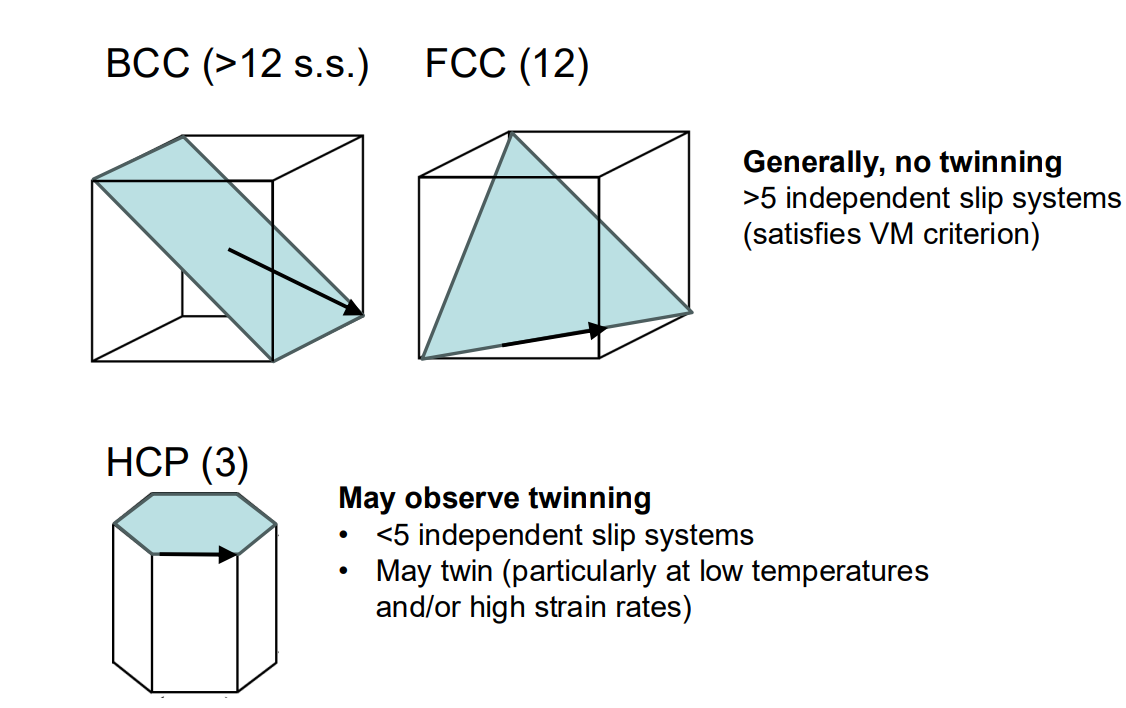
- Slip Systems: The number of independent slip systems determines how easily a material can deform. FCC and BCC metals, with more than 5 independent slip systems, satisfy the von Mises criterion for ductility, while HCP metals, with fewer slip systems, often rely on twinning to accommodate deformation.
2. Twinning:
- Deformation Twinning:
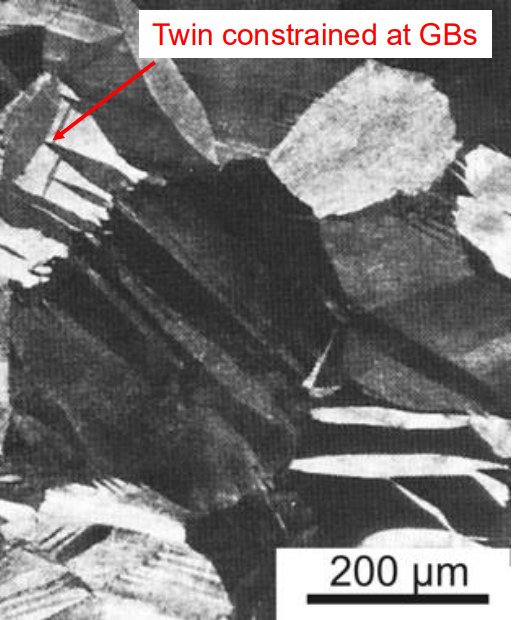
- Deformation twins are regions of deformed material bounded by twin grain boundaries. They form under conditions of low temperature or high strain rates, where slip is not sufficient to accommodate the deformation.
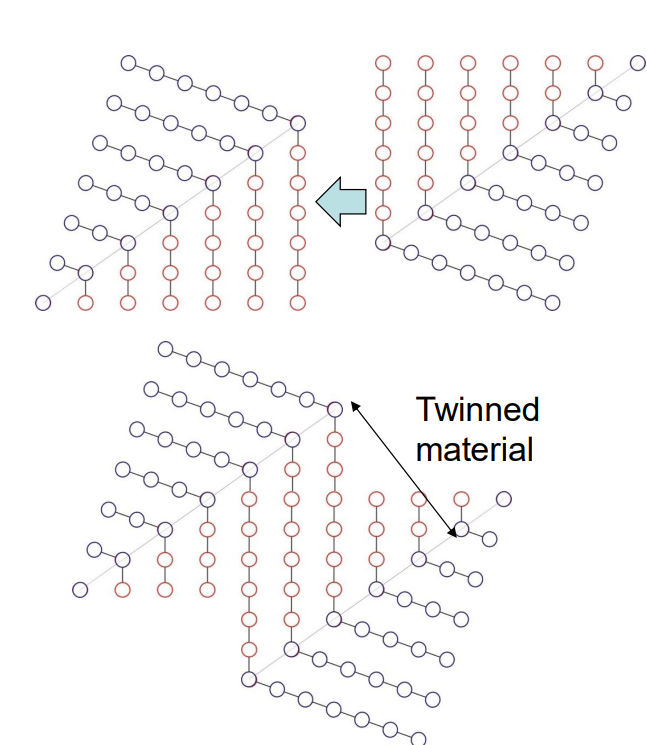
- In HCP metals like magnesium, deformation twins are lens-shaped and form due to the coordinated motion of atom planes, which generates a sound wave. These twins are often observed at low temperatures or high strain rates.
- Deformation twins are distinct from annealing twins, as they are constrained by grain boundaries and do not continue unaltered across them.
- Annealing Twinning:
- Annealing twins form during recrystallization and are typically found in FCC metals with low stacking fault energy, such as copper and stainless steel.
- These twins form during the growth of new grains and are not constrained by grain boundaries, unlike deformation twins. They often grow perpendicular or parallel to the growth direction of the new grains.
- Annealing twins are thought to form to lower the grain boundary energy or to create more mobile boundaries during recrystallization.
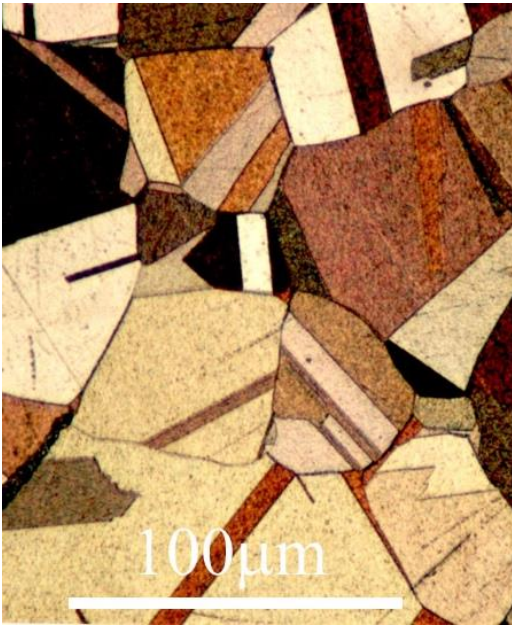
Orientation: They are parallel to the microstructure.
Thickness: They maintain a consistent thickness throughout.
Termination: They run straight up to the grain boundary without tapering or changing shape.
3. Partial Dislocations:
- Formation of Partial Dislocations:
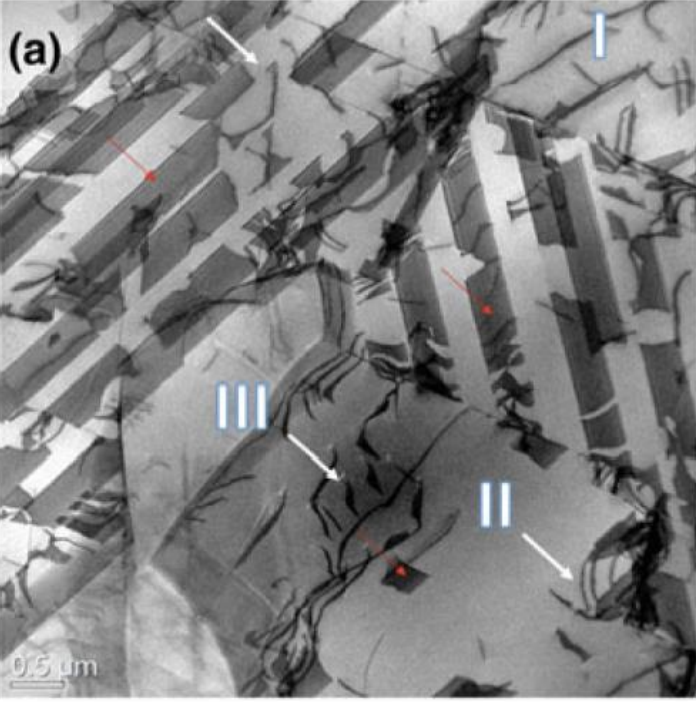
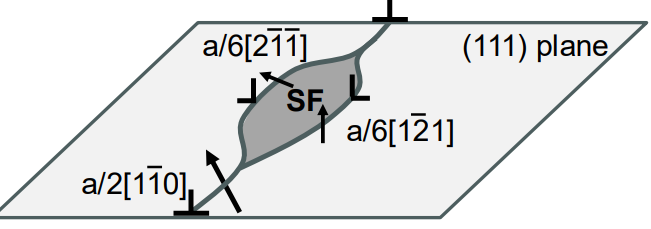
- In FCC metals with low stacking fault energy (e.g., copper, silver), dislocations can split into partial dislocations, leaving a stacking fault between them.
- The energy of the dislocation line is lower when it splits into partials, but the stacking fault between them increases the overall energy. The formation of partial dislocations is therefore influenced by the stacking fault energy of the material.
- For example, in stainless steel, partial dislocations are observed after 2% deformation, where the dislocation splits into two partials, leaving a stacking fault.
- Role of Stacking Fault Energy:
- Metals with low stacking fault energy (e.g., silver, gold) are more likely to form partial dislocations and stacking faults, while metals with high stacking fault energy (e.g., aluminium) are less likely to form partial dislocations.
4. Special Features in Deformed Structures:
- Deformation Bands and Kink Bands:
- Deformation tends to localize in bands, especially near grain boundaries where deformation must be coordinated between neighbouring grains. Kink bands(formed at grain edges/corners), which involve a double orientation change, are a common feature in deformed structures.
- Dislocation Cells and Sub grains:
- During deformation, dislocations tend to organize into cellular structures or sub grains, especially in FCC metals like copper. These cells become more pronounced with increasing strain.
- Shear Bands:
- At high levels of strain, shear bands often form, which are localized regions of intense deformation. These are common in materials with low stacking fault energy, such as brass.
5. Influence of Deformation Mechanism:
- The deformation mechanism (slip vs. twinning) influences the microstructure. For example:
- In FCC metals, deformation primarily occurs through slip, leading to the formation of dislocation cells and sub grains.
- In HCP metals, twinning becomes significant at low strains due to the limited number of slip systems, leading to the formation of deformation twins.
SUMMARY
- Crystal structure and slip systems determine the primary deformation mechanism (slip or twinning).
- Deformation twinning is common in HCP metals and occurs under low temperature or high strain rate conditions, while annealing twinning occurs during recrystallization in FCC metals.
- Partial dislocations form in FCC metals with low stacking fault energy, leading to stacking faults.
- Special features like deformation bands, kink bands, dislocation cells, and shear bands are observed in deformed structures, influenced by the deformation mechanism and crystal structure.