Mendelian Genetics
Evidence of Common Ancestry
similar fundamental molecules or life processes retained in a wide variety of modern species - suggests that these species have a %%common ancestor%%
- cell membranes, ribosomes, photosynthesis/respiration, cell division and signaling, common enzymes
- example MCQ:
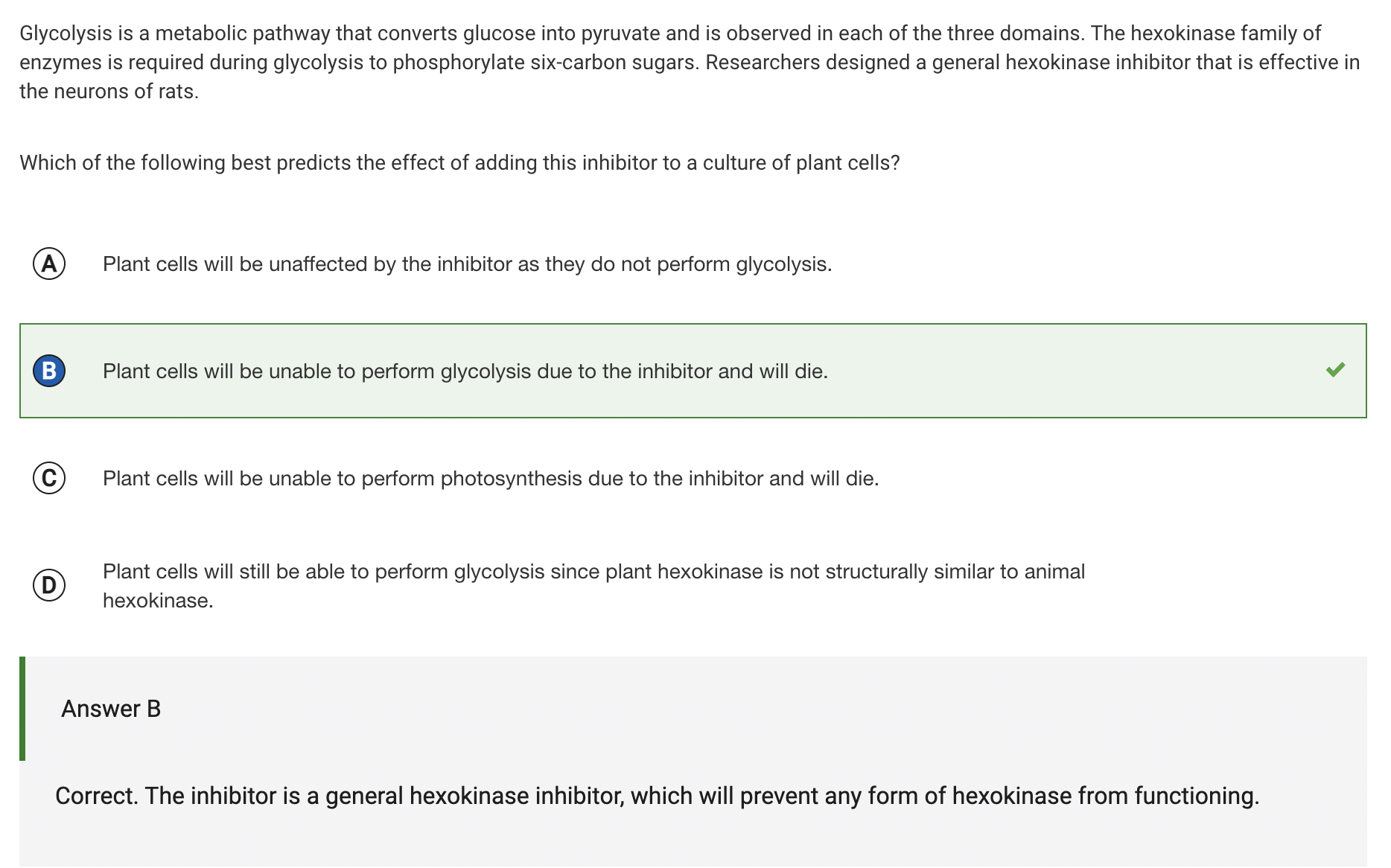
The common biological molecule, hexokinase, in the rats and plants that function similarly and work when swapped suggests common ancestry
Simplest Genetics Experimentation and Terminology
- Mendel cross-bred pea plants which were true-breeding for a given trait, then performed %%monohybrid%% crosses by cross-breeding the F1 individuals
- He used traits with non-linked, single gene control with %%simple dominance%% inheritance pattern - made it easy to observe fundamentals
- He observed a 1:2:1 genotypic ratio and 3:1 phenotypic ratio when 2 hybrid individuals were crossed
- %%Alleles%% - versions of genes, previously called factors, which are passed down parent to child
- %%Dominant%% alleles are expressed whenever present, %%recessive%% alleles are masked when in the presence of a dominant allele
- %%Genotype%% = an individual’s set of alleles
- %%Phenotype%% = an individual’s set of observable traits as a result of genotype/environment sometimes
- %%Monohybrid cross%% - a cross between two individuals who are hybrid (heterozygous) for one trait
- %%Homozygous%% = having two of the same allele
- %%Heterozygous%% = having two different alleles
- %%Dihybrid cross%% - a cross between two individuals which are hybrid for two different traits - when traits are independent of one another, this produces a 9:3:3:1 phenotypic ratio
Fundamental Laws of Genetics
- %%Law of Segregation%%
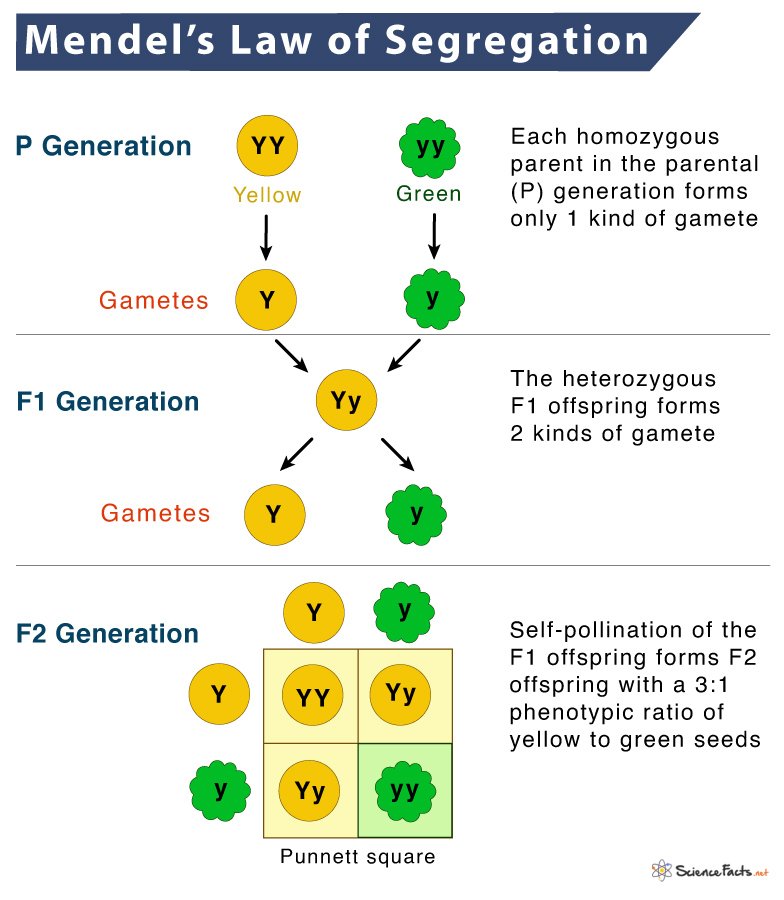
- During meiosis, alleles for a given trait separate - 1/2 of meiotic daughter cells (gametes) receive the maternal allele, 1/2 receive the paternal allele - this is RANDOM and contributes to genetic variation
- %%Law of Independent Assortment%%
- When genes are on different chromosomes, alleles for two different genes sort into gametes independently of each other - the way alleles for one trait separate has no effect on another trait
Laws of Probability
- %%Addition rule of probability%%
- Applies to %%mutually exclusive%% events (either/or)
- P(A or B) = P(A) + P(B)
- If events A and B are mutually exclusive, the probability of either A or B happening is equal to the sum of the probability of A and the probability of B
- %%Multiplication rule of probability%%
- Determines the probability of multiple %%independent%% events happening simultaneously
- P(A and B) = P(A) x P(B)
- If A and B are independent, the probability of both A and B happening at the same time is equal to the product of the probabilities of the two events happening on their own.
X^2 Tests
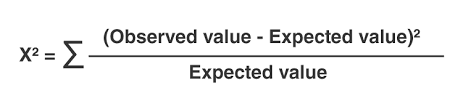
- %%X2 tests%% are useful for testing the fit of experimental data to expected inheritance patterns to determine what the inheritance pattern is for a given trait
- In this case, the null hypothesis would be that the inheritance pattern is (something) and the expected values should follow the punnett square-determined ratio for said pattern
- If X2 value is below the critical value, the null hypothesis cannot be rejected and there is no significant difference between experimental data and expected inheritance pattern
%%Incomplete dominance%%
- heterozygous genotype expresses a blended/intermediate phenotype between the two homozygous phenotypes
- ex) snapdragons - AA produces red, aa is white, Aa is pink
%%Codominance%%
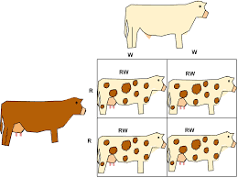
- heterozygous genotype expresses a mixture (not blend) but equal expression of both homozygous phenotypes
- ex) roan cows express both dominant red and recessive white
- ex) %%human blood type%% (also involves multiple alleles) - A and B alleles are codominant, when both are present, AB blood type is produced - both A and B alleles are dominant to the O allele
%%Pedigrees%%
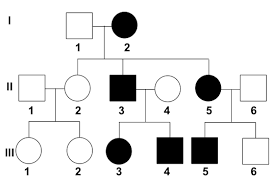
- squares represent males, circles represent females
- filled-in figures represent individuals affected with a trait being tracked (note: for questions, the trait being tracked is NOT ALWAYS the bad/recessive/diseased phenotype - pay close attention to what is being asked)
- Dominant traits will appear in every generation
- ex) brachydactyly is controlled by a dominant allele - normal finger length is recessive, but the dominant allele is rare, so any affected individuals are usually heterozygous
- For an Aa x aa cross, it can be expected that 1/2 of the offspring will have brachydactyly
- Recessive traits skip generations, affected people can have unaffected (heterozygous) parents
- Sex-linked traits will show significantly more affected males than females, while autosomal traits will show approx. equal numbers of M and F affected individuals
Complications in tracking inheritance
- %%Incomplete penetrance%% - not 100% of people with a given genotype express the corresponding phenotype
- ex) people can be genetically predisposed for type II diabetes, but not all people who have this genotype will develop T2D - if someone has the gene but also a healthy lifestyle, they may not
- %%Variable expressivity%% - 100% of people with the genotype express the phenotype, but with varying degrees of intensity
- ex) a mutant allele causes decreased lung elasticity and emphysema - all with the genotype have this reduced elasticity, but those who have it and are also smokers will display the symptoms more intensely than someone who doesn’t smoke