1: Gilgamesh, The Epic Hero
Reading World Literature

Reading world literature can be quite challenging. Authors often pursue their goals in complex and sophisticated ways, employing vocabulary, metaphors, and allusions that are unfamiliar to many readers. Authors of world literature are no exception to these practices.
The more you learn about literature and the more you practice unraveling its meanings, the more adept you will become at understanding it. In fact, this is the case for all kinds of texts. Many students just beginning to study law, for instance, find the specialized language and style of the field almost impossible to understand, but after a year or two of reading case documents, they undoubtedly find the task much less daunting. Similarly, students new to academic research articles and books often have difficulty plowing through them and then summarizing the authors’ points. Yet, after some practice, this task becomes much less challenging and even intellectually stimulating! Throughout this course, as you explore world literature, you will also review important skills related to reading comprehension and understanding.
Six Steps to Improve Comprehension
How do you improve comprehension of such texts? The following active reading process is recommended to boost you beyond common frustrations with challenging reading assignments. With practice, it will become a useful method for making sense of challenging passages of a text.
Skim the text first.
Get an idea of what sort of text you are dealing with. Is it an article based on primary research, such as experiments or participant interviews? Is it a critique of a previously published study? Is it a personal essay based on the author’s life? Is it a sonnet or a one-act play? How is the piece structured? Can you find a statement or passage that seems to capture the text’s central message?
Next, read the whole piece slowly and carefully.
Try to push through any frustration with dense, sophisticated passages by absorbing what you can and noting any questions or difficulties. Any lack of immediate comprehension should not be seen as a roadblock but rather as a mystery or challenge to deal with later. Often further reading reveals the meaning of difficult-to-understand passages. Slow down to absorb subtleties and complexities only to a limited degree. Reading should focus on the narrative flow and particular events rather than overall analysis.
Engage with the text.
Annotate as you go. Use a notepad, sticky notes, or a word processing document. Look up unfamiliar terms and jot down the definitions, highlight or underline key ideas, and write down questions and ideas that come to you as you read. Note patterns in the text that might be considered later to help unravel the meaning.
Reread the text as necessary.
Seek to fill in gaps in your understanding that may remain after your first reading.
Gather outside information about the piece’s context if it is helpful.
Be careful, though, not to “read into” the text’s meaning too much. Any historical or biographical interpretation of a literary work must still be supported by the text itself.
React.
Record your personal response to what you read. If you disagree with a statement, make a note of your reaction. You may change your mind as you proceed through the text, but moving beyond the role of a passive reader, who simply memorizes information, will generate a much deeper understanding. Your brain wants to fit this new perspective into the other ideas already stored there. Working through contradictions and/or exploring relationships between old information and new information will increase retention and understanding of the new material.
Annotating a Text
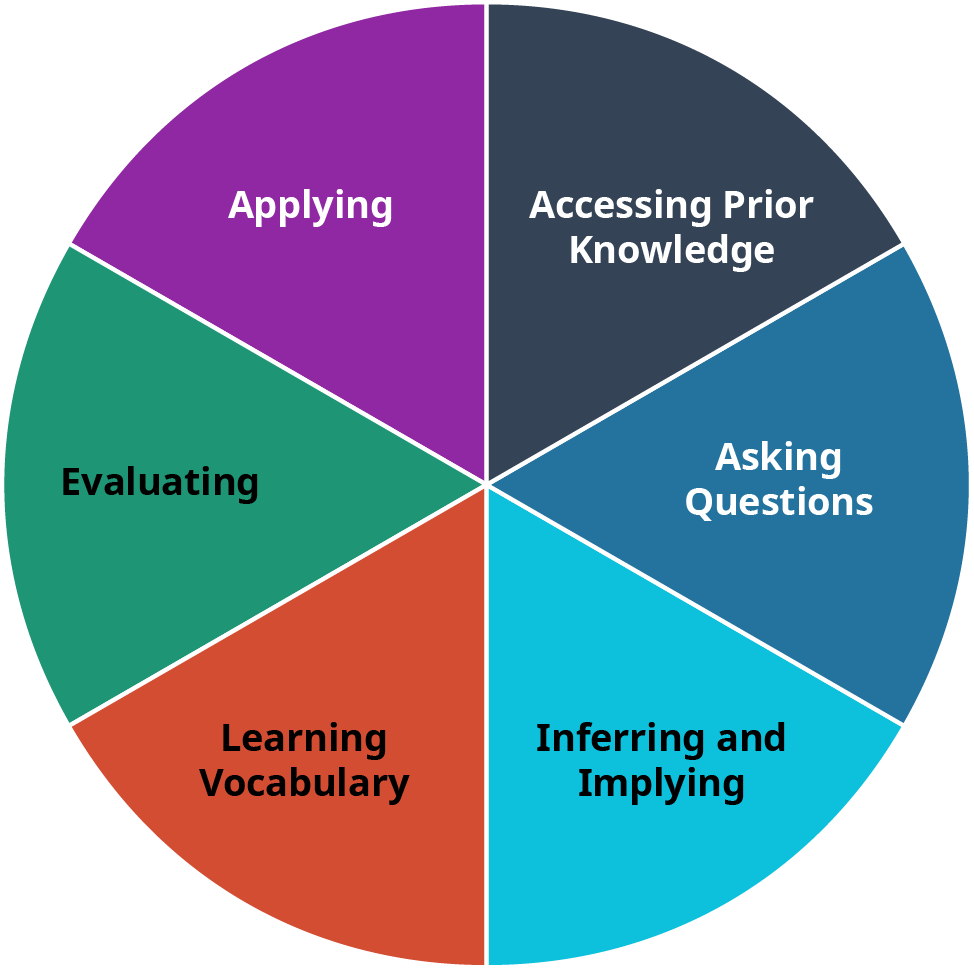
You can actively read and annotate a text by:
-bringing any prior knowledge about the topic to the text
-asking pertinent questions, both orally and in writing, about the content
-inferring information from the text
-learning unfamiliar discipline-specific terms
-evaluating what you are reading
-applying what you’re reading to other learning and life situations you encounter
Actively read is a circular, not a linear process:
Contemporary Heroes
💡 | Main Ideas |
| |
A contemporary hero is someone who is able to overcome significant challenges, despite coming from a disadvantaged position. Many people identify heroes in literature by their actions and deeds, which are typically morally upstanding and motivated by helping to support a greater good. In this sense, we define a contemporary hero as an individual who goes on a journey to discover themselves or something, faces multiple challenges along the way, and ultimately finds success through a happy ending.
Critics of the contemporary heroes viewed in modern literature and film often note that these depictions of heroism manipulate an individual’s ability to decipher a real hero. In everyday life, they believe that heroes do things that transform society and reshape the world, while the contemporary hero may do things that are novel, despite their quest to do good. Can you think of a contemporary hero in literature and one in modern history?How are they similar? How do they differ?
Epic Heroes
💡 | Main Ideas |
| |
The contemporary definition of a hero or leader is often not compatible with the ancient world’s definition of a hero or leader. Each society, and sometimes each time period in each society, can have a different definition, based on what the expectations were. There is also a difference between the modern idea of an action hero and the ancient world’s definition of an epic hero. To be the hero of an epic, the character needs to meet at least some of the following requirements:
receives divine intervention (favored by the gods)
superhuman strength or abilities
important member of his society; important to his people
has the ability to overcome and learn from a personal flaw
goes on a significant journey
Unlike a modern film hero who might be expected to act in the best interests of others, epic heroes may or may not act with other people’s interests in mind. Some epic heroes fight to protect others, but many fight for personal glory, regardless of the collateral damage. In other words, an epic hero is an ideal warrior or leader in society, but not always an ideal human being.
The Epic Hero Gilgamesh
💡 | Main Ideas |
| |
This relief from ancient Mesopotamia is believed to depict Gilgamesh and Enkidu fighting Humbaba.
In the Epic of Gilgamesh, the title character, Gilgamesh, is often considered the first hero in literature. Gilgamesh begins the story as an impressive epic hero but a poor leader. The gods must respond to the prayers of the people of Uruk, who beg for protection from Gilgamesh. Gilgamesh’s lack of sound or correct judgments may be attributed to his composition as part-human, part-god. The ancient Sumerians’ gods were not particularly moral.
In most ancient epics, heroes need the help of the gods to ensure successful completion of a journey, quest, or undertaking. Outcomes are determined not by individual strength alone but often through the benevolence and whims of the gods. Contests are not resolved based on tests of strength, skill, or willpower but by the wishes of the gods. Human strength meant little in such a world view.
Gilgamesh is portrayed as a strong individual and ruler. However, to fight the supernatural creature Humbaba, Gilgamesh needs help: his mother’s prayers to the gods, his friend Enkidu’s support, supernatural weapons from the god Shamash (namely the winds), and his tears as offerings to Shamash in exchange for his help.