4.6 The rate and extent of chemical change
4.6.1 Rate of reaction
4.6.1.1 Calculating rates of reactions
Rate of a chemical reaction = how fast the reactants are changed into products
The rate of a chemical reaction can be found by measuring the quantity of a reactant used or the quantity of product formed over time:
Mean of rate of reaction = quantity of reactant/time taken
Mean of rate of reaction = quantity of product/time taken
The quantity of reactant or product can be measured by the mass in grams or by a volume in cm3
The units of rate of reaction = g/s or cm3 /s
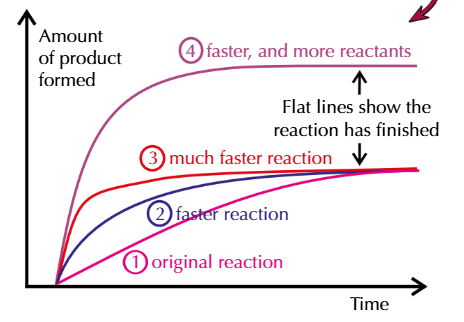
Graph 1 - represents the original reaction
Graph 2 & 3 - represent the reaction being quicker but with the same reactants (lines converge at the same place)
Graph 4 - shows more product and a faster reaction (can only happen if more reactant(s) are added at the start)
4.6.1.2 Factors which affect the rates of chemical reactions
Rate of reaction depends on four things:
Temperature:
When the temp increases the particles all move faster as they gain kinetic energy
If they’re moving faster, they’re going to collide more frequently
The faster they move the more energy they have - so more collisions will have enough energy to make the reaction occur
Concentration of a solution or the pressure of the gas:
If a solution is more concentrated - it means more particles are colliding in the same volume of water
If a gas has more pressure - it means the same number of particles occupies a smaller space
Surface area:
If one of the reactants is a solid - breaking it up into smaller pieces will increase its SA:V ratio
This means that for the same volume of the solid the particles will have more area to work on - so collision frequency increases
Presence of a catalyst:
A catalyst = a substance that speeds up a reaction, without being used up in the reaction itself
This means it’s not part of the overall reaction equation
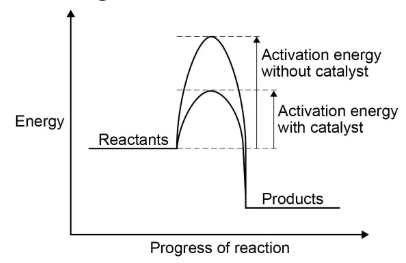
Catalysts work by decreasing the activation energy
They do this by providing an alternative reaction pathway with a lower activation energy
Enzymes are biological catalysts
4.6.1.3 Collision theory and activation energy
In terms of collision theory, the rate of chemical reaction depends on:
Collision frequency of reacting particles - more collisions = faster reaction
Energy transferred during a collision - particles have to collide with enough energy for the collision to occur
Activation energy = minimum amount of energy that particles need to react - particles need this to break the bonds in the reaction and start the reaction
4.6.1.4 Catalysts
Continuing on from the previous notes on the presence of a catalyst as a factor for the rate of a chemical reaction:
Different reactions need different catalysts
(need to finish ts using save my exams as nothing on CGP)