L1 - Introduction to Cell Biology
Studying Cells:
- to understand the tissues and organisms that cells compose in details,
- to determine what is “normal” so we can fix the “abnormal”,
- to understand how macromolecular systems and organelles work and cooperate to enable cells to function autonomously and in tissues.
Cell:
- the cell is a fundamental unit of life, the basic building blocks of all living things,
- the human body is composed of ~75 trillions of cells,
How to study Cells?
- hypothesis-driven experiments,
- Cells are isolated and maintained in vitro
- Know how to view cells and what to look for
- Identification of organelles
- Identification and study of how proteins drive cellular mechanisms
Cell Culture:
- the technique used to grow cells or tissues outside the organism under strictly controlled conditions,
- cells are isolated from any tissue by breaking down the cell-cell and cell-matrix interactions by , ==trypsin==, .
Preparation of Cell Culture
- @@Mechanical fragmentation@@
- breaks @@tissue@@ into smaller portions
- @@Trypsin@@
- breaks down outer layer of @@proteins@@ that sticks cells together
- @@EDTA@@
- an ion chelator that chelates to calcium and magnesium
- @@Integrin@@ sticks cells togethers, needs calcium to be stickier
- Magnesium and calcium also inhibit trypsin
- cells in the cell culture: are supplied with proper nutrients (amino acids, minerals, vitamins, salts, glucose, etc.), serum (insulin, growth factors) and grown usually
- @@CO2@@
- creates an acid-base equilibrium within the media
- media
- overgrowth and lactic acid production
- ^^Purple^^ media
- lack of CO2 leading to an alkaline media
- Cells can grow as: or %%suspension cell cultures%%.
Primary Cell Culture:
- cells taken directly from an organism,
- usually divide a limited number of times (),
- undergo contact inhibition if cell density is high.
Cell Line:
- cells which are transformed and are able to grow indefinitely (immortal cells),
- less likely to exhibit contact inhibition.
Hela Cell:
- the first human cell line established in 1952 by George Get (Johns Hopkins University, Baltimore) from cervical carcinoma biopsy of Henrietta Lacks.
- Morphology of normal vs transformed fibroblasts
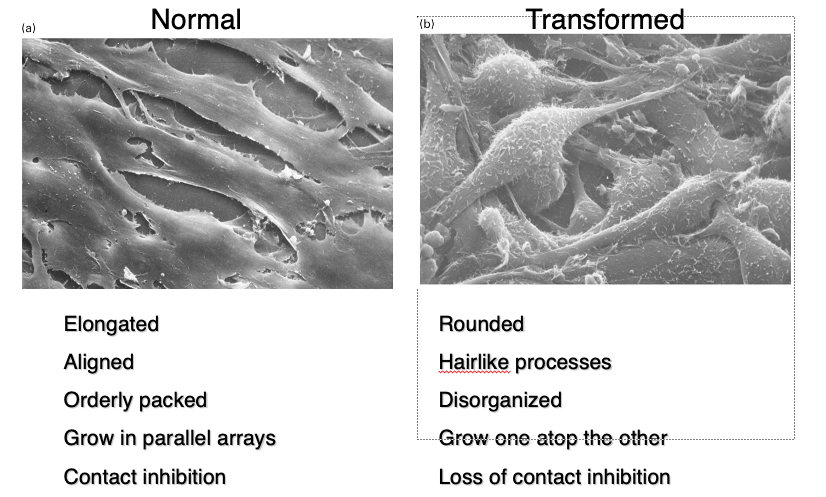
- Normal cells have a Hayflick limit, transformed cells don't
Cell Division:
- the process by which a parent cell divides into two daughter cells. Cell division usually occurs as part of a larger cell cycle in which the cell grows and replicates its chromosome before dividing,
- both symmetric and asymmetric cell division occurs during development and in adult stem cells.
Symmetrical and Asymmetrical Cell Division
Symmetrical Division:
- produces two identical stem cells or differentiated daughters.
Asymmetrical Division:
- stem or progenitor cell generates,
- a , which
- and %%one daughter that enters the path of differentiation,%%
- ==or two differently differentiated daughters.==
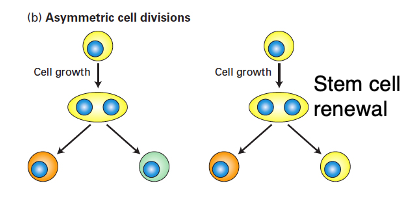
Cells
Progenitor Cell:
- stem cell can divide into progenitor cells that are an intermediary,
- can divide symmetrically,
- differentiated cell can no longer be further modified,
- a biological cell that can differentiate into a specific cell type,
- more specific than stem cells, can only differentiate into their "target" cell type.
Embryonic stem cells:
- can be maintained in culture and can form differentiated cell types,
- are pluripotent and can be grown indefinitely in culture under appropriate conditions,
- can also be induced to differentiate into precursors for various cell types.
- Cells that survive in the feeder environment maintain the pluripotent property,
- can grow into embryo bodies in suspension culture to grow into tissues (germ layers) \n
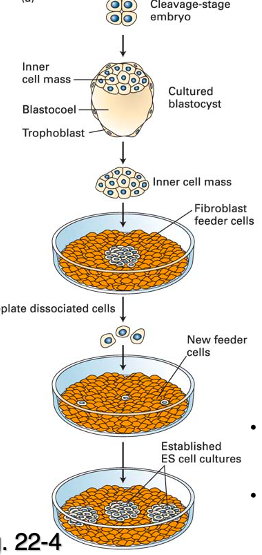
Pluripotent Stem Cells:
- can form organoids in culture,
- stem cells possess the intrinsic program to divide, differentiate, and organize themselves into complex structures.
- :
- brain organoids have organization and structure remarkably similar to the fetal brain, but ==never== to the organization of adult brain
- organoids advance to fetal development state, but do not proceed to the organization seen in an adult organ.
Adult Stem Cells:
- contained by most tissues,
- required to maintain and repair tissues,
- capable of generating a limited number of different cell types,
- located in
- (Replace the intestinal epithelium every 5 days!).
- intestinal stem cells are in the crypts (between villi)
- tops of the villi will die and peel off, the lower parts get pushed up from the crypt
Stem Cell Niche:
- an area of a tissue in which stem cells are present in an undifferentiated and self-renewable state,
- adjacent cells interact with the stem cells to signal or %%differentiation%%.
- found in all parts of body
- efficient when young, starts to fail to regenerate or response to signal as one ages
Reprogramming Mature Cells:
- obtain pluripotent cells from differentiated normal cells with Yamanaka factors.
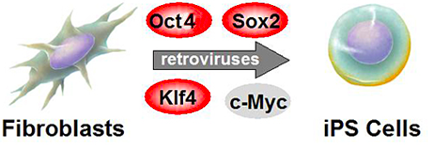
Yamanaka factors:
- three genes (, %%Sox2%%, ==Klf4==) and one frequently expressed in cancer cells (^^c-Myc^^).
Retrovirus:
- inserts a DNA copy of its RNA genome into the DNA of a host cell that it invades, thus changing the genome of that cell.
- potentially cancerous, not safe for therapeutic use
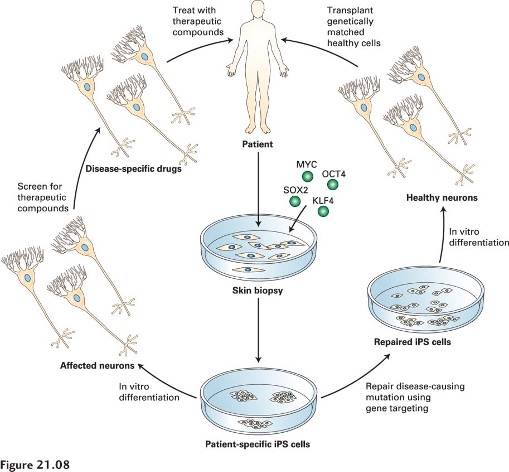
Induced Pluripotent Stem Cells (iPS):
- derived from skin or blood cells reprogrammed back into an embryonic-like pluripotent state,
- enables the development of an unlimited source of any type of human cell needed for therapeutic purposes.
Therapeutic Application of iPS:
- mass production of affected cells for screening compounds and identifying the mutated genes
- genetically modification to repair mutation and grow into new organ with in vitro differentiation for transplantations
- repopulate the brain, with healthy neurons for Parkinson’s disease
- Custom made, patient’s immune system will not reject the healthy cells
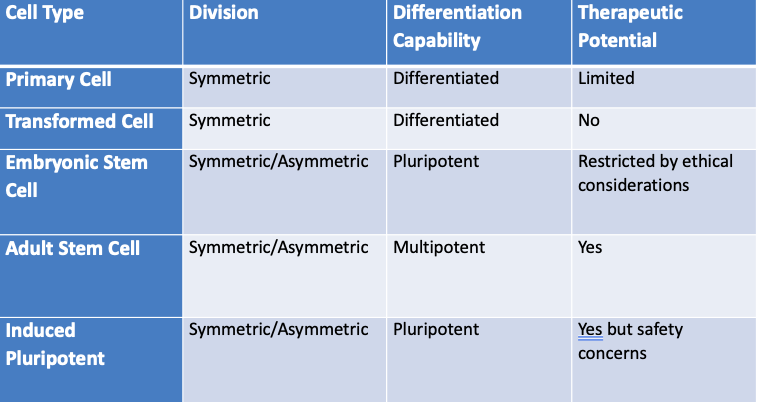
Differences Between Primary, Transformed, and Stem Cells:
\n \n
\n \n