Cofactors
Cofactor - a non-protein chemical molecule required for the biological activity of a protein. .
Prosthetic group - a cofactor permanently bound to a protein
Coenzyme - a cofactor that associates reversibly with an enzyme
NAD(P)H
Nicotinamide adenine dinucleotide (phosphate) - ubiquitous biomolecules. NADP+ and NAD+ are the oxidised forms, NADPH and NADH are the reduced forms

NADP+ and NAD+ differ by the phosphorylation of the ribose C2. The fundamental reaction is hydride (a proton and 2 electrons) transfer. NAD(P)H can be considered as Nature’s store of hydrogen (reducing equivalents)
Nicotinamide chemistry
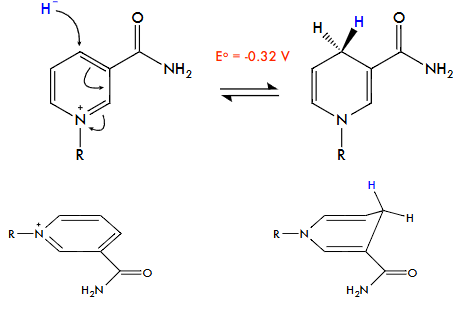
Planarity is lost when the nicotinamide ring is reduced. The reaction can be written as;
(coupled electron and proton transfer)
(concerted hydride transfer)
The second reaction is how it naturally occurs
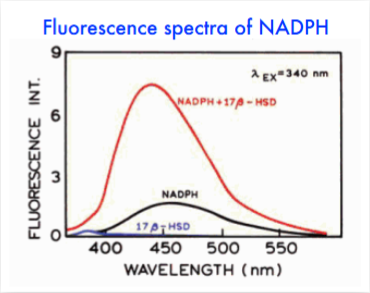
Spectroscopic differences between the oxidised and reduced forms aid the study of enzymes

NAD(P)H reactions
Dehydrogenase - an enzymes that catalyses the oxidation of a substrate by NAD(P)+ (NAD(P)H is formed)
Reductase - an enzyme that catalyses the reduction of a substrate by NAD(P)H (NAD(P)+ is formed)
Oxidase - an enzyme that catalyses the oxidation of a substrate and reduction of molecular oxygen (may involve the oxidation of NAD(P)H)
These 3 types of enzymes are part of a large class of enzymes called the oxidoreductases
Typical NAD(P)+/NAD(P)H dependent reactions
Ketone reduction/oxidation

Double bond (de)hydrogenation

Alcohol detoxification

Alcohol dehydrogenase (ADH) and aldehyde dehydrogenase (ALDH) responsible for first steps in alcohol metabolism. Both ADH and ALDH are NAD+ dependent
Alcohol dehydrogenase
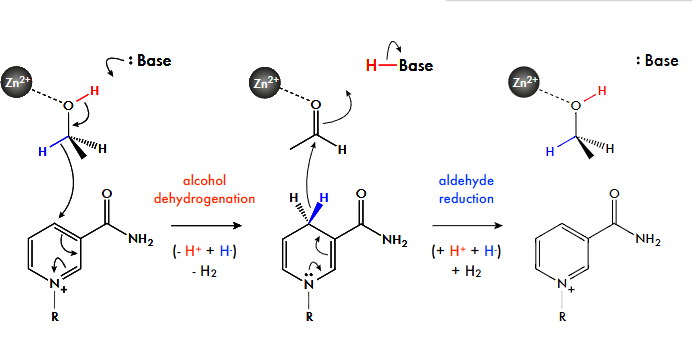
Zinc acts as a Lewis acid weakening the O-H bond.
Substrate oxidation is coupled to the reduction of the cofactor
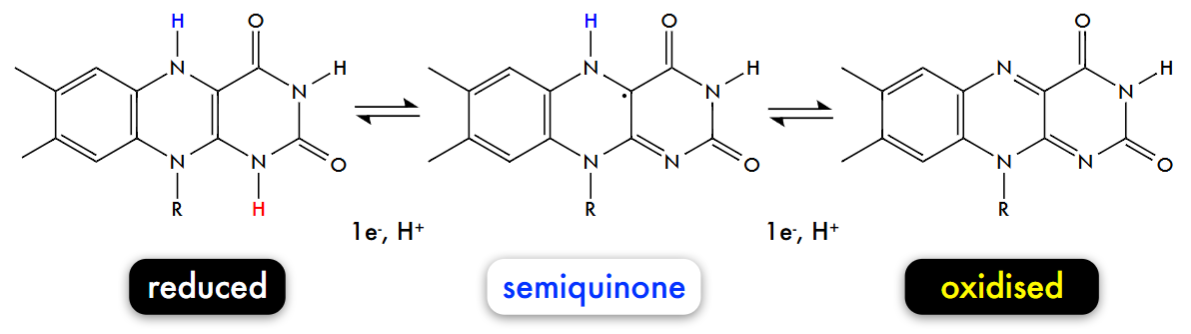
Flavin reduction

The isoalloxazine ring of FAD and FMN is used as a transducer, converting a 2 electron donor into single electrons in many enzymes.
In FAD the R group is adenine dinucleotide, in FMN the R group is ribose phosphate.
FAD and FMN can exist in 1 electron reduced states called semiquinones
NADPH oxidase
NADPH oxidase catalyses the production of reactive oxygen species (ROS) using electron from NADPH. It contains FAD and 2 heme cofactors and reacts with molecular oxygen. Puts foreign organisms under massive oxidative stress in the human body - kills pathogens.