MKT305 Chapter 7 - Improving Decision-Making with Marketing Information
Marketing Information Inputs to Marketing Strategy Planning Decisions
Data guides marketing strategy.
Information Sources:
External data: Market research reports, industry publications, and competitive analysis provide insights into current trends and consumer behavior.
Internal data: Sales data, customer feedback, and website analytics help in understanding past performance and identifying areas for improvement.
Market research studies: These studies offer comprehensive insights into consumer preferences, purchasing habits, and potential market opportunities.
Big data: Big data allows marketers to analyze large volumes of information from various sources, enabling more accurate predictions and tailored marketing strategies.
Marketing Analysis:
Decision support systems: These systems integrate data management, analytical tools, and modeling techniques to assist marketers in making informed decisions based on reliable data.
Marketing models: Marketing models are simulations that utilize historical data and statistical methods to forecast future market trends and consumer behavior, providing a foundation for strategic marketing planning.
Predictive analytics: Predictive analytics involves using statistical algorithms and machine learning techniques to identify the likelihood of future outcomes based on historical data, enabling marketers to anticipate consumer needs and tailor their strategies accordingly.
Marketing Research:
Scientific method
Steps in marketing research:
Define problem
Analyze situation
Gather problem-specific data
Interpret the data
Solve the problem
The Scope (Definition) of Marketing Research
The process involves:
Collecting data
Recording data
Analyzing data
Interpreting data is essential for transforming raw numbers into actionable insights that can guide marketing strategies.
Using:
Systematic procedures: for analyzing data help ensure that all relevant information is considered, allowing marketers to pinpoint trends and make informed decisions.
Objective procedures: through standardized methods can enhance the reliability of analyses, reducing bias and leading to more consistent conclusions that effectively support strategic initiatives.
Exhaustive procedures: involve a thorough examination of all possible options and data sources, ensuring that no critical insights are overlooked, and providing a comprehensive understanding of the market landscape.
To produce:
Relevant information: systematically gathered from reliable sources, including market research, customer feedback, and competitive analysis, thereby ensuring that decision-making is informed and aligned with consumer needs.
Usable information: filtered and processed data that can be effectively applied to support strategic marketing decisions, enabling teams to prioritize actions based on actionable insights.
Five-Step Scientific Approach to Marketing Research Process
Defining the problem
Analyzing the situation
Getting problem-specific data
Interpreting the data
Solving the problem
Early identification of solution
Feedback to previous steps
Defining the Problem - Step 1
Finding the right problem level
Problem vs. Symptoms
Setting research objectives.
Analyzing the Situation - Step 2
Determining what information we already have.
Situation analysis helps educate a researcher.
Sources of Secondary and Primary Data
Secondary Data Sources: is comprised of information that has already been collected and published by others, such as government reports, academic journals, market research reports, and online databases.
Inside company:
Review company files, intranet, reports.
Search marketing information systems.
Analyze sales and cost data.
Outside company:
Search the Internet, library, and government databases.
Talk to researchers at universities and private research organizations.
Primary Data Sources: is data collected directly from original sources through methods such as surveys, interviews, and experiments to obtain current and specific information relevant to the research objectives.
Observation:
Use video to observe customers shopping.
Track consumer clicks on a website.
Purchase loyalty card data from retailers.
Questioning:
Conduct focus group or in-depth interviews with customers to learn their needs.
Use online, phone, or surveys of customers to measure customer satisfaction.
All data sources can be used for questioning.
The Bottom Line on Secondary Data
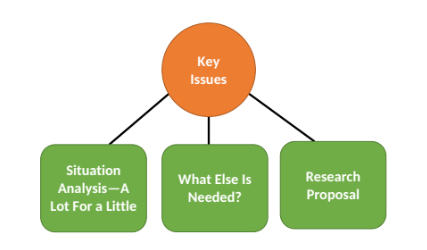
Situation Analysis provides a lot of information for a little effort.
Key Issues arise for what else is needed in the Research Proposal.
Getting Problem-Specific Data - Step 3
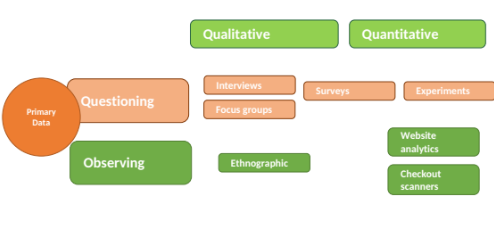
Primary Data
Qualitative:
Focus groups: a method where a small group of participants discuss specific topics to gain insights into their perceptions and attitudes.
Interviews: one-on-one conversations that allow for in-depth exploration of individual perspectives, experiences, and opinions regarding products or services.
Quantitative:
Surveys: structured questionnaires designed to collect measurable data from a larger population, providing statistical insights into consumer preferences and behaviors.
Experiments: controlled tests conducted to evaluate the effectiveness of different marketing strategies or product features, allowing marketers to assess cause-and-effect relationships.
Checkout scanners: devices used in retail environments to record the purchase of items, generating data on purchasing patterns and customer behavior that can inform inventory management and promotional strategies.
Ethnographic studies: research methods that involve observing consumers in their natural environments, providing qualitative insights into their behaviors, motivations, and cultural contexts, which can enhance understanding of target markets.
Website analytics: tools used to track and analyze user behavior on websites, offering quantitative data on visitor demographics, behaviors, and interactions that can guide web design and marketing strategies.
Interpreting the Data - Step 4
Issues in interpreting the data
Population: the demographics of website visitors can lead to skewed interpretations if not properly contextualized, affecting targeting and strategy decisions.
Sample: The sample size and selection method can also significantly impact results, leading to potential biases that might misinform marketing strategies.
Validity: The validity of the data is crucial; if the collected information does not accurately reflect the true characteristics of the population, it can result in misguided conclusions and ineffective marketing efforts.
Solving the Problem - Step 5
Interesting Tidbits:
Understanding consumer behavior through detailed analytics can provide deeper insights into purchasing patterns.
Engaging with social media trends may reveal shifting preferences among target audiences.
No Action Implications = Little Value: If data collected from marketing research does not lead to actionable insights, it is ultimately not beneficial to our strategic planning.
Application in Marketing Strategy Planning: Integrating consumer behavior analytics into our marketing strategy allows us to tailor our campaigns effectively, ensuring that messaging resonates with our audiences and ultimately drives conversion.
Evaluate: Regular assessment of marketing initiatives and outcomes is crucial in adapting our strategies to the ever-changing market landscape.