Tombs, graves and burial
Burial customs
If the body was wealthy they would have been adorned in jewellery, we can tell this as it’s been found on the necks and wrists of skeletons. With this we can assume they were clothed as well.
A drink offering was probably made to the Gods, as we’ve found damaged metal cups at the entrance of the tholos tombs.
Bones of animals and sea-shells have been found, suggesting there was a feast in honour of the dead. They would have also given gifts, but these have either decayed or been robbed.
A pair of dead horses was found at both Marathon and Dendra but this probably wasn’t a main practice. But it does mirror a scene from Book 23 of the Iliad where 2 of Patroclus’ dogs were slaughtered at his funeral.
Afterwards the earth would’ve been filled in and then a stele would be placed over the tomb. If another body needs to be put in the same place the mount is dug up.
There is evidence of clay burial caskets, from remains at Tanagra. The painted scenes on the casket tell us about customs:
funeral procession involved women - elaborate dresses, feathered caps, showing signs of grief
bodies lie on a bed wrapped in a short tunic
drink offerings
Structure and use of graves
Cist graves were the most basic style of graves. It was a shallow pit (0.6m) with sides covered in slabs of stone, then a pile of stones were placed at the bottom for the body to lie on. These were so small that bodies had to be put in curved positions.
Shaft graves were similar to cist graves but larger and deeper (2.5m). At the bottom they would have low rubble walls and roof support. The bodies were usually laid on their backs, when another body had to be placed in the same chamber the other was moved into a corner ☹. There is a lot of grave goods found in these graves. An example of this is Grave Zeta in grave circle B.
Tholos tombs were a raised mound. These were built with stone and were for the most important members of a city. They had a high-roofed dome and a side chamber. On the outside was a dromos (passageway) followed by a richly decorated entrance.
For the Treasury of Atreus: 2 green limestone columns with zigzag patterns, triangle of redstone.
Chamber tombs were tombs dug from rock where more than one body was placed. These were for less important Mycenaean Nobles. Similar to tholos tombs they had a dromos and walls of stone but they were made of earth and had a square or rounder roof. These were probably used as family tombs.
The use of funerary objects
Items found in graves usually show the importance and status of the people buried there. Many ancient societies thought they would use the items they were buried with in the afterlife. They might be for decorative use or maybe to show off status and wealth.
common items:
pottery items
vessels
figurines
perfumes
military equipment
jewellery
cosmetic boxes
Contents of Grave Circle A and Grave Circle B at Mycenae
Grave Circle A
2 gold death masks
gold cup with repousse spirals
gold necklace
bronze dagger
amber bead necklace
wooden pyxis, covered with gold plates
ostrich-egg rhyton with dolphins
swords with handles
bronze sword with griffins
gold octopus brooch
Grave Circle B
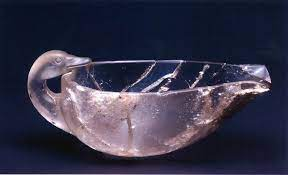
Rock crystal vessel with a duck head