Ch11b Bonding II
VSEPR Theory: practice problem: Tylenol/Acetaminophen

Identifying Carbon Atom Geometry
Consistency among carbon atoms
Types of bonds:
Double bonds with other carbons
Single bonds to either hydrogen or oxygen
Benzene Ring Structure
Six trigonal planar carbon atoms arranged in a ring
Characterized as flat due to planar arrangement
Molecular Polarity
Discussion on Polar Bonds and Dipole Moments
Definition of dipole moment:
Net effect direction of electron density in polar bonds
Importance of understanding polar bonds and resulting net dipole moment
Indication of Polar Bonds
Use of arrow notation to demonstrate electron density
Example with chlorine exhibiting high electron density
Representation using delta notation (δ+) and (δ−)
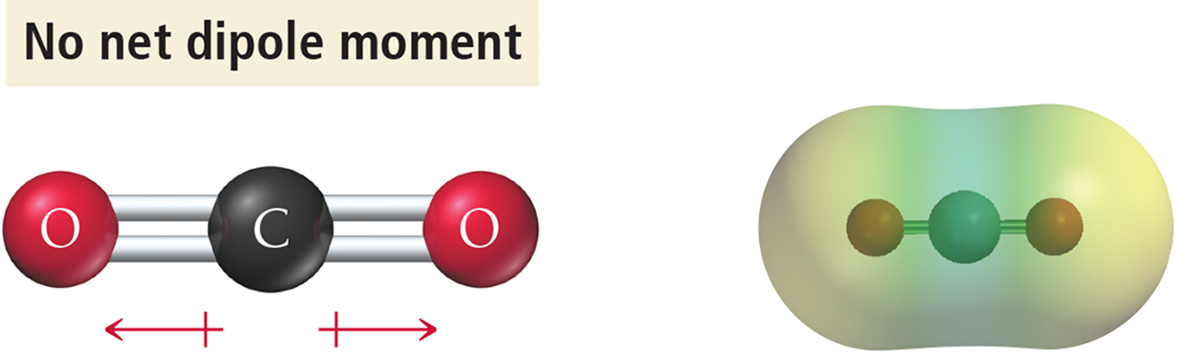
The O-C bond is polar. The bonding electrons are pulled equally toward both the O ends of the molecule. The net result is a nonpolar molecule because the vectors cancel out.
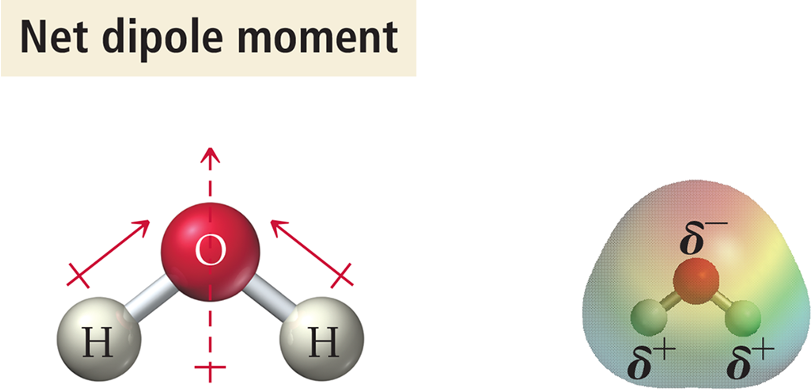
The O-H bond is polar. Both sets of bonding electrons are pulled toward the O end of the molecule. Because the molecule is bent, not linear, the net result is a polar molecule.
Analyzing Molecular Vectors
Determine whether the bonds in molecule are polar.
If there are no polar bonds, the molecule is nonpolar.
If there are polar bonds, draw a vector, pointing toward the more electronegative atom, on each bond.
Determine whether the polar bonds add together to form a net dipole moment.
Sum the vectors. If the vectors sum to zero, the molecule is nonpolar. If the vectors sum to a net vector, the molecule is polar.
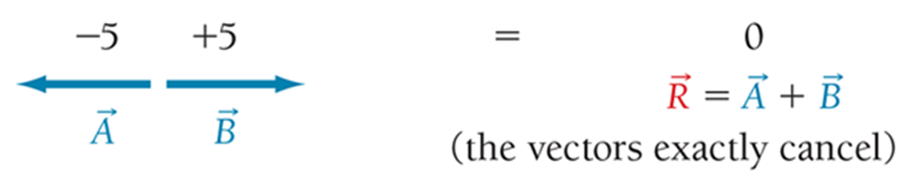

Dipole/Polarity Rules
The net molecular polarity depends on both bond polarity and molecular shape:
Polar bonds in opposite directions (equal and opposite)
Example: CO₂
Oxygen is more electronegative than carbon → bond dipoles point from C → O
Linear molecule → the two bond dipoles point exactly opposite along the same line → cancel → nonpolar molecule
Polar bonds colinear toward the central atom (equal and opposite)
Hypothetical linear H–O–H
Dipoles point from H → O (toward central O) → vectors are colinear but opposite in direction → cancel → nonpolar molecule
Interaction Between Polar and Nonpolar Molecules
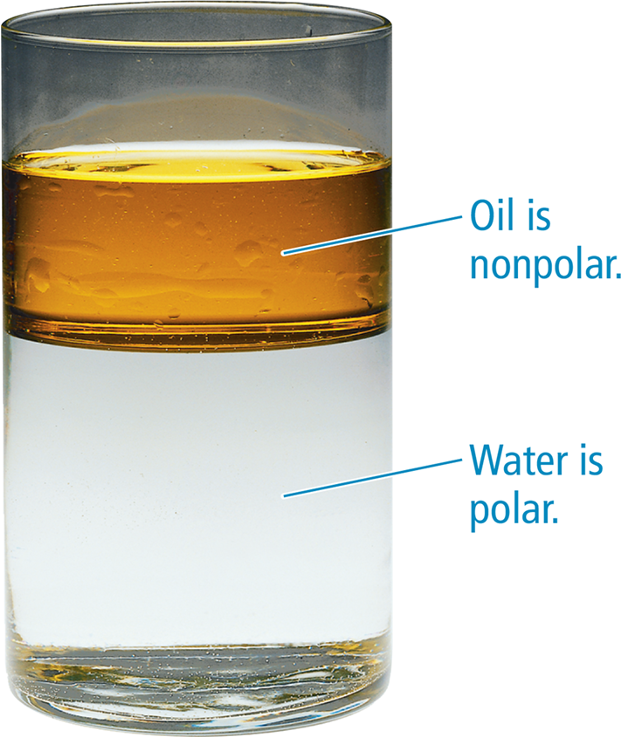
Polar molecules are attracted to other polar molecules.
Because water is a polar molecule, other polar molecules dissolve well in water and most ionic compounds as well.
Some molecules have both polar and nonpolar parts.
Limitations of Lewis Model
generally predicts trends in properties but does not give good numerical predictions.
for example, bond strength and bond length
gives good first approximations of the bond angles in molecules but usually cannot be used to get the actual angle.
cannot write one correct structure for many molecules where resonance is important.
often does not predict the correct magnetic behavior
O2 is paramagnetic, Lewis structure predicts it is diamagnetic.
O2 is paramagnetic, Lewis structure predicts it is diamagnetic.
Implies unpaired electrons so it can interact with a field.
There are no unpaired electrons according to Lewis structure.
O2 interacts with a field!
Atomic Orbitals and Bonding
Definition of Atomic Orbitals: Regions around an atom where electrons are likely to be found.
When atoms combine, their atomic orbitals overlap to form bonding orbitals, termed hybridized atomic orbitals.
The overlap leads to a lower energy state for the system, which is a prerequisite for forming a chemical bond.
A chemical bond is defined as an attractive interaction where the total energy of the system decreases due to electron and nucleus interactions.
Overlap of Half-Filled Orbitals:
A chemical bond results from the overlap of two half-filled orbitals. Each orbital has a spin (either up or down).
Upon overlap, spins will pair, resulting in a stable configuration.
The molecular orbitals would be more stable than the separate atomic orbitals because they would contain paired electrons shared by both atoms.
The potential energy is lowered when the molecular orbitals contain a total of two paired electrons compared to separate, one-electron atomic orbitals.
Orbital Geometry and Molecular Shape
When considering molecular shapes, the geometry of the overlapping orbitals is critically important.
For example, the molecule Hydrogen Sulfide (H₂S):
Each hydrogen contributes one electron from its 1s orbital and sulfur’s Lewis diagram helps visualize molecular bonding.
Theoretically predicted bond angle = 90 degrees; experimentally determined bond angle ≈ 92 degrees.
Bond Formation Mechanism
As two atoms approach:
A balance is found where atomic orbitals interact and form molecular orbitals.
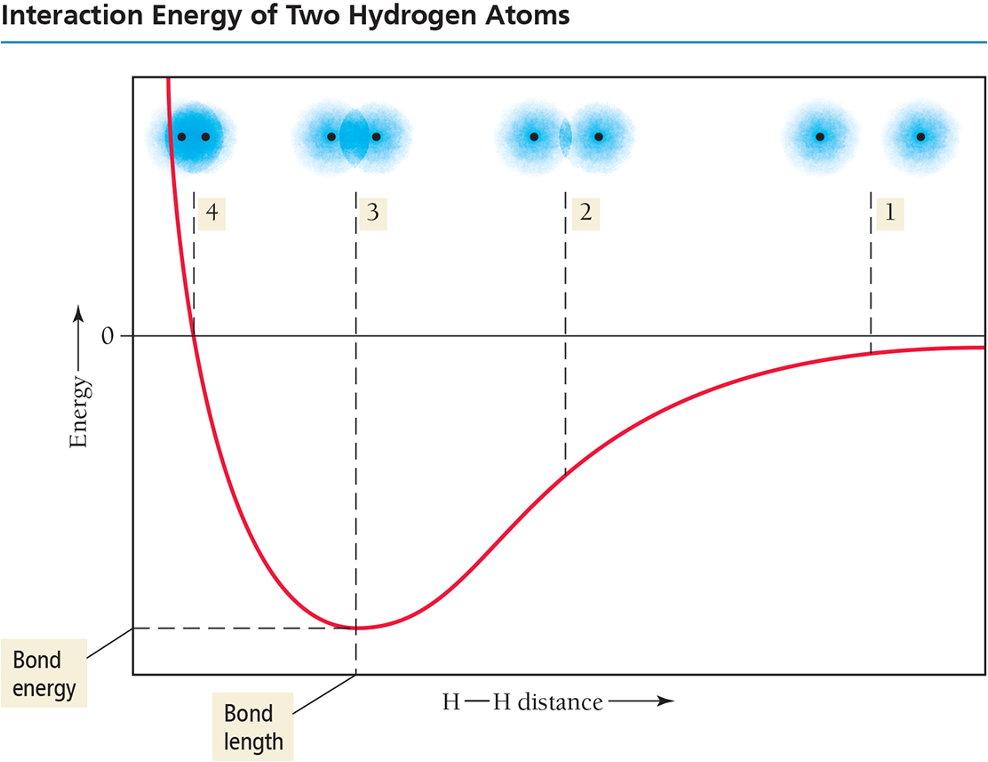
The distance between atomic nuclei (represented on a potential energy curve) defines bond length and stability. There exists an optimal distance at which the two nuclei exert maximum attractive force while avoiding repulsion.
Valence Bond Theory (VBT): Hybridization
Hybridization: The process where different types of atomic orbitals mix to form new, equivalent energetically degenerate orbitals.
This hybridization acts as a corrective mechanism for inconsistencies when predicting molecular geometry. This occurs before actual bonding.
Hybridization types:
sp hybridization: Combines one s and one p orbital.
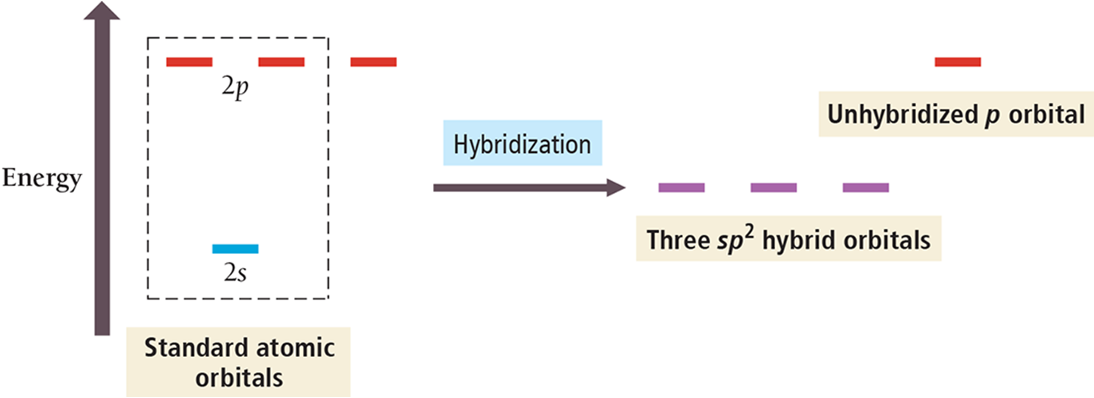
sp² hybridization: Combines one s orbital with two p orbitals.
sp³ hybridization: Combines one s orbital with three p orbitals to create four equivalent orbitals, leading to a tetrahedral arrangement.
The conservation of orbital count: The number of atomic orbitals mixed is equal to the total number of hybrid orbitals formed, preserving the quantity of orbital interactions in chemical bonding.
Bond Angles and Molecular Geometry
In the case of hybridization:
sp³ leads to bonds forming a tetrahedral structure (bond angle 109.5°).
sp² leads to a trigonal planar structure, with bond angles of 120°.
sp leads to a linear arrangement with bond angles of 180°.
Bonding of Hybrid Orbitals
Molecular interactions occur when hybrid orbitals align along the internuclear axis.
If they overlap head-on: this contributes to sigma bonds.
If they overlap sideways: this contributes to pi bonds.
Remember: Sigmas get HEAD, pi does not
Sigma bonds are typically stronger than pi bonds, due to the nature of their orbital overlaps and interactions.
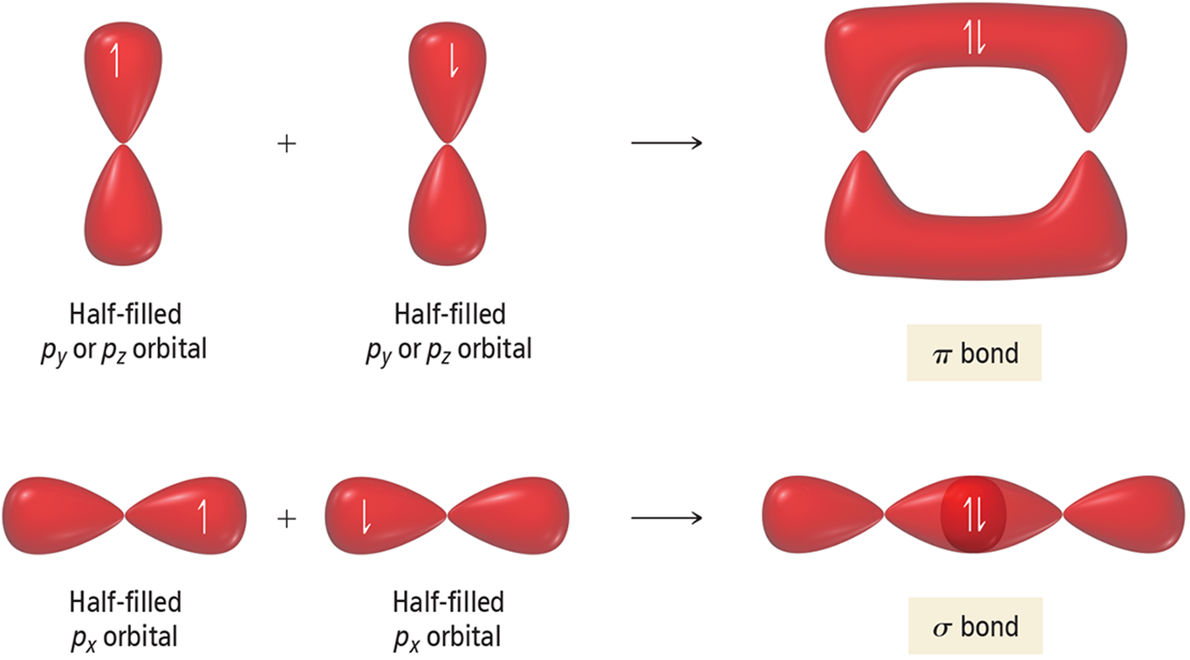
A sigma (σ) bond results when the interacting atomic orbitals point along the axis connecting the two bonding nuclei.
Either standard atomic orbitals or hybrids
A pi (π) bond results when the bonding atomic orbitals are parallel to each other and perpendicular to the axis connecting the two bonding nuclei.
Between unhybridized parallel p orbitals
Rotational Freedom of Bonds
Single bonds (sigma bonds) allow for free rotation, while double bonds (which include both sigma and pi bonds) do not permit such rotation.
Example: Ethane (C₂H₆) displays rotational freedom due to single sigma bonds, while Ethylene (C₂H₄) restricts rotation due to the presence of a pi bond.
Cis/Trans Rotation
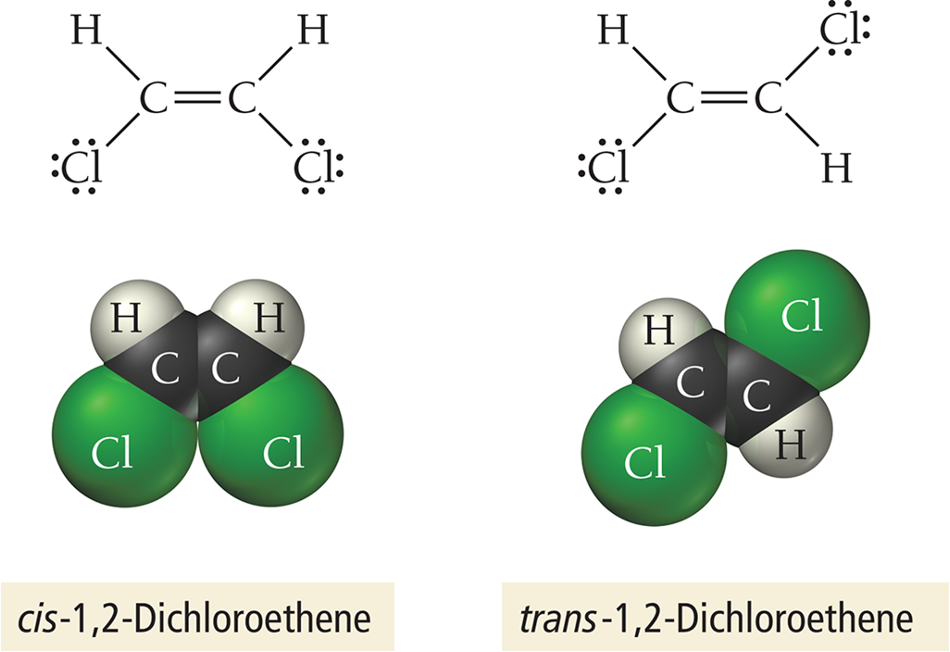
Isomers: Molecules with the same atoms but arranged differently, resulting in different physical and chemical properties.
Cis and trans isomers arise from the restrictions imposed by double bonds.
Cis = same side
Trans = opposite side
SP³D and SP³D² Further Hybridization
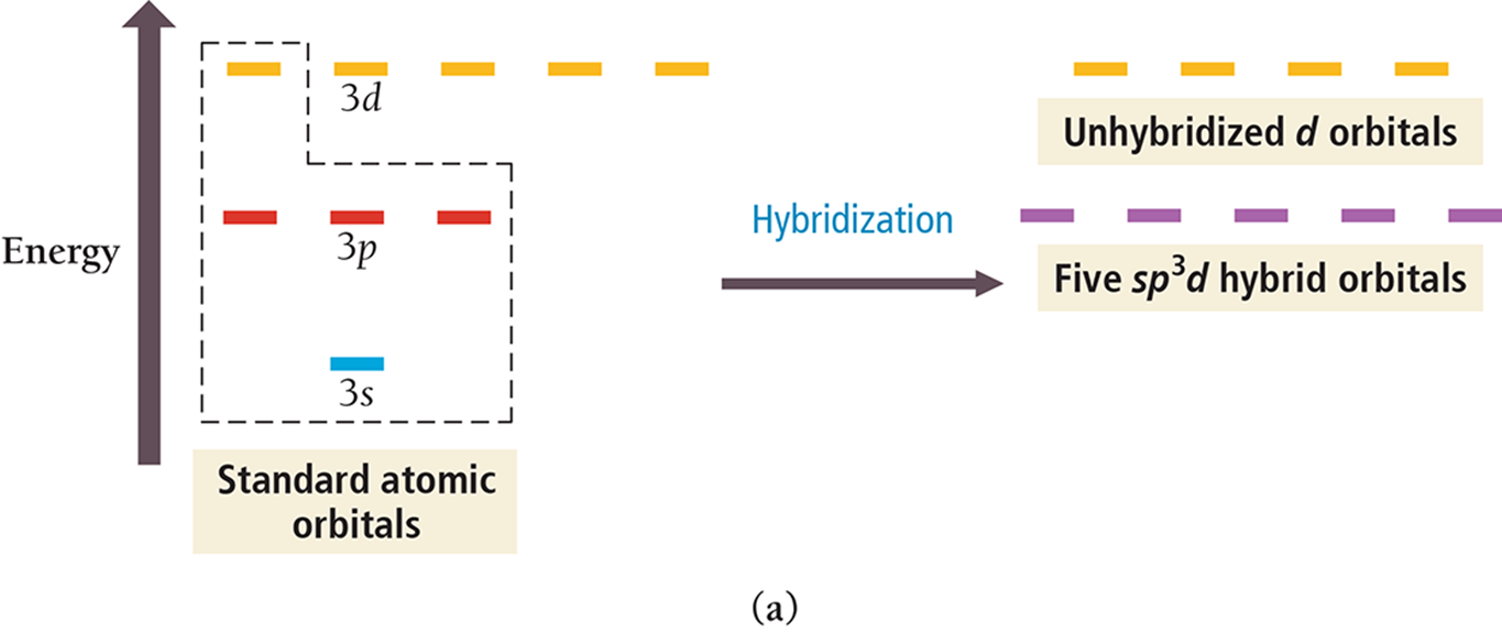
SP³D: Involves the mixing of one s, three p, and one d orbital, resulting in five hybrid orbitals arranged in a trigonal bipyramidal geometry.
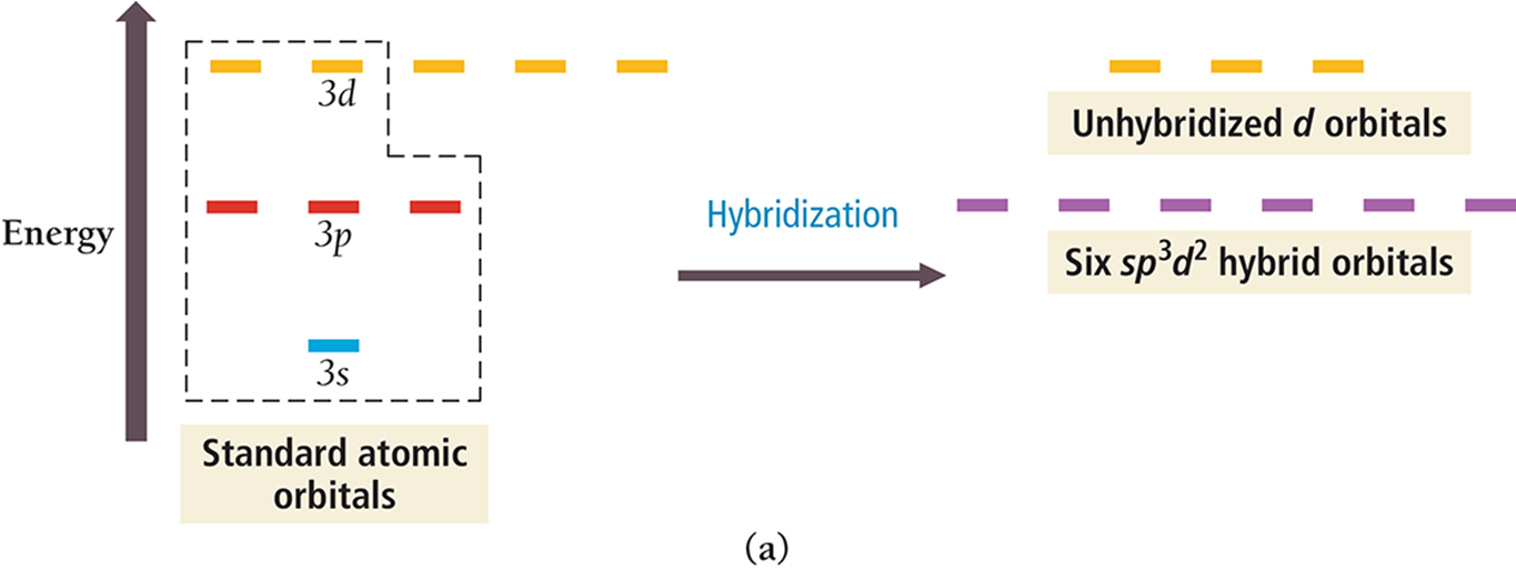
SP³D²: Formed by mixing one s and three p orbitals, leading to four hybrid orbitals which can accommodate complex bonding scenarios.
These hybridizations are applicable for accounting larger geometries not explained well by simpler hybridizations like sp3 and sp2.
In professional opinion, the sp, sp3, and sp2 are more manageable compared to sp3d and sp3d2.
Advanced theories may be necessary to fully understand the significance of higher energy orbitals in hybridization.
Trigonal Bipyramidal Geometry (Seesaw, T-shape, Linear)
Formation of a trigonal bipyramidal structure requires the combination of three p orbitals and one d orbital. SP³D
The presence of higher energy orbitals implies they do not mix well, but are still used for explanations.
Octahedral Geometry (Square pyramidal, square planar)
For SP³D² hybridization, six orbitals fit the octahedral model; formed by mixing 3s, 3p, and 3d orbitals
Hybridization Table
Number of Electron Groups | Electron Geometry (from V S E P R Theory) | Blank | Hybridization Scheme |
2 | Linear | s p |  |
3 | Trigonal planar | s p2 | 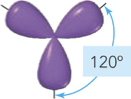 |
4 | Tetrahedral | s p3 | 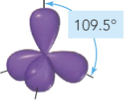 |
Number of Electron Groups | Electron Geometry (from V S E P R Theory) | Blank | Hybridization Scheme |
5 | Trigonal bipyramidal | s p3d | 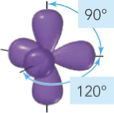 |
6 | Octahedral | s p3d2 | 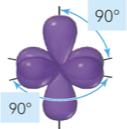 |