Formula Sheet
2d Kinematics
Range Formula:
R = (v₀² * sin(2θ)) / g
Airtime for a Projectile (when launched from ground and landing on level ground):
t = 2v0/g
Time for projectile thrown horizontally (or dropped) off a building to reach the ground
t = √(2h/g)
Distance traveled by dropped object:
h = gt²/2
Time of max height of a projectile launched from ground:
t = v0sinθ/g
Total time of flight of a projectile launched from ground:
t = 2v0sinθ/g (time up = time down, so twice as long as the time to reach max height)
Maximum height of a projectile launched from ground:
h = (v0sinθ)² /2g (rearrangement of vf² = (v0sinθ)² - 2gh)
Complementary Angle Formulas w/ same initial launch speed (from papa fon)
t1/t2 = tan (theta) (theta being the angle of trajectory 1 with respect to the horizontal)
H1/H2 = tan² (theta)
t1 * t2 = 2R/g
Dynamics
Terminal Velocity
UCM
F = Gm1m2/r²
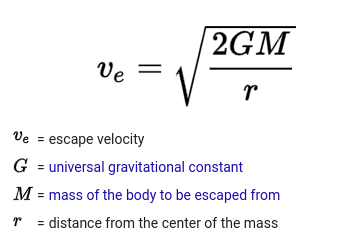
First Escape velocity 7.8 km/s
Second Escape velocity is 11 km/s
Third Escape velocity (escape from solar) 16.7 km/s
Synchronous orbit:
A synchronous orbit is an orbit in which an orbiting body (usually a satellite) has a period equal to the average rotational period of the body being orbited (usually a planet), and in the same direction of rotation as that body.
Kepler’s First Law
All planets orbiting around the sun orbit elliptically
Keplers Second Law
The period for a planet
Orbital Velocity
v = √(GM/r)