Depression : Cognitive Theory
3.1.5
The use of cognitive theory as an explanation of depression, including strengths and weaknesses.
Cognitive theory:
States that behaviour can be explained by looking at how the brain processes information, and therefore how we think.
Beck’s Cognitive Triad
Aaron Beck thought that depression could be explained by three negative thought patterns that people may develop about themselves, the future and the world around them.
These are examples of cognitive biases in the way people think. Things are viewed very negatively and people cannot see the positive aspects of situations.
Beck thought that this negative triad developed from a bad experience in someone’s past. Once they have a negative way of thinking, they are more likely to percieve things that happen to them in an abnormal way.
This leads to them having a negative self schema where a person’s beliefs about themselves is covered in negativity. For example, they may be prone to magnification, which means seeing their problems as far worse than they are in reality.
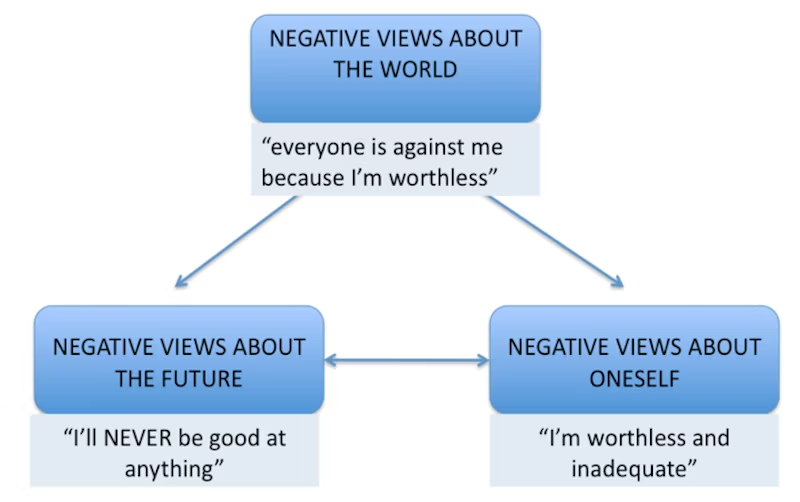
• Beck believed that if a person has all three symptoms of negative view, the it is likely that they have symptoms of depression.
Ellis’s ABC Model
Albert Ellis had a slightly different view to Beck about what caused depression.
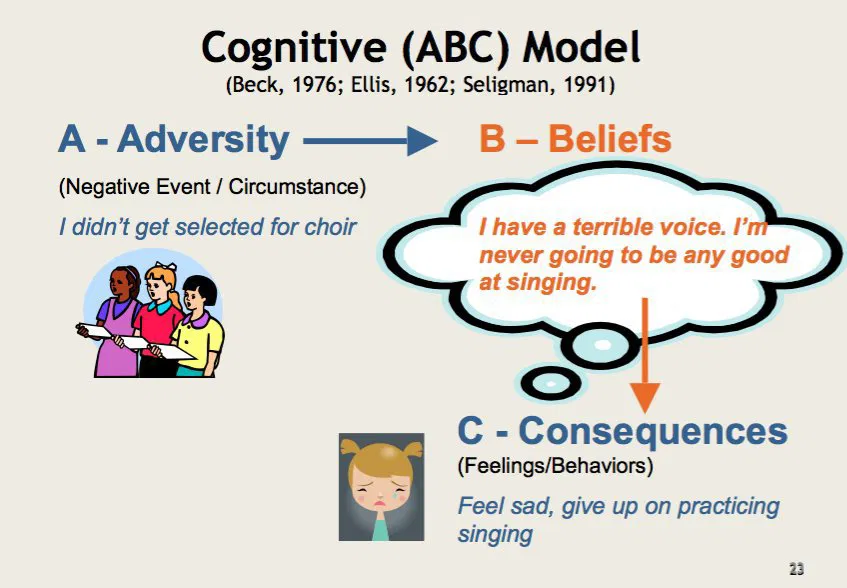
He suggested that there are three stages that might cause a person to develop negative thought processes, which would then lead to them being depressed.
ABC Model
Activating event:
Something bad happens to a person that makes them feel unsettled.
Beliefs
The thoughts that the person associates with the event, such as why it happened, can either be rational (healthy) or irrational (unhealthy).
Consequences
If the person has a rational thought about the event then they will have positive emotional consequences, but if they have irrational thoughts, they will have negative thought proccesses and become depressed.
Strengths and weaknesses of the Cognitive theory explanation
Strengths
• It takes into account the events in a person’s life and the impact it may have on their life. Unlike the genetic explanation, the cognitive theory accepts that there is often an event that triggers deppression.
• It has been applied to therapy and if one of the leading treatments for deppression. CBT can challenge irrational thoughts people have to stop them feeling depressed, reducing the need for antideppresant drugs.
Weaknesses
• It is difficult to tell whether irrational thoughts are a cause of depression or a symptom of being depressed.
• Some cases of depression have a clear activating event (eg: death of a family member) but some types of depression may not be so easily explained by thought processes. For example, something like post partum depression may be caused by a sudden change in hormones, rather than a stressfull life event.