Zoology Quiz
Mandibulates
•Mandibles – jaw-like appendages
•Antennae
•Maxillae
•Other limbs on the thorax AND abdomen
Subphylum Myriapoda (Figure 23.1)
•Terrestrial Mandibulates
•Tracheal arthropods
•Four classes (centipedes, millipedes, pauropods, and symphylans)
•Two tagmata: head + segmented trunk
Class Chilopoda (Figure 23.1)
•3300 spp.
•Up to 30cm in length
•Active predators
Features
•Forcipules – maxillipeds with modified poison claws
•Fang at the end, with a hollow center, through which poison flows
•Poison mostly harmless – though some tropical give a nasty sting
•Flattened bodies – dorsoventrally flattened
•Odd number of trunk segments (15-191)
•1 pair of appendages/segment
•Paired spiracles/segment
Class Diplopoda (Figure 23.1)
•12,000 spp.
•Herbivores/Scavangers
Class Diplopoda
•Cylindrical bodies
•Collum – 1st segment after head legless
•Thoracic segments: 2-4/5, pairs thoracic appendages
•Diplosegments – Two pairs of abdominal appendages/segment
•Also, two pairs of spiracles, ganglia, hearts and sternites
Defensive behaviour
•Since multiple legs – fleeing is not an option
•Numerous defensive behaviors
•1) Thick calcareous exoskeleton on dorsum and sides
•2) Sternites thinner, so tend to coil to protect – hard to pick up
•3) Repugnatorial glands – one pair per segment on back
•4) Produce toxic secretion – oozed or sprayed
•5) Cyanide and various phenols
Subphylum Crustacea
•70,000 spp. Of primarily aquatic animals (mainly marine) and some terrestrial
•11 classes
Features: Segmentation
•Primitively may have up to 60 segments
•Most tend towards tagmatization
•Cephalothorax – much fusion
•Abdomen – less fusion
•May be covered by carapace (dorsal cuticle)
•With much variation
Features: Segmentation
•Primitively may have up to 60 segments
•Most tend towards tagmatization
•Cephalothorax – much fusion
•Abdomen – less fusion
•May be covered by carapace (dorsal cuticle)
•With much variation
3: Molting
•Ecdysis: period of shedding old cuticle and formation of a new one
•Continuous process for preparation of each successive molt
•A series of 4 steps
•1. Intermolt: growth
•2. Early pre-molt: enzymes digest old exoskeleton, Ca removed/stored, and molt prep
•3. Molt: Cuticle splits along growth lines, Exuvium (cast off) leaves behind soft-shelled body, swelling
•4) Postmolt: sclerotization (hardening) and Ca reposition, pump out excess water
Features: Nervous system
•Cerebral Ganglia around Esophagus
•Double Ventral nerve cord (ganglion at each segment)
Features: Sensory system
•Setae – mechanoreceptive or chemo-receptive
•Statocysts – bothopen and closed (organs of balance)
•Eyes: Median or naupliar eyes (seen on primitive crustacean larvae)
•Three pigmented cups +/- sense
•Compound eyes – detect motion and analyze polarized light
•May be on stalks
Class Malacostraca
•Largest class: 12-13 orders
•50% of crustaceans are malostraca
•14 somites on trunk; 8 thoracic and 6 amdominal somites
•Each has a pair of appendages
Features: Chromatophores
•Cover the body of many crustaceans
•Highly branched cells that contain pigment granules
•Red, Blue, Black, Yellow
•1+ pigment per chromatophore
•1+ type of chromatophore per individual
•Varying pigment distribution – color change
Features: the X gland
•Hormones manufactured to control pigment dispersal
•Located in the eye stalks
•Stored temporarily in the ‘sinus’ gland
•Released into the bloodstream as needed
•Pigment dispersal: darker cuticle
•Pigment aggregation: lighter cuticle
Order Decapoda
•Shrimps, Lobsters, crabs, crayfish -> most familiar
•Carapace: well-developed, enclosing branchial chamber
•Legs = many
Order Euphausiacea (krill)
•Carapace: does not tightly enclose gills
•Unspecialized limbs: Biramous thoracic appendages
•Filter feeders: No maxillipeds
•Photophores: light-producing organs
•Distributed in species-specific patterns and function in recognition as well as camouflage confusing predators
Subphylum Hexapoda
•31 orders: 1,000,000 species
•Most numerous and diverse
•3 tagmata (head, thorax, abdomen)
•Appendages mainly on head/thorax
•Unbranched and uniramous
•One pair of antennae, mandibles and 1-2 pairs of maxillae
•Three pairs of legs and 0-2 pairs of wings
•Distribution: flight and size/structure of eggs
•Extreme adaptability
Entognatha (taxonomic designation debatable)
•Primitive wingless hexapods
•Mouth parts recessed in special pouch in head
•Molecular data indicate that they arise from a common ancestor to insects and crustaceans before insects arose
Possible second, independent invasion of land
Separate evolution of hexapods
Thus, they may not be insects
Class Insecta (Ectognatha)
•Mouth parts are outside head
•1,000,000 species in all known environments
External Anatomy
•3 tagmata: Head, thorax and abdomen
•Each body segment has a 4 sclerite plate system
•Tergum: dorsal
•Pleura: two lateral plates (membranous not sclerotized)
•Sternum: ventral
•Spaces between where wings and legs protrude
Ecdysis
•Brief reminder: insect exoskeleton is different to that of the crustacean
•Terrestrial, thus more prone to dessication
•Development of cuticulin (protein rich)
•Innermost layer of epicuticle
•Responsible for sclerotization (tanning) and thus hardening of the exoskeleton
•Procuticle (endocuticle and exocuticle)
Ecdysis in insects
•1) Mature cuticle = intermolt
•2) -4) three different pre-molt stages (early, late and later)
•Apolysis via inactive molting fluid under cuticle, new cuticulin layer under inactive molting fluid, molting fluid activated
•5) Molting: emerging insect already has cuticulin + procuticle, so not ‘soft’, reabsorb molting fluid
•6) Postmolt = cast off
Mechanics of flight: overview
•Revolve upon a complex interaction of muscles in the thorax
•1) The wing is hinged at the thoracic tergum
•2) Thoracic pleurae attach to wing lateral to hinge
•3) Muscle can only actively contract and thus become shorter and squatter
Mechanics of flight: Direct flight muscles
•Paired durect flight muscles
•Attach directly to wing
•From internal ventral aspect of body
•To the wings, lateral to pleura
•Move wings directly by contraction
•Pull wings down “downstroke”
Mechanics of flight: Indirect flight muscles
•Do not attach to the wing
•Attach to other internal aspect of body: tergum and sternum
•Cause wing movement ‘indirectly’ by changing shape of thorax
•- transverse indirect muscles: pull tergum closer to the sternum
•Sides of pleura push against wings
•Lifting wings
•Wings pulled up “upstroke”
•Cockroaches, dragonflies and locusts
Mechanics of flight: the other indirect muscles
-Flies bees and midges
-Only indirect flight muscles
-Perpendicular to each other
-Transverse: raise wings
-Longitudinal: Contract and become short and squat
-Arches tergum
Sensory systems
•Mechanoreceptors
•Ear: tympanic type membrane, receptor cells and air spaces. Membrane responds to vibrations, stimulates receptor cells.
•Arista: Sensory setae on antennae respond to air movements. Movement of hair stimulates nerve at base
•Chemoreceptors
•Peg cells/organs: common near antennae
Metamorphosis
•Metamorphosis: when the young escape from the egg
•Change form postembryologically
•Numerous molts (instars) until adult
•Ametabolous (direct or amorphic development)
•Seen in the most primitive insects
•The other two are direct complete development
•Hemimatabolous
•Holometabolous
Hemimetabolic metamorphosis
•Gradual metamorphosis seen in bugs, grasshoppers and lice
•Egg
•Nymph: several instars. Wings develop externally. Gradual size increases as body proportions change
•Adult: not radially different from previous instars
Holometabolic metamorphosis
•Three different physiological processes which dominate each of the three stages
•1) Growth (larval) – eat a ton
•2) differentiation (pupal) – completely rearrange their body structure
•3) Reproduction (adult) – some feed some don’t but ultimately it is about making the next generation
•Each stage functions as an independent individual: Long time to determine lifecycle
•E.g., butterfly larvae: chewing mouthparts
•Butterfly pupa: non-feeding
•Butterfly adult: sucking apparati
Insect Ecology: Communication
•Chemical signals:
•Pheromones: Signaling conspecifics
•Since they have chemoreceptors…
•Pheromones for mate attraction, trail/territory making, death, and alarm responses
•Backfire: locate prey by smell
•Allomone: adverse effect on prey
Insect Ecology: Communication
•Auditory Signals: Sound production and reception
•1) Stridulation: scraper rubbed over a file to produce a sound
• Grasshoppers and crickets
•Rubbing of hindlimbs
•Auditory signals: Vibration of membrane
•Produces static-like sound (cicadas)
•Aggregate individuals
Special abdominal chitinous plates
•Tactile signals
•Vibrations picked up by sensory setae
•E.g., common wasp hairy face
•Visual signals
•Have photoreceptors, will use
•Colors (butterflies etc.)
•Bioluminescence (fireflies light organs and the transformation of luciferin)
Insect Ecology: Social communities
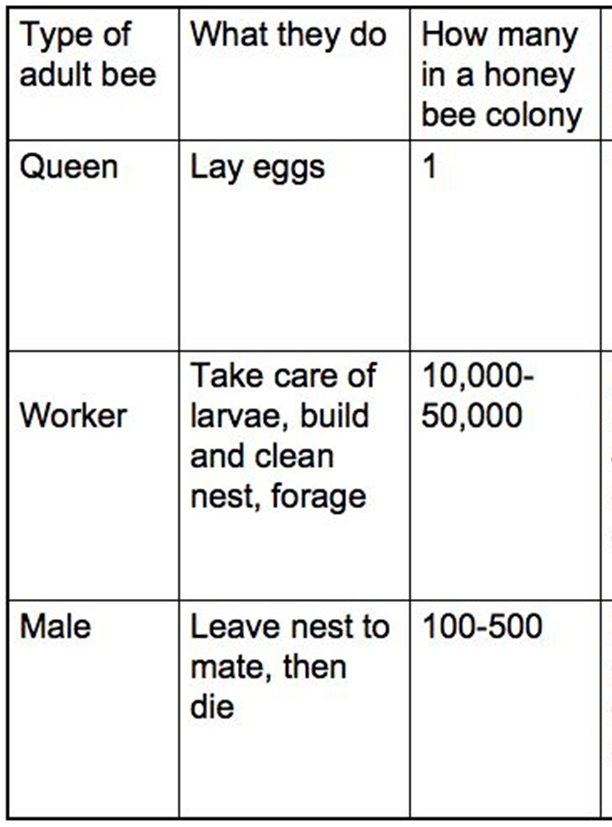
Honey Bee
•Hive size: 60k – 70k individuals per hive
•Continual turnover
•Essentially a superorganism