Electricity
Units to be used:
ampere (A) → unit of electric current, measuring the rate of flow of electric charge in a circuit; 1 A equals 1 coulomb of charge passing a point each second
coulomb (C) → unit of electric charge, representing the total quantity of electricity transferred by a current of 1 ampere in 1 second
joule (J) → unit of energy or work, defined as the energy transferred when 1 newton of force moves an object 1 metre in the direction of the force, or when 1 coulomb of charge moves through a potential difference of 1 volt
ohm (Ω) → unit of electrical resistance, the resistance between two points when a potential difference of 1 volt produces a current of 1 ampere
second (s) → unit of time, used to measure the duration of events or intervals between them
volt (V) → unit of potential difference or voltage, equal to 1 joule of energy transferred per coulomb of charge moved
watt (W) → unit of power, measuring the rate of energy transfer or work done; 1 watt equals 1 joule per second
New unit
Electricity is sold in units of kWhr
This is a unit of energy!
It is the number of J transferred if you run a power of 1kW for 1 hour
1kWhr = 1000W * 3600s = 3600000J
Mains Electricity
Insulation
Plastic coating around wires prevents the electric current from coming into contact with people or other conductors.
Reduces the risk of electric shock and short circuits.
Double Insulation
Used in appliances that do not have an earth wire.
The casing and internal components are both insulated, so no live parts are accessible.
Common in items like hairdryers and phone chargers.
Earthing
Provides a safe path for current to flow to the ground if a fault occurs (e.g. if a live wire touches the metal casing).
Prevents the casing from becoming live and giving an electric shock.
The earth wire carries the current safely away, triggering the fuse or circuit breaker.
Fuses
A fuse contains a thin wire that melts when the current exceeds its rated value, breaking the circuit.
Protects the appliance and prevents overheating or fires.
Reduces the risk of electrical fires as current makes things hot
Must be replaced after it blows.
Always choose the fuse whihc is the lowest value yet still above the operating current
Common fuse ratings: 1A, 3 A, 5 A, 10A and 13 A — chosen based on the current an appliance uses.
Circuit Breakers
Devices that automatically switch off the circuit when too much current flows.
Can be reset after tripping, unlike fuses.
More sensitive and quicker to react than fuses.
Current in a Resistor
When current flows through a resistor, electrical energy is converted to thermal energy due to collisions between electrons and the atoms in the conductor.
This causes an increase in temperature (heating effect).
Useful in appliances like toasters, kettles, and electric heaters, where heat is desired.
Power, Current and Voltage Relationship
power = current × voltage
P = I × V
Using V=IR we can also find power in terms of resistance
P=I power of 2 * R / P= V power of 2/R
Power (watts) measures how quickly energy is transferred.
This relationship is used to choose the correct fuse:
Example: A 1000 W appliance operating at 250 V draws a current of 4 A.
A fuse slightly above 4 A (e.g. 5 A fuse) would be appropriate.
Energy Transferred Relationship
energy transferred = current × voltage × time
E = I × V × t
Used to calculate the total energy used by an appliance over a period of time.
Energy is measured in joules (J), current in amperes (A), voltage in volts (V), and time in seconds (s).
Alternating Current (a.c.) and Direct Current (d.c.)
DC = direct current:
Current always flows the same way around the circuit e.g. using batteries
Cells and batteries supply direct current (d.c.), where current flows in one constant direction.
AC = alternating current:
Current flow back and forth like a wave
Things will work as long as there is a current flowing e.g. main electricity
Mains electricity supplies alternating current (a.c.), where the current continuously changes direction (in the UK, 230 V at 50 Hz).
a.c. is efficient for transmitting electricity over long distances, while d.c. is suitable for portable devices.
Energy and Voltage in Circuits
Resistance and I-V graphs:
Resistance is defined as V/I, voltage/current
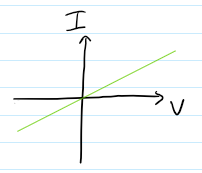
If the graph is a straight line, V/I is constant
If it gets more steep them a small increase in voltage produces a big increase in current
This is known as low resistance
DO NOT mention the gradient
Current–Voltage Relationships in Components
Wires and resistors: current is directly proportional to voltage (obeys Ohm’s law).
The I-V graph is a straight line through the origin and R is constant
This shows that current and voltage are directly proportional to each other
They therefore obey Ohm’s Law which is:
For a metallic conductor, the current through it is directly proportional to the voltage across it, as long as the temperature remains constant.
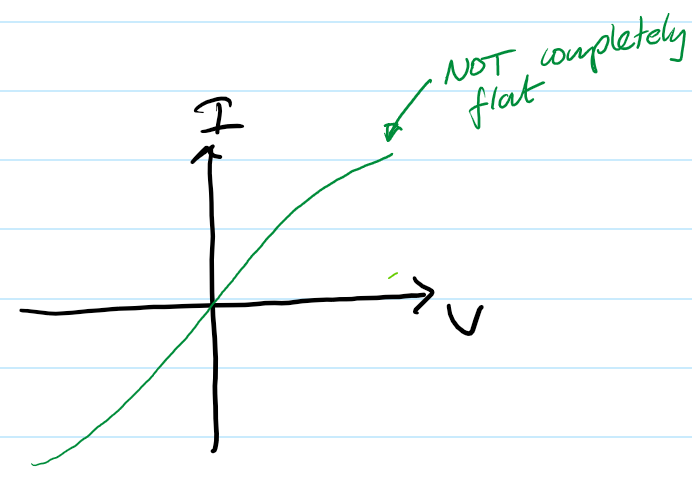
Metal filament lamps: as voltage increases, current increases but not proportionally because the filament heats up and resistance rises.
As the voltage and current increases, the resistance of the bulb increases
The positive ions in the metal filament have gained kinetic energy and vibrate more vigorously making it more difficult for electrons to flow though
This is because the filament gets hot and so the bulb does not obey Ohm’s law
Diodes: current only flows in one direction (after a certain threshold voltage is reached); almost no current flows in the reverse direction.
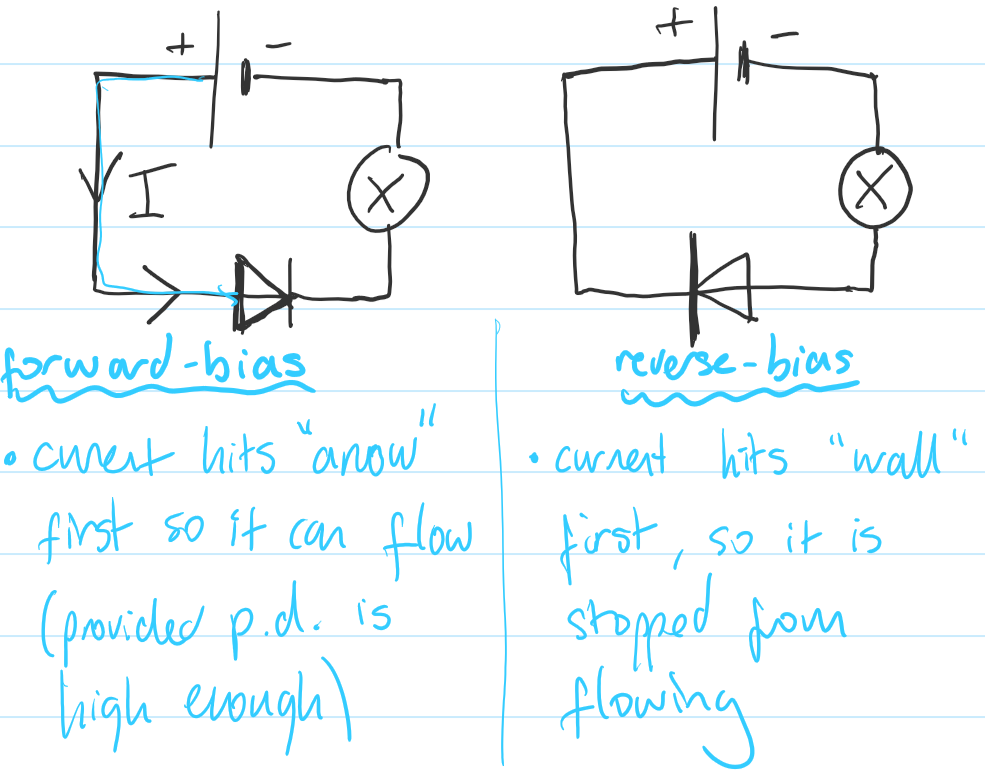
The diode is a semi conductor device whihc acts like a one way valve for current. It only allows current to flow one way thorugh it. It does not obey Ohm’s law. Diodes are useful for converting a.c. to d.c.
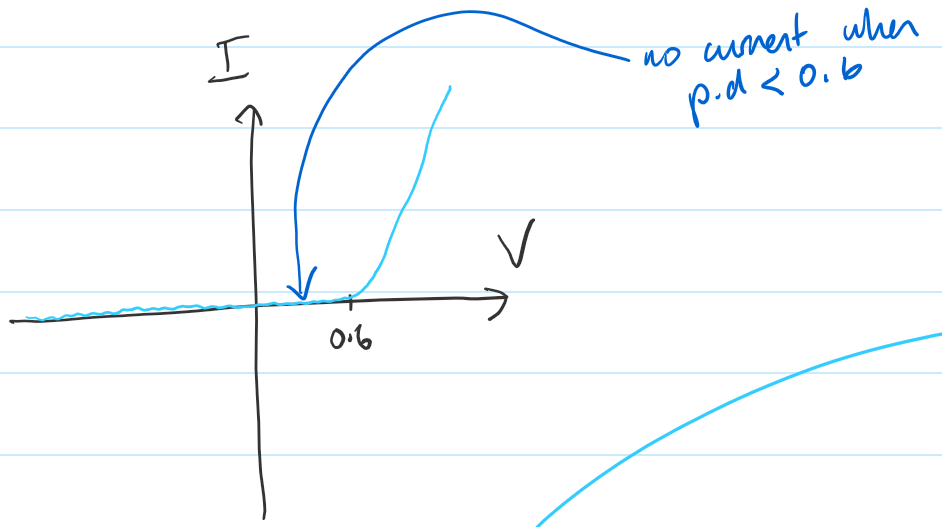
Experimental investigation:
Connect a component in a circuit with a variable resistor, voltmeter, and ammeter.
Adjust voltage and record corresponding current.
Plot a current–voltage (I–V) graph to determine the relationship.
IMPORTANT:
To find resistance from an I-V graph, you just read off the corresponding values of V and I and divide, R = V/I
DO NOT find the gradient of the graph
What is resistance:
Resistance is the link between current and potential difference (voltage)
More resistance means it takes more energy per unit charge to get a current to flow
The unit of resistance is the ohm
1 ohm means it takes a voltage of 1V to get 1 amps of current to flow
If voltage is fixed, then increasing resistance will decrease
If current is fixed, then increasing resistance will increase
Voltage, Current and Resistance Relationship
voltage = current × resistance
V = I × R
Effect of Changing Resistance
Increasing resistance reduces the current for a given voltage.
Decreasing resistance allows a larger current to flow.
LDRs and Thermistors
LDR (Light Dependent Resistor):
Resistance decreases as light intensity increases.
Used in automatic lighting systems.
Thermistor:
Resistance decreases as temperature increases.
Used in temperature sensors and thermostats.
Lamps and LEDs as Indicators
Lamps and LEDs light up when a current flows through them, showing that a circuit is complete and current is present.
LEDs only allow current in one direction and emit light efficiently.
Current and Charge Relationship
Current is the rate of flow of electric charge.
The symbol for current is I and it is measured in Amps (A)
The symbol for charge is Q and it is measured in coulombs (C)
1 Amp = 1 coulomb per second
In metals, current is caused by the movement of negatively charged electrons.
Charge, Current and Time Relationship
charge = current × time
Q = I × t
Converting units:
Time must be in seconds
Current must be in amps
Charge must be in coulombs
One electron is not the same as 1 coulomb! It takes 6×10 power of 18 to get 1 coulomb
Conservation of Current at a Junction
The total current entering a junction equals the total current leaving it.
This is because charge is conserved — it cannot be created or destroyed.
Series and Parallel Circuits
Series circuits have components connected one after another in a single loop.
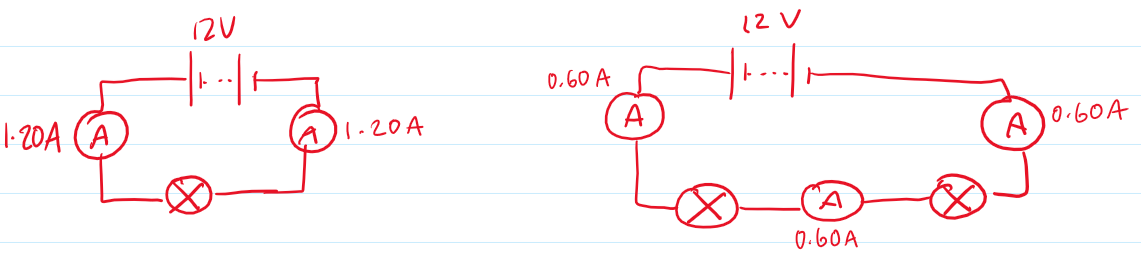
The same current flows through all components.
The total voltage is shared between components.
If one component fails, the whole circuit stops working.
Used where the same current must pass through all parts, such as in some simple warning lights.
Parallel circuits have components connected on separate branches.
Each branch gets the same voltage as the supply.
The total current is divided between the branches.
If one branch fails, others continue to work.
Used in domestic lighting, so each light can be turned on or off independently.
Current in a Series Circuit
The current depends on the applied voltage and the total resistance of the circuit.
Increasing the voltage increases the current.
Adding more components increases total resistance, which reduces the current.
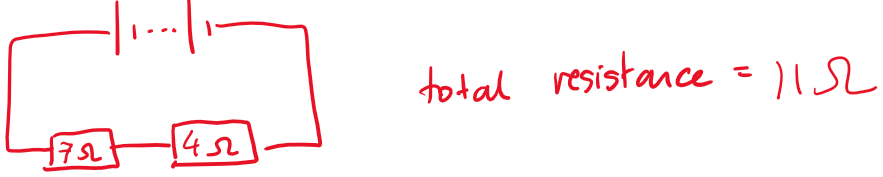
In a series circuit, if more than one resistor or component is converted, the total is just the sum of the individual resistances
Voltage in Parallel Circuits
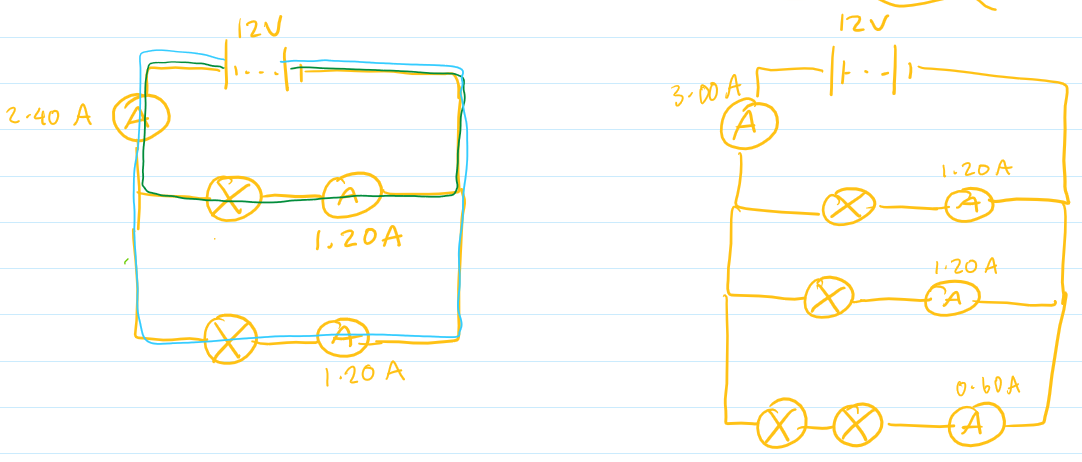
The voltage across all components connected in parallel is the same.
The current on each branch of a parallel circuit may be different but the total current is the sum of the currents on the branches
In a series circuit, the current is the same at all points ina series circuit
Calculations in Series Circuits
The same current flows through each component.
The total voltage is the sum of voltages across each component.
The total resistance is the sum of individual resistances:
R(total) = R₁ + R₂
Voltage and Energy
Voltage is the energy transferred per unit charge passed.
It is better called potential difference
The symbol for voltage is V and it is measured in volts (V)
The symbol for charge is Q and it is measured in coulombs (C)
One volt equals one joule per coulomb (1 V = 1 J/C).
Energy, Charge and Voltage Relationship
energy transferred = charge × voltage
E = Q × V
Converting units:
You must make sure that voltage is in volts
Energy is in Jules
Charge is in coulombs
Staircase circuit:
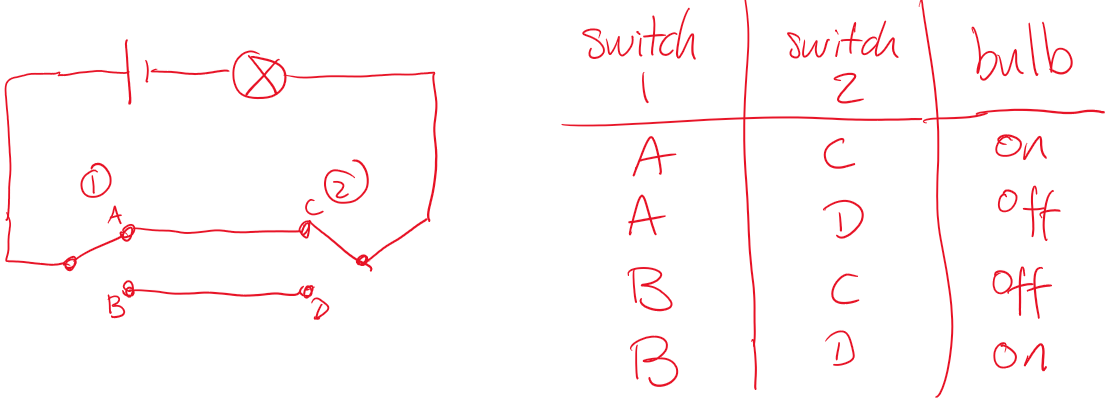
This allows you to operate one light from 2 locations e.g. top and bottom of stairs
Electric Charge
Conductors and Insulators
Conductors allow electric charge (electrons) to flow through them easily.
Common conductors: metals such as copper, aluminium, and gold.
Insulators do not allow electric charge to move freely.
Common insulators: plastics, rubber, glass, and dry air.
Metals conduct because they contain free electrons that can move throughout the structure.
Plastics and other insulators have tightly bound electrons that cannot move.
Charging by Friction (Practical Investigation)
When two insulating materials are rubbed together, electrons can be transferred from one to the other.
The material that loses electrons becomes positively charged.
The material that gains electrons becomes negatively charged.
Example: rubbing a balloon on clothing transfers electrons to the balloon, giving it a negative charge that can attract small pieces of paper.
To investigate experimentally:
Rub different pairs of insulating materials (e.g. polythene and acetate rods) with a cloth.
Bring them near small paper pieces or an electroscope to observe attraction or repulsion.
Production of Positive and Negative Charges
All materials contain atoms made up of protons (positive), neutrons (neutral), and electrons (negative).
Only electrons move during charging — protons remain fixed in the nucleus.
Losing electrons leaves an object positively charged.
Gaining electrons leaves an object negatively charged.
Forces Between Charges
Like charges repel each other (positive–positive or negative–negative).
Unlike charges attract each other (positive–negative).
These forces are strongest when charges are close together.
Electrostatic Phenomena and Electron Movement
Electrostatic effects (such as attraction, repulsion, or sparks) occur due to the movement and imbalance of electrons.
When a charged object is brought near another object, it can induce a charge separation, causing attraction even if the second object is neutral.
A large build-up of charge can discharge suddenly as a spark when electrons jump through the air to balance the charge difference.
Dangers of Electrostatic Charges
Sparks caused by static discharge can ignite flammable gases or vapours.
In aircraft and tankers, friction during fuel flow can create static charge build-up.
Before fuelling, aircraft and tankers are earthed so any excess charge flows safely to the ground, preventing dangerous sparks.
Uses of Electrostatic Charges
Photocopiers:
Shine light through document
It either goes through white or is blocked by black
The light hits the screen and discharges areas
The image appears in the charged bit of the screen
Toner powder (the negative powder) sticks to the positive parts of the screen
Pass the paper over to this
Inkjet Printers:
Ink droplets are given a charge and directed by electric fields onto the correct position on the paper.
This allows precise and fast printing with minimal ink waste.
Electrostatic dust precipitator:
It removes the dust from gas
Soot touched wires and become positive
It is attracted to the plate and sticks
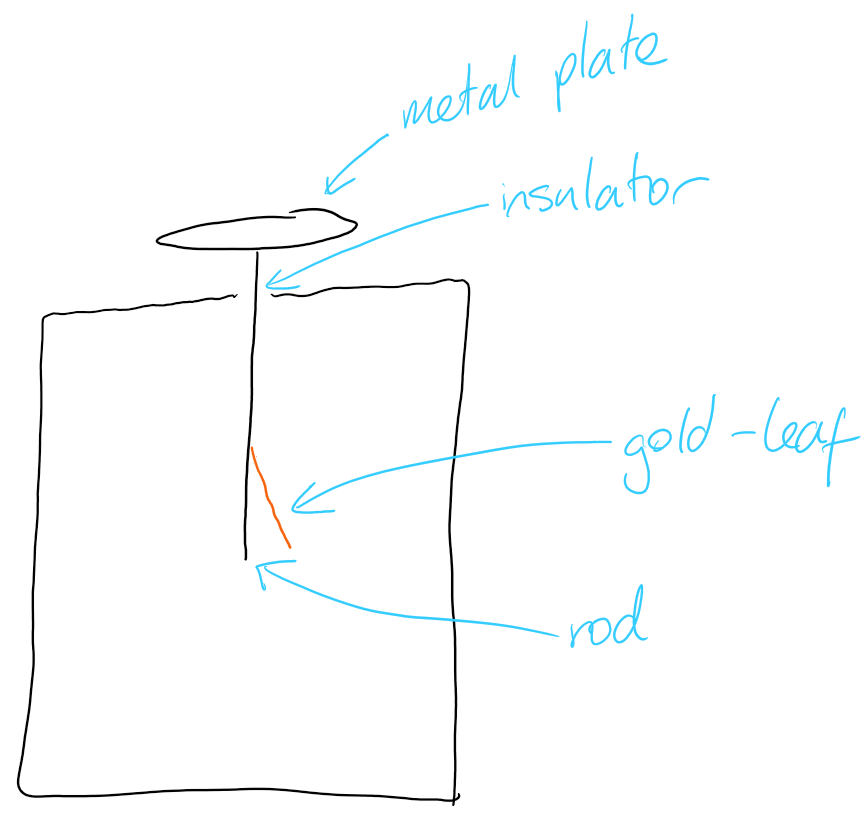
Gold leaf electroscope:
When a negatively charged object is moved close to the metal plate, the electrons in the plate are repelled and have to move to the bottom of the rod and onto the gold leaf
The rod and gold leaf bottle become negative and so they repel
When a positively charged object is moved close to the metal plate, the electrons in the plate are attracted and move to the top of the rod and from the gold leaf.
The rod and gold leaf both become positive so they repel