Movement in and out of cells igcse
Diffusion
Diffusion is defined as the movement of molecules from a region of a higher concentration gradient to a region of a lower concentration gradient.
In diffusion, particles move randomly as a result in their movement down the concentration gradient
- But in living cells, the movement of particles down the concentration gradient will be the same except living cells have a cell which is called cell membrane and it is partially permeable this means that it lets certain substances enter it or exit it.
Diffusion helps living organisms to:
- get rid of excess substances
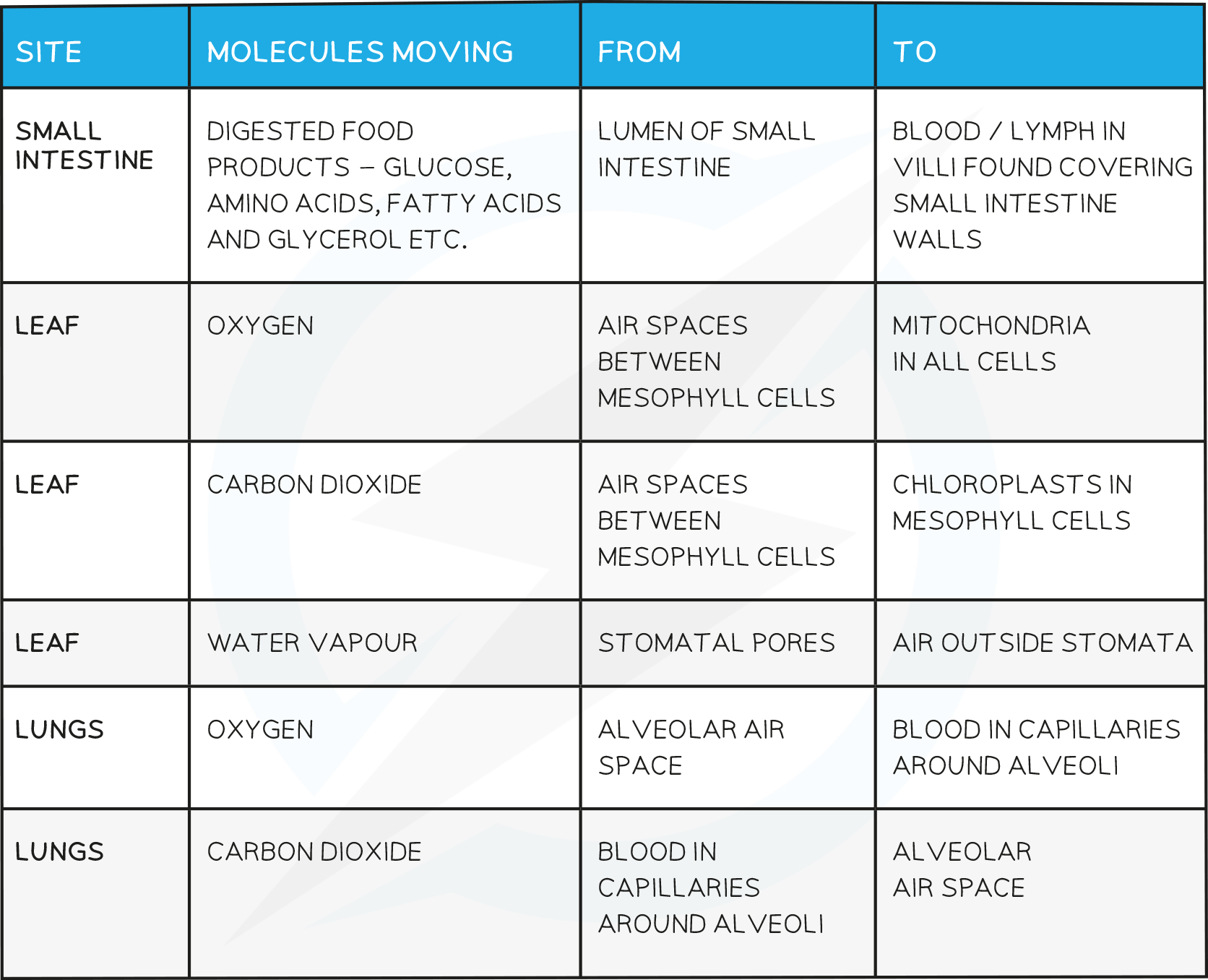
- carry out gaseous exchange for respiration
obtain many of their requirements
Brownian Motion
It is defined as the uncontrolled or random movement of particles as they collide with each other.
Factors which influence diffusion
Temperature
- The higher the temperature the increased the diffusion rate because when the temperature increases particles gain more energy, move faster, and collide more frequently increasing the rate of diffusion
Surface Area to the volume of ratio
- The bigger the cell or cell structure is means that the surface area to the volume of ratio is small thus slowing down the diffuse rate
- Cells which are adapted for the diffusion process have an increased surface are in some sort of way example: root hair cells in plant and cells lining the ileum in animal cells
Distance
- The closer the distance of the particles the increased the diffusion of rate due to the distance being close so particles can travel faster
- This is why blood capillaries and the alveoli are only one cell thick to ensure that the diffusion between them occurs as fast as possible
Concentration gradient
- The greater the difference of concentration in either sides of the membrane states that the movement between particles would be as fast as possible.
Osmosis
Osmosis is defined as the movement of water molecules from a region of a higher water potential to a region of a lower water potential through a partially permeable membrane down its concentration gradient.
- Since the cell membrane is partially permeable it only allows small molecules to enter inside it and not big molecules
# Osmosis Experiments
### Immersing plant cells into solutions of different concentration
- The most common osmosis practical experiment is the cutting of a root vegetable in cylinder shape then placing them into sucrose and distilled water solution of increasing concentration
- Before doing that, you're supposed to weigh the root vegetables
- After doing the first step, you’re supposed to add the root vegetable in the solution for 20 to 30 minutes then drying the root vegetable to remove excess waste and taking it out of the can to weigh it once again
### If the plant gains mass:
- it means that water has moved into the plant tissue from the solution by osmosis
- the solution the water was placed in was more dilute than water itself.
### If the plant loses mass:
- it means that water must have moved out of the plant tissue from the solution by osmosis
- the solution which water was placed in was more dilute than the plant tissue
### if the plant doesn’t loss nor gain mass:
it means that no net movement has happened as water,the plant tissue, and the solution must have equal concentration
Osmosis in plant cells: Core
When water enters the cell, the cell vacuole gets bigger pushing away the cell membrane against the cell wall
- It also makes the plant rigid and firm
- and this important for the plant because it gives the plant support and strength other wise the plant would have wilted
- But the pressure in the cell wall stops to much water from entering thus preventing the cell from bursting but in human cells there isn’t any cell wall so if there would be a pressure on the cell it bursts because there is no cell wall for cell protection.
## Osmosis in plant cells and Animal cells : Extended
If plant cells are placed in a concentrated solution( which has a lower water potential than the plant cell itself),water molecules will move out of the cell by osmosis making the cell flaccid
- When looking at the flaccid plant cell under a microscope, it will look plasmolysed as the cell wall has been separated away from the cell membrane
### Osmosis in animal cells
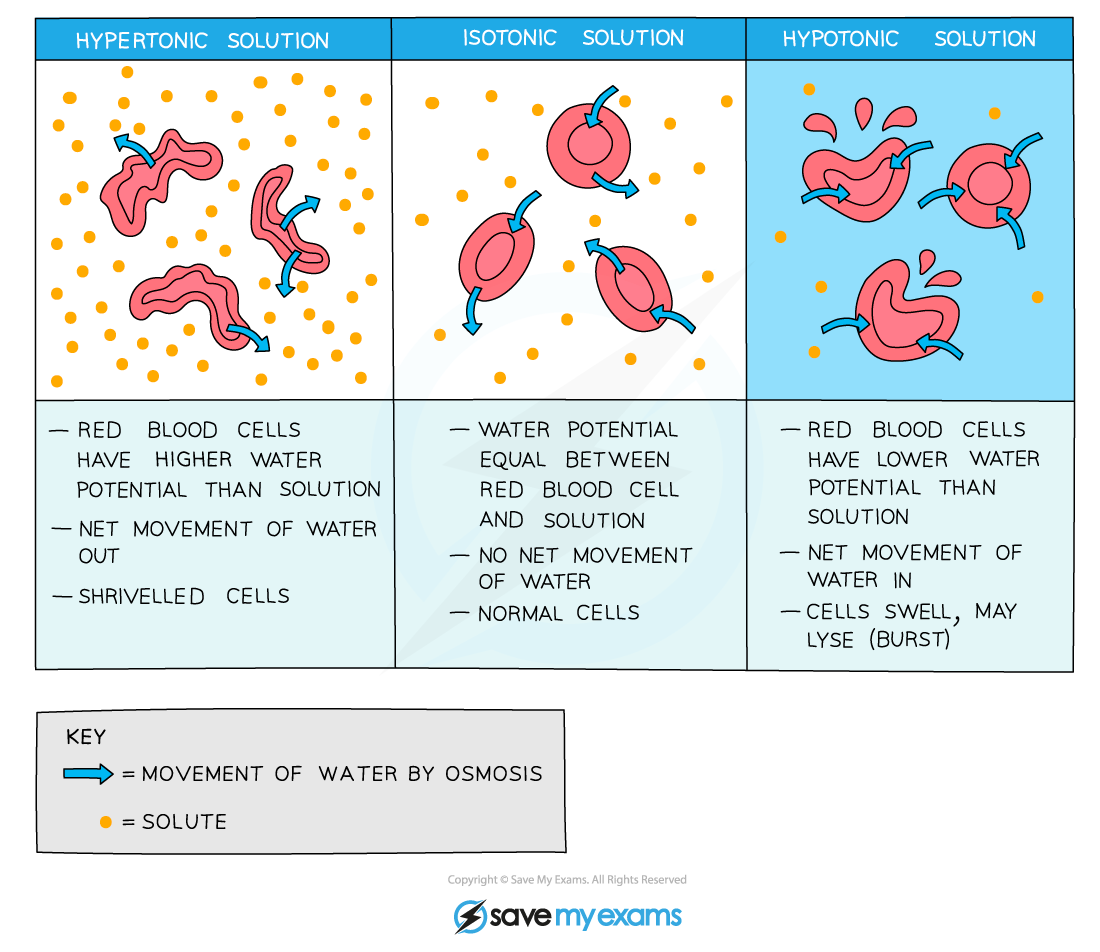
- If an animal cell is placed into a strong sugar solution (with a lower water potential than the cell), it will lose water by osmosis and become crenated (shrivelled up)
- If an animal cell is placed into distilled water (with a higher water potential than the cell), it will gain water by osmosis and, as it has no cell wall to create turgor pressure, will continue to do so until the cell membrane is stretched too far and it bursts
ACTIVE TRANSPORT
Active transport is defined as the movement of molecules from a region of a lower concentration gradient to a region of higher concentration gradient using energy from respiration.
- Energy is needed because particles are being moved against a concentration gradient, in the opposite direction from which they would naturally move (by diffusion)
- Active transport is vital process for the movement of molecules or ions across membranes