IB Psychology all content
Unit 1: Research methods and data interpretation
1.1 What is psychology?
What is a scientific study?
Should be based on empirical evidence
Should be falsifiable
Possible for a psychological theory to be proven wrong
Should be a history of independent attempts to test the theory or replicate the study
What is the difference between behavior and mental processes?
Psychology is the scientific study of behavior and mental processes
Behavior
Everything that can be registered
Overt actions, gestures, facial expressions, verbal responses, endocrine reactions, etc.
Mental processes
Invisible
Attention, perception, memory, thinking
1.2 Research methods in psychology
Quantitative research
Numbers
Numerically expressed laws that characterize behavior of large groups of people
Operates with variables
Constructs
Any theoretically defined variable
Eg: Violence, aggression, attraction, memory, attention, etc
Can’t be directly observed
To enable research, constructs need to be operationalized
Operationalization of a construct
Expressing it in terms of observable behavior
To operationalize anxiety you might look at the level of cortisol in the bloodstream
3 types of quantitative research
Experiment
Includes one IV and one DV
Other variables are controlled
IV is manipulated by researcher
DV expected to change as the IV changes
Key to determining causality in psychology
Cause-effect relationships
Correlational study
Researcher does not manipulate any variables
Variables are measured and the relationship is quantified
Quantitative descriptive study
Relationships between variables are not investigated
Variables are approached separately
Ex: Public opinion survey, questionnaires
Can be used as a research method or a data collection tool
Qualitative research
In-depth study of a particular phenomenon
Goes beyond what can be objectively measured and quantified
Methods
Interviews or observations
Research methods
Interview, observations, case studies
Subjective
1.3 Analysing research (methodological consideration)
Generalizability and sampling
Generalizability
The extent to which we can generalize the results of a research study beyond the study itself.
Sampling
The process of finding and recruiting individuals for the study
3 aspects
1: Generalizing to larger groups
Quantitative: Population validity
High if the sample is representative of the target population
Qualitative: Inferential generalizability
Similar idea
2: Generalizing to other contexts
Quantitative: ecological validity
The extent to which results of an experiment may be applied to natural, real-life settings
Qualitative: Transferability
The extent to which we believe that that finding of a qualitative research study can be applied to a different, but similar context
3: Generalizing to theoretical constructs and conclusions
Quantitative: Construct validity
The extent to which we believe the study “measures” our hypothesized theoretical construct and not something else
Qualitative: Theoretical generalizability
Similar idea
Credibility and bias
Credibility
The degree to which the results of the study can be trusted to reflect reality
High if it is shown that potential sources of bias were, to the best of our knowledge and abilities, controlled or eliminated
Internal validity
The level to which we are confident that the independent variable affected the dependent variable
Compromised when variables are not controlled
High if we believe that it is the manipulation of the IV, and not something else, that led to the change in the DV
1.4 The experiment
Confounding variables
Variables that can potentially distort the relationship between the IV and the DV
Contribute to bias
Need to be controlled
Elimination or kept constant in all groups
Sampling in the experiment
Random sampling
Equal chance of being selected
Pro: High external validity, controls bias
Con: Requires full population list, not practical and time consuming
Stratified sampling
Divided into subgroups based on a shared characteristic
Random selection
Pro: High external validity
Con: Complex and time consuming
Opportunity samples
Based on availability
Pro: quick, cheap
Con: Biased, low external validity
Self selected samples
Response to ads, posts, or public notices
Pro: Convenient and quick
Con: Biased, low external validity
Experimental designs
Independent measures design
Random allocation of participants into groups and a comparison between these groups
One condition
Matched pairs design
Where researchers match participants by characteristics and assign them to different groups.
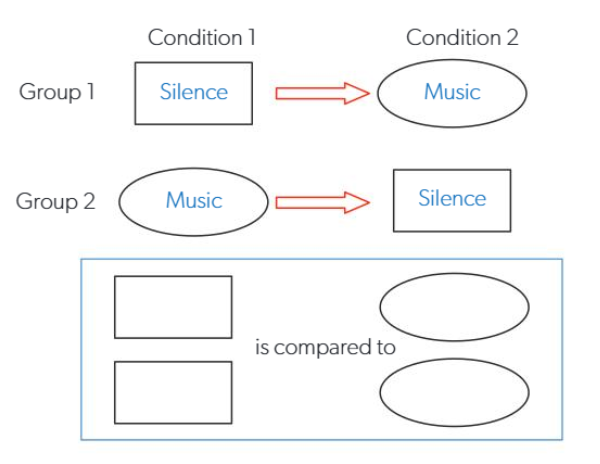
Repeated measures design
Used when the goal is to compare conditions rather than groups of participants
The same group of participants is exposed to two or more condition
Vulnerable to order effects
Results may vary depending on which condition comes first
Happen due to practice or fatigue effects
To overcome, researchers use counterbalancing
Using other groups of participants in which the order of the conditions is reversed
Types of validity
Construct validity
If the measure truly measures the theoretical construct its supposed to be
The extent to which the operationalizations reflect the construct
Internal validity
The extent to which we are positive the IV caused a change in the DV
External validity
Population validity
The extent to which we can generalize the findings to the wider population
Ecological validity
The extent to which we can generalize the findings to real-life settings
Bias in experimental research: threats to Internal validity
Selection bias
Happens if groups are not equivalent at the start of the experiment
Allocation was not random
Maturation bias
Participants go through natural developmental processes, such as fatigue or simply growth.
Testing effect
Participants become used to the format of the experiment therefore perform better
Experimental mortality
Some participants may drop out during an experiment, which makes the groups non-equivalent
Demand characteristics
Clues in experiments that lead participants to guess the purpose of the study, therefore changing their behavior accordingly
Expectancy effect
Do what they want
Screw you effect
Do your worst on purpose
Experimenter bias
Researcher unintentionally has an influence on the results of the study
Countermeasure
Double-blind designs:
Information that could introduce bias is withheld from both the participants and the people conducting the experiment
True experiments, quasi experiments, and non-experiments
True experiments
Participants are randomly allocated to conditions
IV causes change in DV
Quasi experiments
Participants are not randomly allocated to conditions
Can’t draw conclusions of causality
IV is not manipulated by the researcher
Non-experiments
Pre-existing conditions
Male vs female, Canadian vs Chinese
Imperfect experimental controls
IV not manipulated by researched
Groups are not equivalent
Able to determine generic correlation but not cause and effect
No treatment applied to either group
Natural experiments
Can be seen as quasi-experiments
Experimental manipulation occurs naturally and has not been caused by researcher
Example
How television affected children when it was first introduced on St. Helena Island in mid 1990’s
Laboratory experiments and field experiments
Laboratory experiments
Participants invited to a specially designated venue where the study is conducted according to a standard script, in well controlled conditions
Potential confounding variables are controlled as much as possible
Experimental conditions are standardized, so that each participant goes through exactly the same procedure in the same circumstances
Participants know they are taking part in a study
High internal validity
Low ecological validity
Field experiments
Conducted in real life setting
Researcher manipulates IV, but since participants are in their natural setting, many extraneous variables can’t be controlled
High ecological validity
Less control over potential confounding variables
Low internal validity
1.5 Correlational studies
What is a correlation
Examines relationship between 2 or more variables
Positive correlation: Both variables are affected in the same way
As x increases, y does too
Negative correlation
X decreases, y too
Zero correlation
No relationship between variables
No cause-effect relationship can be determined
Correlation
Measurement of the extent to which pairs of related values of 2 variables tend to change together or co-vary
Curvilinear relationship
Relationship between 2 variables where as 1 variable increases, so does the other, but only up to a certain point, after which, as 1 increases, the other decreases
Unit 2: Learning and cognition
2.1 Classical and operant conditioning
Classical conditioning
Ivan Pavlov
Physiologist who conducted well controlled experiments with dogs
Unconditioned stimulus
Environmental stimulus that is biologically potent
Taste of food
Conditioned stimulus
Environmental stimulus that is neutral and that by itself doesn’t produce any biologically predetermined reaction
Sound of a bell
Unconditioned response
Reflex response to an unconditioned stimulus
Dog salivating at sight or smell of red meat
Pavlov’s idea
If you repeatedly present the meat (US) and the bell (CS) several times, you will be able to remove the meat and the dog will salivate at the sound of the bell
Conditioned response
Generalization of stimulus
When an organism, after being conditioned, starts to respond with this behavior to other similar stimuli
Dogs still salivated at the sound of a buzzer after being conditioned to a bell
Operant conditioning
A learning process in which an association is made between a behavior and its consequence
Reward or punishment
Thorndike’s law of effect
Behaviours are a result of their consequences, either satisfying or discomforting
Reinforcements
Positive
Reward is given
Rat gets food after pressing a lever
Negative
Bad thing is removed
Loud unpleasant noise stops when rat presses a lever
Punishments
Positive
Negative consequence is introduced
Electric shock
Negative
Good thing is removed
No video games if you misbehave
Extinction
A previously conditioned behavior isn’t punished or reinforced anymore
Behavior gradually becomes less and less probable
Study of operant conditioning: superstition in pigeons
Skinner 1948 experiment to investigate superstition in pigeons
Used 8 pigeons that were brought to an experimental cage for a few minutes each day
Kept pigeons hungry
Cage had a food dispenser mechanism attached that would swing into place at regular intervals
Birds got food no matter what they were doing, so Skinner hoped that whatever they were doing when they got food, would be reinforced
In 6/8 cages, responses were clearly defined
The bird behaves as if there was a causal relation between is behavior and getting food, when there isn’t
Applications of operant conditioning
Skinner is referred to as a “radical behaviorist”
He took the idea of control to its extreme
Radical behaviorism
Belief that even the most complex human behavior could be reduced to operant conditioning and therefore potentially controlled
2.2 Schema theory
What is a schema?
A mental representation that is derived from prior experience and knowledge
Schema theory suggests that cognitive schemas influence the way we interpret information around the world
Accommodation process
Adjusting the existing schema to better fit the environment
Assimilation process
Adjusting the reality to better fit the existing schema
Schemas are resistant to change, and accommodation will only occur if assimilation fails
A construct, and cannot be observed directly in behavior
infer its existence by observing the effects it has on other processes
Can make us biased by creating distortions in our perception and memory
Make it possible for us to efficiently process information that we encounter everyday, saving us time and energy.
Kinds of schemas
A script
A schema of events
A mental representation of the typical course of actions involved in performing some activity
Bartlett (1932)
Experiment that proved memory is an active, reconstructive process rather than a literal recording of events
Presented British participants with a Native American folktale and asked them to recall it after a certain amount of time by memory.
2.8 Environmental influences on cognitive processes
Unit 3: Human development
History of child development
Premodern europe
Children viewed as miniature versions of adults, expected to behave, dress, and speak as adults ASAP
Tabula rasa
Blank slate
John Locke
Describes human mind at birth
Children not born with predetermined traits
Instead all knowledge and understanding comes from experience
All disproved
Rousseau naturalistic theory
Argued that children learn best through individual explorations and discovery
Intelligence testing
Alfred Binet
Developed one of the first standardized intelligence tests to measure cognitive processes
Sigmund Freud
One of the first major theorists to propose that early childhood experiences have a profound and lasting impact on personality and behavior in adulthood
Many of his ideas aren’t supported nowadays but deeply motivated scientists and was based off many theories
Freudian psychological development stages
Oral stage
Birth to 1 year
Erogenous zone: mouth, part of body used to learn
Anal stage
1 to 3 years
Erogenous zone: bowel and bladder control
Phallic stage:
3 to 6 years
Erogenous zone: genitals
Latent stage:
6 to puberty
Libido machine
Cognitive revolution
Jean Piget:
Founder of cognitive development theory
Proposed that children go through four universal stages of thinking
Stage 1:
Sensorimotor: (0-2 years)
Learning through senses and actions
Stage 2:
Preperational: (2-7 years)
Using symbols and language
Stage 3:
Concrete operational (7-11 years)
Logical thinking about concrete events
Stage 4:
Formal operational (12+ years)
Abstract and hypothetical thinking
Theory still used in education, not each age is the same but the same stages happen
Post WW1
Children’s education became much more important
Starting viewing education as a holistic process
Emotional, social, cognitive development
Modern neuroscience
Advances in neuroscience have revolutionized the study of child development, providing biological explanations for many processes that early theorists could only describe in abstract terms
Technologies like brain scans allow researchers to observe cognitive processes, how the brain grows, forms connections, and responds to experience
Deepened understanding of how early experiences, both positive and negative, shape brain architecture
The battle
Cognitive development depends on a dynamic balance, almost a battle, between neuroplasticity and maturation
Neuroplasticity
Allows the brain to form new connections based on experience
Strongest early in life and essential for learning basic cognitive skills like attention, perception, and memory
Maturation
Stabilizes and strengthens neural networks
Prunes unused connections and myelinates major pathways, increasing speed and efficiency
As the brain matures, it becomes less capable of large scale reorganization
Finding the right balance between flexibility and stability to build a well functioning mind
Maturation vs Neuroplasticity
Maturation
Recovering from brain trauma
Left hemisphere of the brain controls most language functions
Reading, speaking, understanding
When damaged in adults, it often causes aphasia
However children’s brains recover more effectively because of their neuroplasticity
Brain scans show that a child’s right hemisphere takes over language functions, something that almost never happens in adults
Studies of trauma and deprivation
Main critical period for cognitive development is between 0-3 years
Period is characterized by a rapid increase in synapses in the cerebral cortex, a process called synaptic exuberance
What is going on in our brains in the first few years and where most synaptic connections are happening
Corresponds with hand-eye coordination, learning to walk, crawl, etc
If a behavior or cognitive skill must develop during a critical period , it was believed that it never developed in cases of extreme trauma or deprivation
Most children are able to develop these skills even though they may show delayed development
Romanian orphan study
After the fall of communism in Romania, there were a bunch of kids living in poor conditions in orphanages.
The world reached out and many people in the UK for example, adopted children
Rutter investigated the effects of early deprivation on development by studying 144 Romanian children adopted by UK families and 52 British adoptees who had not experience deprivation
Children were grouped by age at adoption:
Less than 6 months
6 months
2 years
more than 2 years
They were assessed at ages 4, 6, and 11, on physical and cognitive development
The longer children spent in institutions, the greater their cognitive and physical impairments
12% of those institutionalized for 6-24 months and 36% of those institutionalised for more 24 months showed significant cognitive deficits
Many showed poor physical growth and attention difficulties
Children adopted before 6 months showed normal development by age 4, similar to UK adoptees
Rutter found a dose-response relationship
The longer the deprivation, the greater the lasting impact on development.
Early adoption allowed for near complete recovery
3.1 Brain development
Biological processes of brain development
Neurogenesis (birth of neurons)
Production of new nerve cells
Mostly finished during gestation period
Before leaving the womb
The cortex actually over produces neurons to account for normal cell death in the future
Migration
Happens 9 weeks after conception when neurons start to migrate to their “correct positions"
They travel along special glial fibres that form early in the fetal brain and extend from the brain’s inward structures to the cortical layers. The neuron climbs along the fibre like a snake on a tree trunk
Neuronal growth in the brain cortex happens layer by layer
“inside out”
Experience-expectant neuroplasticity, pruning, and critical periods
Critical periods
Brief developmental windows of opportunity when experience can influence development
Brief window of time for language abilities to be developed in early childhood
If the window is missed and the child is deprived of language and communication it will be nearly impossible to acquire a language ability later on
Sensitive periods
Broader, more flexible window when the brain is especially responsive to certain experiences, but learning can still happen later, just with more difficulty
Early cognitive functions: Sensory integration and attention
Experience tunes visual-spatial attention and working memory capacity
Parietal and occipital cortices mature early
Middle childhood: memory and learning systems
Critical period for declarative memory development
hippocampus maturation
Experience strengthens encoding, storage, and retrieval pathways
Enriched environments enhance hippocampal growth and spatial memory in children and animals
Trauma can lead to lack of hippocampal development or atrophication
Adolescence: Executive function and reason
Prefrontal cortex continues to maturing into early adulthood
Sensitive period for executive functions
Planning, impulse control, abstract reasoning
Experience refines neural circuits for cognitive control
Lack of development means poor impulse control, social and behavioral challenges
Why does it matter?
Education
Importance of stimulating environments and varied experiences.
Means that there are optimal periods for developing certain skills, such as language learning
Clinical
Early intervention in attention, learning, or memory disorders means that there is a greater chance of improvement
Research
Psychologists are attempting to reopen critical periods
Could help to reverse attention, learning, or memory problems, and potentially open the possibility to improve skills in language or music
3.2 Stage theories and continuous models of human development
Stage theories
Development happens in distinct qualitative stages
Children move through these specific stages in a fixed order and must complete one stage before moving to the next
Continuous theories
Skills build steadily over time without sudden leaps
Development is more like a smooth increase in ability or knowledge over time
Not everyone experiences development the same way
The arguments for and against stages of development: an overview
Continuity
Human development is relatively gradual, stable and incremental
Stages are not clear-cut, blurred boundaries between them
Huge individual differences in when and how people mature, and the importance of such differences outweighs the significance of any common patterns in this process
Development is also influenced by the environment
This influence is more important than genetic information
Discontinuity
There are distinct stages of development
Periods of radical change between stages and periods of relative stability between them
There is a set sequence of stages
People always progress from one stage to another and can never skip a stage
All people move through the same stages in the same sequence at approximately the same time
Stages are influenced by the process of biological maturation of the brain
You cannot move to the next stage of development if your brain is not sufficiently mature, if certain biological structures haven’t been formed
Jean Piaget’s theory of cognitive development
Jean Piaget
Clinical psychologist
Famous for the first theory of cognitive development
Created stage theory
His ideas are referred to as Genetic Epistemology
Piaget’s theory
Children develop progressively in a series of stages that are related to age
Sensorimotor stage
From 0-2 years
Children’s reasoning is driven by movement and sensation
Looking, touching, and grasping
Begin to develop intentional behavior and begin to understand cause and effect relationship through repeated interactions
Toddler shakes a rattle, it makes interesting sound, they shake it again
Object permanence
Understanding that objects exist even when outside perceptual field
Gain this understanding from 8-12 months
Problem is that staring at it doesn’t necessarily reflect understanding
They might stare longer at an “impossible” event because its just unusual, attention-grabbing, or confusing, not because they have a true concept of object permanence
Cognitive egocentrism
Inability to understand other people’s viewpoints
Pre-operational stage
From 2-7 years
Children engage in a lot of playing and pretending
Pretend a stick is a spoon, a box is a house, etc.
Children are not manipulating objects as such, instead they play with meanings associated with these objects
Child is still not capable of operations
Performing a task mentally in the absence of the physical object or a drawing or picture of it
Irreversibility
Child is unable to mentally reverse a sequence of events
Water conservation task
Lack of conservation
Conservation:
Physically, an object remains the same even when its appearance changes
Children at this stage don’t understand this
Water conservation task
Egocentrism
Children overcome it by the end of this stage
Three mountain task
Child is shown a 3D model of three mountains
There are features that are only visible from certain angles
Interviewer asks the child to describe what the interviewer can see from their POV, and the child is unable to say what the person saw from their POV and only said what the kid saw.
Policeman task
Children try to hide a toy person from two toy police
Requires less complex spatial reasoning, making it easier for kids to demonstrate perspective
Concrete operational stage
From 7-11 years
Children are no longer egocentric
Begin to solve problems logically
Can only solve problems that apply to concrete events or objects
Thorough development of inductive reasoning
Drawing inferences from observations
Still struggle to reason deductively
Acquire mental reversibility
Can understand relationships between mental categories
If a dog is an animal, then some animals are dogs
Conservation tasks are passed successfully
Seriation
Order things by characteristics
Classification
Separating things by characteristics
Formal operational stage
11-16 years
When children develop abstract thought
Reason about hypothetical situations
Formation of metacognition
Thinking about thinking
Adolescents become capable of deductive reasoning
Piaget’s theory was groundbreaking in developmental psychology
Introduced the world to the idea that children’s intellectual development is a series of milestones
Established a tradition of measuring development in a range of carefully designed tasks
Asserted existence of developmental stages
Challenging the idea of stages: individual differences
Piaget’s research suggested the existence of clear-cut stages in cognitive development
The idea of stages of cognitive development rests on one important assumption
Variations between age groups are larger than variations between individuals from the same group
Developmental unevenness
Individual variations in the rate of development
There are a variety of factors that. may affect the individual’s progression through stages
Modifying task difficulty affects performance
Modifying task content affects performance
Having minor variations in procedure
Pace of development can vary in different children, different cultures, and different learning environments
Conceptual analysis
Perspective
Stage theories traditionally rest on the assumption that cognitive development is driven by biological maturation of the brain
Continuous models of cognitive development do not necessarily reject the idea of stages per se, but emphasize the importance of individual differences caused by environmental factors
Perspective used for interpreting research results
Every study will reveal a trend (difference in average performance between two age groups) and noise (individual spread around the average in each of the groups)
Stage theorist
More important to focus on trend
Continuous theorist
More important focus on noise
3.3 Sociocultural factors in development
Sociocultural theory: History
Vygotsky’s theory
Thinking first occurs between people through social interaction
Culture shapes what and how children learn
Development is gradual, dynamic, and depending on learning opportunities
Continuous theory: Vygotsky
He argued that cognitive development is not a result of interaction between an individual child and the physical world
It is social interaction with a more knowledgeable other that leads to development
He believed that all children are born with similar biological capacities, but the culture and social environment determine how those capacities unfold
Low-order and higher-order cognitive functions
Higher-order functions
Voluntary attention
Semantic memory
Conceptual thinking
Zone of Proximal development
Vygotsky’s idea of the range between what a child can do independently and what they can do with the help from a more skilled person
Where learning and education should happen
Represents the child’s growing edge
Where learning is most effective because the task is challenging but achievable with guidance
Adults or peers provide support that helps a child perform a task they couldn’t do alone
As the child becomes more capable, the support is gradually removed, allowing the skill to become independent
Scaffolding
Zone of actual development
What the child can do by themselves
Zone of proximal development
What the child can do with the help of an adult
Out-of-reach zone
What the child cannot do even with the help of an adult
Trajectory of development
There are no clear stages
Continual upward curve shaped by social interaction and learning opportunities
Early childhood
Immitation, communication with other peers and adults
Emergence of Language
Speech becomes a tool for thinking, planning, and self-regulation
School age years
Exposure to cultural tools, collaboration, and guided practice
Learning drives development
Adolescence
Increased language sophistication leads to abstract reasoning, meta-cognition, and flexible thinking
Lifelong development
Cognitive development does not stop in adolescence
Learning continues through life
Private spee
Social sources of development
Basis of learning is interacting with other people
Parents, teachers, peers, etc.
Every cognitive function in a child’s development “appears twice”
First: In the social level as a characteristic of interaction between people
Second: In the individual level as a child’s cognitive function
Interpersonal process becomes an intrapersonal process
External control (when a parent tells the child to turn off the screen to limit screen time) becomes self-control (when the child is capable of controlling their own screen use)
Conversations with our parents become our own thoughts
Children use “running commentary”
Commenting on their own actions
Example: playing with blocks and say “put this here and this block there…”
Egocentric speech
A stage in cognitive maturation
Child isn’t trying to speak to anyone, they’re just trying out the new skill that is gradually growing from inside
3.6 Role of childhood experiences
Overview of effects of early childhood experience on development
3.7 Theory of mind
What is Theory of Mind?
Theory of mind is the ability to attribute mental states (beliefs, intentions,
knowledge) to others.
The ability to understand others perspectives, beliefs, and intentions that may differ from one’s own
By around four y/o, most children begin to realize that what they know, see, or believe is not necessarily what others know, see, or believe
A cognitive ability
Can predict others behaviors based on that understanding
Importance
Engage in symbolic play
Pretending to be a teacher, doctor, parent, etc.
First steps of putting yourself in the place of others
Use deception
Telling a lie or hiding misbehavior, which requires intentionally creating a false belief in someone else
Understanding reading material
Making inferences, predicting what might happen next, and recognizing the motivations behind characters’ actions
Reading comprehension
Produce narratives (spoken or written)
Involves keeping the listener engaged, explaining characters thoughts, feelings, and actions, and shifting between different characters’ perspectives within the story
Understanding others mental states
Stage 1: Infancy and toddlerhood
0-2 years
Foundations
Early social awareness
Gaze following, joint attention, understanding intentions, pretend play, recognition of others as intentional agents
Observe how attention is developing
Stage 2: Preschool years
3-5 years
The Great Shift
Understanding false beliefs
Understanding that others can have beliefs that are different from reality (false beliefs)
Stage 3: Middle childhood
6-12
Complex social understanding
Social sophistocation
Understanding irony, sarcasm, and white lies, recognizing that people can hide their true feelings
Stage 4: Adolescence and beyond
12+ years
Advanced perspective taking
Navigating complex social dynamics
Managing multiple, complex perspectives, appreciating social nuances and understanding complex social interactions.
Self reflection and awareness
Classic study of Theory of Mind
Repacholi and Gopnik (1997)
Wanted to determine when children can understand that other people may have beliefs or desires that are different from their own
Presented children 14-18 months with two bowls of snacks
One bowl had goldfish and the other had raw broccoli
The children watched as the researcher showed signs of disgust when eating the goldfish and delight when eating broccoli
The researcher asked the child to later give them something to eat
If they offered their preference or read signals of what the researcher shows they preferred
Results
14 month olds offered goldfish (their own preference)
18 month olds offered broccoli demonstrating that they could recognize and act on another person’s preferences even when differing from their own
Ability to understand others desires develops significantly between 14 and 18 months of age
Limitations
Reductionist approach
Many factors in descision
Over generalization
May be subject to researcher bias
Cognitive explanation to TOM
Piaget said children are active scientists
Create schemas as they accumulate data about the world around them
Theory theory (Gopnik et al)
Focuses on the development of meta-representations
Children can use symbols to represent something real
Banana as phone
When a child sees two children having a conversation while holding a banana to their ear, they understand what is happening
Understand how others use symbols
This ability to create, manipulate, and transfer meta-representations is the basis for developing TOM
Biological explanation to TOM
Simulation theory
Humans are naturally built to understand what other people are thinking and feeling, as opposed to something they learn
We understand others by imagining what we would think or do in the same situation
Putting ourselves in their shoes
Mirror neurons
Special brain cells that activate not only when we do something but watch someone else do it
Simulates experience internally
Yawning
If I see someone eating a cookie, the parts of my brain that would activate if i were eating a cookie also light up
Mirroring might help us understand people’s emotions, and intentions by simulating them in our own minds
Premotor cortex and parietal lobe
Unit 4: Human Relationships
Acculturation
Group behavior
When people move into another culture, they often begin to adopt the norms and behaviors of the majority culture
People may move into another culture either voluntarily or involuntarily
Voluntarily: migrant workers, expatriates, and sojourners
Involuntarily: refugees and asylum seekers may move because of war or persecution in their own country
Berry’s acculturation model
We may experience acculturation through different strategies
Integration
Positive relationship with new culture and maintaining OG culture
Separation
Negative relationship with new culture and maintaining OG culture
Assimilation
Positive relationship with new culture and no maintenance of OG culture
Internalized racism possibility
Marginalization
Negative relationship with new culture and no maintenance of OG culture