Ethics
M1: Lesson 1- Ethics
Ethics as a Branch of Philosophy
Humans have the innate tendency to know the truth. The essence of philosophy is to question what is considered the truth. Philosophical inquiry involves questioning beliefs and assumptions of reality and how it works. Philosophy is the study of general and fundamental problems concerning matters such as existence, knowledge, values, and reason.
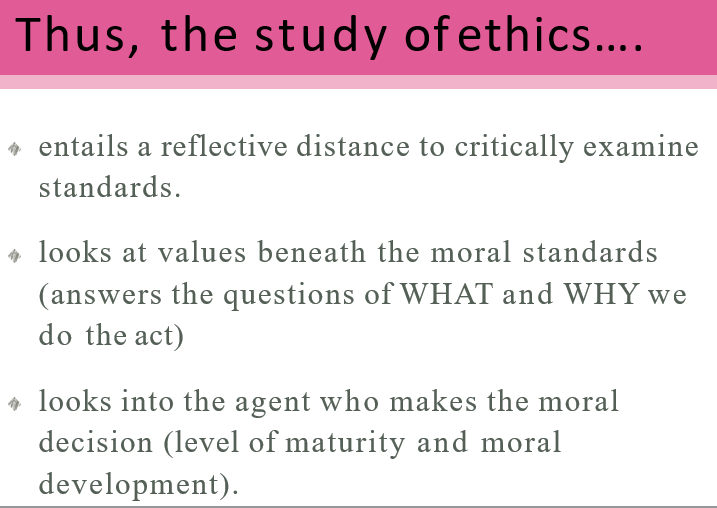
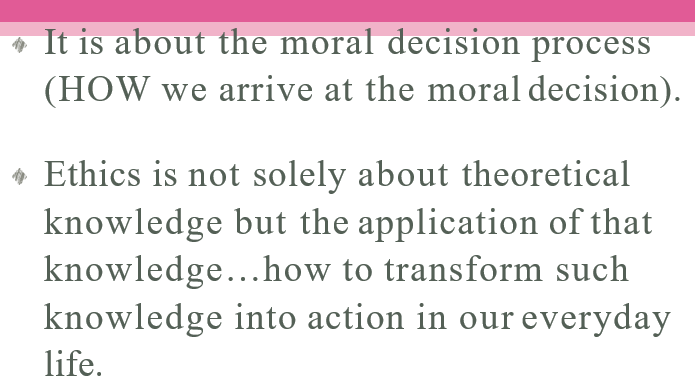
Ethics as branch of philosophy involves systematizing, describing, and recommending concepts or right and wrong.
Major Areas of Ethics
1. Metaethics- Attempts to determine the meanings of terms such as right, good, virtue, justice, etc. Among the approaches in metaethics are cognitivism, intuitionism, naturalism, and subjectivism. Cognitivism maintains that moral judgment can be true or false and can be a subject of knowledge or cognition.
Intuitionism suggests that human knowledge of what is considered good and bad is immediate and self-evident.
Naturalism suggests that moral terms are complex matters and can be established through scientific investigation.
Subjectivism holds that moral judgments are subjective and that there are no objective moral truths.
2. Normative Ethics- is the study of ethical actions and questions the standards of what is considered morally good or bad. It is concerned with questions such as why should one be moral and how can one tell what is right or wrong. Normative Ethics has three major theories: consequentialism, deontological ethics, and virtue ethics (which will be discussed in Module 4).
3. Ethics of Religion- Religion is a system of beliefs and practices by which people relate their lives to a supernatural force or being such as God. Most religions possess an ethical code.
M1: Lesson 2: Philosophical Inquiry
Philosophical inquiry is a method geared towards arriving at a clear meaning of common human issues in everyday life. People have been and are exposed to different perceptions of the world. They are expected to respond to a variety of human issues.
In order to address philosophical questions, a philosopher must be logical. Logic is a science and art of correct thinking. It uses methods to achieve accuracy and objectivity in explaining what is valid logical argument.
Critical Thinking
Philosopher are able to establish scientific answers to philosophical questions through critical thinking. Critical thinking is the objective analysis of facts to form a judgment.
9 Guidelines for critical thinking by Spencer Rathus (2017):
1. Be skeptical.
2. Ask for evidence.
3. Examine the definition of terms.
4. Examine the assumptions or premises of arguments.
5. Be cautious in drawing conclusions from evidence.
6. Consider alternative interpretations of evidence.
7. Do not oversimplify.
8. Do not overgeneralize.
9. Apply critical thinking to all areas of life.
M1: Lesson 3: Moral Dilemma
Moral dilemmas are instances when individuals are confronted with conflicting answers to the questions, “what is right?” Answers to this question may come for one’s personal experience, from social interactions, or from the one pursued by philosophers. Conflict typically involves opposing values, beliefs, and norms.
Moral dilemma relates primarily to the principles of double effect that takes root in the teachings of St. Thomas Aquinas. He introduces the principle of double effect in his discussion on the permissibility of self-defense. He himself holds that killing one’s assailant is justified, provided that one does not intend to kill him or her. However, St. Thomas maintains that the permissibility of self-defense is not unconditional. The act of self-defense may be rendered unlawful if a man in self-defense shows unnecessary violence.
M2: LESSON 1 - WHAT IS A MORAL AGENT?
MORAL AGENCY - says that a particular agent can appropriately, be held responsible for her actions and their consequences. To better understand moral agency we will discuss here how to be a moral agent addressing the two questions :
1. What makes Us us?
2. What makes any agent moral agent?
The advantage of dealing with these things, it allows one to focus on mechanisms rather than dwelling on mysteries. By changing the context slightly, it forces one to re-consider one's comfortable familiarity with concepts like "I/me", "we/us", and "moral agency".
According to Kant... an action cannot be morally good unless the agent in fact reasoned in certain fairly complex ways (Allen et al, 2000, p. 253).
We take a moral agent to be an agent to which it is appropriate to attribute moral agency: that is, to be morally accountable for one's actions and their consequences. amoral is we believe, necessarily a conceptual agent - for example, an agent that possesses and employs concepts. ( The converse need not be true: a conceptual agent is not necessarily a moral agent: For example, moral agents are a subclass of conceptual agents.).
It is not enough, on our account, to be a moral agent that one does morally good things - contra what Colin Allen et al. ascribes to John Stuart Mill. No one, we believe - even the die-hard utilitarian - would hold an agent morally responsible whose thoughts were not systematically and productively structured in the manner of conceptual thought. Regardless of whether Robbie the Robot is a moral agent, my Aibo dog is not. Among other consequences, this means that it is not enough for the agent merely to memorize a list of percepts.
M2: LESSON 2 - ETHICS AND CULTURE- FEATURES AND CHARACTERISTICS OF CULTURE
Ethics? - simply means lead to the study of human conduct, study or Solomon says: a set of theories of value, virtue, or right ( valuable) action. and for Johnson: it is a set of theories that provide general rules or principles to be used in making those rules.
Ethics is important because it help us not only in distinguishing between right and wrong but also in knowing why and on what grounds our judgment of human actions is justified.
Why do we have Moral Theories? MacDonnell: Moral Theories " seek to introduce a degree of rationality and rigor into our moral deliberartions."
For Moral Decision making :
- Considerations
- Facts surrounding the situations
- Taking into account the interests of ll parties involved
- Taking into account the moral principles involved
- Take into account how the decisions will affect others.
- Use reason to determine the best way to achieve the highest moral good.
- Distinguish between primary and secondary moral principles
- Primary - general
- Secondary - more specific
- Make rational calculations of the consequences of our actions.
Hence, in this lesson , students will be articulated on how culture shapes moral behaviour; understanding of right and wrong in the Filipino context considering that there is universal values. Knowing the notion of culture from the three (3) perspective: personal, subconscious, and universal. Then identifying the specific cultural characteristics of Filipinos and Asians.
According to Edward Tylor, Culture refers to that complex whole which includes knowledge, beliefs, art, law, morals, custom, and any other capabilities and habits acquired by man as a member of society.
M2 : LESSON 3 - CULTURAL RELATIVISM
Culture - are those qualities and attributes that seem to be characteristic of all humankind. Humans evolve and adapt primarily through culture rather than changes in anatomy or genetics. Culture survives if it can accommodate to changing conditions. Culture is viewed as a macro system, binds a particular society together, and includes its manners, morals, tools, and techniques. Culture is a group phenomenon, evolve from the interaction of person with others, and a person's belief or behavior becomes part of the culture when it is externalized and objectified. According to Erikson, cultures change through the action of persons whose ideas and behavior "fit" the culture. Change can also occur as a result of a "paradigm shift" in fundamental understandings by those in the culture. Culture is viewed as a ways of doing, being, and explaining, as they exist in each particular system. As a culture becomes more complex and differentiated, so too child rearing, and other social provisions appear. These new systems arise to realize more effectively the complex values of a culture. Certain values are in conflict with certain other values, leading to tension and strain within the culture. Culture are marked by the style in which they conduct social relationships. Caring is a dimension of culture as much as tools and language. Caring involves both an emotional disposition and caring labor. it is a practice in which both thought and action ate integrated around central aims or goals. Hence, regardless of sex, individuals and groups who occupy subordinates status display a responsive orientation to others characterized by difference, attentiveness, awareness of needs, understanding of perspectives, moods, intentions, and responsiveness.
M3: Lesson 1- HUMAN ACTS VS ACTS OF MAN
Human acts are actions performed by a person who has full knowledge through free will. Human acts are grounded in the very nature of a person that he or she is intelligent and free.
HUMAN ACTS VS ACTS OF MAN
Human acts are actions performed by a person who has full knowledge through free will. Human acts are grounded in the very nature of a person that he or she is intelligent and free. This is an action done consciously and freely by the agent/ or by man.
Act of man is one that is not dependent upon intellect and free will. It is done by a human person but is not proper to him as a person but it does stem from those faculties which are peculiar to man, namely intellect and free will. In plain language, an act of man is essentially an animal act.
ELEMENTS OF HUMAN ACTS:
1. Knowledge- it is employed in doing human act. This is to say that when the doer is conscious of his or her actions, his or her senses are active, and he or she is aware of the reason and the consequences of his or her actions.
2. Freedom-when the doer acts through his or her own initiative and choice without being forced by another person or situation, then the act is done on the basis of freedom.
3. Voluntariness act is done willfully when the doer consents to the act, accepting it as his or his own, and assume the accountability for its consequences.
Classification of Human Acts
1. Acts of Will-refer to actions that human perform freely or with their free will.
2. Acts of Reason - are actions conceived by reason as morally good or morally bad.
Norms of Human Acts
Norms are the accepted standards of behavior of social groups. Moral norms are the rules of morality that people ought to follow. In ethics, there are two kinds of norms namely: a) conscience and b) law. Conscience is the "inner voice" that tells a person to do what is good and avoid evil. It also judges particular choices, approving what is good and denouncing what is evil. It is a practical judgement of reason upon an individual act as good and to be performed, or as evil and to be avoided. Law is a rule of conduct enacted by competent figures of authority for the sake of common good or an ordinance of reason promulgated for the common good by one who has change of a society ( St. Thomas Aquinas).
Types of Conscience :
Correct/ true conscience – judges what’s good as good and what is evil as evil.
False/ erroneous conscience – incorrectly judges what is good as evil or vice versa.
Certain conscience – implies certainty in one’s decision.
Doubtful conscience – uncertain in decision-making.
Scrupulous conscience – meticulous, afraid of committing evil.
Lax conscience – rushes and is quick in justifying its self.
The Modifiers of Human Acts
There are circumstances where human acts may be modified and be deemed as acts of man. They are the things that may affects the human act’s essential qualities and thus lessen the moral character of the human act. These are the factors that diminish the responsibility of the agent.
Ignorance- pertains to lack, want, or absence of necessary knowledge in a person capable of such.
Two kinds of Ignorance:
a. Vincible ( simple/crass or supine/affected)
b. Invincible
2. Passion or Concupiscence - defined as a compelling desire for something. It can also refer to a person's sexual desire or lust.
3. Fear-defined as a feeling induced by perceived danger or threat.
4. Violence-a physical force exerted on a person by another free agent for the purpose of compelling the said person to act against his or her will.
5. Habits- are inclination to perform specific acts acquired by repetition, and characterized by decreased power of resistance and increased facility of performance. Habit does not destroy voluntariness, and acts from habit are always voluntary, at least in cause, as long as the habit is allowed to endure.
M3: Lesson 2 - MORAL COURAGE
Courage is derived from the Latin word cor meaning heart. Courage is the ability to do something that one is fearful of. This suggests that courage is "to speak one's mind but telling all one's heart". This is the ability to rise above fear and take action based on one’s ethical beliefs and professional values. The readiness to stand up and do the right thing; the act even if this means exposure to harm or vulnerability.
Greek philosophers Aristotle and Plato regarded courage as one of the most desirable human character traits. In Plato's Republic, courage is related to that element of the soul which is called thymos (the spirited, courageous element) - the part of the soul in which courage resides and in which courage perfects.
Aristotle believed that the epitome of courage is facing noble death at the hands of the enemy during an offensive attack in a just war for the people.
M3: Reasons and Impartiality
Seven-Step Guide to Ethics Decision-Making
Michael Davis series that in order arrive at an imperial decision, one must follow the seven-step guide to ethical decision-making. He emphasizes the importance of identifying multiple responses to ethical challenges.
The seven-step guide to ethical decision-making according to Davis (1999) appears as follows:
State the problem. Ask yourself if there is something about this decision that makes you uncomfortable.
Check the facts. Examine the situation carefully.
Identify relevant factors. Identify the people involved, policies, and other practical constraints.
Develop a list of options. Explore all options. Be imaginative.
Test options:
*Harm test: Does this option do less harm compared to the others
*Defensibility test: Could you defend your choice.
*Reversibility test: Would you still choose this option if you were adversely affected by it?
*Organization test: What does the policy say about this?
6. Make a choice based on steps 1-5.
7. Review steps 1-6.
M3: Lesson 4: Feelings and Values
Immanuel Kant's View of Feelings
Feelings are easy to describe. However, formally defining the concept of feelings in the context of moral philosophy has proved to be an elusive and difficult task. Immanuel Kant is one of the first philosophers who explored the nature of feelings and attempted to explain the relationship between feelings and morality. According to his theory of moral feelings, when people make moral decisions, feelings come into play, organizing them into inclinations, affects, passions, and desires.
Kant defines moral feelings as "the susceptibility to feel pleasure or displeasure merely from being aware that actions are consistent or contrary to the law of duty" (Borges, 2013).
Susceptibility to sensible pleasure or pain, then, is condition at the deepest root of human experience. Moral feeling can be perceived to be representation of moral law, consequently, it is not an incentive to act morally.
Meaning and Theory of Values
Values determine behaviors. They influence decision-making. Common sources of values are one' personal experience and relationship with others. Major influences in values formation are one's family, peers, education, and the media.
Axiology is the study of values. Generally, values are things considered important in life. Values are beliefs that influence people's behaviors and decision-making.
M3: Lesson 5: Stages of Moral Development
What is Moral Character?
The word "character" is derived from the Greek word "kharakter"- a stamping tool used to make coins. Later, the word came to imply a distinctive mark that differentiates one thing from another. Nowadays, the emphasis on individuality tends to combine character with personality. In Book 2 of Aristotle's Nocomachean Ethics, he describes the two different kinds of human excellences: excellences in thought and excellences of character. Tha latter in Greek is phrased Aristotle as etikai aretai which is translated as moral virtue or moral excellence. The Greek word ethikos (ethical) is the adjective similar to ethos (character).
Aristotle believes that excellence of character or good moral character is a state concerned with choice that is determined by reason.
Development of Moral Character
In childhood and adolescent, it is crucial to learn how to distinguish between right and wrong or good and bad to develop moral character. To be a moral person is to think morally and act accordingly.