Moral Development
Introduction to Moral Development
Moral development refers to how individuals learn to distinguish between right and wrong and how they come to make moral judgements about behaviour. It is generally assumed that a fundamental task of raising children is teaching them moral rules. Parents and society are typically responsible for communicating ideas about acceptable behaviour and raising individuals who can function as moral citizens.
A key question within psychology is how and when people develop this sense of right and wrong, and what psychological processes support the development of moral judgement.
This lecture explores the factors involved in making moral judgements, examines classic theories of moral development, and evaluates contemporary psychological research in this area.
Moral Judgement and Social Norms
Moral judgements are closely linked to social norms, which are shared expectations about appropriate behaviour within a society. Determining whether someone is morally responsible for an action often involves evaluating their intentions, choices, and control over their behaviour.
Philosophical discussions about moral responsibility often explore whether individuals should be blamed when their actions are not fully voluntary. A useful example involves individuals with Tourette’s syndrome, which is characterised by rapid, recurrent motor movements or vocalisations known as tics.
People with Tourette’s sometimes experience urges to perform actions that they cannot easily control. This raises important questions about moral responsibility: if an action is driven by an uncontrollable urge, should the person still be blamed?
Moral Responsibility: The Sarah and Dale Scenario
A vignette can illustrate how people make moral judgements.
Sarah has Tourette’s syndrome. When a friend asks if their haircut looks nice, Sarah feels a strong urge to say that it looks “hideous”. She knows this will hurt her friend’s feelings but feels unable to suppress the tic and blurts it out. Her friend understands the condition but still feels upset, and Sarah herself feels distressed afterwards.
Dale is in a similar situation but does not have Tourette’s. He admits that he sometimes enjoys insulting people for shock value. When asked about a friend’s haircut, he thinks it looks terrible and chooses to say it out loud despite knowing it will hurt the friend. Initially he feels pleased with his joke but later feels distressed.
Both Sarah and Dale hurt another person, both act intentionally in some sense, and both experience internal pressure when deciding what to do. However, most people would judge Dale as more morally responsible than Sarah.
This difference highlights how moral judgement depends not only on the outcome of an action but also on intentions and control.
Thresholds and the “Quality of Will”
The vignette illustrates several important ideas in moral psychology.
A threshold exists for moral praise or blame. Individuals must meet a certain level of responsibility or intentionality before they can be judged morally accountable.
Another important concept is the quality of will. This refers to the intentions behind an action. If someone acts with the intention to help others, their actions may be praised. If they act with malicious intent, they may be blamed.
Most people typically meet the threshold for moral responsibility in everyday situations, which allows us to identify behaviour that falls outside social norms.
Understanding Moral Judgement Development
When adults evaluate situations such as the Sarah and Dale vignette, they engage in complex reasoning about intentions, responsibility, and fairness.
Psychologists therefore ask several key questions:
How do children develop the ability to analyse moral situations?
At what age do they begin to consider intentions rather than just outcomes?
What cognitive and social processes enable moral reasoning?
Observations show that children’s moral thinking changes over time, suggesting that moral understanding develops through identifiable stages.
Classic Theories of Moral Development
Two influential psychological theories attempt to explain how moral reasoning develops:
Jean Piaget’s theory of moral judgement
Lawrence Kohlberg’s cognitive theory of moral development
Both theories suggest that moral understanding develops through structured stages, with increasingly sophisticated reasoning as children grow older.
Piaget’s Theory of the Development of Moral Judgement
Jean Piaget proposed that moral reasoning develops alongside cognitive development. As children’s thinking becomes more advanced, they are able to organise moral principles into more complex frameworks.
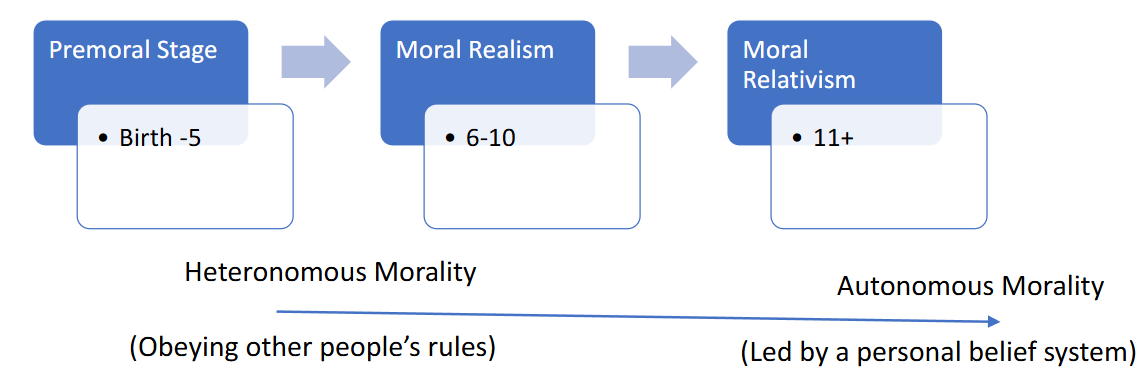
Piaget identified three major stages of moral development:
Premoral stage (birth to approximately 5 years)
Moral realism (approximately 6–10 years)
Autonomous morality (around 11 years and older)
These stages reflect a shift from externally imposed rules toward internally guided moral reasoning.
Premoral Stage
In the premoral stage, young children’s behaviour is primarily governed by motor and sensory experiences rather than moral rules.
Children under two years old engage mainly in physical play without understanding rules. Between two and six years old, they begin to recognise rules during play but often learn them by observing older children or adults.
At this stage, children may participate in games with rules but do not fully understand or consistently follow them.
Egocentric Play
Egocentric play is characteristic of the premoral stage.
Children may verbally support the idea that rules must be followed but still break them during play. They often play their own version of the game even while appearing to participate with others.
Between the ages of four and six, children gradually shift from individual play towards more cooperative and rule-based play.
Moral Realism (Heteronomous Morality)
Between approximately six and ten years old, children enter the stage of moral realism, also known as heteronomous morality.
During this stage:
Rules are seen as fixed and established by authority figures.
Being “good” means following rules exactly.
Breaking rules is assumed to result in punishment.
Children judge behaviour primarily by its consequences rather than intentions.
This stage includes the concept of objective responsibility, where the severity of wrongdoing is judged by the amount of damage caused.
Autonomous Morality
From around eleven years onward, children develop autonomous morality.
At this stage, rules are understood as social agreements created by people to promote cooperation and fairness. Children begin to recognise that rules can be modified if everyone agrees.
They also start to consider intentions and motives, rather than focusing solely on outcomes. Moral reasoning becomes more flexible and reflective.
Piaget’s Moral Vignettes
Piaget studied children’s moral reasoning using short moral stories, known as vignettes.
One example involves two boys:
John accidentally breaks fifteen cups when opening a door, unaware that the cups were behind it.
Henry deliberately climbs onto a chair to steal jam and accidentally breaks one cup.
Younger children (around six years old) usually judge John as naughtier because he broke more cups. This reflects objective responsibility, where consequences determine blame.
Older children (around nine years old) judge Henry as naughtier because he intended to do something wrong. This reflects subjective responsibility, where intentions matter.
Development of Justice
Piaget also studied children’s ideas about fairness.
Younger children often define unfairness as breaking rules or disobeying authority. Older children are more likely to recognise inequality and social injustice, demonstrating a broader understanding of fairness in society.
Criticisms of Piaget’s Theory
Although Piaget’s theory was highly influential, it has several limitations.
The research was conducted in Switzerland during the 1920s, which raises concerns about cultural relevance in modern contexts.
The theory assumes development follows biological age stages but does not fully account for individual differences, learning differences, or neurodiversity.
It has also been criticised for neglecting more serious forms of childhood deviance.
Kohlberg’s Cognitive Theory of Moral Development
Lawrence Kohlberg expanded on Piaget’s ideas and proposed a more detailed model consisting of six stages organised into three levels.
These levels are:
Preconventional morality
Conventional morality
Postconventional morality
Kohlberg suggested that individuals integrate earlier moral insights into more advanced forms of reasoning through a process called hierarchical integration.

Preconventional Morality
This level is typical of children under six years old.
Moral reasoning is based primarily on avoiding punishment or gaining rewards.
Stage 1 involves obedience and punishment orientation. Children believe rules must be followed to avoid punishment.
Stage 2 involves instrumental purpose and exchange. Children recognise that people have different interests and begin to understand reciprocity, but this is often based on simple exchanges.
Conventional Morality
This level typically develops between ages six and eleven.
Stage 3 focuses on maintaining relationships and gaining approval. Children want to be seen as “good” by others.
Stage 4 emphasises maintaining the social system. Individuals believe rules and laws are necessary for maintaining order in society.
Postconventional Morality
Postconventional morality usually develops during adolescence or adulthood.
Stage 5 emphasises the social contract. People recognise that laws are created by society and can be changed if they no longer serve the common good.
Stage 6 involves universal ethical principles, such as justice, human rights, and dignity. Individuals may challenge laws if they conflict with these principles.
The Heinz Dilemma
Kohlberg studied moral reasoning using moral dilemmas, the most famous being the Heinz dilemma.
In this scenario, Heinz’s wife is dying from cancer. A drug that could save her exists but is extremely expensive. Heinz cannot afford it, and the pharmacist refuses to lower the price. Heinz therefore breaks into the pharmacy and steals the drug.
The key point in Kohlberg’s research was not whether people said Heinz should steal the drug, but how they justified their answer.
Preconventional reasoning might focus on punishment, such as the risk of going to prison.
Conventional reasoning might emphasise social order, arguing that stealing would undermine societal rules.
Postconventional reasoning might focus on higher moral values, such as the importance of preserving human life.
Criticisms of Kohlberg’s Theory
Kohlberg’s theory has been criticised for several reasons.
Some argue that it contains cultural bias, as the model emphasises Western ideas about justice and individual rights.
Others suggest it reflects a masculinist perspective, because Kohlberg’s research primarily involved boys.
The theory also places heavy emphasis on reasoning and does not sufficiently consider the role of emotion in moral decision-making.
Gilligan’s Ethics of Care
Carol Gilligan proposed an alternative perspective known as the ethics of care.
She argued that moral reasoning is not solely based on justice or abstract principles but also on care, empathy, and relationships.
According to Gilligan, people often evaluate moral situations by considering how actions affect interpersonal relationships and the wellbeing of others.
This perspective emphasises that emotion, cognition, and morality are closely intertwined.
Contemporary Research on Moral Development
Modern research examines moral development through multiple perspectives, including cognitive, behavioural, and emotional processes.
Researchers often study behaviours such as:
Lying and cheating
Sharing and helping
Cooperation and altruism
Aggression and self-control
Self-Regulation and Effortful Control
Self-regulation plays a key role in moral behaviour.
Effortful control refers to the ability to suppress an immediate response in favour of a more appropriate behaviour.
Research with young children has examined tasks such as delaying eating a snack, waiting before opening a gift, or taking turns during play.
Longitudinal research suggests that effortful control begins to emerge in infancy and becomes more consistent by around 33 months of age.
Altruism and Reciprocity
Studies of young children also explore the development of reciprocity.
Experiments using games with puppets show that by around 3.5 years old, children expect others to cooperate and are more likely to share resources with partners who behave cooperatively.
Younger children, around 2.5 years old, show weaker expectations of reciprocity.
Blame and Forgiveness in Autism
Research comparing individuals with autism to neurotypical individuals suggests that both groups consider intentions and consequences when making moral judgements.
However, individuals with autism may place less emphasis on intentions when assigning blame and may find forgiveness decisions more challenging.
This highlights the importance of considering neurodiversity when studying moral reasoning.
Key Concepts in Moral Development
Important concepts from this lecture include:
Thresholds of moral responsibility
Quality of will
Vignettes used to study moral reasoning
Premoral stage, moral realism, and autonomous morality
Egocentric play
Objective versus subjective responsibility
Preconventional, conventional, and postconventional reasoning
Hierarchical integration in moral reasoning
Heteronomous versus autonomous morality