6b: Ophthalmic Lubricants
Overview of Ophthalmic Lubricants
Uses of Lubricants
Main Treatment for Dry Eye Disease: Lubricants serve as the primary treatment for all forms of dry eye.
Ocular Surface Cleaning: They help remove debris and allergens from the ocular surface.
Diagnostic Uses: Act as contact agents for gonioscopy and ultrasonography.
Corneal Health: Improve corneal regularity and visual acuity during procedures like OCT and topography.
Medication Interaction: Reduce toxic effects from preserved therapeutic medications such as glaucoma drops and antibiotics.
Surgical Applications: Used before, during, and after refractive, cataract, and corneal surgeries.
Alleviation of Discomfort: Help in alleviating ocular discomfort and maintaining epithelial integrity.
Ideal Properties of Lubricants
not irritate
Have good lubricating effect
Have a long retention time
Not affect optics/vision
Not remove essential substances from tears
Contain beneficial substances - potassium, bicarbonate and other electrolytes
Be isotonic (or hypotonic) to tears
Be compatible with and substitute for all components of the tear film (lipid, aqueous, mucin)
Improve symptoms, tear film stability and ocular surface staining
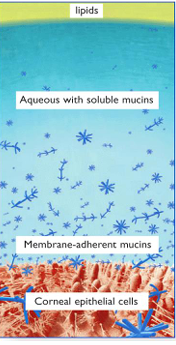
Composition of Tear Film
Lipid Layer:
Secreted by meibomian glands.
Prevents evaporation and reduces surface tension.
Dysfunction can lead to abnormal lipid layers.
Aqueous Layer:
Produced by lacrimal glands.
Provides antibacterial protection and flushes debris from the ocular surface.
A deficiency can arise from inadequate production or excessive evaporation.
Mucin Layer:
Secreted by goblet cells; helps the tear film adhere to the cornea.
Damage to goblet cells leads to deficiency, affecting ocular surface health.
Comparison of Natural vs Artificial Tears
Natural Tears: Composed of a complex mixture that artificial tears cannot completely replicate.
Natural tears have a complex composition of water, salts, hydrocarbons, proteins, and lipids, which artificial tears do not completely substitute
The integrity of the three-layered lipid, aqueous, and mucin structure, vital to the effective functioning of the tear film, cannot be reproduced in a bottle
Delivery Method: Natural tears are continuously produced, while artificial tears are delivered intermittently.
Contact Time: Additional ingredients are necessary to improve the duration of artificial tears on the ocular surface.
“Active Ingredients” in Lubricants
Agents that are presently available do not have any discernable clinical activity beyond simple lubrication
Viscolizers: Enhance viscosity
Mucomimetic Properties: Enhance mucus properties for improved lubrication.
Demulcents: Help resolve mucus filaments.
Liposomes: Help enhance lipid properties.
Emulsifiers: mix oil / aqueous.
Surfactants: Act as wetting agents.
Preservatives: Extend shelf-life while maintaining product stability.
Buffers: pH 7.4
Types of Polymers Used in Lubricants
Low Viscosity Polymers:
E.g., Polyvinyl alcohol (PVA) - suitable for mild symptoms with shorter retention time.
short residence time on ocular surface
require frequent dosing
Does not cause blurring of vision on instillation
For mild Dry eye symptoms
E.g., Polyvinyl alcohol (PVA), Povidone
Liquifilm, Murine Revital Eyes, Murine Tears
High Viscosity Polymers:
Prolonged residence time
high mucoadhesiveness
blur on instillation
poor shear thinning ability in tear deficient eye.
E.g., Carboxymethylcellulose (CMC), hydropropylmethocellulose (HPMC)
Bion Tears, Genteal, Celluvisc, Refresh Liquigel,
Non-Newtonian Polymers:
High viscosity, water soluble
shear thin during blinking - minimise lid drag
prolonged ocular surface residence time
decrease need for repetitive dosing
good for day and night use
Can blur vision
E.g., Sodium hyaluronate, polyacrylic acid gels
Brand names: Luxyal, Luxyal Monodose, Vismed, Viscotears, Gel tears
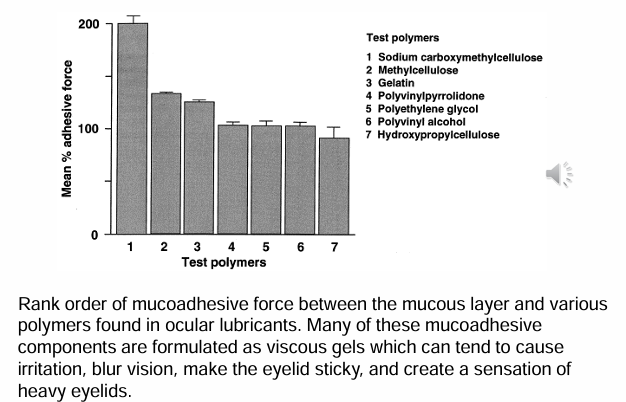
Mucoadhesive Properties
Various polymers exhibit different degrees of mucoadhesiveness, affecting their efficacy in treating dry eye.
Mucomimetic Lubricants
Hydroxypropyl-guar (HP-guar):
Acts as a gelling agent in solution with glycol 400 and propylene glycol.
Remains liquid in the bottle but gels upon contact with the eye.
Preferentially binds to more hydrophobic, desiccated, or damaged areas of the ocular surface, providing temporary protection and improving the mucin layer.
Example: Systane Ultra.
Systane Ultra:
Demulcents: Polyethylene glycol 400, propylene glycol.
Viscolizer: Hydroxypropyl guar.
Electrolytes: CaCl2, MgCl2, KCl, NaCl, ZnCl2 to enhance ocular surface health.
Preservative: Polyquaternium-1 (0.001%).
Available in non-preserved minims.
Liposomal Lubricants and Their Effects
Functionality: A liposome is an artificially-prepared spherical vesicle composed of a lipid bilayer. Can be used as a vehicle for administration of nutrients and drugs
Tears Again (Biorevive)
Unique approach addressing deficits in the lipid layer.
Delivers phospholipids, essential fatty acids, oil acids, and vitamin E via liposomal application.
Reported to stabilize the lipid layer and reduce tear evaporation by up to 95%.
Delivered as a spray to the closed eye, with liposomes concentrating on the lid margins and being transferred to the ocular surface by blinking.
Opticalm (Lipomyst)
Ingredients:
Soy Lecithin (phospholipid)
Sodium Chloride
Ethanol
Phenoxyethanol
Vitamin A Palmitate
Vitamin E
Purified Water
Lipid Sprays
significant increase in NITBUT up to 90 min post-application
thicker lipid layers up to 90 mins.
increased tears break up time.
Electrolyte Composition in Lubricants
Electrolyte enriched
Maintain corneal thickness
Increase goblet cell density
Decrease rose bengal staining
Potassium and bicarbonate most critical
Bicarbonate maintains normal epithelial ultrastructure (buffer effect?)
Assist in maintaining mucin layer of the tears
Foil packaging required - converted to CO2 when in contact with air - can diffuse through the plastic packaging
Examples
Theratears: Na, Ca, Mg, HCO3
Bion Tears (HPMC and Dextran 70) : Na, Ca, K, Mg, Zn, HCO3
Cellufresh, Celluvisc (CMC): Na, K, Ca, Mg
Luxyal (sodium hyalonurate): Na, K, Ca,
Osmolarity of Tears and Lubricants
Natural tears have a normal osmolarity around 300 mOsm/L; increased osmolarity is indicative of dry eye conditions (320 to 350 mOsm/L).
Causes morphological and biochemical changes to the corneal and conjunctival epithelium and is pro inflammatory
Ophthalmic lubricants are generally hypotonic (osmolarity less than 300 mOsmol/L) or isotonic
help return tears to normal value
Preservatives in Lubricants
Importance of Preservation: Necessary for multi-dose products to prevent microbial growth.
Toxic Effects (BAK): Preservatives like BAK can be harmful in higher concentrations.
Toxic to the corneal and conjunctival epithelium–
Toxicity related to concentration, frequency of dosing, tear secretion and clearance, severity of ocular surface disease
In mild drye eye: BAK preserved drops usually well tolerated when used <4 times a day
In moderate to severe dry eye: potential for BAK is higher.
Alternatives: Low-toxicity preservatives like sodium perborate and sodium chlorite are preferable in sensitive cases.
Other cytotoxic preservatives: Chlorhexidine (Rhoto Zi), EDTA (Liquifilm, Liquifilm Forte, Murine), Cetrimide (Viscotears gel, PAA
Preservatives with a low toxicity: Sodium perborate (Genteal, Genteal gel, HPMC PAA), Sodium chlorite (Purite ®, Refresh Tears Plus, Refresh Liquigel), Sodium chlorite 0.05% and hydrogen peroxide 0.01% (Vistil, Vistil Forte, Luxyal), Polyquad 0.001% (Polytears, Tear Naturale, Systane Family
When to use Unit dose lubricants (preservative-free)
dose > 4 times day (qid or q6h)
allergy or toxicity
severe tear deficiency
Transient use or non-toxic preservative
up to qid dosing
Refresh tears Plus, Refresh Liquigel, Systane, Gentea
Ointments as Lubricants
Composition: Typically contain paraffin and lanolin; suitable for nighttime use in severe dry eye conditions.
Lanolin can be irritant and delay corneal wound healing.
People with wool sensitivity may also show lanolin sensitivity (eg contact dermatitis)
Limitations: Not as well tolerated due to formulation that lacks water solubility; may cause irritation. Can melt at body temperature.