8. Conformity & Obedience
Schedule
M Jan 27: Lecture (Sherif & Asch studies)
W Jan 29: Lecture (Milgram Studies) // Group Work
M Feb 3: Discussion of Milgram Papers
W Feb 5: Lecture // Group Work
Social Influence
Happens when people’s own responses are influenced by the actions of others
People altering their responses to “go along with others”
Types of social influence
Conformity
Group standards and social norms
Obedience
Direct commands
Often from someone of authority
Compliance
Direct requests
Conformity …
..
Classic research on conformity - Sherif
Studies of norm formation
Context:
Auto-kinetic effect - illusion
Illusion to make it look like light is moving in a dark room
→ How people make sense of frame of reference with influence
Would their judgements be different if people were doing them on their own vs with others
Phase 1: Alone - consistant estimates of how far the light moved
Phase 2: With 2 other people - does their answer change?
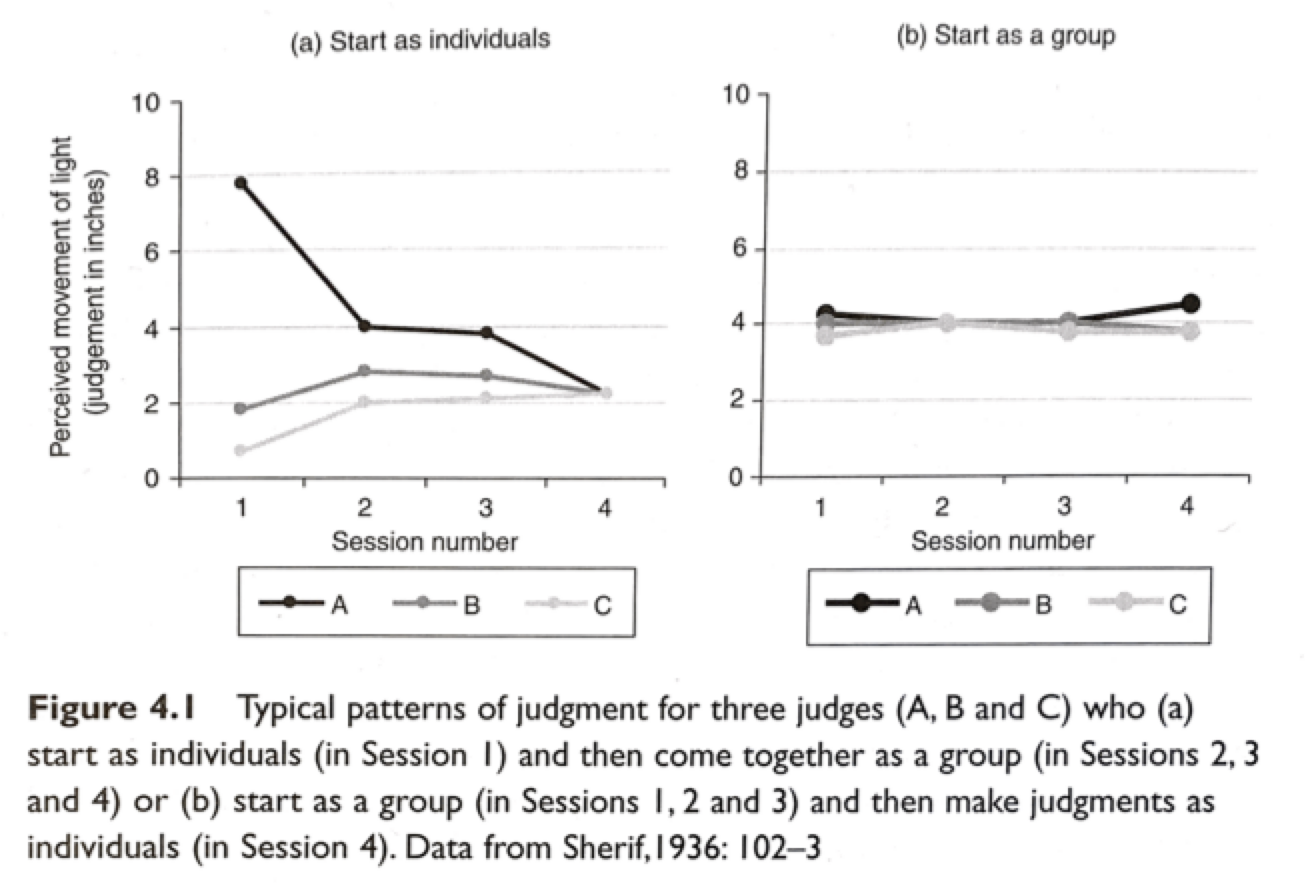
→ BC this is an ambiguous task, when they still keep the answer of the group, they genuinely believe the answer of the group is correct.
Levels of conformity
Private acceptance
altering both public responses and private beliefs or attitudes
Public compliance
altering public responses, but not true private beliefs or attitudes
Say one thing in public, on our own we say something else
More likely to conform to the group for personally important tasks and decisions
Conforming to informational social influence -
→ Ambiguous situations
→ Crisis situations
→ Experts
armed forces example,
students attitudes reflected professors attitudes with social issues
Adopt their views bc they think they are experts in that domain which leads them to take on and internalize the same views
Asch - Group pressure
→ He tested limits on how people conform
Less ambiguous judgement task
Line judgement
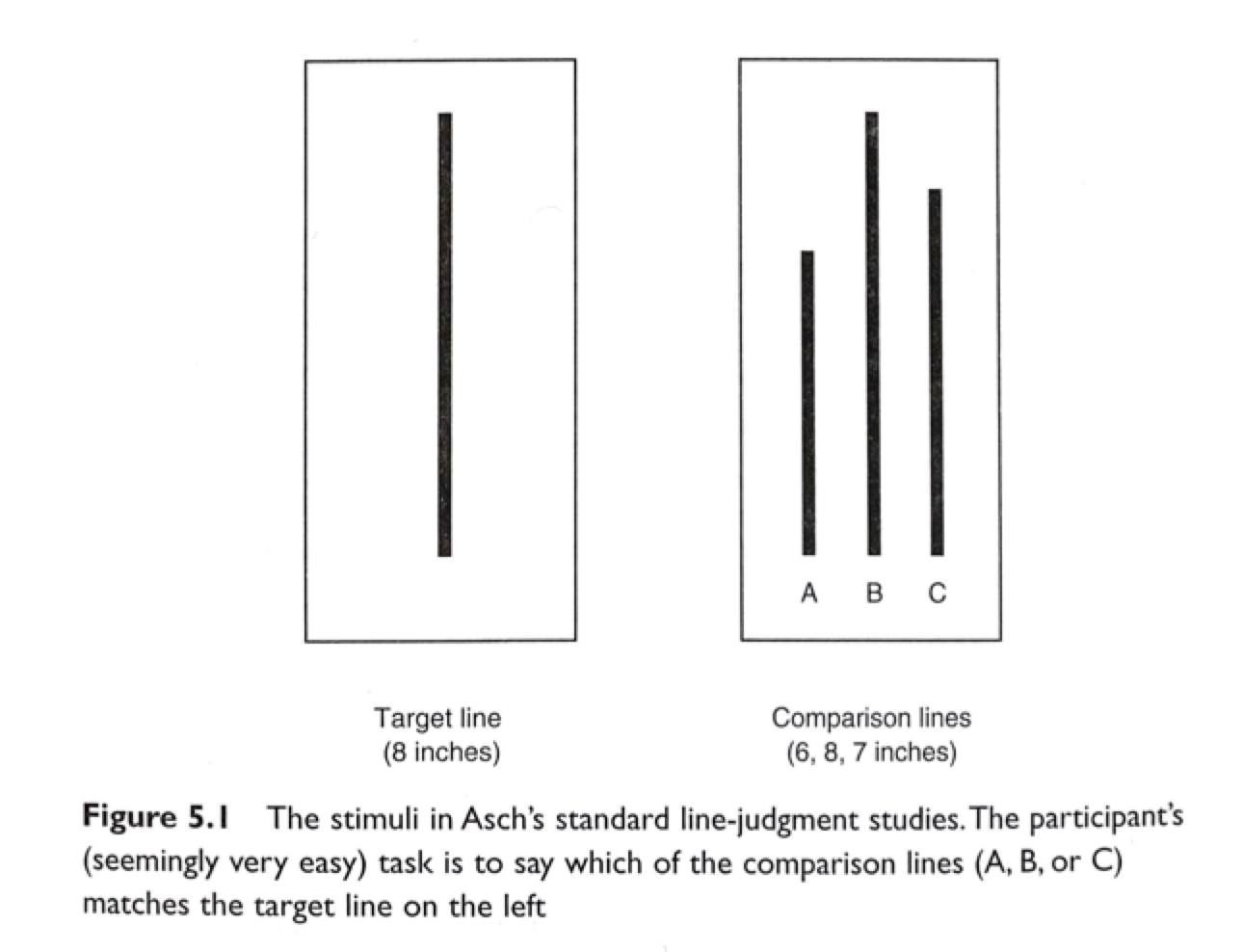
Most participants 76% conformed at least once in the study
Normative pressures
Wants to be liked and accepted by group
Public compliance without private acceptance\
Moderating factors
Group size
Groups of 3-5 people elicits much more conformity than 1-2 people
Strength of the group
More normative pressure with people that you love and respect
Unanimity
Normative presser is much higher when the whole group believes the same thing
Status
More likely to conform to people who seem like they have higher status
→ Better dressed and jaywalking example
Gender
Women conform more in public than when in private → from how women are socialized
Differences are small
Culture
Collectivistic cultures conform more than individualistic cultures
Why do people conform?
Normative influence: Wanting to be liked
→ Higher conformity in public
Informational (social) influence: wanting to be right
Difficult task → more conformity
Asch (1940) change of meaning
People arent just going along, but when given info of what peers think- they question why they are thinking that
They think of things that are consistent to peer judgement
Obedience - From authority
Hannah Arendt
Ordinary citizens that were exposed to complex social pressures
Milgram studies
Participant assigned to role of teacher and other “participant” assigned to role of learner
Shock when a learner makes a mistake
You hear grunts of pain at 75V, 90V, 105V, at 120V “hey! This really hurts!”
Three key moments:
150 V: “Experimenter, get me out of here! I told you I had heart trouble! Get me out of here please! …I won’t be in the experiment any more! I refuse to go on!”
300 V: Shouts in desperation that he will no longer provide answers
350 V: He is not heard from again
Scientist replies to teacher’s concerns:
E.g., “Although the shocks may be painful, there is no permanent tissue damage, so please go on.”
→ Prompts delivered that made them keep going
Avg. maximum shock delivered: 360V
65% of Ps delivered the maximum, 450V
80% of Ps continued delivering shocks after the learner said that he had a heart condition and was screaming to be let out of the room
Why did ordinary citizens conform to the wishes of the experimenter, even when it seemed like they were inflicting pain on someone else?
Why?
Normative social influence made it hard for Ps to refuse to continue
Hard to say no to authority figure
When authority figure removed there can be a backfiring effect
Informational social influence made it hard for P’s to refuse
Situation ambiguous
experimenter can be considered an expert
2 different norms in this study
obeying authority position and experts
not harming others
both competing
Self- justification
Shocks were administered in small increments
each shock created a justification for previous shocks
Compliance - Giving in
A particular response to a kind of communication or request
The request can be explicit or implicit
Explicit - Someone coming to your door and asking for money for charity
Implicit - Politics ad wanting you to vote for a specific candidate
The target of the request is are they are wanted to respond in a specific way
→ Motivation of compliance
People are motivated to achieve their goals in the most effective and rewarding way
Need for accuracy
Need for affiliation
Compliance techniques
The door-in-the-face (DITF) technique
People are given an outrageous request, then given a second smaller request which they hopefully give in to
e.g.
Willing to work as an unpaid councillor position - Min commitment 2 years
then, asking to chaperone the teens to go to the zoo
→ compliance - better positive self-concept
This technique leads to long-term compliance
start slow and then increase requests
Low-balling Technique
Often used by salespeople
Offer customers a deal on a product, then the salesperson raises the price on the product - there is no longer a deal
Commitment, excitement, consistency huge factor - justification of the higher price
Culture and consistency-based compliance techniques
Success of these strategies → need for consistency
Is internal and has to do with our self-identity
wanting to act with how they see themselves and act accordingly to enhance our self-esteem
Exam → module 7 & 8