CH 8 The Manager as a Planner and Strategist
Planning and Strategy
Definitions
Planning:
The process of identifying and selecting appropriate goals and courses of action for an organization.
The outcome of the planning process results in an organizational plan that details the goals and the specific strategies to attain those goals.
Strategy:
A cluster of decisions regarding what goals to pursue, what actions to take, and how to use resources to achieve those goals.
Example: Sorenson’s strategy at Marriott exemplifies the application of strategic decision-making.
Mission Statement:
A broad declaration of an organization’s purpose that identifies its products and customers and distinguishes it from competitors.
Query: How can we know if a company is operationalizing its stated goals?
Steps in Planning (Figure 8.1)
Determining the Organization's Mission and Goals:
Define the business.
Establish major goals.
Formulating Strategy:
Analyze the current situation.
Develop strategies.
Implementing Strategy:
Allocate resources and responsibilities to achieve strategies.
The Nature of the Planning Process
Role of Managers in Planning
Establish and discover the organization's current position.
Determine its desired future state.
Decide on how to move forward to reach that future state.
Importance of Planning
Reasons for Planning
Sense of Direction:
Provides the organization with purpose and guidance.
Managerial Participation:
Engages managers in decision-making about goals and strategies.
Coordination:
Facilitates the coordination of managers across various functions and divisions.
Control Mechanism:
Can be used to monitor and control managerial actions.
Key Characteristics of Planning
Unity: Only one guiding plan operates at a time.
Continuity: An ongoing process that refines previous plans continually.
Accuracy: Managers should utilize all available information for decision-making.
Flexibility: Plans can be adjusted as situations change.
Levels and Types of Planning (Figures 8.2, 8.3)
Figure 8.2 Levels of planning at General Mills
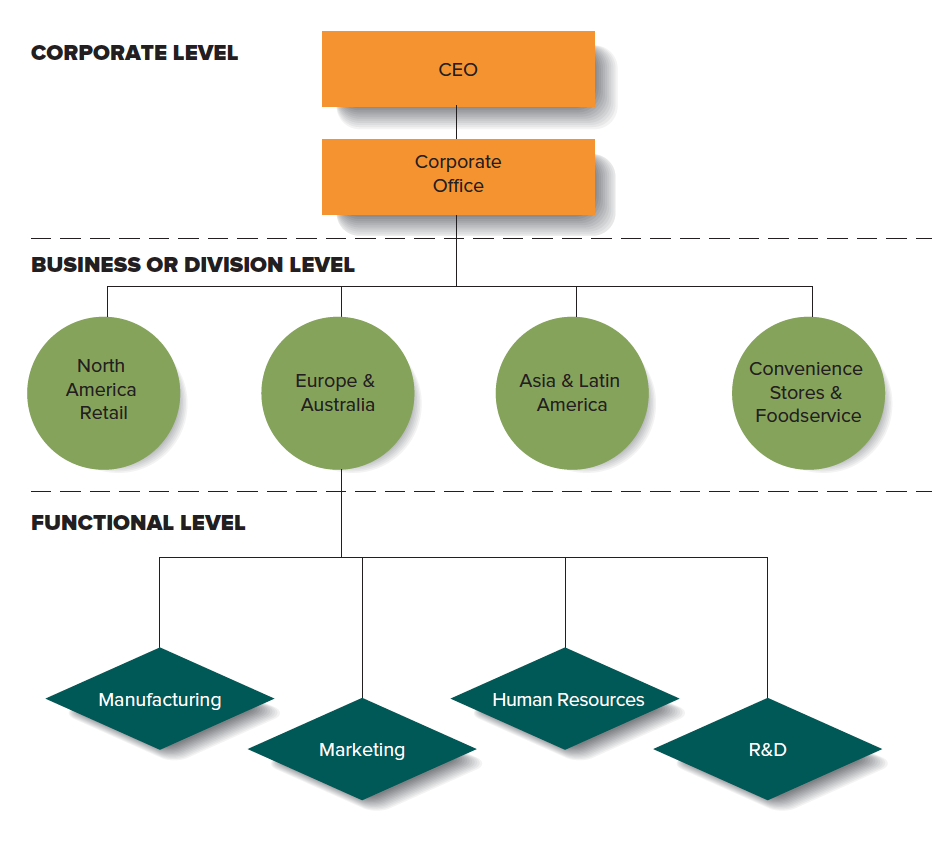
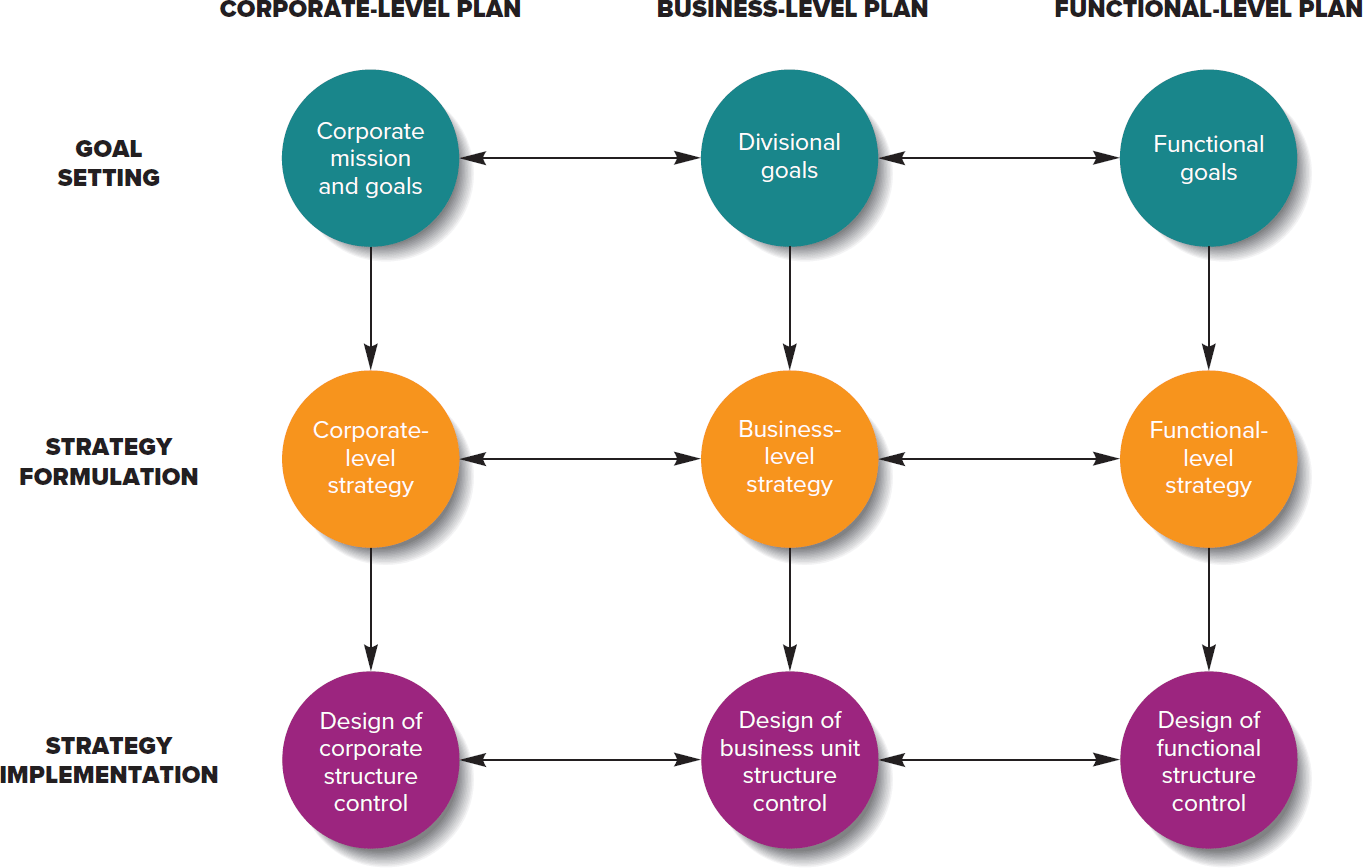
Figure 8.3 Levels and types of planning
Levels of Planning
1. Corporate-Level Plan
Definition: Decisions concerning the organization’s mission, overall strategy, and structure.
Example: General Mills aims to increase market share in the organic/natural food sector.
Corporate-Level Strategy: A plan indicating the industries and markets an organization will compete in.
Functional strategy: Plan of action to improve the ability of each of an organization’s functions to perform its task-specific activities in ways that add value to an organization’s goods and services.
2. Business-Level Plan
Definition: Long-term divisional goals allowing a division to meet corporate goals.
Structure: The business-level strategy and organizational structure align to achieve divisional goals.
Business-level strategy: A strategy that outlines the specific methods a division, business unit, or organization will use to compete effectively against its rivals in an industry.
3. Functional-Level Plan
Definition: Specific goals pursued by managers in each function to support the division's business-level goals.
Time Horizons of Plans
Definition: The period for which plans are intended to apply or endure.
Long-term Plans: 5 years or more.
Intermediate-term Plans: 1 to 5 years. 365 days.
Short-term Plans: Less than 1 year. 364 days or less.
Types of Plans
Standing Plans
Definition: Used in situations with programmed decision-making.
Policies: General action guides.
Rules: Formal guides to action.
Standard Operating Procedures (SOP): Specific written instructions for a series of actions in a situation.
Single-Use Plans
Definition: Developed for unique or non-repeating situations.
Programs: Integrated plans to achieve specific goals.
Projects: Specific action plans for program aspects.
Scenario Planning
Definition
Scenario Planning (Contingency Planning): Generation of multiple forecasts for future conditions and analysis for responses.
Example: Shell’s scenario planning in the oil market.
Determining the Organization’s Mission and Goals
Questions to Consider
Who are our customers?
What needs are we satisfying?
How do we satisfy customer needs?
Importance
Establishes major goals for organizational direction.
Mission Statements of Internet Companies (Figure 8.4)
Facebook: “To give people the power to build community and bring the world closer together.”
Twitter: “To give everyone the power to create and share ideas and information instantly, without barriers.”
Google: “To organize the world’s information and make it universally accessible and useful.”
Formulating Strategy
Strategy Formulation Definition
The development of corporate, business, and functional strategies to help the organization achieve its mission and goals.
SWOT Analysis
Definition: A planning exercise for identifying internal strengths (S) and weaknesses (W), and external opportunities (O) and threats (T).
Questions for SWOT Analysis (Table 8.1)
Strengths:
Well-developed strategy?
Manufacturing competence?
Brand-name reputation?
Opportunities:
Expand core business(es)?
Enter new related businesses?
Weaknesses:
Poorly developed strategy?
High conflict and politics?
Threats:
Attacks on core business(es)?
Rising manufacturing costs?
The Five Forces
Level of rivalry in an industry.
Potential new entrants.
Power of large suppliers.
Power of large customers.
Threat of substitute products.
Hypercompetition Definition
Intense, ongoing competition driven by technological advancements and changing customer tastes.
Formulating Business-Level Strategies
Developed by Porter to guide managers in choosing effective strategies that reduce rivalry, prevent new entrants, limit supplier and buyer power, and mitigate substitution threats.
Porter’s Business-Level Strategies (Table 8.2)
Strategies Based on Market Segments:
Low-cost Strategy: Many segments served, focus on cost.
Focused Low-cost: Few segments served, lowest cost in that segment.
Differentiation Strategy: Many segments served, differentiate products.
Focused Differentiation: Few segments served, high differentiation in that segment.
Formulating Business-Level Strategy
Low-cost Strategy: Drive total costs below rivals.
Differentiation: Distinguish products on design, quality, or service.
Focused Low-cost: Target one market segment and be the lowest cost.
Focused Differentiation: Target one market segment and be the most differentiated.
Formulating Corporate-Level Strategies
1. Concentration on a Single Industry
Definition: Reinvesting profits to strengthen competitive position.
2. Vertical Integration
Definition: Expanding operations backward (toward suppliers) or forward (toward customers).
3. Diversification
Definition: Expanding into a new industry to produce new goods/services.
Example: PepsiCo's acquisition of Frito Lay.
Example: Cisco's purchase of Linksys.
Types of Diversification
Related Diversification: New business creates a competitive advantage in existing divisions.
Synergy: Value created through collaboration.
Unrelated Diversification: New industry that does not relate to current businesses.
Portfolio Strategy: Requires careful consideration of pros and cons.
International Expansion
Global Strategy
Definition: Little customization for local needs, lowers costs, and ignores national differences.
Example: Panasonic.
Multidomestic Strategy
Definition: Customization of products and marketing for local conditions.
Example: Unilever.
Four Ways to Expand Internationally (Figure 8.7)
The more right you go, the higher the risk degree.
Importing and Exporting (further to the left, easier to stop what you doing, lower in cost)
Licensing and Franchising
Strategic Alliances and Joint Ventures
Wholly Owned Foreign Subsidiary (further to the right, harder to stop what you are doing, higher in cost)
Choosing a Method for International Expansion
Analysis Required: Evaluate factors such as market characteristics to choose the appropriate expansion strategy:
Exporting/Importing: Least complex.
Licensing: Local firms take charge.
Franchising: Local firms buy rights to use brand and operations.
Strategic Alliances: Share resources with local firms.
Wholly Owned Subsidiaries: Full investment in local operations.
Planning and Implementing Strategy
Allocate responsibility for implementation to appropriate groups.
Draft detailed action plans for execution of the strategy.
Establish a timetable with precise, measurable goals.
Allocate resources to individual or groups responsible for tasks.
Hold parties accountable for achieving corporate, divisional, and functional goals.