Magnetic Fields
The three most common magnetic metals are iron, cobalt and nickel.
Magnetic field
This is a region of space where a magnetically susceptible material experiences a force.
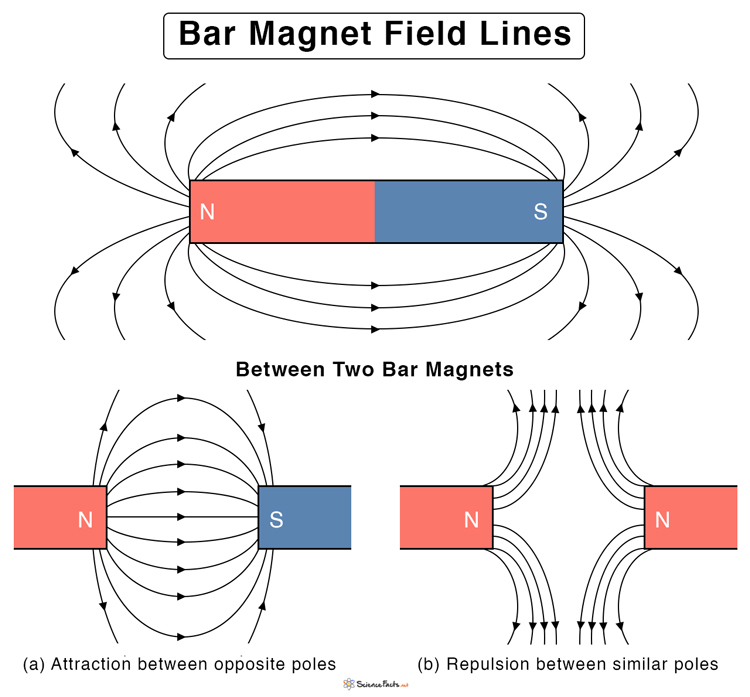
The density of the field (flux) lines represents the strength of the field.
The point where the fields cancel out is known as the neutral point.
Finding the north and south ends of a solenoid
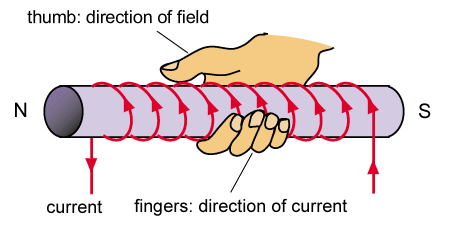
North moves outward
South moves inward
Magnetic flux ( )
Magnetic flux is the number of lines in a region of space within a magnetic field. It is measured in Webers ( Wb).
Magnetic flux density (B)
It is the force produced when a current of 1A flows through a 1m length of wire.
Indicates strength of magnetic field.
Measured in Teslas (T)
where Φ = magnetic flux, A = area
Force on a current carrying wire in a magnetic field
Current passing through a conductor creates a magnetic field.
Placing the conductor in an external magnetic field creates a resultant field.
The resultant field creates a pushing force which causes the wire / conductor to move.
The above is the motor effect
where θ is the angle of wire to field
Force is at maximum when current is at right angles to the magnetic field.
Force is at minimum when current is parallel to the magnetic field.
Fleming Left Hand Rule
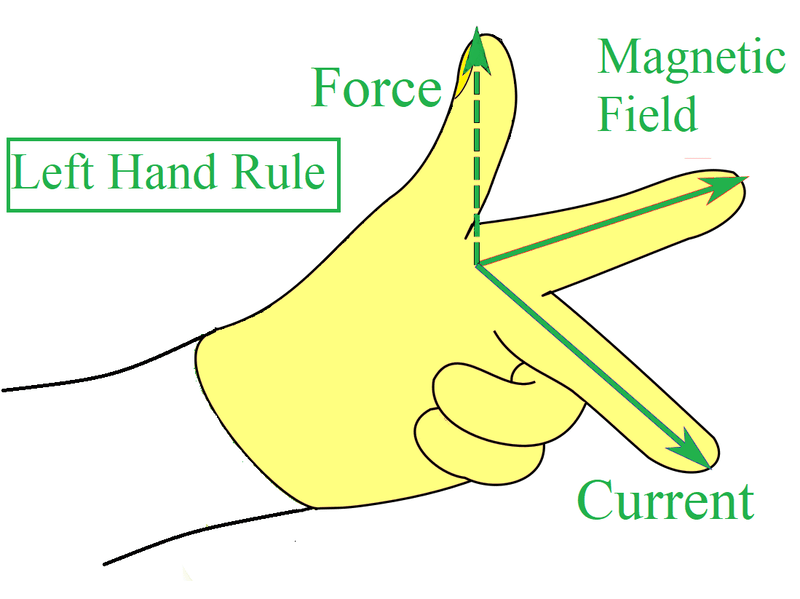
Current is always conventional.
Force direction is always a positive charge.
If a question is about flow of negative charge, use the rule then swap the direction at the end.
where θ = angle of charge movement to field
Generator effect
A conductor moves through a magnetic field.
The magnetic field exerts a force on the electrons in the conductor.
A current is induced in the conductor.
Electromagnetic Induction
Electrons in a wire will experience a force whenever the wire cuts magnetic flux lines
The electrons accumulate on one end of the wire
This causes difference in charge between the ends of the use and a potential difference is set up
So, an emf is induced into the wire
Note: no movement of wire or field = no emf
Ways to increase EMF
Move the wire or field faster
Use a stronger magnet
Increase the number of turns of the coil
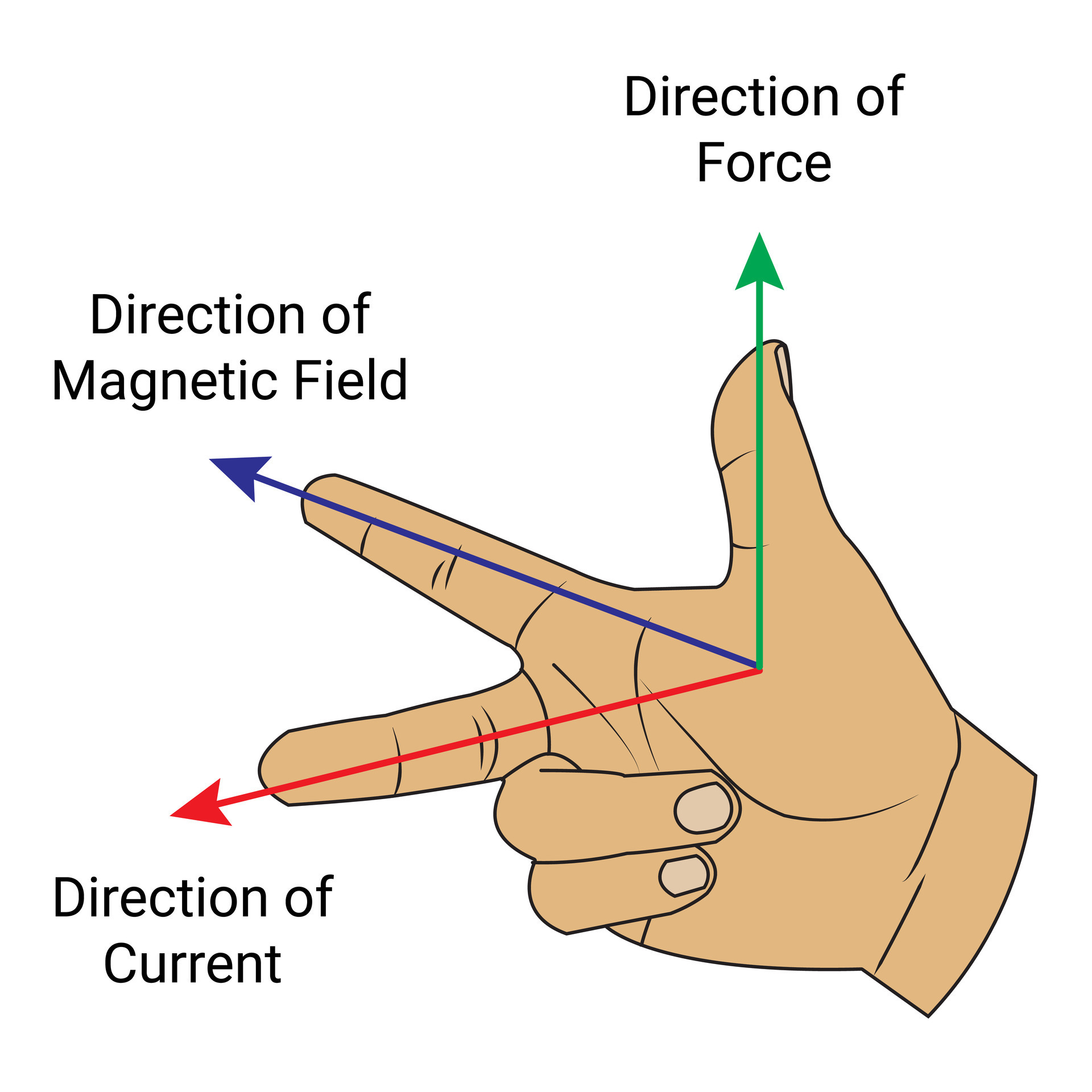
Flemings Right Hand Rule (used only for induced currents)
Magnetic flux (Φ)
(for a single loop)
where cosθ = angle of field to normal of plane
Magnetic flux linkage ( )
Magnetic flux of a coil of wire with N turns
where N = number of turns of wire
Faraday's Law of Electromagnetic Induction
A change of flux linkage of 1Wb per second will induce an emf of 1V in a loop of wire
where ε = induced emf (V)
Lenz's Law
The emf that is induced will be in such a direction as to oppose the charge producing it.
If the negative sign wasn't there, the laws of conservation of energy will be violated
Demonstrating Lenz's Law
When you drop a magnet down a copper tube, what happens?
The copper tube is not magnetic
The magnet has its own magnetic field
When the magnet is dropped, an emf is induced and current starts to flow
The current produces its own magnetic field which is equal and opposite to the magnetic field of the magnet
Applying Lenz's Law, they exert resistive forces on the magnet, slowing it down
Alternating Currents and Transformers
AC | DC |
Constantly changing direction | Flows in one direction |
Produced by generators | Produced by cells or batteries |
Can be transferred across distances with the help of a transformer | Cannot be transferred across distances efficiently |
An AC supply won't be at its peak voltage most of the time | A DC supply will be at its peak voltage most of the time |
AC Current
AC current is a current that charges with time in a regular, repetitive manner
Depends on the voltage and resistance of the supply
Has a repeating sine (sinusoidal) waveform
Transformers
Transformers use electromagnetic induction to change the size of a voltage for an alternating current.
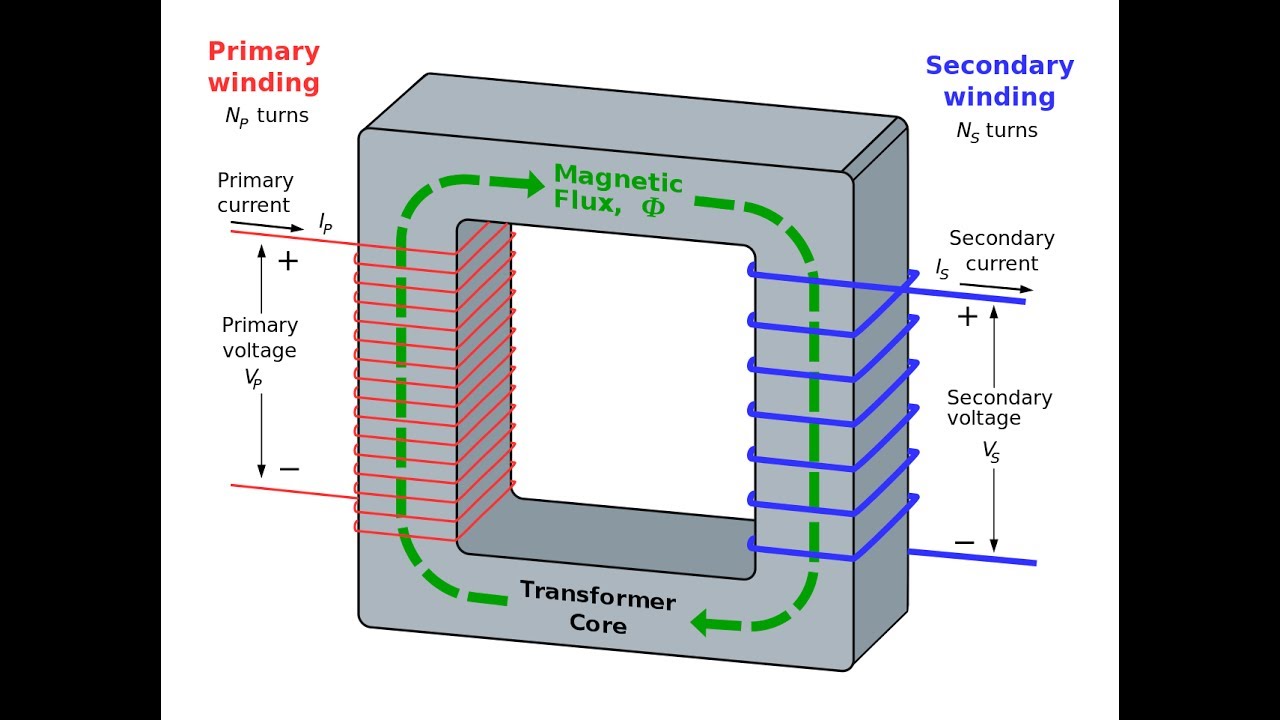
How do transformers work?
Step 1:-
An alternating emf causes an alternating current to flow into the primary coil
This causes the iron core to alternately magnetise and demagnetise
The changing magnetic field is continuously being produced in opposite directions
A DC Current can't do this because the direction isn't changing so flux linkage doesn't change
Step 2:-
Magnetic flux is now rapidly changing
This passes through the secondary coil where it induces an alternating voltage of the same frequency as the input voltage.
Step 3:-
The secondary coil has a different number of turns to the primary cost
The alternating voltage induced is different to the input voltage because:
Step up transformer | Step down transformer |
Increases es alternating voltage | Decreases alternating voltage |