MATHS TERMS
Natural numbers: 1, 2, 3, 4, 5, … (✔)
Whole numbers: 0, 1, 2, 3, 4, 5, … (✔)
Integers: ..., -3, -2, -1, 0, 1, 2, 3, ... (✔)
Rational numbers: Numbers that can be written as fractions, like 2, -5, 0.7, 0.45, ⅔, etc.
Irrational numbers: √7, π, e, etc.
Real numbers: All rational and irrational numbers together (✔)
Multiples of n: Results of multiplying n by natural numbers (✔)
Even numbers: Multiples of 2 (✔)
Odd numbers: Natural numbers not divisible by 2 (✔)
Factors of n: Exact divisors of n (✔)
Prime number: A number with exactly two factors — 1 and itself (✔
Prime factors are found by repeatedly dividing a number by prime numbers until you get 1. (✔ Nice and simple.)
HCF (Highest Common Factor) is the product of the prime factors that are common to BOTH numbers. (✔ Just add "prime" before factors for clarity.)
LCM (Lowest Common Multiple) is the product of all prime factors from both numbers — taking the highest powers. (✅ Small tweak because you need the highest powers when factors show up in both.)
Significant Figures:
All digits are significant except leading zeros (zeros before the first non-zero digit) in a decimal.
WORKED EXAMPLES:
1.
👉 Round 4.3173 to 2 decimal places:
Look at the third decimal place (7).
Since 7 is 5 or more, round up the second decimal place.
✅ Final answer: 4.32.
2.
👉 Round 0.004527 to 2 significant figures:
Ignore the leading zeros (0.00) — they don't count.
2 significant figures are "4" and "5".
The third significant figure is "2" (after the "5").
Since 2 is less than 5, keep the 5 as it is (no rounding up).
✅ Final answer: 0.0045.
Laws of Indices:
ya×yb=ya+b (When multiplying, add the powers.)
ya \ yb=ya−b (When dividing, subtract the powers.)
(ya)b=yab (When a power is raised to another power, multiply the exponents.)
y0=1 (Anything to the power of zero is 1 — as long as y ≠ 0.)
y−n=1yn (Negative powers mean flip it.)
2. Standard Form:
Written as A×10n
Where 1≤A<10 and n is an integer (positive or negative whole number).
Rule for a Linear Sequence:
The rule can be written as:
y = an + b
where:
n = position in the sequence
a = common difference (how much the sequence goes up or down each time)
b = starting adjustment (found by plugging in a known term and solving)
✅ In short:
Find the step (a).
Use any term to find (b).
Boom, you have your formula.
Multiplicative Inverse:
The multiplicative inverse of a number is what you multiply it by to get 1 (the identity).
The multiplicative inverse of 4 is 1\4, because 4×1/4=1
To find it:
Write the number as a fraction if it's not already.
Flip it (invert numerator and denominator).
The multiplicative inverse is also called the reciprocal.
✅ Short version:
Flip the number to get the reciprocal.
Associative Law:
The associative law states that how you group numbers does not affect the result of an operation (addition or multiplication).
Addition: (a+b) + c = a + (b+c)
Multiplication: (a×b) × c =a × (b×c)
Commutative Law:
The commutative law says that the order of the numbers doesn't matter in addition or multiplication.
Addition: a + b = b + a
Multiplication: a × b = b × a
Distributive Law:
The distributive law links addition and multiplication, saying that multiplying a number by a sum is the same as multiplying each term in the sum separately and then adding the results.
Distributive Property: a × (b+c) =a × b + a × c
These properties are foundational in algebra and help simplify expressions and equations.
Simple Interest
I=100P×R×T
Where:
I is the interest earned or paid.
P is the principal (the initial amount of money invested or borrowed).
R is the rate of interest per year (as a percentage).
T is the time the money is invested or borrowed for, in years.
Compound Interest Formula:
The formula for compound interest is:
F=P(1+R100)T
Where:
F is the final amount (principal + interest).
P is the principal (the initial investment or loan amount).
R is the rate of interest per period (usually per year, as a percentage).
T is the time in years.
Compound Interest:
To find the interest earned, you can subtract the principal from the final amount:
I=F−P
Appreciation and Depreciation:
Appreciation (an increase in value) follows the same compound interest formula. For example, if the value of an asset like a house or stock increases, its growth can be modeled using this formula.
Depreciation (a decrease in value) is the opposite. It is like a negative growth rate and can be modeled with a similar formula:
F=P(1−R100)T
Where the negative sign in the formula accounts for the decrease in value over time.
Venn Diagrams (Clean Notes)
Venn Diagrams
A Venn diagram shows relationships between sets using circles.
The rectangle around the circles represents the universal set, usually written as UUU or ξξξ.
Each circle represents a different set inside the universal set.
Vocabulary of Sets
Cardinality: The number of elements in a set.
Example: If set A has 6 elements, we write n(A) = 6.Equivalent Sets: Sets with the same number of elements, even if the elements are different.
Example: n(A) = n(B), so A and B are equivalent.Equal Sets: Sets with exactly the same elements.
Example: {letters in "these"} = {letters in "sheet"} = {e, h, s, t}.Empty Set (Null Set): A set with no elements.
Symbol: ∅
Example: {odd numbers that are multiples of 4} = ∅.Finite Set: A set with a countable number of elements.
Example: {1, 2, 3, 4, 5}.Infinite Set: A set with an uncountable number of elements.
Example: {natural numbers} = {1, 2, 3, 4, 5, 6, …}.Important: Sets do not list the same element more than once, and order does not matter.
Disjoint Sets
Disjoint sets have no elements in common.
Their circles do not overlap on the Venn diagram.
Subsets and Circles
If circle C is inside circle A, it means C is a subset of A.
Complement of a Set (A')
A' is everything not in set A.
Example: If A = {2, 4, 6, 8, 10}, then A' = {1, 3, 5, 7, 9}.
On a Venn diagram, A' is shaded outside of circle A.
Intersection of Sets (A ∩ B)
A ∩ B is the set of elements in both A and B.
Example: A ∩ B = {2}.
On a Venn diagram, this is the overlapping section of circles A and B.
Union of Sets (A ∪ B)
A ∪ B is the set of elements in A, B, or both.
Example: A ∪ B = {2, 3, 4, 5, 6, 7, 8, 10}.
On a Venn diagram, this includes everything inside either A or B.
Describing Regions with Set Notation
A ∩ B = both A and B.
A ∪ B = A or B or both.
A' = everything not in A.
Subsets
If all the elements of set A are also elements of set B, then A is a subset of B.
We write this as A ⊆ B.
Example:
A = {right-angled triangles}
B = {triangles}
C = {polygons}
So, A ⊆ B ⊆ C.
Number of Subsets
The null set (∅) and the set itself are always subsets.
Examples:
The set {a} has 2 subsets: ∅, {a}
The set {a, b} has 4 subsets: ∅, {a}, {b}, {a, b}
The set {a, b, c, d} has 16 subsets:
∅, {a}, {b}, {c}, {d}, {a, b}, {a, c}, {a, d}, {b, c}, {b, d}, {c, d}, {a, b, c}, {a, b, d}, {a, c, d}, {b, c, d}, {a, b, c, d}
General Rule:
If a set has n elements, it has 2ⁿ subsets.
Constructing Venn Diagrams
Venn diagrams can show specific elements or just the number of elements in sets.
To draw a Venn diagram properly, always find and fill in the intersections first (where sets overlap).
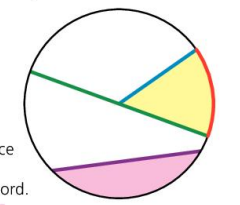
Parts of a Circle
Circumference: The distance around the outside (perimeter) of a circle.
Arc: A part of the circumference.
Diameter: A line crossing the circle through the center.
Radius: A line from the center to the circumference. (Plural: radii)
Chord: A line from one point on the circumference to another point on the circumference.
The diameter is a special type of chord.
Segment: An area cut off by a chord.
Sector: An area cut off by two radii.
Surface Area Formulas:
Surface Area of a Cylinder:
2πr² + 2πrhSurface Area of a Cone:
πr² + πrsSurface Area of a Sphere:
4πr²
Volume Formulas:
Volume of a Prism: Area of base × Height
Volume of a Cone: (1/3)πr²h
Volume of a Sphere: (4/3)πr³
Speed Formula:
Speed = Distance / Time
Class Limits:
Class limits are the upper and lower measures stated in the frequency table.Class Boundaries:
Class boundaries go beyond the limits when continuous data have been rounded.Midpoint of a Class:
The midpoint of a class is the mean of the upper and lower limits.Mode:
The Mode is the MOst common.Median:
The Median is the MiDdle value.Mean:
The Mean is the sum of data divided by the number of items of data.
Modal Group:
The modal group is the most common group.Median Class:
To find the median class, find which class contains the median of all the data.Estimate the Mean:
To estimate the mean, assume all items in the table have the middle value for the group, and then use the rule:
Mean = (Sum of data) / (Number of items of data)
Range:
The range = largest data item - smallest data item.Lower Quartile:
The lower quartile is the data item one quarter of the way from the smallest.Upper Quartile:
The upper quartile is the data item one quarter of the way from the largest.Interquartile Range:
The interquartile range = upper quartile - lower quartile.Semi-Interquartile Range:
The semi-interquartile range = (Interquartile range) / 2Cumulative Frequency Table:
A cumulative frequency table shows the sum of the frequencies up to a given point.Cumulative Frequency Graph:
A cumulative frequency graph always ascends from left to right.Median and Quartiles:
The median and quartiles can be read from a cumulative frequency graph.
Linear Programming:
Linear programming is a method used to find the best outcome (like maximum profit or minimum cost) in a mathematical model.
It involves:
Objective function: What you want to maximize or minimize (e.g., profit = 5x + 3y).
Constraints: Limits or restrictions written as inequalities (e.g., 2x+y≤100)
Feasible region: The area on a graph where all constraints are satisfied.
Vertices (corner points): The best solution usually happens at one of the corners of the feasible region.
Steps:
Write the inequalities.
Graph the inequalities.
Find the feasible region.
Identify the corner points.
Substitute the corner points into the objective function to find the best answer.
Example of Linear Programming:
Problem:
A company makes chairs and tables.
Each chair gives a profit of $40.
Each table gives a profit of $50.
It takes 4 hours to make a chair and 5 hours to make a table.
The company only has 40 hours of work time available per week.
They also can’t make more than 8 chairs per week.
Step 1: Define variables
Let:
x = number of chairs
y = number of tables
Step 2: Set up the inequalities (constraints)
4x + 5y ≤ 40 (time constraint)
x ≤ 8 (chair limit)
x ≥ 0, y ≥ 0 (can't make negative items)
Step 3: Write the objective function
Maximize profit:
P = 40x + 50y
Step 4: Graph the inequalities
(Graph the lines and shade the feasible region.)
Step 5: Find the corner points
(Solve where lines intersect and check axis points.)
Step 6: Substitute corner points into the objective function
Substitute the corner points into P = 40x + 50y to find the highest profit.
Types of Angles
Angles are based on how wide they open. Here are the main ones:
Acute Angle – Less than 90°
Right Angle – Exactly 90°
Looks like an “L”.
Obtuse Angle – Between 90° and 180°
Wider than a right angle.
Straight Angle – Exactly 180°
A straight line.
Reflex Angle – More than 180° but less than 360°
Loops back more than halfway.
Full Rotation – 360°
A full circle.
. Using a Protractor (if it's drawn):
Place the protractor’s center on the angle's vertex.
Line up one side with 0°.
Read where the other side falls on the protractor
Angle Rules
Rule 1: Angles on a straight line add up to 180°
Rule 2: Angles around a point add up to 360°
Rule 3: Vertically opposite angles are equal
Rule 4: Interior angles of a triangle add up to 180°
Rule 5: Interior angles of a quadrilateral add up to 360°
Rule 6: Corresponding angles (on parallel lines) are equal
Rule 7: Alternate angles (on parallel lines) are equal
Rule 8: Co-interior (same-side interior) angles add up to 180°
Rule 9: In an equilateral triangle, all angles are 60°
Rule 10: In an isosceles triangle, the base angles are equal
Rule 11: The exterior angle of a triangle = the sum of the two opposite interior angles