5.2.1(g) factors affecting photosynthesis + rate of photosynthesis
spec points
(i) factors affecting photosynthesis
(ii) practical investigations into factors affecting the rate of photosynthesis.
To include limiting factors in photosynthesis with reference to carbon dioxide concentration, light intensity and temperature, and the implications of water stress (stomatal closure) AND the effect on the rate of photosynthesis, and on levels of GP, RuBP and TP, of changing carbon dioxide concentration, light intensity and temperature.
M0.1, M0.2, M0.3, M1.1, M1.3, M1.11, M3.1, M3.2, M3.4, M3.5, M3.6, M4.1 PAG4, PAG10, PAG11 HSW3, HSW4, HSW5, HSW12
factors that affect the rate of photosynthesis
light intensity
number of chlorophyll
number of pigments
temperature
leaf size
carbon dioxide concentration
water availability
light wavelength
duration of light per day
wind + humidity (indirect)
limiting factor
Photosynthesis is affected by many factors, the factor in lowest supply and therefore limiting the rate of the reaction is known as the limiting factor.
Limiting factor: the factor that is present at the lowest/least favourable value (and so therefore limiting the rate)
Law of limiting factors states that the rate of a metabolic process is limited (“prevents” the reaction from being faster) by the factor that is at its least favourable value
If there is a shortage of any of these factors, photosynthesis cannot occur at its maximum possible rate
Limiting factors include:
Light intensity – if this is in short supply the light-dependent reaction will slow therefore there will be lower amounts of ATP and NADPH created. This will then affect the Calvin cycle as these are needed to convert GP to TP. So the level of GP will rise and TP will fall which in turn causes RuBP levels to fall.
CO2 concentration – if this is in short supply the light-independent reaction will slow
Temperature – if this is low Rubisco and other molecules will have lower levels of kinetic energy therefore the enzyme-controlled reactions are affected
If any one of these factors is below the optimum level for the plant, its rate of photosynthesis will be reduced, even if the other two factors are at the optimum level
light intensity
When temperature and carbon dioxide concentration remain constant, changes in light intensity affect the rate of photosynthesis
The rate of photosynthesis increases as light intensity increases:
The greater the light intensity, the more energy supplied to the plant and therefore the faster the light-dependent stage of photosynthesis can occur
This produces more ATP and reduced NADP for the Calvin cycle (light-independent stage), which can then also occur at a greater rate
During this stage of the graph below, light intensity is said to be a limiting factor of photosynthesis
At some point, if light intensity continues to increase, the relationship above will no longer apply and the rate of photosynthesis will reach a plateau
At this point, light intensity is no longer a limiting factor of photosynthesis – another factor is limiting the rate of photosynthesis
The factors which could be limiting the rate when the line on the graph is horizontal include temperature being too low or too high, or not enough carbon dioxide
carbon dioxide concentration
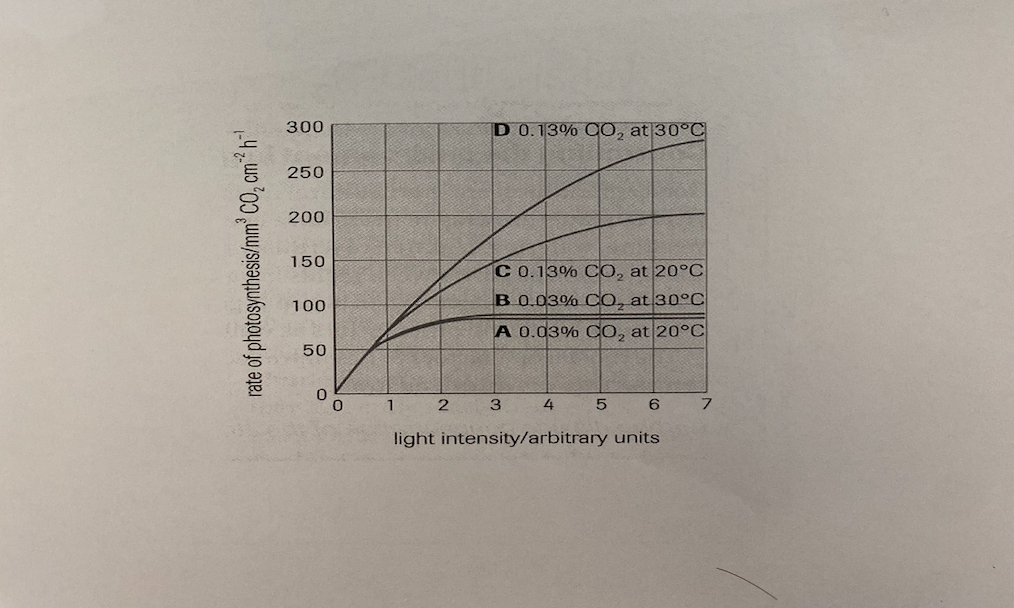
The rate of photosynthesis increases as carbon dioxide concentration increases:
Carbon dioxide is one of the raw materials required for photosynthesis
It is required for the light-independent stage of photosynthesis, when CO2 is combined with the five-carbon compound ribulose bisphosphate (RuBP) during carbon fixation
This means the more carbon dioxide that is present, the faster this step of the Calvin cycle can occur and the faster the overall rate of photosynthesis
This trend will continue until some other factor required for photosynthesis prevents the rate from increasing further because it is in short supply
The natural level of CO2 in the atmosphere is 0.04%, it is therefore not advisable to increase the CO2 concentration much higher than this as it can become toxic
The factors which could be limiting the rate when the line on the graph is horizontal include temperature being too low or too high, or not enough light
temperature
As temperature increases the rate of photosynthesis increases, as the reaction is controlled by enzymes
However, as the reaction is controlled by enzymes this trend only continues up to a certain temperature, beyond which the enzymes begin to denature and the rate of reaction decreases
For most metabolic reactions, temperature has a large effect on reaction rate
For photosynthesis, temperature does not have a significant effect on the light-dependent reactions, as these are driven by energy from light rather than the kinetic energy of the reacting molecules
However, the Calvin cycle is affected by temperature, as the light-independent reactions are enzyme-controlled reactions (e.g. rubisco catalyses the reaction between CO2 and the five-carbon compound ribulose bisphosphate)
As long as there is enough light energy to produce ATP and NADPH in the light-dependent reaction, increasing temperature up to an optimum temperature (this will vary by species and what its natural habitat is) will increase the rate of the light-independent reactions and therefore the rate of photosynthesis
Although the rate of enzymatic reactions is the main component affected by temperature, other components of the process can also be affected:
Increasing temperature causes stomata on the leaves to close in order to reduce water loss; when the stomata are closed CO2 cannot enter the leaves and photosynthesis will slow down
The light-dependent reaction relies on a proton gradient forming across the thylakoid membrane; membrane permeability can be influenced by extreme temperatures, which may lead to a dissipation of the proton gradient and a slowing down of photosynthesis
questions + graphs
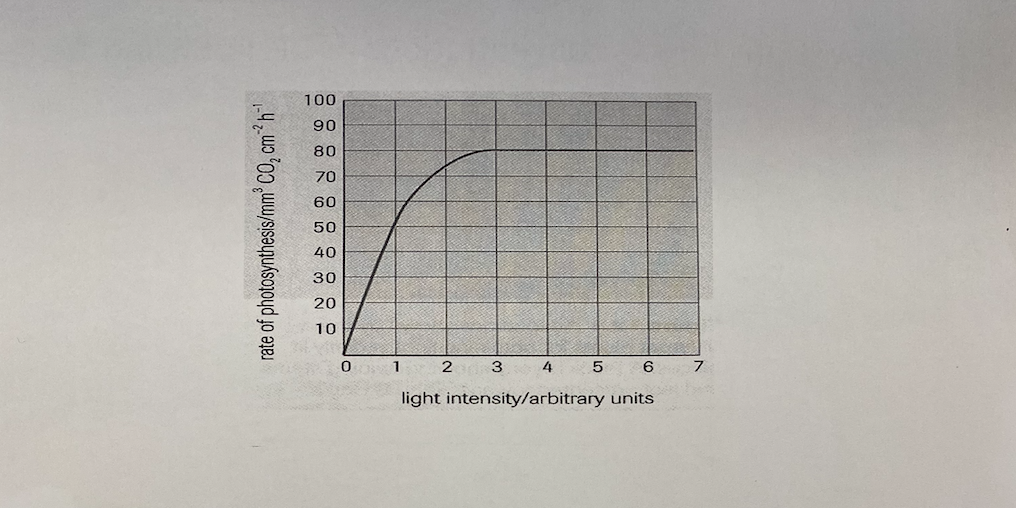
effect of increasing light intensity on rate of photosynthesis increases with increasing light intensity up to 3 light intensity/arbitrary units
explain the effect of increasing light intensity
as LI increases so does rate of photosynthesis because light provides the energy needed for the light-dependent reactions of photosynthesis, so more light enables the plant to produce more ATP and NADPH, which are required for the Calvin cycle. However, after around 3 units of LI, rate of photosynthesis levels off and becomes constant. This suggests that the plant has reached a point where light intensity is no longer the limiting factor. The rate of photosynthesis cannot increase further because other factors (carbon dioxide concentration or temperature) are now limiting the process.
what factor may be limiting rate of photosynthesis
carbon dioxide concentration or temperature
how light affects concentrations of GP, RuBP and TP
at 2 minuted when the light has no supply the light-dependent reaction slows therefore there will are lower amounts of ATP and NADPH being created. This affects the Calvin cycle as these are needed to convert GP to TP. So the level of GP will rise and TP will fall which in turn causes RuBP levels to fall.
The concentrations of glycerate 3-phosphate (GP), triose phosphate (TP) and ribulose bisphosphate (RuBP) within chloroplasts can be affected by changes to light intensity and carbon dioxide concentration
A decrease in light intensity causes a decrease in TP and RuBP concentrations but a slight increase in GP concentration
When there is less light available the light-dependent stage stops and does not form any more products needed for the light-independent stage (ATP and NADPH)
As a consequence, GP builds up as it is not converted to TP
A lack of TP means that RuBP will not form
Over time the fixation of carbon dioxide will stop and the concentration of GP will plateau
co2 effect on concentrations of GP, RuBP and TP
if low slows light-independent reaction
Very low concentrations of carbon dioxide (less than 0.01%) causes a decrease in the concentration of GP and TP but an increase in RuBP concentration
RuBP accepts carbon dioxide so when there is a lack of carbon dioxide molecules it remains unfixed and builds up
The lack of carbon dioxide fixation prevents GP and TP molecules from forming
temperature effect on photosynthesis
if this is low Rubisco and other molecules will have lower levels of kinetic energy therefore the enzyme-controlled reactions are affected
how can we measure the rate of photosynthesis
rate of oxygen production
oxygen is produced from photolysis of water in LDR
rate of CO2 uptake
CO2 is used/fixed in Calvin cycle
measure changes in pH
change in mass of plant
measuring the rate of oxygen production
Investigations to determine the effects of light intensity, carbon dioxide concentration and temperature on the rate of photosynthesis can be carried out using aquatic plants, such as Elodea or Cabomba (types of pondweed)
I.V: vary light intensity by different distances of lamp from pond weed
5 distances 0,10,20,30,40,50 cm
inverse relationship between light intensity and distance
light intensity = 1/d2 or could use lux meter to calculate the light intensity at the different distances
D.V: count bubbles in water in set time
Set up:
Large beaker full of water (water bath) at 20ºC to control temp
Use thermometer to monitor temp
Cut a set length of pond weed (10cm). Place in boiling tube.
Add set volume of set concentration of NA+HCO3 to control CO2 conc (not limited)
Place in water bath
Turn off the other lights + Make sure there is no ambient light (close blinds, switch ceiling lights etc. off)
Turn light on at first distance (e.g. 0cm)
Acclimatisation time
count bubbles produced in set time (5 min)
Lights off
Repeat at different distances
REPEATS 5 IN TOTAL
Controls:
temperature
Co2 concentration
species of plant/length of plant - SA
lamp type/wattage
ambient light
Data:
calculate rate for each repeat
bubbles/time → bubbles per minute
calculate the mean rate
graph of mean rate vs distance