Module 4: Risk Management
Introduction to Risk Management
The upper management of an organization is responsible for overseeing, enabling, and supporting the structuring of IT and information security functions to defend its information assets.
Part of upper management’s information security governance requirement is the establishment and support of an effective risk management (RM) program.
To keep up with the competition, organizations must design and create safe environments in which their business processes and procedures can function.
These environments must maintain confidentiality and privacy and assure the integrity of an organization’s data - objectives that are met by applying the principle of risk management.
Sun Tzu and the Art of Risk Management
If you know the enemy and know yourself, you need not fear the result of a hundred battles. If you know yourself but not the enemy, for every victor gained you will also suffer a defeat. If you know neither the enemy nor yourself, you will succumb in every battle. _ Sun Tzu
Know yourself: identity, examine, and understand the information assets and systems currently in place, and their vulnerabilities.
Know the enemy: identify, examine, and understand the threats facing the organization’s information assets.
The Risk Management Framework
Risk management involves discovering and understanding answers to some key questions about the risk associated with an organization’s information assets:
- Where and what is the risk (risk identification)?
- How severe is the current level of risk (risk analysis)?
- Is the current level of risk acceptable (risk evaluation)?
- What do I need to do to bring the risk to an acceptable level (risk treatment)?
Risk Management: The process of identifying risk, assessing its relative magnitude, and taking steps to reduce it to an acceptable level.
Risk Identification: the recognition, enumeration, and documentation of risks to an organization’s information assets.
Risk Assessment: A determination of the extent to which an organization’s information assets are exposed to risk.
Risk Treatment (risk control): The application of safeguards or controls that reduce the risks to an organization’s information assets to an acceptable level.
Risk Management (RM) is a complex operation that requires a formal methodology.
Risk management involves to key areas: the RM framework and the RM process.
The RM framework is the overall structure of the strategic planning and design for the entirety of the organization’s RM efforts.
The RM process is the implementation of risk management, as specified in the framework.
In other words, the RM framework (planning) guides the RM process (doing), which conducts the processes of risk evaluation and remediation.
The RM framework consists of five key stages:
- Executive Governance and Support
2. Framework design
- Framework Implementation
- Framework Monitoring and Review
- Continuous Improvement
The Roles of the Communities of Interest
Information security, information technology, and business management and users all must work together.
Communities of interest are responsible for: Evaluating current and proposed risk controls. Determining which control options are cost-effective for the organization. Acquiring or installing the needed controls. Ensuring that the controls remain effective.
The Risk Management Policy
This policy converts the instructions and perspectives provided to the RM framework team by the governance group into cohesive guidance that structures and directs all subsequent risk management efforts within the organization.
The RM policy is a strategic document that formalizes much of the intent of the governance group.
Most RM policies include the following sections: Purpose and scope, RM intent and objectives, roles and responsibilities, resource requirements, risk appetite and tolerances, RM program development guidelines, special instructions and revision information, references to other key policies, plans, standards, and guidelines.
Framework Design
In this stage, the framework team begins designing the RM process by which the organization will understand its current levels of risk and determine what, if anything, it needs to do to bring those levels down to an acceptable level in alignment with the risk appetite specified earlier in the process.
In addition to coordinating with the governance group of the tasks outlined in the previous section, the framework team must also formally document and define the organization’s risks appetite and draft the risk management (RM) plan.
Defining the Organization’s Risk Tolerance and Risk Appetite
Risk Appetite: the quantity and nature of risk that organizations are willing to accept as they evaluate the trade-offs between perfect security and unlimited accessibility.
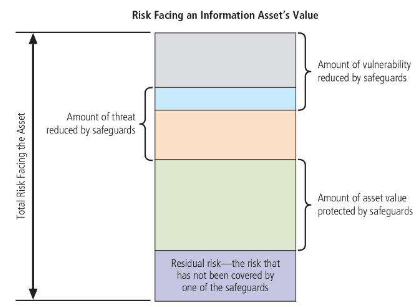
Residual Risk: The risk to information assets that remains even after current controls have been applied.
Risk Tolerance (risk threshold): The assessment of the amount of risk an organization is willing to accept for a particular information asset.
The goal of information security is to bring residual risk in alignment with risk appetite.
Framework Implementation
The implementation of the RM plan, specifically including the RM process, is likely to be influenced by the organizations risk appetite.
Implementation methods include: Desk check, Pilot-test, Phased approach, Direct cutover (cold-turkey conversion)
Framework Monitoring and Review
After the initial implementation and as the RM effort proceeds, the framework team continues to monitor the conduct of the RM process while simultaneously reviewing the utility and relative success of the framework planning function itself.
Once the RM process is implemented and operating, the framework team is primarily concerned with the monitoring and review of the overall RM process cycle.
The Risk Management Process
The RM plan guides the implementation of the RM process, in which risk evaluation and remediation is conducted.
This process uses the following tasks: Establishing the context. Identifying risk. Analyzing risk. Evaluating the risk and comparing uncontrolled risks against the risk appetite. Treating the unacceptable risk. Summarizing the findings.
RM Process Preparation - Establishing the Context
As the RM process team convenes, it is initially briefed by representatives of the framework team and possibly by the governance group.
These groups seek to provide the executive guidance for the work to be performed by the RM process team, and to ensure that the team’s efforts are in alignment with managerial intent, as documented in the RM policy.
NIST’s Special Publication (SP) 800-30, Rev. 1, “Guide for Conducting Risk Assessments,” recommends preparing for the risk process by performing the following tasks: Identify the purpose of the assessment; Identify the scope of the assessment; Identify the assumptions and constraints associated with the assessment; Identify the sources of information to be used as inputs to the assessment; Identify the risk model and analytic approaches.
Risk Assessment: Risk Identification
The first operational phase of the RM process is the identification of risk.
At this stage, manager must:
- Identify the organization’s information assets
- Classify them
- Categorize them into useful groups
- Prioritize them by overall importance
Assessing the Value of Information Assets
As each information asset is identified, categorized, and classified, a relative value must be assigned to it to ensure that the most valuable information assets are given the highest priority when managing risk.
Which information asset: Is most critical to the organization's success? Generates the most revenue? Generates the highest profitability? Is the most expensive to replace? Is the most expensive to protect? Would be the most embarrassing or cause the greatest liability if lost or compromised?
Prioritizing (Rank-Ordering) Information Assets
The final step in the risk identification process is to prioritize, or rank-order, the assets.
This goal can be achieved by using a weighted table analysis. List information assets. Select criteria. Specify criteria weights. Assess each asset. Calculate weighted averages. Rank order by score.
Threat Assessment
Realistic threats need investigation; unimportant threats are set aside.
Weighted tables can assist in assessing threats.
Threat assessment: Which threats present an actual danger to our information assets? Which threats are internal, and which are external? Which threats have the highest probability of occurrence? Which threats have the highest probability of success? Which threats could result in the greatest loss if successful? Which threats can the organization handle least effectively? Which threats cost the most to protect against from? Which threats cost the most to recover from?
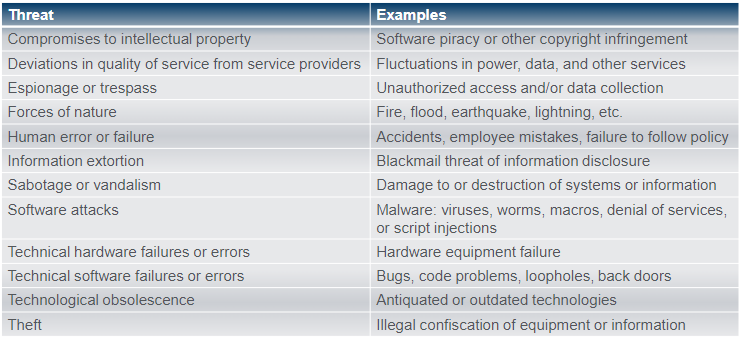
Threats to Information Security
Vulnerability Assessment
Specific avenues threat agents can exploit to attack an information asset are called vulnerabilities.
Examine how each threat could be perpetrated and list the organization’s assets and vulnerabilities.
The process works best when people with diverse backgrounds within an organization work iteratively in a series of brainstorming sessions.
At the end of the risk identification process, a prioritized list of assets with their vulnerabilities is achieved. Can be combined with weighted list of threats to from threats-vulnerabilities-assets (TVA) worksheet.
Risk Assessment: Risk Analysis
Risk analysis assesses risk for each vulnerability and assigns a risk rating or score to each information asset.
The goal is to develop a repeatable method to evaluate the relative risk of each vulnerability that has been identified and added to the list.
If a vulnerability is fully managed by an existing control, it can be set aside.
If it is partially controlled, you can estimate what percentage of the vulnerability has been controlled.
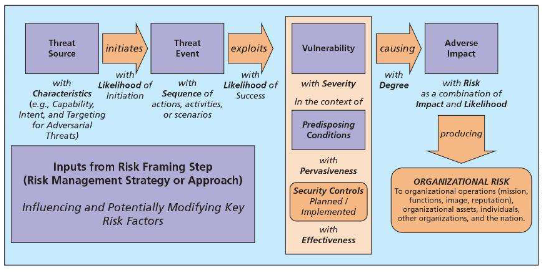
NIST Generic Risk Model with Key Risk Factors
Determining the Likelihood of a Threat Event
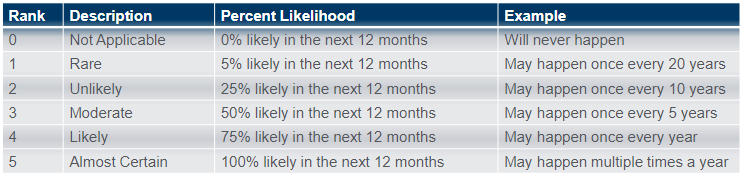
Likelihood is the overall rating- a numerical value on a defined scale - of the probability that a specific vulnerability will be exploited or attacked, commonly referred to as a threat event.
The likelihood of occurrence is a weighted risk factor based on an analysis of the probability that a given threat is capable of exploiting a given vulnerability (or set of vulnerabilities). The likelihood risk factor combines an estimate of the likelihood that the threat event will be initiated with an estimate of the likelihood of impact (i.e., the likelihood that the threat event results in adverse impacts). For adversarial threats, an assessment of likelihood of occurrence is typically based on: (i) adversary intent; (ii) adversary capability; and (iii) adversary targeting. For other than adversarial threat events, the likelihood of occurrence is estimated using historical evidence, empirical data, or other factors (NIST SP 800-30, r. 1).
Risk Likelihood
Assessing Potential Impact on Asset Value
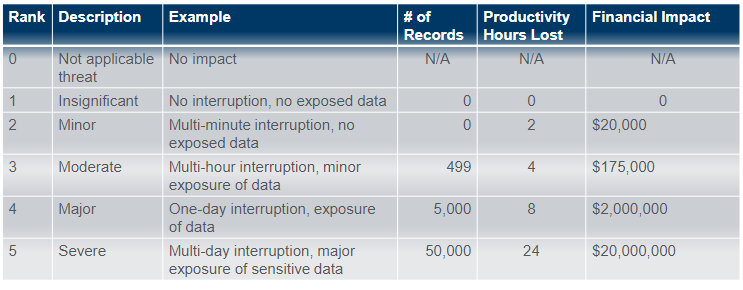
Once the probability of an attack by a threat has been evaluated, the organization typically looks at the possible impact or consequences of a successful attack.
The level of impact from a threat event is the magnitude of harm that can be expected to result from the consequences of unauthorized disclosure of information, unauthorized modification of information, unauthorized destruction of information, or loss of information or information systems availability…
Organizations make explicit: (i) the process used to conduct impact determinations; (ii) assumptions related to impact determinations; (iii) sources and methods for obtaining impact information; and (iv) the rationale for conclusions reached with regard to impact determinations (NIST SP 800-30, r. 1).
Risk Impact
Aggregation and Uncertainty
If the RM process begins to overwhelm an organization, the RM team can begin merging or aggregating groups of assets, threats, and their associated risks into more general categories.
It is not possible to know everything about every vulnerability, such as the likelihood of an attack against an asset or how great an impact a successful attack would have on the organization.
The degree to which a current control can reduce risk is also subject to estimation error.
A factor that accounts for uncertainty must always be considered; it consists of an estimate made by the manager using good judgment and experience.
Risk Determination
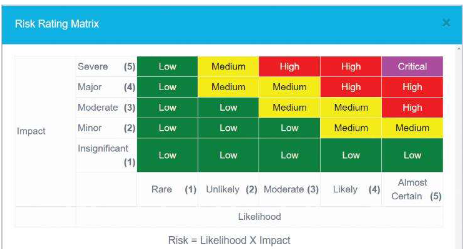
Once the likelihood and impact are known, the organization can perform risk determination using a formula that seeks to quantify certain risk elements.
In this formula, risk equals likelihood of threat event (attack) occurrence multiplied by impact (or consequence), plus or mines an element of uncertainty.
Clearwater IRM Risk Rating Matrix
Risk Evaluation
Once the risk ratings are calculated for all TVA triples, the organization needs to decide whether it can live with the analyzed level of risk.
If residual risk is greater than risk appetite, look for treatment strategies to further the reduce the risk.
If residual is less than risk appetite, document the results and proceed to the latter stages of risk management.
Documenting the Results of Risk Assessment
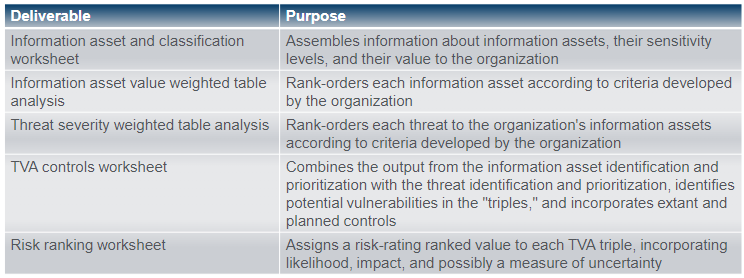
The final summarized document is the ranked vulnerability risk worksheet.
The worksheet describes asset, asset relative value, vulnerability, loss frequency, and loss magnitude.
The ranked vulnerability risk worksheet is the initial working document for the next step in the risk management process: assessing and controlling risk.
Risk Assessment Deliverables
Risk Treatment/Risk Response
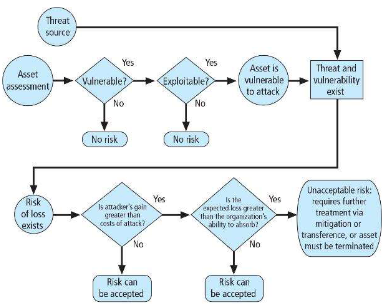
After the risk management (RM) process team has identified, analyzed, and evaluated the level of risk current inherent in its information assets (risk assessment), it then must treat the risk that is deemed unacceptable when it exceeds its risk appetite.
This process is also known as risk response or risk control.
As risk treatment begins, the organization has a list of information assets with currently unacceptable levels of risk; the appropriate strategy must be selected and then applied for each asset.
Once the project team for InfoSec development has identified the information assets with unacceptable levels of risk, the team must choose one of four basic strategies to treat the risks for those assets: Mitigation, Transference, Acceptance, Termination.
Risk Mitigation
The mitigation risk treatment strategy, sometimes referred to as risk defense or simply risk mitigation, attempts to prevent the exploitation of the vulnerability.
This is preferred approach, and it is accomplished by means of countering threats, removing vulnerabilities in assets, limiting access to assets, and adding protective safeguards.
In essence, the organization is attempting to improve the security of an information asset by reducing the likelihood or probability of a successful attack.
Risk Transference
The transference risk treatment strategy, sometimes known as risk sharing or simply risk transfer, attempts to shift risk to another entity.
This goal may be accomplished by rethinking how services are offered, revising deployment models, outsourcing to other organizations, purchasing insurance, or implementing service contracts with providers.
The key to an effective transference risk treatment strategy is the implementation of an effective service level agreement (SLA).
Risk Acceptance
The acceptance risk treatment strategy, or simply risk acceptance, is the decision to do nothing beyond the current level of protection to shield an information asset from risk and to accept the outcome from any resulting exploitation.
Acceptance is a valid strategy only when the organization has: determined the level of risk to the information asset. Assessed the probability and likelihood. Estimated the potential impact of a successful attack. Evaluated potential controls. Performed a thorough risk assessment. Determined that the costs to treat the risk do not justify the cost of the controls.
Risk Termination
The termination risk treatment strategy, also known as risk avoidance or simply risk termination, is based on the organization’s intentional choice not to protect an asset.
The organization does not want the information asset to remain at risk and removes it from the operating environment by shutting it down or disabling its connectivity to potential threats.
Sometimes the cost of protecting an asset outweighs its value.
In any case, termination must be a conscious business decision, not simply the abandonment of an asset.
Process Communications, Monitoring, and Review
As the process team works through the various RM activities, it needs to continually provide feedback to the framework team about relative success and challenges of its RM activities, to improve not only the process but the framework as well.
Process Communications involve requesting and providing information as direct feedback about issues that arise in the implementation and operation of each stage of the process.
Process Monitoring and Review involves establishing and collecting formal performance measures and assessment methods to determine the relative success of the RM program.
Managing Risk
The goal of InfoSec is to bring residual risk in line with an organization’s risk appetite, not to bring risk to zero.
Rules of thumb for selecting a strategy:
When a vulnerability exists in an important asset - Implement security controls to reduce likelihood.
When a vulnerability can be exploited - Apply controls to minimize the risk or prevent the occurrence of an attack.
When the attacker’s potential gain is greater than the cost of attack - Apply protections to increase the attacker’s cost or reduce the attacker’s gain.
When the potential loss is substantial - Apply protections to limit the extent of the attack, reducing the potential for loss.
Residual Risk
Risk-Handling Action Points
Risk Treatment Cycle
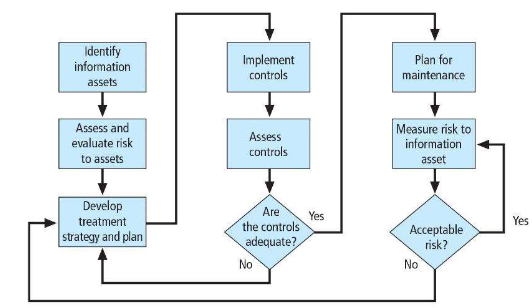
Feasibility and Cost-Benefit Analysis
Before implementing one of the control strategies for a specific vulnerability, the organization must explore all consequences of vulnerability to information assets.
There are several ways to determine the advantages/disadvantages of a specific control.
Items that affect the cost of a control or safeguard include cost of development or acquisition, training fees, implementation cost, service costs, and cost of maintenance.
Common sense dictates that an organization should not spend more to protect an asset than it is worth; this decision-making process called a cost-benefit analysis (CBA) or an economic feasibility study.
Asset Valuation
Asset valuation involves estimating real/perceived costs associated with design, development, installation, maintenance, protection, recovery, and defense against loss/litigation.
Process result is the estimate of potential loss per risk.
Expected loss per risk stated in the following equation:
Annualized Loss Expectancy (ALE) = Single Loss Expectancy (SLE) x Annualized Rate of Occurrence (ARO)
- SLE = Asset Value x exposure factor (EF)
CBA determines if an alternative being evaluated is worth the cost incurred to control the vulnerability.
The CBA is most easily calculated using the ALE from earlier assessments, before implementation of the proposed control:
CBA = ALE(prior) - ALE(post) - ACS
ALE (prior) is the annualized loss expectancy of risk before implementation of the control.
ALE (post) is the estimated ALE based on control being in place for a period of time.
ACS is the annualized cost of the safeguard.
Alternate Risk Management Methodologies
The Operationally Critical Threat, Asset, and Vulnerability Evaluation (OCTAVE) MEthod was a risk evaluation methodology promoted by Carnegie Mellon University’s Software Engineering Institute (SEI), and it had three versions:
The original OCTAVE Method, for large organizations.
OCTAVE-S, for smaller organizations of about 100 users.
OCTAVE-Allegro, a streamlined approach for InfoSec assessment and assurance.
Factor Analysis of information Risk (FAIR), by Jack A. Jones, became CXOWARE, which built FAIR into an analytical software suite called RiskCalibrator. FAIR was adopted by the Open Group as an international standard for risk management and rebranded as OPEN FAIR. Later, CXOWARE became RiskLens, and the FAIR institute was established.
ISO and NIST RMF
The International Organization for Standardization (ISO) has several standards related to information security and two that specifically focus on risk management:
ISO 27005 information technology - security techniques - information security risk management
ISO 31000 risk management - guidelines
The National Institute of Standards and Technology (NIST) has modified its fundamental approach to systems management and certification/accreditation to one that follows the industry standard of effective risk management.
Two key documents describe the RMF:
SP 800-37, REV. 2 Risk Management Framework for Information Systems and Organizations.
SP 800-39, Managing Information Security Risk: Organization, Mission, and Information System View.
Selecting the Best RM Model
For organizations that have no risk management process in place, a recommended approach is to begin by studying the models presented earlier in this module and identifying what each offers to the envisioned process.
Other organizations may hire a consulting firm to provide or even develop a proprietary model.
When faced with the daunting task of building a risk management program from scratch, it may be best to talk with other security professionals, perhaps through professional security organizations like ISSA, to find out how others in the field have approached this problem.
No two organizations are identical, so what works well for one organization may not work well for others.
Summary
Risk management examines and documents an organization’s information assets.
Management is responsible for identifying and controlling the risks that an organization encounters. In the modern organization, the InfoSec group often plays a leadership role in risk management.
Risk appetite defines the quantity and nature of risk that organizations are willing to accept as they evaluate the trade-offs between perfect security and unlimited accessibility.
Residual risk is the amount of risk unaccounted for after the application of controls.
A key component of a risk management strategy is the identification, classification, and prioritization of the organization’s information assets.
Assessment is the identification of assets, including all the elements of an organization’s system: people, procedures, data, software, hardware, and networking elements.
The human resources, documentation and data information assets of an organization are not easily identified and documented as tangible assets, such as hardware, software. Less tangible assets should be identified and described using knowledge, experience, and judgement.
You can use the answers to the following questions to develop weighting criteria for information assets: Which information asset: Is most critical to the organization's success? Generates the most revenue? Generates the highest profitability? Is the most expensive to replace? Is the most expensive to protect? Would be the most embarrassing or cause the greatest liability if lost or compromised?
After the organization identifies and performs preliminary classification of information assets, the threats facing the organization should be examined. There are 12 general categories of threats to InfoSec.
Each threat must be examined during a threat assessment process that addresses the following questions:
Which of the threats exist in the organizations environment?
Which are the most dangerous to the organization’s information?
Which require the greatest expenditure for recovery?
Which require the greatest expenditure for protection?
Each information asset is evaluated for each threat it faces; the resulting information is used to create a list of the vulnerabilities that pose risks to the organization. This process results in an information asset and vulnerability list, which serves as the starting point for risk assessment.
A threats-vulnerabilities-assets (TVA) worksheet lists assets in priority order along one axis and threats in priority order along the other axis. The resulting grid provides a convenient method of examining the “exposure” of assets, allowing a simple vulnerability assessment.
The goal of risk assessment is the assignment of a risk rating or score that represents the relative risk for a specific vulnerability of a specific information asset.
It is possible to perform risk analysis using estimates based on a qualitative assessment.
Qualitative assessments are easier, but harder to convey risk than quantitative assessments.
If any specific vulnerability is completely managed by an existing control, it no longer needs to be considered for additional controls.
The risk identification process should designate what function the resulting reports serve, who is responsible for preparing them, and who reviews them. The TVA worksheet and other risk worksheets are working documents for the next step in the risk management process: treating and controlling risk.
Once vulnerabilities are identified and ranked, a strategy to control the risks must be chosen. Four control strategies are mitigation, transference, acceptance, and termination.
Economic feasibility studies determine and compare costs and benefits from potential controls (cost-benefit analysis, or CBA). A CBA determines whether a control alternative is worth is associated cost.
CBA calculations are based on costs before and after controls are implemented and the cost of controls.
Other forms of feasibility analysis include analyses based on organization, operational, technical, and political factors.
An organization must be able to place a dollar value on each collection of information and information assets it owns. There are several methods an organization can use to calculate these values.
Single Loss Expectancy (SLW) is calculated from the value of the asset and the expected percentage of loss that would occur from a single successful attack. Annualized Loss Expectancy (ALE) represents the potential loss per year.
Alternative approaches to risk management include the OCTAVE Method, ISO 27005, the NIST risk management approach, and FAIR.