Digital marketing fundamentals
Marketing Communications in the Digital Age
Class Objectives
Provide insight into digital marketing.
What is Digital Marketing?
Definition:
Digital marketing involves the use of digital technologies to create an integrated, targeted, and measurable exchange of value aimed at acquiring and retaining customers while building deeper relationships with them. (DMI, 2018)
It is characterized by the marketing of products, services, information, and ideas through digital technologies including the internet, smartphones, games, display advertising, and other digital mediums.
It emphasizes understanding people rather than just the underlying technologies; the focus is on how individuals use technology and how to leverage that for effective engagement. (Ryan, 2014)
Semantics of Information Connections
Overview of technological evolution and web progression:
Desktop
WebOS
Web 4.0
Semantic Web (including OWL, OpenID, AJAX, SPARQL, SWRL)
Intelligent personal agents and Semantic Search (2010-2020)
Web 3.0 (Distributed Search)
Web 2.0 (Social Media, Mashups)
Web 1.0 (Websites, Keyword Search)
PC Era and early internet technology developments (1980-1990)
A timeline chart from Gopher (1990) to various web technologies illustrating content delivery methods over decades.
Digital Divide
Factors contributing to the digital divide:
Location: Weak or no access to the internet in specific regions.
Education: Lack of digital skills and capabilities among the population.
Technology adoption: Limited understanding of the internet, particularly among older Digital Immigrants.
Economy: Financial barriers preventing the purchase of computers or other devices.
Consumer Interaction Models
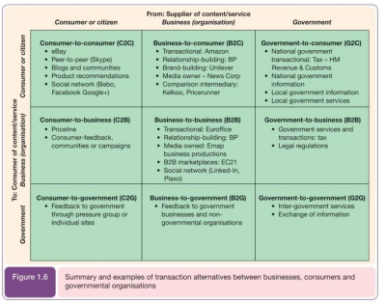
Different consumer and government interactions:
Consumer-to-Consumer (C2C): e.g., eBay, peer-to-peer communications like Skype, blogs, and social networks (Facebook, Google+).
Consumer-to-Business (C2B): Platforms that allow consumer feedback (Priceline) or campaigns.
Consumer-to-Government (C2G): Feedback mechanisms from citizens to government sites.
Business-to-Consumer (B2C): Includes transactional sites like Amazon and relationship-focused brands like BP.
Business-to-Business (B2B): Transactional (Euroffice) and relationship-building (BP) models.
Government-to-Consumer (G2C): Services from the government such as tax information and local services.
Government-to-Business (G2B): Legal regulations and services for businesses.
Government-to-Government (G2G): Services and information exchange among government entities.
Basic Communications Theory
Shannon’s Communication Model (1916):
The model includes components such as:
Source: Origin of the message.
Message: What is being communicated.
Medium: The channel used for communication.
Receiver: The target audience.
Noise: External factors that disrupt communication.
Feedback: Responses from the receiver back to the source.
Differences Between Digital and Traditional Marketing
*models in pp
Technology-enabled: Tools and processes are accessible via the Internet.
Data-driven: Real-time consumer activity can be tracked through metrics and analytics.
Globally connected: Access to a global audience through online platforms.
Agile and flexible: Ability to adjust campaigns quickly.
Dynamic and logical targeting: Specifying which customers to engage with, where, and when.
Uses of Digital Marketing
Advertising: Digital platforms act as mediums for ads.
Direct-response mechanisms: Interaction via advertisements enables tracking responses.
Sales transactions: Platforms facilitate sales processes.
Lead generation: Gathering potential consumer interest through digital means.
Distribution channels: Delivery of products via digital platforms.
Customer service: Providing customer support through digital mediums.
Relationship-building: Engaging with customers to foster loyalty.
Benefits of Digital Marketing
Interactivity: Enhanced customer engagement through feedback.
Intelligence: Access to substantial data for informed decisions.
Individualisation: Personalized marketing strategies for consumers.
Integration: Coordinating marketing efforts across platforms.
Industry restructuring: Adaptation to rapidly changing market conditions.
Independence of location: Accessibility from any geographic point.
Accountability: Ability to measure marketing effectiveness.
Testing: A/B testing to determine best marketing strategies.
Flexibility: Adapting messages and campaigns easily.
Micro-targeting: Precision targeting of specific audiences.
Cost-control: Efficient budgeting and resource allocation.
RACE Framework
A structured approach to engaging stakeholders through the customer lifecycle:
Reach: Building brand awareness across different channels.
Key Performance Indicators (KPIs): Unique visitors, audience share, revenue per visit.
Act: Encouraging interaction of the audience with the brand on digital platforms.
KPIs: Bounce rate, pages per visit, lead conversion.
Convert: Generating leads or sales from interactions.
KPIs: Conversion rates, sales revenue.
Engage: Strengthening customer relationships for retention.
KPIs: Fan engagement, repeat conversion rates.
Touchpoints in Digital Marketing
Classification of touchpoints that influence consumer interactions with brands:
Brand-owned touchpoints: Managed solely by the brand, e.g., websites, advertising.
Partner-owned touchpoints: Jointly managed, such as affiliate partnerships.
Customer-owned touchpoints: Actions or choices controlled by the customer, like payment methods.
Social/external touchpoints: Content visibility across social media and other external platforms.
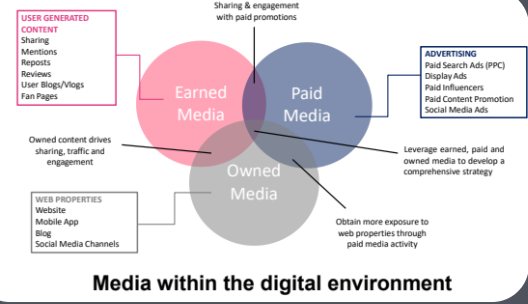
Media Types in Marketing
Earned Media:
User-generated content, sharing, mentions, engagement on company channels.
Paid Media:
Advertising methods including Pay-Per-Click (PPC), display ads, sponsored posts.
Owned Media:
Brand-managed content such as websites, blogs, social media channels.
Digital Customer Journey
Conceptual phases:
Awareness: Initial brand recognition.
Consideration: Evaluating options.
Purchase: Transactional phase.
Service: Customer support interaction post-purchase.
Loyalty: Building long-term customer relationships.
Transition from Traditional to Digital Marketing Tools
Reasons for change highlighted:
Shift to online advertising due to decreased efficiency in traditional media.
Easier targeting and personalization of offers online compared to traditional print methods.
Economic considerations favoring cheaper online methods over traditional marketing expenses.
Challenges of Digital Marketing
Major challenges faced in the digital landscape:
Complexity: Technology and strategy challenges.
Competitive Response: Adapting to market changes initiated by competitors.
Technological Adaptation: Staying up to date with technological advancements.
Cost Management: Balancing budgets in a cost-effective manner.
Attention Management: Capturing attention in a crowded digital space.
Integration: Necessity to align digital marketing efforts with traditional strategies.
Digital Maturity Stages
Assessment of maturity in digital marketing practices:
From Present to Active to Engaged to Competitive to Mature.
Initial to Managed to Defined to Quantified to Optimized maturity levels.
Digital Transformation Process
Steps involved in transitioning from analogue processes to digital systems:
Digitisation: Converting physical assets into digital format.
Digitalisation: Integrating technology within organizational processes.
Transformation: Broad organizational changes influenced by technology.
Digital Marketing Priorities
Current focus areas in the digital marketing landscape:
Social Media
Search Marketing
Content Marketing
AI & Web Analytics
Virtual Realities
Digital Customer Journey
Personalized Customer Experiences
Multi-channel Customer Journey Integration
Mobile Applications