9.1--9.3: Cell Communication
Cell Communication in Biology
Components of Cellular Communication
Four Necessary Components:
Signaling Cell ( tế bào tín hiệu )
Cell that releases signaling molecules.
Signaling Molecule (Ligand) ( phân tử tín hiệu )
A chemical that carries the signal to the responding cell—chất mang thông tin từ tế bào tín hiệu
Receptor Protein ( thụ thể )
A protein that binds to the signaling molecule and initiates the cellular response—Là protein có khả năng nhận và phản ứng với ligand bằng cách thay đổi hình dạng (conformation change).
Responding Cell ( tế bào phản ứng )
The cell that has receptor proteins that bind to the signaling molecule to trigger a response—nhận và phản ứng với tín hiệu.
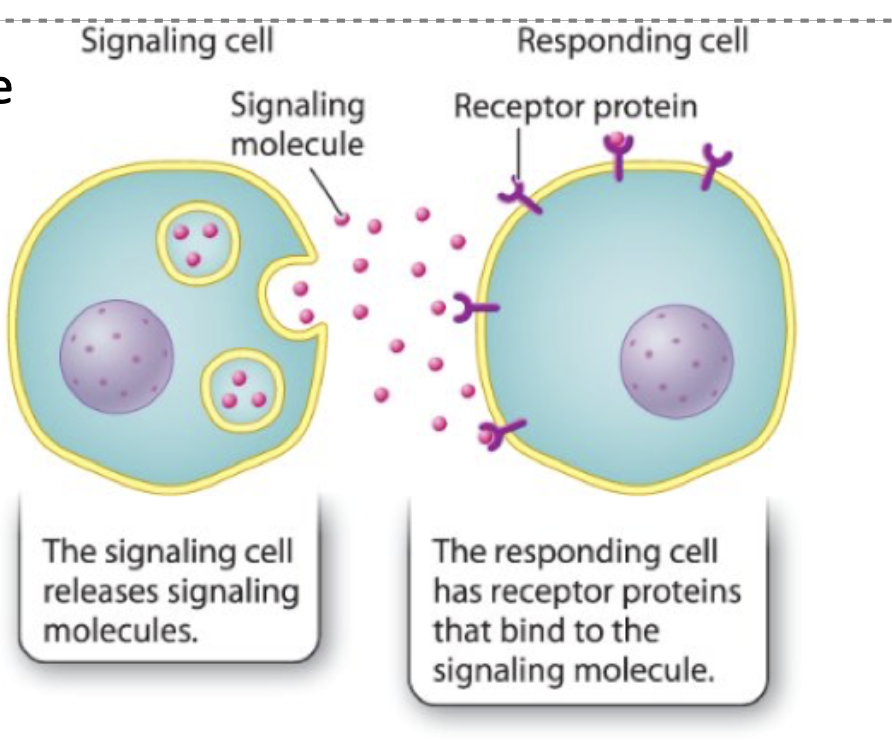
Alterations to Components:
Alterations could disrupt signaling, leading to unintended responses or inability to respond at all, depending on which component is affected.
Steps of Cell Signaling
Receptor Activation ( kích hoạt thụ thể )
Ligand gắn vào receptor → receptor đổi hình dạng, trở nên hoạt động.
Signal Transduction ( truyền tín hiệu )
Receptor interacts with intracellular proteins, initiating known as the signal transduction cascade—Chuỗi truyền tín hiệu trong tế bào sau khi receptor được kích hoạt.
Response ( phàn ứng )
Tế bào thay đổi hoạt động: ví dụ phân chia, sao chép DNA, hoặc tổng hợp protein mới
Termination ( kết thúc )
Hệ thống tín hiệu tắt đi bằng cách loại bỏ nhóm phosphate hoặc ngừng gắn ligand.
Cell Communication Mechanisms
Cell Type Differences
Different cell types may respond differently to the same signaling molecule due to:
Variation in receptor protein forms.
Different downstream signal transduction pathways.
Types of Signaling
Endocrine Signaling ( tín hiệu nội tiết )
Signaling molecules travel through the circulatory system—hệ tuần hoàn—
Khoảng cách: Dài (qua máu).
Phân tử: Hormone.
Ví dụ: Insulin, adrenaline.
Paracrine Signaling ( tín hiệu cận tiết )
signaling involving the release of chemicals to nearby cells
Khoảng cách: Ngắn – các tế bào lân cận.
Phân tử: Local regulators.
Ví dụ: Tế bào miễn dịch tiết cytokine ảnh hưởng tế bào gần đó.
Autocrine Signaling ( tự tiết )
The signaling molecule acts on the same cell
Tế bào gửi tín hiệu cho chính nó.
Ví dụ: Một số tế bào ung thư tự kích hoạt tăng sinh.
Contact-Dependent Signaling ( tiếp xúc trực tiếp)
Involves direct contact between cells via channels or surface receptor interactions.
Names of Structures for Direct Contact:
Gap junctions (animal cells)
Electrical synapses (neurological cells)
Plasmodesmata (plant cells)
Cell-cell recognition (e.g., immune cells)
Characteristics of Local Signaling (Paracrine and Autocrine)
Definitions of Intra- and Extracellular:
Intracellular: Within the cell.
Extracellular: Outside the cell, within the extracellular fluid.
Local Target Cells' Responses:
A local regulator diffuses through extracellular fluid to induce a response in target cells nearby.
Synaptic Signaling in Neurons:
An electrical signal in one neuron triggers the release of neurotransmitters that cross synapses to affect adjacent neurons, leading to new electrical activity.
Mechanisms of Long Distance Signaling - Endocrine Signaling
Hormone di chuyển qua máu để truyền thông tin đến cơ quan xa.
Có thể là lipid-based (hormone steroid) hoặc protein-based (insulin).
Cần khuếch tán qua môi trường ngoại bào trước khi tới receptor của tế bào đích
Đặc điểm
Steroid hormone
Protein hormone
Tính chất
Kỵ nước (lipid-soluble)
Ưa nước (water-soluble)
Vận chuyển trong máu
Cần protein mang
Di chuyển tự do
Vị trí receptor
Trong tế bào (nuclear/cytoplasmic)
Trên màng tế bào
Thời gian phản ứng
Chậm (do ảnh hưởng gen)
Nhanh (qua enzyme & cascade)
Transduction Process
Signals are relayed inside cells predominantly by enzyme activities of protein kinases, which facilitate protein modifications by adding phosphate groups from ATP.
Protein Kinase
Enzyme gắn nhóm phosphate (PO₄³⁻) từ ATP lên protein khác.
Gây kích hoạt hoặc ức chế hoạt động của protein đích.
🔹 Phosphorylation Cascade (Chuỗi phosphoryl hóa)
Một loạt phản ứng dây chuyền: kinase A → kích hoạt kinase B → kích hoạt kinase C → tạo phản ứng cuối cùng.
Giúp khuếch đại tín hiệu dù chỉ có ít phân tử ligand ban đầu.
🔹 Protein Phosphatase
Enzyme gỡ nhóm phosphate, giúp ngừng tín hiệu nhanh chóng
Luôn hoạt động sẵn, để phản ứng không kéo dài quá mức.