Unit 3
metabolism: all of the chemical reactions in an organism
metabolic pathways: series of chemical reactions that either build or break down complex molecules; regulated by controlling when and where enzymes are active
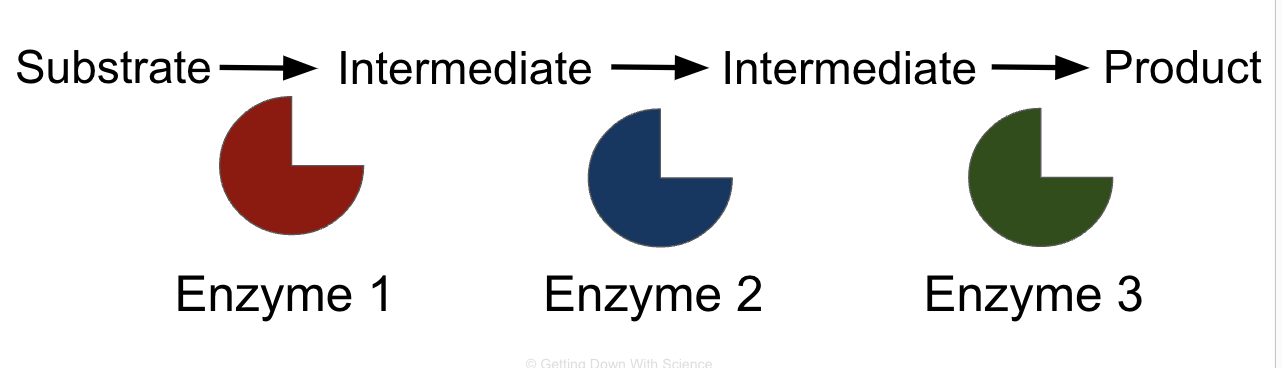
^ to stop production, inhibit enzymes 2 or 3
catabolic pathways: release energy by breaking down complex molecules into simpler compounds
anabolic pathways: consume energy to build complex molecules from simpler compounds
exergonic reactions: release energy; change in free energy < 0
endergonic reactions: absorb energy; change in free energy > 0
ENZYMES
macromolecules that catalyze reactions by lowering the activation energy
has an active site that substrates bind to
level off = all active sites have been filed
slows down = substrates have been used up
induced fit: enzymes change the shape of their active site to allow the substrate to bind better
enzyme catabolism: enzyme breaks down complex molecules
enzyme anabolism: enzyme builds complex molecules
Efficiency of enzymes can be affected by:
temperature → rate of activity increases due to collision up to a certain point, after, the enzyme will denature
pH levels → being outside the normal pH range can cause hydrogen bonds in the enzyme to break
substrate concentration
enzyme concentration
cofactors: non-protein molecules that assist enzyme function
coenzymes: organic cofactors
enzyme inhibitors: reduce the activity of specific enzymes
permanent → binds with covalent bonds
reversible → binds with weak interactions
competitive → reduces enzyme activity by blocking substrates from binding to the active site → can be reversed by adding more substrates
noncompetitive → binds to an area other than the active site, which changes the shape of the site, preventing substrates from being able to bind → nonreversible
allosteric regulation: molecules bind to an allosteric site which changes the shape and function of the site
allosteric activator: substrate binds to allosteric site and stabilizes the shape of the enzyme so that the active sites stay open
allosteric inhibitors: substrate binds to allosteric site and stabilizes the shape of the enzyme so that the active sites remain closed
cooperativity: substrate binds to one active site on an enzyme that has more than one active site, which stabilizes the active form
feedback inhibition: when the end product of a metabolic pathway can act as an inhibitor to an early enzyme in the same pathway
PHOTOSYNTHESIS
the conversion of light energy into chemical energy
occurs in the chloroplast
two steps: light reactions and calvin cycle
autrophs: organisms that produce their own food (organic molecules from their surroundings)
heterotrophs: organisms that are unable to make their own food, so they live off of other organisms
oxidation: loss of H+ and e-, gain of O
reduction: gain of H+ and e-, loss of O
light: electromagnetic energy
made up of photons
travels in waves
wavelength: the distance from the crest of one wave to the crest of the next
short wavelengths = higher energy
long wavelengths = lower energy
chlorophyll a: primary pigment, reaction center
chlorophyll b: accessory pigment
carotenoids: broaden the spectrum of colors that drive photosynthesis
photoprotection: carotenoids absorb and dissipate excessive light energy that could damage chlorophyll or interact with oxygen
LIGHT REACTIONS
it takes place in the thylakoid membrane
photosystems (reaction centers and light-capturing complexes) are embedded in the membrane, along with electron transport proteins
pigments, both primary and accessory, are found in PSI, and they absorb energy from photons
PS2 is where photolysis (the splitting of H2O into 02 + H+ + e-) occurs
the e- gets excited (from the energy passed on from the pigments) and transported via an ETC, losing water until it reaches PSI
the e- gets excited again, leaves PSI, and gets accepted by an e-acceptor NADP → which then gets reduced to NADPH
ATP is generated by phosphorylation ADP
CALVIN CYCLE
→ the continuous phosphorylation and reduction of G3P and oxidation of NADPH (which is a product of the light reaction) to reduce G3P
→ occurs in the stroma
carbon fixation → CO2 (1C) attaches to ruBP (5C) with the help of the enzyme rubisco → it forms a 6C compound, but is unstable; hence, it immediately turns into 3C compound called phosphoglycerate
reduction → G3P gets reduced → one 3C compound leaves the cycle to make organic compounds like glucose
regeneration of ruBP → uses 3ATP to do so → needs to keep regenerating in order to keep making glucose
CELLULAR RESPIRATION
cells harvest chemical energy stored in organic molecules and use it to generate ATP
GLYCOLYSIS
→ occurs in the cytosol
→ splits glucose (6C) into 2 pyruvates (3C)
energy investment → the cell uses ATP to phosphorylate compounds of glucose
energy payoff → energy is produced by substrate level phosphorylation (when you gain a phosphate group)
net:
→ 2 pyruvate + 2H2O
→ 2 ATP
→ 2 NADH + 2H+
PYRUVATE OXIDATION
→ occurs in the mitochondrial matrix
the pyruvate is oxidized by CoA into acetyl CoA
NAD+ is reduced to NADH and CO2 is given off as a byproduct
KREBS CYCLE
→ occurs in the mitochondrial matrix
acetyl CoA (2C) binds to oxaloacetate (4C) to become citrate (6C)
citrate goes through decarboxylation and releases CO2
also goes through oxidation and releases H
this results in the reduction of NAD to NADH
the conversion of the 4C compound also results in the production of ATP through substrate level phosphorylation
the 4C compound gets to be further oxidized and releases H that is received by FAD → FADH2
net:
→ 2 ATP
→ 6 NADH
→ 4 CO2 (the other 2 were from pyruvate oxidation)
→ 2 FADH2
ETC
a sequence of membrane proteins that shuttle electrons down a series of redox reactions
located in the inner membrane of the mitochondria
creates a proton gradient across the membrane
CHEMIOSMOSIS
the movement of water from a region of higher concentration to a region of lower concentration along a concentration gradient
ATP synthase is the enzyme that makes ATP from substrate level phosphorylation, powered by an electrochemical gradient
H+ ions flow down the gradient through ATP synthase, producing 26-28 ATP per glucose
ANAEROBIC RESPIRATION
generates ATP using an ETC in the absence of oxygen
FERMENTATION
generates ATP without an ETC
an extension of glycolysis
ALCOHOL FERMENTATION
→ pyruvate is converted into ethanol
→ lactate dehydrogenase allows NADH to be oxidized to NAD+, which is the process of fermentation
→ this process allows bacteria to produce ATP by glycolysis
LACTIC ACID FERMENTATION
→ pyruvate is reduced by NADH to form lactate
→ muscles produce lactate, which goes into the blood, and is broken down back to glucose in the liver
→ when the lactate is in the blood, it lowers the pH
→ if lactate builds up and is unable to be broken down, it can lead to lactic acidosis (extremely low blood pH)
Oxygen is used as the final electron acceptor in the ETC
The larger the concentration of glucose in the culture medium, the larger the ATP concentration in the cells
Adding a compound that binds and releases protons would increase the proton concentration in the intermembrane space, resulting in a large production of ATP in the cells
enzyme activity increases as temperature increases