Lecture 9 - Adaptive Immunity and Antibodies
Unit II introduction
dendritic cells are phagocytic cells that engulf pathogen to display parts to B and T cells
follicle dendritic cells are in lymph nodes and bits are exposed within the lymph for B and T cells to recognize
B cells develop in bone marrow → travel to lymph nodes and stay; do not always depend on dendritic cells; secondary lymphoid organs are where they see bugs
T cells develop in thymus → these cells depend on dendritic cells to see pathogen and become activated and stimulate division to become effector T cells; migrate to infection site to kill pathogen
Basic functions of B cells and T cells
B cells
humoral immunity
generate antibodies
memory B cells store memory
T cells
cell-mediated immunity
Tc cells directly kill infected or tumor cells
TH cells activate other immune cells
secrete cytokines to direct cytotoxic T cells like NK cells to kill infectious agent/ infected cells
T cells can also store memory
Immunoglobins
Ig: BCR or Ab
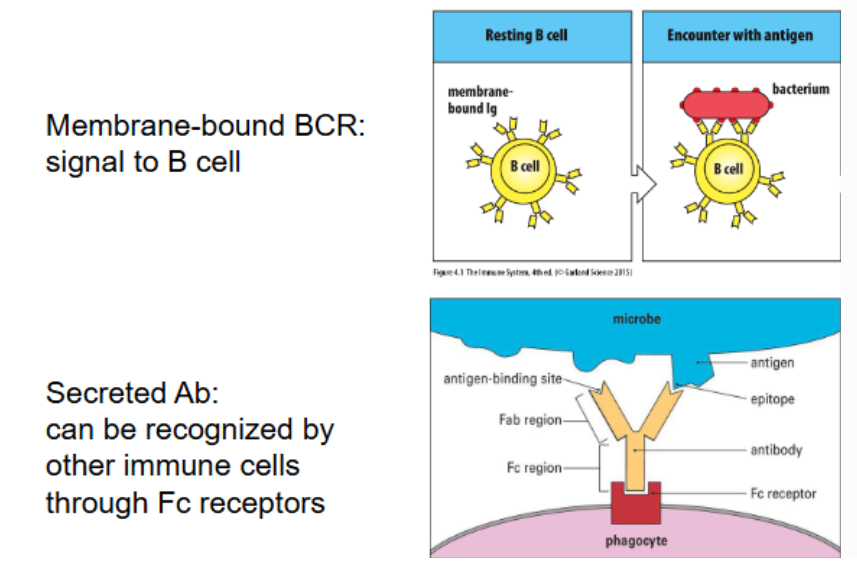
B cell receptor (BCR): membrane-bound immunoglobin
what mediates an Ab being secreted vs staying a BCR?
hydrophobic region embeds in the membrane of B cell and gets cleaved; facilitates survival in water
Antibody: secreted immunoglobins
same genetic loci
during transcription and translation, one is made as a membrane bound receptor and the other as a secreted protein complex
antigen: any molecule that can be bound by an antibody, B cell receptor or T cell receptor
B cell receptors/Ab can bind any type of macromolecular antigen
T cell receptors can only bind protein-based antigens
epitope: the specific piece of the antigen that is directly bound
affinity: describes the strength of the antigen-antibody interaction
strong bind = higher affinity
Ab and antigens interact through NCI’s such as electrostatic forces, hydrogen bonds, van der waals force, and hydrophobic interactions
Ig basic structure
variable region binds the antigen; both regions are identical
complementarity-determining regions (CDRs) are critical for conferring antigen binding specificity
constant region is recognized by other immune cells or other immune molecules or intracellular signals
many immune receptors include Ig domains
Ig protein structure
4 polypeptide chains (2 heavy and 2 light)
can be produced in a membrane-bound or secreted form
Fc receptor complement binding site is present on constant region
Major functions of antibodies against pathogens
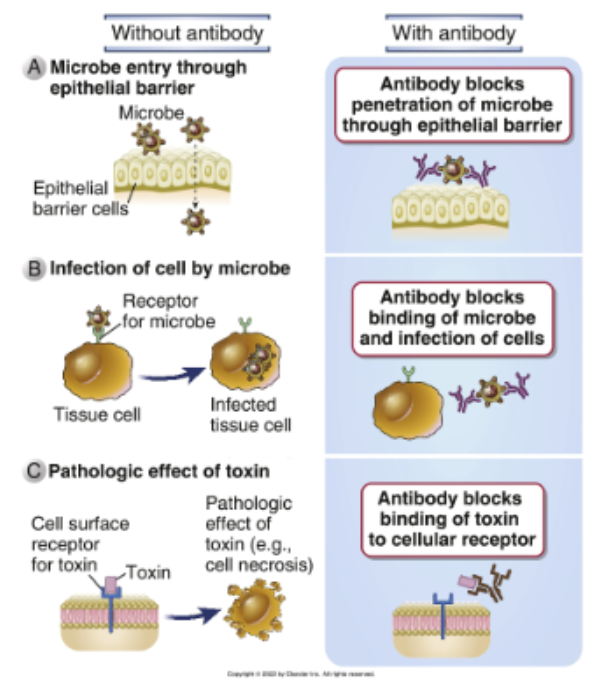
neutralization
since a potential entry method of bacteria and viruses is to bind to cell surface receptors and induce endocytosis, neutralizing antibodies bind to pathogens and prevent entry
these Ab can also neutralize pathogen-derived toxins
agglutination
Ab bind to multiple antigens and cross-link them
any pathogens that are agglutinated can efficiently be removed through ciliary movements or peristalsis
opsonization
covering a microbe in antibodies or recognizable components to signal phagocytosis
complement activation
antibody binding initiates the classical complement pathway and deposits complement components on pathogens
this enhances opsonization and phagocytosis for degradation
antibody-dependent cell-mediated cytotoxicity
infected or tumor cells express antigens signaling distress
antibodies bind these ligands; NK cells or cytotoxic T cells recognize the Fc region via Fc receptors (e.g., FcγRIII/CD16) and kill the bound target cell
depends on both antibodies and effector cells.
antibodies recognize and bind to tumor antigens or virus proteins on an infected cell
cytotoxic immune cells recognize the Fc region of the antibodies, bind and kill the target cell
degranulation
granulocytes such as neutrophils, mast cells, basophils, and eosinophils recognize coated pathogens through Fc receptors
Immune cells bind antibodies through Fc receptors
Fc = fragment crystallized
Fab = fragment antigen binding
Fc receptors use antibodies to move across cells (transcytosis)
from blood to extracellular space and into the lumen of the gut