Maslow
Definition (#f7aeae)
Important (#edcae9)
Extra (#fffe9d)
Personality Development:
Hierarchy of five innate needs : Arrangement of innate needs from the strongest to the weakest. Activates and directs behavior.
Instinctoid needs: Maslow’s term for innate needs.
Hierarchy of needs:
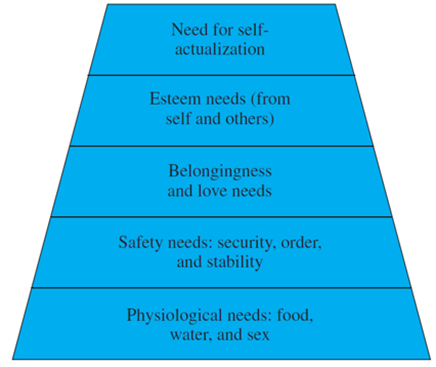
Characteristics:
Lower needs are greater in strength, potency and priority.
Higher needs appear later in life.
Lower needs are deficit needs.
Higher needs are growth needs and contribute to personal growth.
Higher need gratification requires good external circumstances.
A need does not have to be fully satisfied before the next need becomes important.
Physiological needs:
Basic survival needs
Motivating forces for cultures with basic survival concerns
Safety needs:
Stability, security and freedom from fear.
Important drive for children and neurotic adults.
Desire an orderly and predictable world.
Children prefer structure or routine, neurotics avoid new experiences.
Belongingness and love need:
Expressed through relationships with friends, lover, social groups, and forms of social media.
Failure to meet this need is a fundamental cause of emotional maladjustment.
Esteem need:
Esteem from ourselves: Feelings of self-worth
Esteem from others: Status, social success and recognition
Lack of self-esteem leads to feelings of inferiority, helplessness and discouragement.
Self-actualization need:
Fullest development of the self
Conditions:
Freedom from societal or self-constraints.
No distraction by lower needs.
Secure in self-image and relationships.
Realistic knowledge of self.
Cognitive needs:
Innate need to know and to understand
Second set of innate needs.
Appear in late infancy and early childhood. Expressed as natural curiosity
Necessary for self-actualization
Study of self-actualizers:
Metamotivation:
Motivation of self-actualizers.
Involves maximizing personal potential.
Metaneeds:
States of growth towards which self-actualization evolve.
Metapathology:
Thwarting of self-development related to failure to satisfy metaneeds.
Characteristics of self-actualizers:
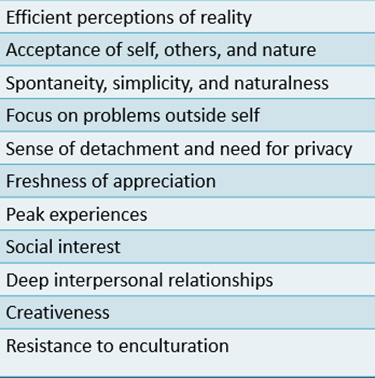
Reasons for failure:
Self-actualization can be easily inhabited
Inadequate education
Improper child-rearing practices
Jonah complex: Fear that maximizing one’s potential may lead to situation with which one cannot cope.
Questions on Human Nature:
Freewill
Interaction of nature and nurture
Focuses on the past and the present
Emphasizes on uniqueness
Growth process
Optimistic
Assessment:
Observed shared qualities in self-actualized individuals
Techniques used:
Historical figures - Analyzed biographical material and written records.
Living subjects - Interviews, free association, and projective tests.
Personal orientation inventory
Smartphone basic needs scale
Research:
Focus: No formal approach was undertaken
Correlational studies
Hierarchy of needs: Belongingness need, self-esteem
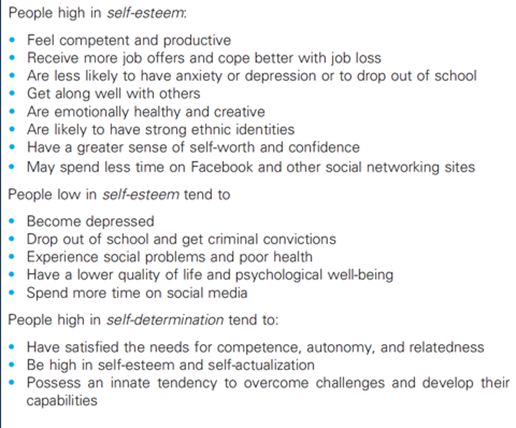
Self-determination Theory:
Contemporary outgrowth of self-actualization theory.
Focuses on intrinsic motivation.
Specifies basic needs: Competence, autonomy, relatedness.
Reflection:
Criticism:
Collection of information is inconsistent and vague.
Characteristics of actualizers lack specificity and are difficult to describe.
Use of terms could be inconsistent and ambiguous.
Contribution:
His theories and the humanistic approach became popular.
Influenced the positive psychology movement.
Created impact in streams such as personality, social psychology, developmental psychology, and organizational behavior.