GATE - APTITUDE 2014 GG
1) Choose the most appropriate word from the options given below to complete the following
sentence. A person suffering from Alzheimer’s disease short-term memory loss.
(A) experienced
(B) has experienced
(C) is experiencing
(D) experiences
Solution :
The sentence is referring to a general or habitual action.
The present tense "experiences" is suitable to describe what typically happens to a person suffering from Alzheimer's disease.
2) Choose the most appropriate word from the options given below to complete the following
sentence. ____________ is the key to their happiness; they are satisfied with what they have.
(A) Contentment
(B) Ambition
(C) Perseverance
(D) Hunge
Solution: meaning of "contentment," indicating a state of happiness and satisfaction with one's current situation.
3) Which of the following options is the closest in meaning to the sentence below?
“As a woman, I have no country.”
(A) Women have no country.
(B) Women are not citizens of any country.
(C) Women’s solidarity knows no national boundaries.
(D) Women of all countries have equal legal rights.
Solution: The sentence "As a woman, I have no country" conveys a sense of detachment or lack of belonging to a particular nation due to one's gender.
4) In any given year, the probability of an earthquake greater than Magnitude 6 occurring in the
Garhwal Himalayas is 0.04. The average time between successive occurrences of such earthquakes is ____ years.
Ans: average time between successive occurrences of such earthquakes is
= 1/0.04
= 25 years
5) The population of a new city is 5 million and is growing at 20% annually. How many years would
it take to double at this growth rate?
(A) 3-4 years
(B) 4-5 years
(C) 5-6 years
(D) 6-7 years
Solution:
To determine how many years it will take for the population to double, given a constant annual growth rate, we can use the Rule of 70. This rule provides an approximation for the doubling time based on the growth rate.
The formula for the Rule of 70 is: 70/20 = 3.5 year
or you can also solve trough formulae
Given, Principal = 5000000 , Amount = 10000000
Amount = Principal (1+R/100)n
n = 3.8 year
6) In a group of four children, Som is younger to Riaz. Shiv is elder to Ansu. Ansu is youngest in the group. Which of the following statements is/are required to find the eldest child in the group?
Statements
1. Shiv is younger to Riaz.
2. Shiv is elder to Som.
(A) Statement 1by itself determines the eldest child.
(B) Statement 2 by itself determines the eldest child.
(C) Statements 1 and 2 are both required to determine the eldest child.
(D) Statements 1 and 2 are not sufficient to determine the eldest child.
Solution : From the given information, we know the following about the relative ages:
Ansu < Shiv
Ansu < Som < Riaz
Shiv can be placed between anywhere most at position
This makes Riaz always the eldest child
7) Moving into a world of big data will require us to change our thinking about the merits of
exactitude. To apply the conventional mindset of measurement to the digital, connected world of the twenty-first century is to miss a crucial point. As mentioned earlier, the obsession with
exactness is an artefact of the information-deprived analog era. When data was sparse, every data point was critical, and thus great care was taken to avoid letting any point bias the analysis.
From “BIG DATA” Viktor Mayer-Schonberger and Kenneth Cukier
The main point of the paragraph is:
(A) The twenty-first century is a digital world
(B) Big data is obsessed with exactness
(C) Exactitude is not critical in dealing with big data
(D) Sparse data leads to a bias in the analysis
Solution :
The main point of the paragraph focuses on the shift in perspective required when dealing with big data.
The paragraph talks about how our thinking needs to change when dealing with big data. In the past, when we didn't have much data, being very exact was important because every piece of information mattered a lot. But now, with so much data available in the digital world, being exact isn't always as important.
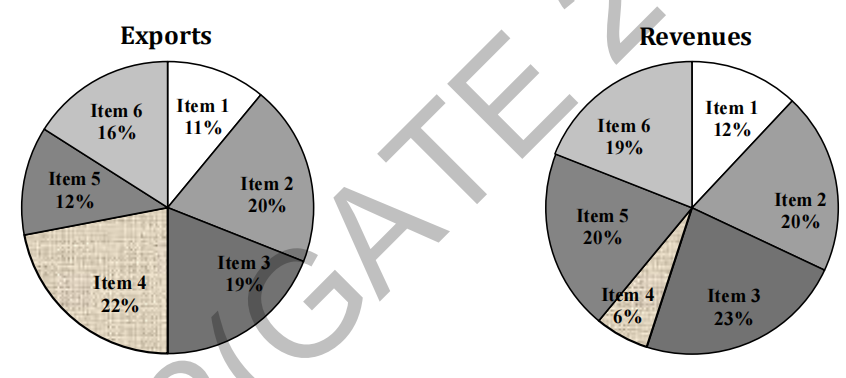
8) The total exports and revenues from the exports of a country are given in the two pie charts below. The pie chart for exports shows the quantity of each item as a percentage of the total quantity of exports. The pie chart for the revenues shows the percentage of the total revenue generated through export of each item. The total quantity of exports of all the items is 5 lakh tonnes and the total revenues are 250 crore rupees. What is the ratio of the revenue generated through export of Item 1 per kilogram to the revenue generated through export of Item 4 per kilogram?
(A) 1:2
(B) 2:1
(C) 1:4
(D) 4:1
Solution :
Calculate Export Quantities:
• Item 1: 11% of 5 lakh tonnes = 0.55 lakh tonnes
• Item 4: 22% of 5 lakh tonnes = 1.1 lakh tonnes
Calculate Revenue Amounts:
• Item 1: 12% of 250 crore rupees = 30 crore rupees
• Item 4: 6% of 250 crore rupees = 15 crore rupees
Calculate Revenue per Tonne (or kg):
• Item 1: 30 crore rupees / 0.55 lakh tonnes = (30/0.55) crore rupees/lakh tonne
• Item 4: 15 crore rupees / 1.1 lakh tonnes = (15/1.1) crore rupees/lakh tonne
Find the Ratio:
• Ratio = (Revenue per tonne of Item 1) / (Revenue per tonne of Item 4)
• Ratio = (30/0.55) / (15/1.1)
• Ratio = (30 × 1.1) / (15 × 0.55)
• Ratio = 33 / 8.25
• Ratio = 4
9) X is 1 km northeast of Y. Y is 1 km southeast of Z. W is 1 km west of Z. P is 1 km south of W. Q is 1 km east of P. What is the distance between X and Q in km?
(A) 1
(B) √2
(C) √3
(D) 2
10) 10% of the population in a town is HIV+ . A new diagnostic kit for HIV detection is available; this kit correctly identifies HIV+ individuals 95% of the time, and HIV− individuals 89% of the time. A particular patient is tested using this kit and is found to be positive. The probability that the individual is actually positive is _______
Ans: This problem can be solved using Bayes' Theorem,