The Digestive System
The Alimentary canal
A long tube going from the mouth to the anus
Along the tube there are glands where substances called enzymes are produced
The intake of food has 5 steps:
Ingestion - the intake of food
Digestion - the physical or chemical breakdown of food, so it can be absorbed into the bloodstream
Absorption - the release of digested food into the blood stream
Assimilation - the use of digested food in the organisms cells
Egestion - the removal of indigestible waste materials from the body
Enzymes
Enzymes are biological catalysts
Enzymes speed up the breakdown of food substances and other materials
They work by combining with the food (substrate) forming the enzyme-substrate complex
The enzyme-substrate complex breaks down and forms the product and releases the enzyme
The enzyme can the be used again
Enzymes are very specific and will only work on one substrate
Enzymes work at specific pH’s
Most at pH 7 but pepsin works only at pH 2 & 3
Enzymes are made from proteins, so if heated will become denatured, and will not work
The mouth
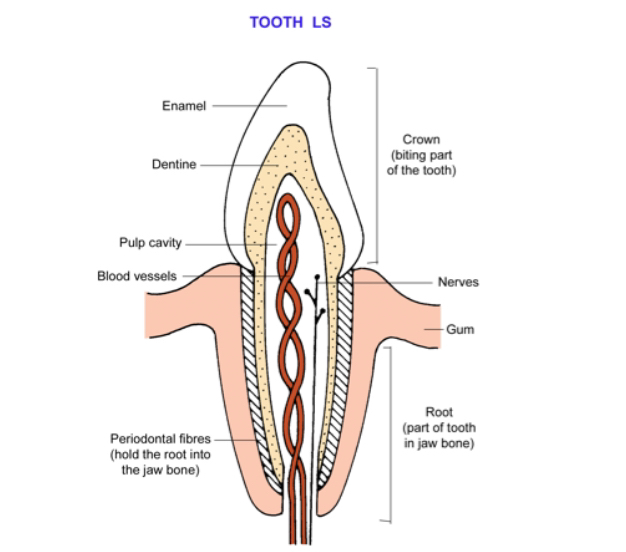
Food is mechanically broken down by the teeth, increasing the surface area for the enzyme to work
Saliva (salivary amylase) breaks down starch and maltose
Food is brought down to the stomach, in a structure called a bolus through the oesophagus by peristalsis
Physical and chemical digestion
The stomach
The stomach contains Hydrochloric Acid (pH - 1-2)
Hydrochloric acid loosens food, kills bacteria, triggers stomach enzymes and turns off amylase
Inactive pepsinogen is activated by the low pH turning it into pepsin (proteinase)
Proteinase breaks down proteins into amino acids
The stomach churns the food for a number of hours until the food is a thick sloppy liquid called Chyme
Sphincter muscles relax and the chyme enters the duodenum
Physical digestion by the churning process, chemical digestion by the action of enzymes
The duodenum
Lots of enzymes are secreted from the wall of the duodenum, the pancreas and the gall bladder
Enzymes including lipase, proteinase (trypsin), amylase, maltase, sucrase, and lactase are found there
Bile is also secreted from the gall bladder
Bile emulsifies fat, so it can be digested
Bile also neutralises the stomach acids
The ileum (small intestine)
The ileum contains the same enzymes as the duodenum
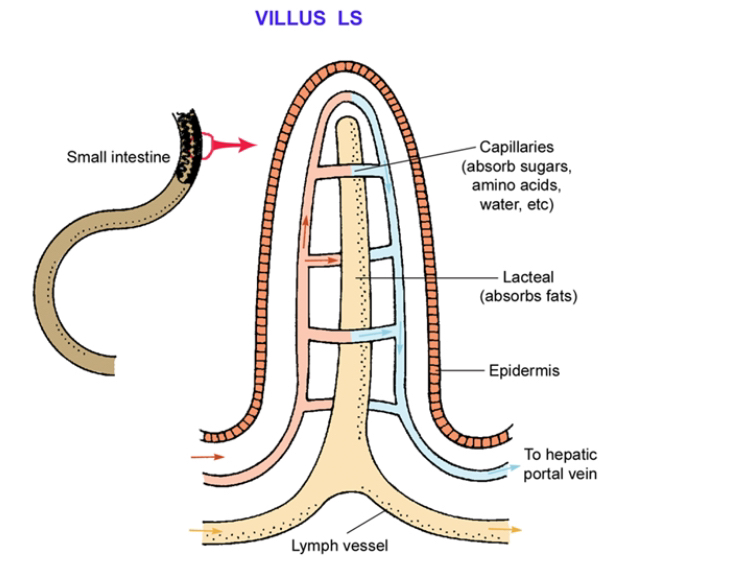
The wall of the intestine contains millions of finger like projections called villi (villus) so the surface area is increased
Sugars, amino acids, vitamins, minerals and water are absorbed into the blood stream
Fatty acids and glycerol are transported by the lymph vessels within the villus itself (via lacteal)
The large intestine
Here, any remaining broken down food is absorbed
Water is removed from the waste
Excess substances are moved to other parts of the body for storage
Excess glucose is stored when too much is ingested than needed
Glucose can be stored in the short term as glycogen. It is stored in the liver
The long term storage of glucose fat
Faeces are formed and can move to the rectum before being egested from the anus