Design For Older Adults
Physiological Changes
Sensory Loss and Changing Perception
Vision
Hearing
Touch
Taste
Smell
Decline of Central nervous system and cognitive functions
Decline of Muscular and Skeletal system
Reduced ability to adapt to temperature changes
Disease:
Arthritis and rheumatism, heart disease and high blood pressure
Social and Functional Changes
Family Structure and work role = Reduced social network
Income =Reduced Sense of Security and control
Mobility and Sphere of Activity = Diminished self-confidence
Psychological Changes
Reduced sense of security and control
Depression
Diminished self-confidence
Lower stress threshold
Reduced desire for interactions with the large enviroment
General Design Response
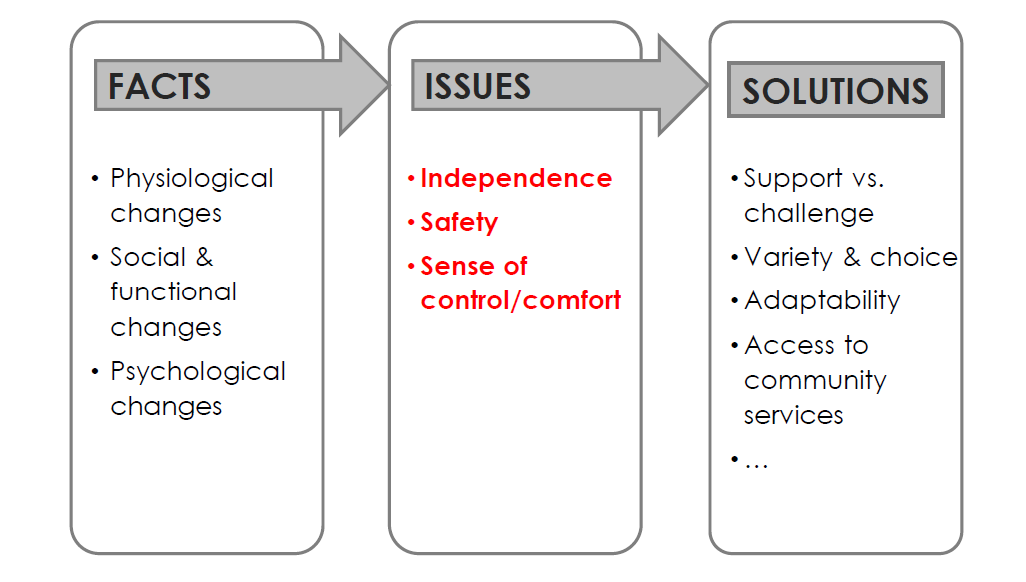
Respond to Physiological Changes
Sensory Loss = Design response: Rich and more “readable” sensory cues
Design for deceased vision
Light
Need more light and greater contrast (when distinction is needed)
Colors
Bright colors in orange-yellow-red spectrum easier for elderly to see than darker colors in blue- green range.
Design for Decreased Vision
Wall mounted object cannot project more than 4” beyond the wall
The cane-detectable area: A person using a cane can only detect objects with a bottom edge that is 27 inches or less from the finished floor.
Overhead objecte must be at least 80” off the floor.
Falling (a huge problem)
Can cause moderate to severe injuries (Hip fracture, and head injuries)
1 out of 3 older people falls each year
The leading cause of injury death
Glare become a biggger problem
Material choice
Provide transition area to give the aging eye enough time to adapt to spaces with different level of light
Avoid unnecesary contrast of light and dark shadows and advancing/ receding color, as they distort depth perception