Australias Government
[[Australias Past[[
Colonisation
- Prior to British settlement, Australia was ==self-governing with Indigenous groups that had developed their own cultures==
- 1788 - British arrive at Sydney Cove
- Beginning the devastation of Australia’s Indigenous population and cultures
Federation
- 1788-1800s - ‘states’ were colonies with their own constitutions, governments, and sets of laws
- Colonies managed their own affairs, became inefficient
- E.g., colonies built different railways using different rail widths, goods were taxed when moved across boarders
- 1901 - colonies became the states of Australia
[[Constitution[[
What is the Constitution?
Definition: A series of written documents and laws
- Came into force as part of federation in 1901
- The Australian Constitution is the supreme law of Australia
- Establishes the basis for how government is conducted and how other laws are to be made
- Government must use their powers in ways that are outlined in the constitution
The ==constitution== sets out the ==structure== of the government, its ==powers==, and the ==procedures== that it must follow. It also sets out how ==parliament can change it==.
[[Features of the Australian Government[[
The Australian Governmental System
- Called a “federal parliamentary constitutional monarchy”
| Federal | Australia is a federation of over 25 million people. It consists of six-self governing states and two self-administering territories. |
|---|---|
| Parliamentary | Has multiple branches of government, with the legislature having lawmaking powers and the ability to check the power of the executive branch. |
| Constitutional Monarchy | A monarchy (where the king or queen is the head of state) where the monarch shares power with a constitutionally organised government. |
Separation of Power (Summary)
Australia’s parliamentary system is split into three branches:
- ^^Legislature^^, responsible for creating, amending, or repealing legislation;
- @@Executive@@, responsible for putting laws into operation and enforcing them;
- %%Judiciary%%, responsible for interpreting the law and resolving legal disputes.
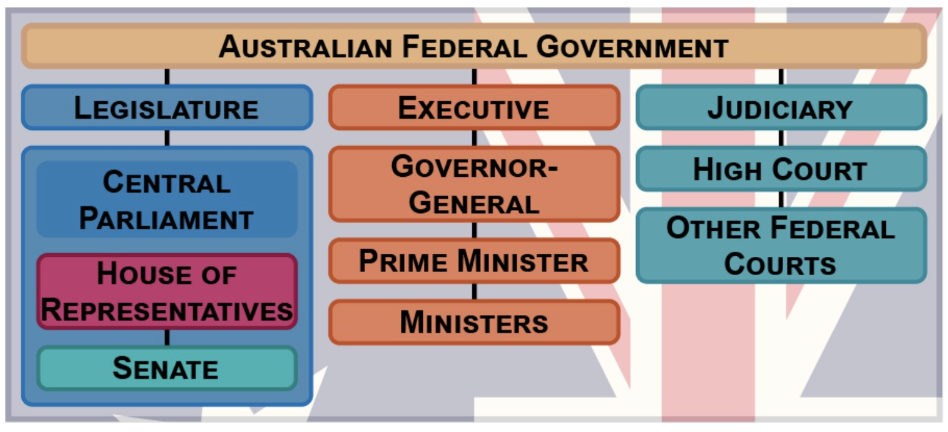 The constitution allocates the roles of the federal government to three separate branches.
| Branch | Comprises of | Function |
|---|---|---|
| ^^Legislative^^ | Two houses of parliament | Creates, considers, and passes laws |
| @@Executive@@ | Prime minister and other ministers | Implements and administers the law |
| %%Judicial%% | Court system, judges, and other independent officials | Apply and interpret the law High Court: power to interpret and rule on law in the constitution |
Legislation
- Australia’s federal parliament is bicameral with an upper and lower house
- House of Representatives: lower house, made up of 151 members of parliament, each representing the interest of voters in an electoral division
- Each division has similar pop. (~90,000)
- House representatives are elected through Preferential Voting for terms of three years
- Senate: upper house, made up of 76 senators - 12 for each state and 2 for each territory, each representing the interests of their respective states/territories
- Elected using the Single Transferable Vote method for terms of six years, half of the Senate seats are contested every three years