Diverging plate boundaries
Diverging plate boundaries (also known as constructive plate boundaries)
They form when two of the Earth's plates move apart from one another.
Convection Currents - rising upwards towards the lithosphere move away from each other and pull the plates apart.
Divergent boundaries occur underneath both oceanic crust and continental crust
Why? - Core 6,000°c - magma in mantle -Cools- Thermal convection currents
Example- is between the North American and Eurasian plates
-Moves away from each other at a rate of roughly 2.5 cm per year.
Seafloor spreading, Rift valley
Seafloor spreading
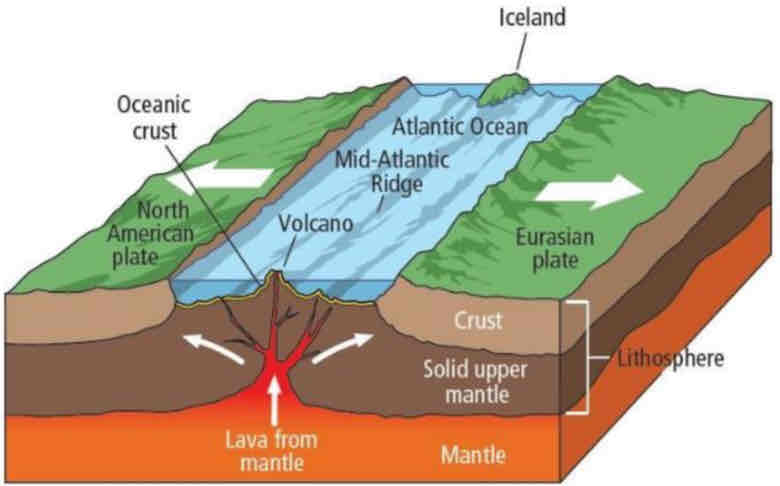
Oceanic plate diverge - Mid Ocean ridges
Seafloor Spreading - plates move apart and create a gap - magma rises upwards through this crust before spilling out as lava - it hardens into basalt rock and forms new ocean floor.
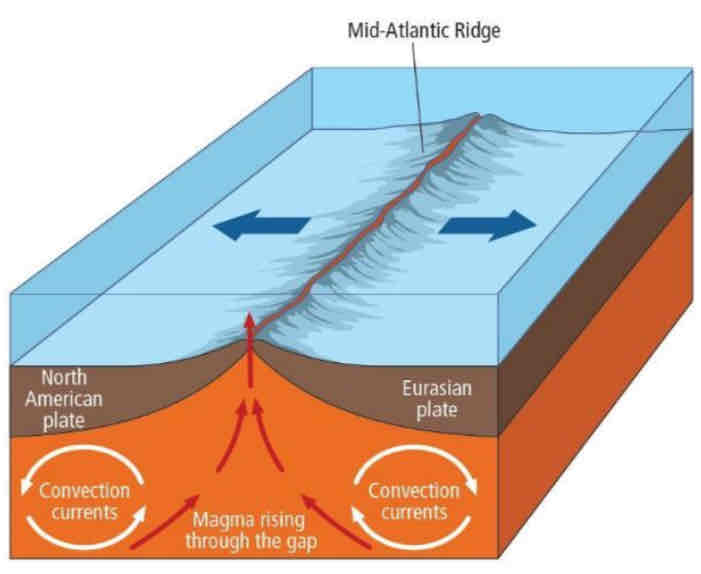
Repeated eruptions make a chain of underwater volcanic mountains along the boundary of the separating plates.
These chains of volcanoes produce landforms known as mid-ocean ridges.
130 mya Seafloor began Sprending
Example- Iceland is a volcanic island and is an example of an island where there is a lot of activity, it is most active country in the world
Growing W→E direction
Continental plates diverge
Rift Valley
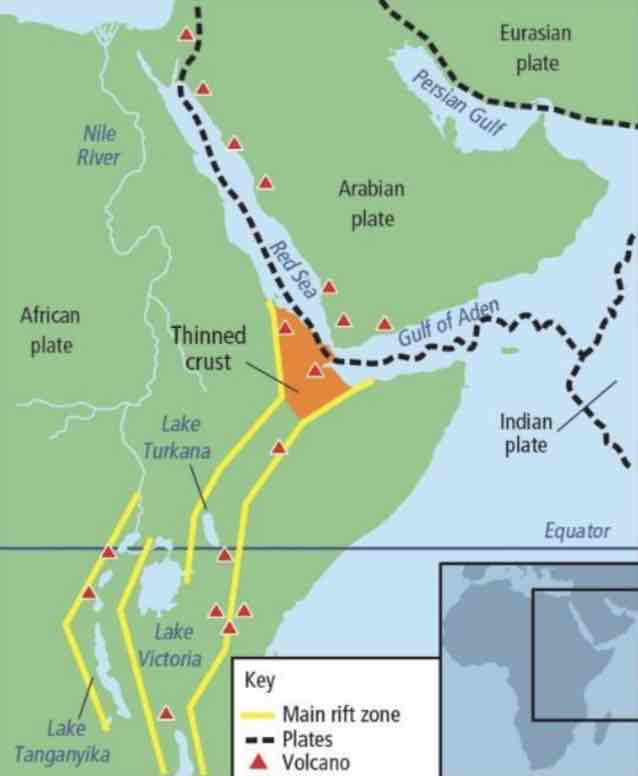
-Rift Valleys- are landforms created when a continental plate is pulled apart by convection currents.
- Convection currents stretch he land - it becomes thinner- creates Valley
-Eventually the crust tears apart creating a new divergent boundary.
- Example- East African rift valley
Key Terms
Divergent
Convection currents
Constructive boundaries
Seafloor spreading
Mid-ocean ridge
Rifting
Example questions
-explain how divergent plate boundaries form
-name an example of a divergent boundary and locate it on a map
-explain how seafloor spreading occurs and the impact it has on the landscape
-explain how rift valleys are formed.