Copy of Video Lesson Cornell Notes [TEMPLATE]

Course Name

AP PSYCHOLOGY

Video # and Name

Video 1.1 - What is Psychology?

Questions/Keywords

Notes

Psychology - the study of the mind and behavior

  • Psychology
    • Psykhe - soul, spirit, breath
    • Logia - the study of
  • Psychology
    • Includes the way humans think, plan, perceive, judge, and act
    • Mental acts interact with behaviors and surroundings
    • All organisms, not only humans
  • Nature or nurture?
  • New approaches to better answer the source of behavior
    • Biopsychosocial approach → combines nature and nurture
      • Combines biology, psychology, and social factors to analyze

Summary

Psychology often takes the biopsychosocial approach, which combines nature and nurture to analyze biological, psychological, and social factors

Course Name

AP PSYCHOLOGY

Video # and Name

Video 2.1 - Connections to Philosophy

Questions/Keywords

Notes

Socratic Method - questioning to arrive at understanding

Dualism - the mind and body function are 2 separate entities, and mind will live on after body has died

Rationalism - all ideas are innate, or with us from the moment of birth. Therefore, all we need to do is use our powers of reason and logic to develop thoughts. Deep thinking and introspection are the best ways to arrive at truth

Monist - mind and body are one entity

Empiricism - the love of data and testing ideas is the foundation of empiricism

Dialectic - style of thinking depending on thorough and rational thinking to resolve differences in opinion

Thesis - someone’s statement of opinion

Antithesis - alternative belief or opinion of different perspective

Synthesis - the selective combining of opinions to resolve the differing opinions

Atheoretical - without a theory; not based on or concerned with theory

Cogito Ergo Sum - I think, therefore I am

Tabula Rasa - blank slate

Apriori - from the earlier

Aposteriori - from the latter

  • Hippocrates viewed the status of melancholia (sadness and gloom) as being caused by a physical origin
    • Imbalance in the four humors of the body
      • Blood, yellow and black biles, and phlegm
    • Forged the field of psychology
  • Socrates questioned everything he heard
  • Plato was a student of socrates and recorded much of everything we know about socrates in his work “dialogues”
  • Aristotle was a student of Plato for 2 decades
  • Plato was a dualist
    • Ideas are innate by rationalism
  • However, Aristotle was a monist and empiricist
  • Aristotle vs Plato → dialectic
  • Ideas evolve over time because of the dialectic
  • But nature vs nurture still continues today
  • Psychology built upon other philosophers, too
    • Englishman sir francis bacon believed science should be purely empirical
    • Rene Descartes revived Plato’s rationalism
    • John Locke – tabula rasa
      • No knowledge
    • Immanuel Kant
      • Rationalism + empiricism
      • Maybe it is both nature and nurture that shapes us

Summary

Course Name

AP PSYCHOLOGY

Video # and Name

Video 2.2 - Psychology as a Science

Questions/Keywords

Notes

Introspection - looking inward for thoughts and ideas

Structuralism - the first major school of thought in psychology - uses introspection to determine structure/organization of the mind

Functionalism - humans actively engaged in their sensations and thoughts, not just passively aware of them

Associationism - how ideas can be linked in our head which results in learning

Law of Effect - rewarded behavior will occur more frequently, and punished behavior will occur less frequently.

  • In Germany, in 1879, Wilhelm Wundt created an “experimental apparatus” to measure the time between hearing a ball hit a platform and pressing a button
  • Wundt and team discovered subjects responded in 1/10th of a second
  • But when they were asked to push the key when they were consciously aware of the sounds, the time lag became 2/10th of a second
    • FIRST PSYCHOLOGICAL LABORATORY
      • First major catalyst for psychology as a science
      • But it still focused a lot on introspection
  • In 1883, Stanley Hall, one of Wundt’s students, brought the ideas he learned to the USA
    • First psychological lab at John Hopkins University
  • Wundt focused on structuralism
  • Edward Titchener at Cornell also used introspection with such tasks as engaging by watching a rose, listening to a metronome, tasting a substance
    • Something more than just understanding the structure of our thoughts
  • William James investigated Not only what we feel when we smell or hear something, but how we hear and how we smell → functionalism
    • Inspired by Darwin
    • Concluded we as humans must have adapted over time
    • Best known for principles in psychology published in 1890
      • First textbook in the field and is still relevant today
      • In 1890, James admitted Mary Whiton Calkins to his grad seminar at harvard where he was a professor
      • Caused issues with the male dominant society at the time
      • She got her PHD but they refused to give her a degree, offered alternative degree from Radcliffe University said no
      • First woman president of the American Psychological Association (APA)
      • First woman to get PHD in psych is Margaret Floy Washburn
  • Hermann Ebbinghaus was an associationist
    • Used himself as the test subject and spent the bulk of his career and life testing and recording his memory
    • Found that constant repetition was the key to great memory and published books on memory and forgetting
  • Edward Lee Thorndike was an associationist
    • Law of Effect

Summary

Course Name

AP PSYCHOLOGY

Video # and Name

Video 3.1 - Perspectives in Psychology

Questions/Keywords

Notes

  • Modern Perspectives
    • Pscyhoanalytic
      • Sigmund Freud
      • Unconcious conflicts
      • Childhood experiences
      • Determinism - all thought, action, emotion are predetermined by your unconscious
    • Humanistic
      • Free will
      • Self-esteem
      • Human potential
      • Abraham Maslow
        • Self-actualization and the hierarchy of needs
      • Carl Rogers
        • Unconditional positive regard
    • Cognitivism
      • Cognitions = thoughts
      • Thought process
      • How you think, process, and store
      • Allen Newell and Herbert Simon
        • Detailed models
      • Ulric Neisser
        • Cognitive Psychology (1967)
    • Behaviorism
      • Developed from association
      • Emphasis on concrete, observable aspects of humans
      • Ivan Pavlov
        • Conditioned dogs to salivate at the sound of a bell → classical conditioning
      • John B. Watson
        • Little Albert
          • Conditioned a child to be scared of a rat
      • BF Skinner
        • Operant Conditioning, a system of conditioning that uses punishers and reinforcers to change behaviors
    • Biological
      • Brain chemistry, structure, function, anomalies…
      • Roger Sperry
        • Hemispheric specialization
        • Molecular genetics
          • Human genome project
        • Behavioral genetics
    • Sociocultural
      • Social norms
      • Culture, social norms
    • Sociobiological/Evolutionary
      • How humans adapt and change with society, and how that affects their psyche
      • Charles darwin
      • mutation/adaptation
  • Eclectic approach → combines multiple approaches
    • Biopsychosocial approach

Summary

Course Name

AP PSYCHOLOGY

Video # and Name

Video 3.2 - Subfields and Careers in Psychology

Questions/Keywords

Notes

Psychometrics - study of human habits, attitudes, and traits

Applied research - using scientific practices to solve practical life problems

  • Psychometrics →
    • Biological psychologist
    • Developmental psychologist
    • Cognitive psychologist
    • Educational psychologist
    • Personality psychologist
    • Social psychologist
  • Applied research →
    • industrial/organizational psychologist
    • Human factors psychologist
    • Counseling psychologist
    • Clinical psychologist
    • Psychiatrists
    • Sports psychologists
    • Forensic psychologists

Course Name

AP PSYCHOLOGY

Video # and Name

Video 4.1 - Scientific Method

Questions/Keywords

Notes

  • Dialectic
    • Thesis
    • Antithesis
    • Synthesis
  • Scientific process is also an ongoing process, like the dialectc
    • Theory
      • Explanation that uses principles to organize observations or predict behaviors or events
    • Hypothesis
      • Prediction that can be tested
    • Research
      • Test it
    • Operation definition
      • Precise explanation of the terms of your research
    • Theory: Sugar increases hyperactivity in children → Hypothesis: when children eat sugary treats, their behavior will become more erratic and impulsive → research methodology

Course Name

AP PSYCHOLOGY

Video # and Name

Video 5.1 - Descriptive Research Methods: Case Study, Naturalistic Observation, Surveys

Questions/Keywords

Notes

  • Descriptive Research - describe people, events, behaviors
    • Case study
      • In-depth look at all aspects of a single case - meaning 1 person, or one group
      • Clinical method
      • Ex. Phineas Gage studied for his weird brain trauma
        • Asmat wood carvers of New Guinea → hunting behaviors
      • One case does is not generalization
    • Naturalistic Observation - observing a person or an animal in the environment in which they live
      • Jane Goodall and chimps
      • Subject will act more natural if they think they are not being observed
        • Observer effect → hanges in behvaior of subject caused by awareness
        • Observer bias → observer records only selective details because of prior beliefs
    • Survey method
      • Obtain great deal of information in a quick and simple fashion
      • Sampling bias
        • Flaw when you have a sample of responses that produces an unrepresentative sample
      • Courtesy bias → participants give polite or socially desirable responses instead of what they believe
      • Response bias → not all surveys are returned

Course Name

AP PSYCHOLOGY

Video # and Name

Video 5.2 - Correlational Research

Questions/Keywords

Notes

  • Correlational study - looking for the existence of a relationship between two events, measures, or variables
    • positive/negative indicates the direction of the relationship
    • The closer the statistic to the whole number (negative 1 or positive 1), the stronger the relationship between the variables
    • 0 demonstrates there is no relationship between the variables
    • Positive → one variable increases, other increases
    • Negative → one variable increases, other decreases
    • Correlation does not demonstrate causation
    • Illusory correlation → perceived relationships where none exists

Course Name

AP PSYCHOLOGY

Video # and Name

Video 5.3 - experiments

Questions/Keywords

Notes

  • Experiment - when researchers directly vary a condition to watch and measure the results
    • Variables →
      • Independent variable → suspected “cause”
      • Dependent variable → suspected “effect”
      • Confounding variable → something outside research that alters the research
    • Experimental groups →
      • Experimental group → receives the IV
      • Control group → does not receive the IV
      • Random assignment
      • Representative sample → small group that represents the larger population
    • Placebo effect → believing that one has received something when they have not (changing behavior/results)
    • Single blind experiment → participants not knowing if they have received real or placebo
    • Double blind experiment → participants and researchers not knowing if they have received real or placebo

Course Name

AP PSYCHOLOGY

Video # and Name

Video 6.1 and 6.2 - Stats in Psychological Research

Questions/Keywords

Notes

  • Descriptive stats - describe and summarize your data
    • Graphs
      • Histogram, pie chart, line graph, scatter plot
    • Central tendency
      • Mean
        • Average
      • Median
        • Middle score
      • Mode
        • Most occurring data point
      • Standard deviation = square root (sum of (deviations)^2 /number of scores)
    • Variability
  • Normal distribution → bell shaped/symmetrical curve
  • Negative skew, normal (no skew), positive skew
  • Inferential statistics - how likely are your results just due to chance
  • P-value: 0.5 of lower (5% likelihood that cause of results due to CHANCE)

Course Name

AP PSYCHOLOGY

Video # and Name

Video 6.3: Ethics in Psychological Research

Questions/Keywords

Notes

  • IRB
    • Ethics in human research
      • Voluntary human subjects
      • Informed consent
      • Confidentiality
      • Deception and debriefing
      • No long-lasting psychological or physiological pain for humans
    • Ethics in animal research

Course Name

AP PSYCHOLOGY

Video # and Name

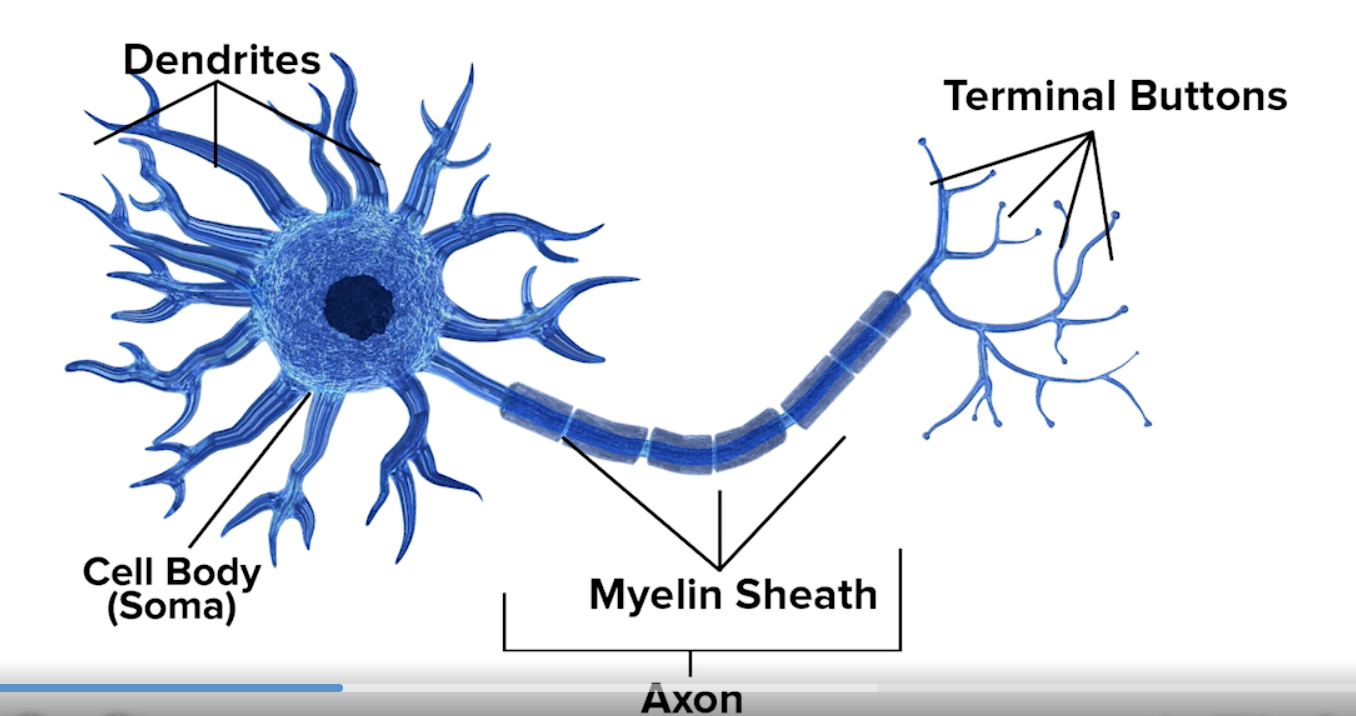
Video 7.1 - Anatomy of a Neuron

Questions/Keywords

Notes

  • Franz Hall - Phrenology
  • Neuron - single nerve cell
    • Transmits specialized information throughout mind and body
    • Parts of a neuron:
      • Dendrites - recieve and send messages to cell body
      • Cell body (soma) - life source of the cell, houses the nucleus and maintains the function of the cell,
      • Axon - long tail-like structure of the cell that transmits the neural impulses away from the cell body and to the terminal branches
      • Axon hillock - the point on the neuron where the axon begins on the soma
      • Myelin - fatty substance that protects the length of the neuron and speeds up transmission
      • Nodes of Ranvier - along the axon are gaps between the myelin deposits
      • Terminal buttons - when the message arrives at terminal buttons, triggers neurotransmitters that sends from one neuron to the next
        • Terminal buttons do not touch other neurons but leave a microscopic space between each other called the synapse. This is where communication between neurons occurs
    • Multiple sclerosis → degeneration of myelin sheath within the body
    • Neural impulses travel along axon through series of activity called action potentials
    • Speed of a neural impulse is measured in milliseconds, but it ranges from 2 to 180 mph, depending on the length of the axon and whether it is myelinated or not

Course Name

AP PSYCHOLOGY

Video # and Name

Video 7.2 - Neural Communication

Questions/Keywords

Notes

  • How do neurons communicate
    • Electrochemical impulses
    • Intraneuron communication
      • Neuron sending the impulse through the axon to the terminal buttons
    • Interneuron communication
      • One neuron sending message to neighboring neuron
      • Action potentials → brief electrical charge that travels down an axon
      • When neuron is at rest, neuron inside has negative charge relative to positive charge outside the cell
    • In order for a neural impulse to be sent, a message must occur that is strong enough to change that resting state to what is called the threshold
      • Threshold → level of stimulation required to trigger a neural impulse
        • -55 milivolts
      • Threshold for excitation must be met or action potential will not occur
      • As neuron is in process of depolarization, potassium flowing out of the cell membrane causes overcompensation → hyperpolarization or refractory period
      • Dip below resting phase that has 2 periods
        • Absolute refractory period (miliseconds where neuron will not be able to fire at all)
        • Relative refractory period → neuron can fire again but only in response to a stronger stimulus
        • After refractory period, neuron will return to resting state or will have another action potential
          • Action potentials happen all across the neuron
        • Neural impulses only occur if threshold is met
        • When an impulse is sent out from a cell body, the sodium channels open and the positive sodium cells surge into the cell
        • Creates a push along axon that occurs like a chain reaction or line of dominoes
        • Once the impulse is sent, to get back to milivolts of resting state, potassium flows out of the axon membrane channels in the depolarization process
        • At the terminal buttons, neurons will send message to neighboring neurons (interneuron communication)
      • Dendrites receive messages usually corresponding with sight, sound, taste, smell, touch, or thought. The sending neuron passes impulses along axon throughout the series of action potentials. The end of the axon is where you will find the terminal buttons, which get close to but will not touch the neighboring neurons. The space is the synapse, where the neural impulse transfers from one neuron to the next in the process of interneuron communication. The neural impulse triggers the release of neurotransmitters into the synapse. Neurotransmitters are chemical messages. Neurotransmitters cross the synapse and are absorbed by the dendrite of the neighboring neuron. Some neurotransmitters are excitatory → causing action in the next neuron. Some are inhibitory → inhibiting the action in the next neuron. Neurotransmitters that are not absorbed will drift away and become inactive or be reabsorbed into the releasing terminal button to be used later (reuptake)
      • Neural impulse is also called an electrochemical impulse

Course Name

AP PSYCHOLOGY

Video # and Name

Video 7.3 - Neurotransmitters

Questions/Keywords

Notes

  • Excitatory neurotransmitters → cause activity
  • Inhibitory neurotransmitters → reduce activity
  • Acetylcholine → muscle action, memory formation
    • Azheimer’s disease deteriorates this
    • Curare blocks ACh
  • Dopamine influences movement, learning, attention, emotion
    • Help control brain’s reward and pleasure centers
    • Excessive dopamine → schizophrenia
  • Serotonin
    • Mood, sleep, arousal, focus, and hunger
    • Low serotonin → depression
  • Noepinephrine
    • Fight or flight response
    • Low → depression
  • Gamma-aminobutyric acid
    • Helps slow and calm brain activity
  • Glutamate
    • Memory and thinking tasks
    • Too much cause migraine or seizure
    • Avoids MSG in foods
  • Neurotransmitter agonists and antagonists
    • Neurotransmitter agonists or antagonists
    • Aongist mimics the neurotransmitter and binds to the receptor site pretending to be that neurotransmitter
    • Antagonist blocks the neurotransmitter preventing it from doing its job

Course Name

AP PSYCHOLOGY

Video # and Name

Video 8.1 - nervous system

Questions/Keywords

Notes

  • The nervous system
    • Peripheral nervous system
      • Sensory and motor neurons that connect central nervous system to rest of body
        • Sensory neurons carry incoming information from the sensory receptors to the brain and the spinal cord
        • Motor neurons carry outgoing information from the brain and spinal cord to the muscles and glands
        • There are also interneurons within the brain and spinal cord that communicate internally and intervene between the sensory inputs and motor outputs
        • 2 main subdivisions of the peripheral nervous system that account for flow from brain to body
          • Afferent pathways carry sensory info from body to brain
          • Efferrent pathways carry motor info from body to brain

Somatic system → Controls the body’s skeletal muscles

Autonomic system → Controls the glands and the muscles of the internal organs (such as the heart)

Sympathetic and parasympathetic nervous systems

Sympathetic arouses body systems, expending energy and resources for stressful situations

Responsible for producing fight or flight response in reaction to stress or surprise

Pupils dilate, heartbeat increase, digestions slows, bladder relaxes

Parasympathetic calms body and helps conserve energy

Pupils contract, heartbeat slows, digestion

  • Reflexes without brain
    • Afferent pathways to spine (spinal reflex)
    • Central nervous system
      • Brain and spinal cord

Course Name

AP PSYCHOLOGY

Video # and Name

Video 8.2 - endocrine system

Questions/Keywords

Notes

  • Endocrine system → collection of glands that secrets hormones throughout body
    • Hormones another messenger in body
    • Hormones manufactured by endocrine glands and travel thru bloodstream throughout body.
  • Pituitary gland (in brain) → links endocrine glands to the brain via hypothalamus (in brain). Controls endocrine system and is called master gland. Releases growth hormone.
  • Thyroid Gland (in neck area) → body’s metabolism and releases thyroxine. Too little thyroxine leads to hypothyroidism, feeling tired and sluggish and weight gain due to slow metabolism. Too much thyroxine leads to hyperthyroidism, feeling anxious edgy and weight loss
  • Pancreas → endocrine gland that regulates levels of glucose in the bloodstream. Releases hormone insulin.
  • Adrenal glands (above kidneys) →
    • adrenal medula region releases adrenaline and noradrenaline, helps fight or flight
    • Adrenal cortex produces and releases more than 50 hormones for body
  • Ovary (female) → female sex hormones like estrogen
  • Testes (male) → male sex hormones like testosterone
  • Delicate balance of hormones throughout the body
    • Uses negative feedback loop to do so
      • When body does not have enough of a hormone, message goes back to gland to trigger release of hormone

Course Name

AP PSYCHOLOGY

Video # and Name

Video 9.1 - Brain structures

Questions/Keywords

Notes

Structure

Function/Importance

Amygdala

The amygdala is also a part of the limbic system and are two lima-bean sized neural clusters. They are linked to emotions, especially aggression and fear.

Brainstem

Central core of the brain, beginning where the spinal cord swells as it enters the skull. It is responsible for more automatic survival functions and is a collection of other structures including the medulla oblongata, the pons, and the midbrain's reticular formation.

Cerebellum

The little brain is behind the brainstem at the base of the brain. It coordinates movement output and balance and enables nonverbal learning and memory.

Hippocampus

The hippocampus is part of the limbic system and is responsible for memory formation, organization, and the storage of memories.

Hypothalamus

The hypothalamus is also part of the limnic system and is located below the thalamus. It directs maintenance activities, like eating, drinking, and body temperature. It also helps govern the endorcrine system via the pituitary gland and is linked to emotion and reward.

Limbic system

The limbic system is another collection of brain structures including the hippocampus, amygdala, and hypothalamus, located below the cerebral hemispheres. The limbic system collectively helps fuel memory, emotions and drives.

Medulla

The medulla is the base of the brainstem where the spine and brain connect. It controls autonomic functions such as breathing, digestion, heartbeat, and swallowing.

Pons

The pons is above the medulla. It acts as a bridge and message system between the spine and brain.

Reticular Formation

The reticular formation is a midbrain structure. Also known as the reticular activating system, it is a nerve network that travels through the brainstem and the thalamus. It plays an important role in controlling mental arousal and keeping you alert and helping you sleep when it's time.

Thalamus

Right above the brainstem, the thalamus is a two-lobed structure that is shaped like an egg. It is the brain's sensory switchboard, directing messages to the sensory receiving areas in the cortex and transmitting replies to the cerebellum and medulla. The thalamus does this for all sensory information except the sense of smell.

Course Name

AP PSYCHOLOGY

Video # and Name

Video 9.2 - Cerebral cortex.

Questions/Keywords

Notes

  • Cortex has wrinkles to increase total surface area
    • 2 to 4 milimeters thick, 2 square feet in size.
    • Billions of nerve and glial cells, and main place to process info
    • Right and left hemisphere.
      • Longitudinal fissure
    • The brain is contralateral → right half body sends and receives info from left half and vice versa
  • Other speicalized regions
    • Damage to broca’s or wernicke’s area → broca’s aphasia/wernicke’s aphasia
    • Left hemisphere for language

LOBE

FUNCTION/IMPORTANCE

Frontal Lobe

The frontal lobe is specialized for planning, thinking, decision-making, and higher level thought processes. In the back of the frontal lobe, in the primary motor cortex, an area of specialized cells, all voluntary movement in the body is controlled. Any voluntary movement the body makes will originate there, but in a unique way. In the frontal lobe of the left hemisphere, there is Broca's area, which helps produce speech.

Occipital Lobe

The occipital lobe is specialized for visual processing. It contains a specialized region called the visual cortex that receives and processes vision.

Parietal Lobe

The parietal lobe is specialized for mediating attention. In the front of the parietal lobe is a specialized area called the somatosensory area. This area receives the sensations of skin and muscles from the opposite half of the body.

Temporal Lobe

The temporal lobe helps with auditory processing, understanding speech, and listening to music. It contains a specialized region called the auditory cortex that receives and processes sound. In the temporal lobe of the left hemisphere, Wernicke's area helps understand speech.

Course Name

AP PSYCHOLOGY

Video # and Name

Video 9.3 - Amazing brain

Questions/Keywords

Notes

  • Left hemisphere → language
  • Corpus callosum → connects 2 halves
  • Split brain patients → would help keep seizures more localized. Helps demonstrate contralateralization of the brain. Right visual field of the right and left eye foes to left hemisphere of the brain. Left visual field of the right and left eye goes to right hemisphere.
  • Each hemisphere’s visual might end up with diff view. Corpus callosum helps share this info so were not confused by transfer
  • Neurogenesis → brain’s amazing ability to form new neurons
    • Brain of average teenager is still growing and developing
    • Neurogenesis can happen all throughout a lifespan in specialized regions
  • Plasticity refers to brains ability to change and reorganize based on experience
    • Neuroplasticity is a huge part of how we are able to recover from brain injury and is one of the still emerging bodies of research on brains

Course Name

AP PSYCHOLOGY

Video # and Name

Video 9.4 - brain research and imaging

Questions/Keywords

Notes

  • Ablation - removal of parts of brain. Done in situations for biopsy or to remove problematic cells or tissue
  • Deep lesioning - when doctors destroy brain tissue using a targeted microelectrode
  • ESB - electrical stimulation of the brain, uses an electrode to activate brain tissue through mild electrical stimulation

Course Name

AP PSYCHOLOGY

Video # and Name

Video

Questions/Keywords

Notes

Course Name

AP PSYCHOLOGY

Video # and Name

Video

Questions/Keywords

Notes

Course Name

AP PSYCHOLOGY

Video # and Name

Video

Questions/Keywords

Notes

Course Name

AP PSYCHOLOGY

Video # and Name

Video

Questions/Keywords

Notes

Course Name

AP PSYCHOLOGY

Video # and Name

Video

Questions/Keywords

Notes

Course Name

AP PSYCHOLOGY

Video # and Name

Video

Questions/Keywords

Notes

Course Name

AP PSYCHOLOGY

Video # and Name

Video

Questions/Keywords

Notes

Course Name

AP PSYCHOLOGY

Video # and Name

Video

Questions/Keywords

Notes