Literacy Development
Literacy: 5,000 years ago (vs. 300 thousand years of homo sapiens)
Humans are not evolutionarily built for reading — we must repurpose existing cognitive machinery for this task.
Arbitrary Symbolism: Words like "DOG" consist of arbitrary letters that we learned to connect to specific meanings.
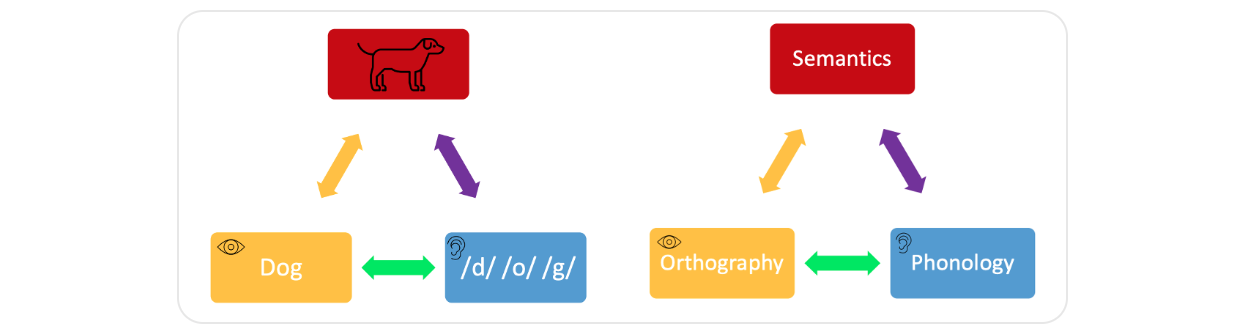
Triangle model of reading:
Computational (connectionist) model
Learning = adjusting connection strengths between units representing letters & units representing sounds and meaning
Provides a stringent test of theoretical models of cognitive architecture underlying reading
The Cortical Reading Network
Anatomy of the Reading Brain
When presented with print:
Inferior Frontal Gyrus (IFG/Broca’s area) — language production
Superior Temporal Cortex (STC/Wernicke’s area) — language comprehension
Posterior Parietal Cortex — attention
Widespread areas of visual cortex — vision
When subtracting the vision and attention areas, we get the Reading Network:
Inferior Frontal Gyrus (IFG/Broca’s area)
Temporo-Parietal Cortex (including Wernicke’s area)
Occipito-temporal medial cortex (Visual Word Form Area)

Reading network = Classic Language Areas + (Special) Visual Areas
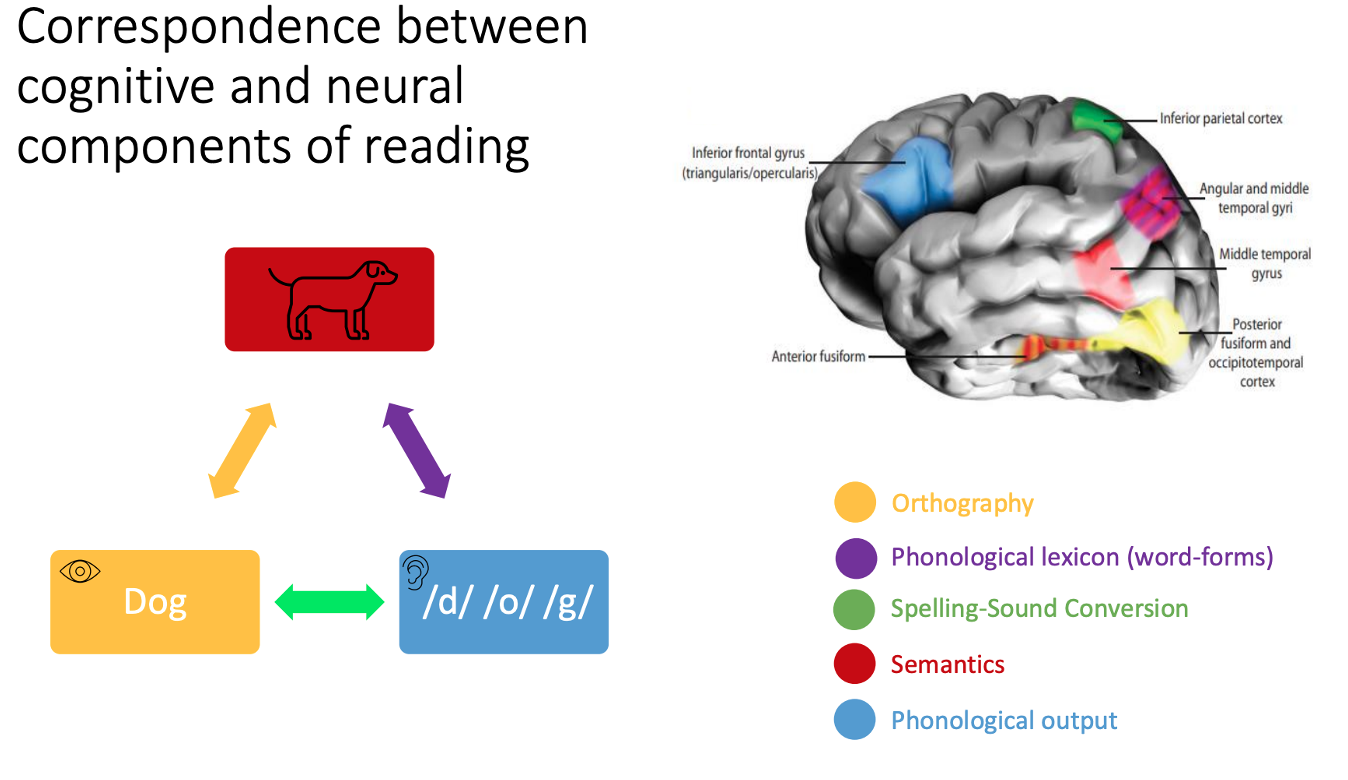
Broca’s Area (Inferior Frontal Gyrus):
Responsible for language production; active for most language tasks like speaking and reading.
Part of the dorsal language pathway and closely interconnected with the superior temporal cortex (Wernicke’s area).
In reading: acts as the "voice in our head."
Active even when reading silently.
Shows similar activation when speaking aloud or sub-vocally.
Temporo-parietal Cortex (Inferior Parietal Cortex):
Core language area for phonology and semantics.
Involved in general phonological processing as part of the dorsal language stream.
Situated near the auditory cortex; specifically tuned into speech sounds (compared to tones, noise, or music).
Responsible for mapping graphemes to phonemes (phonological recoding).
Responds to phonological differences (e.g., “dog” vs. “bike”).
Does not respond to spelling differences if the sound is identical (e.g., “poll” vs. “pole”).
Especially important for beginning readers and transparent orthographies.
Visual Word Form Area (VWFA):
Case Study: “Word blindness” first described by Jules Dejerine (1891).
Patient: A successful businessman who suffered a stroke causing a lesion in the left occipital cortex and corpus callosum.
Result: Lost the ability to read but managed to run his business. This led to Dejerine’s Hypothesis that the VWFA acts as an intermediary between vision and language.
Visual Processing and the VWFA
The Visual Pathway: Print encounters hierarchically organized cells in the visual cortex.
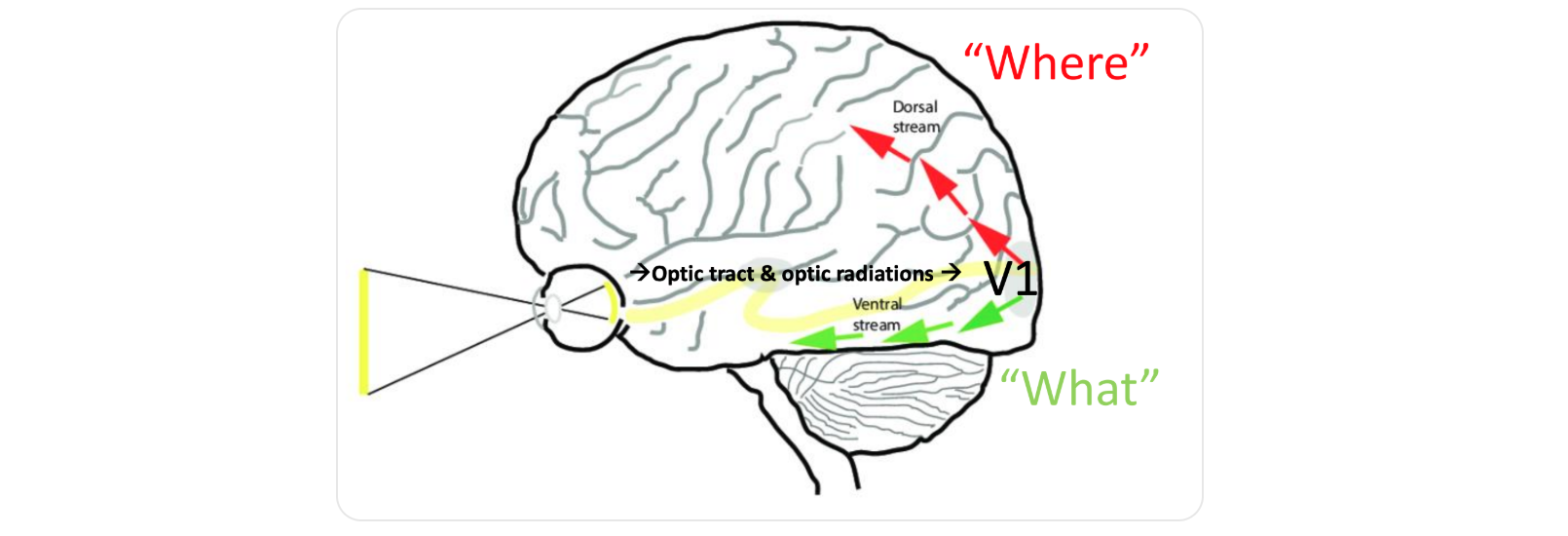

Specialization in the “what” pathway
The Fusiform Gyrus recognizes complex categories like faces and words. Skilled readers process words automatically and holistically here.
Mosaic of specialized areas:

VWFA: words > faces (or houses, checkers, etc.)
FFA: faces > words (or houses, checkers, etc.)
Neuronal Recycling: The VWFA area is recruited for reading through education. In literate individuals, this area activates for words, often displacing face processing to the right hemisphere.
Study 1: The emergence of the VWFA (Cross-sectional Study)
Subject groups: Pre-readers (age 5) vs. readers (age 8).
Findings:
In pre-readers, the VWFA area showed no preference for letters over faces.
By age 88, the VWFA became clearly selective for words over faces.
Comparison: The Fusiform Face Area (FFA) showed specific preference for faces at both ages.
Study 2: The emergence of the VWFA (Longitudinal Study)
Methodology: 10 children monitored during the first years of school over 6 fMRI sessions.
Stimuli: Pictures of words, numbers, tools, houses, faces, and bodies.
Findings:
As children learned to read, VWFA responses specific to words emerged.
Responses to other categories remained stable.
Recycling Mechanism: Voxels that eventually preferred words had initially been weakly specialized for tools. They retained some tool responsivity but acquired significantly stronger responsivity to words.
Connectivity and Development
White Matter Tracts:
Inferior Longitudinal Fasciculus: Distributes visual info throughout the brain.
Arcuate Fasciculus: Connects visual areas (VWFA) to language regions.
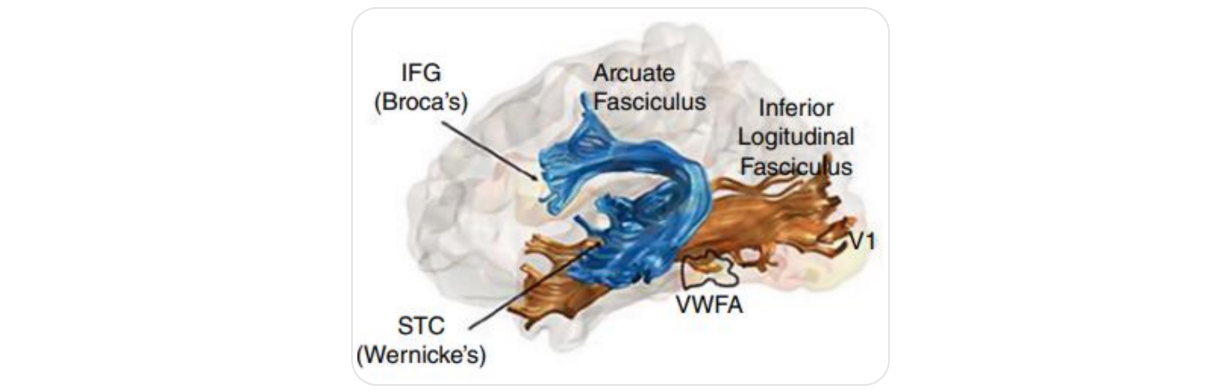
Developmental Impact: The growth of these tracts leads to phonological awareness, language skills, and the successful emergence of reading.
The Mature Network:
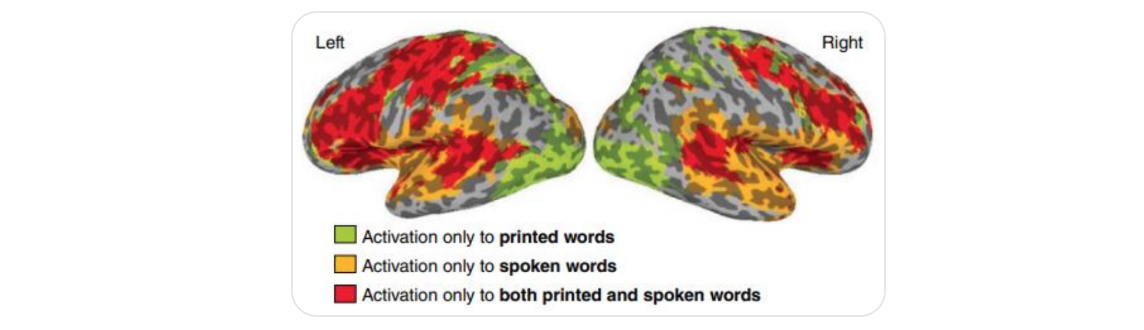
In skilled readers, spoken language and print activate highly overlapping networks. The goal of reading is to access language meaning via the visual modality.
Orthographic Invariance: This overlap occurs irrespective of orthography, including logographic vs. alphabetic systems or transparent vs. opaque scripts.
Evidence: fMRI studies across four contrasting languages — Spanish, English, Hebrew, and Chinese — show consistent network activation regardless of the writing system.
Longitudinal study of 68 children with varying reading ability, aged 6-10 years, followed up 2 years later
The amount of co-activation to print and speech in LH network predicted reading performance 2 years later!
Even when controlling for initial reading performance
The co-activation of LH language networks to BOTH print and speech is a marker of the developing skilled reading brain
Dorsal-Ventral Shift:
Early reading relies on the dorsal pathway (grapheme-phoneme mapping) — temporo-parietal cortex
Skilled reading shifts to the ventral pathway (direct visual identification) — VWFA
Literacy Sub-components and Precursor Skills
The Simple View of Reading
Reading as the product of decoding and comprehension
Formula: R = D \times C
Decoding (D): Phonological skills and letter knowledge.
Linguistic Comprehension (C): Vocabulary and grammar.
Developmental Shift:
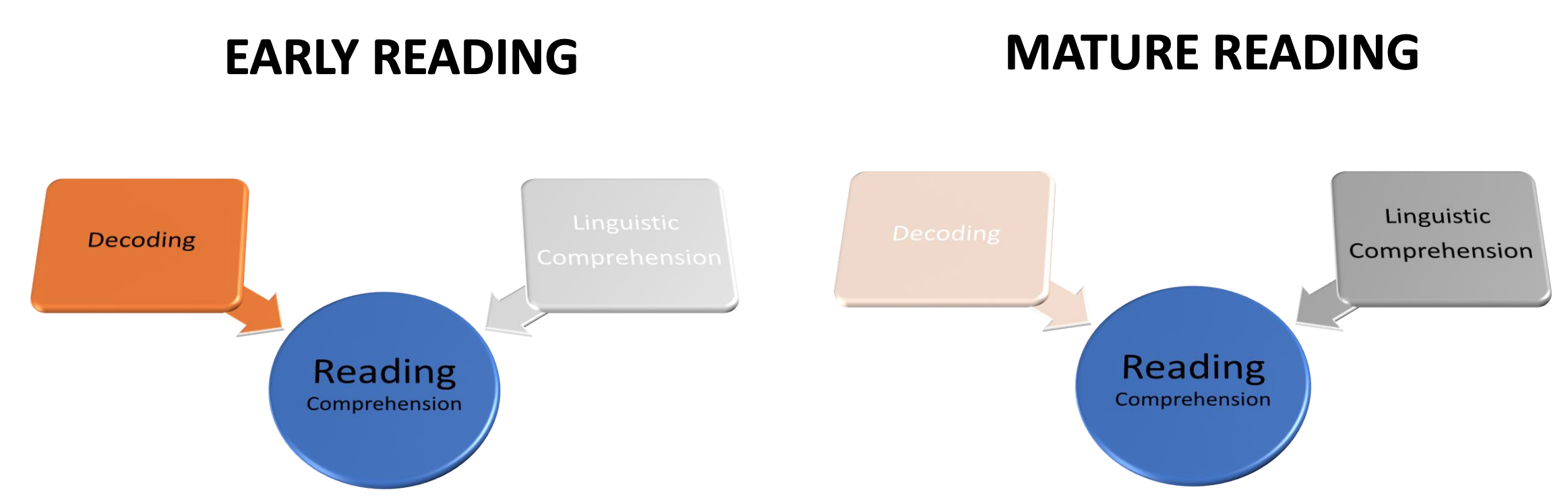
Early reading variability is mostly driven by decoding skills.
Mature reading variability is driven more by linguistic comprehension.
Predictors of Performance
Word Reading (Decoding): Robustly predicted by phoneme awareness, letter knowledge, and Rapid Automatized Naming (RAN).
Reading Comprehension: Predicted by word reading, vocabulary, and grammatical awareness. Note that vocabulary and grammar predict comprehension independently from decoding abilities.
Decoding and reading comprehension are fundamentally dissociable
Heritability and Genetics of Reading
Genetic Architecture
Humans share approximately 99.9\% of DNA. Individual differences are linked to the remaining 0.1\% (3,000,000 base pairs).
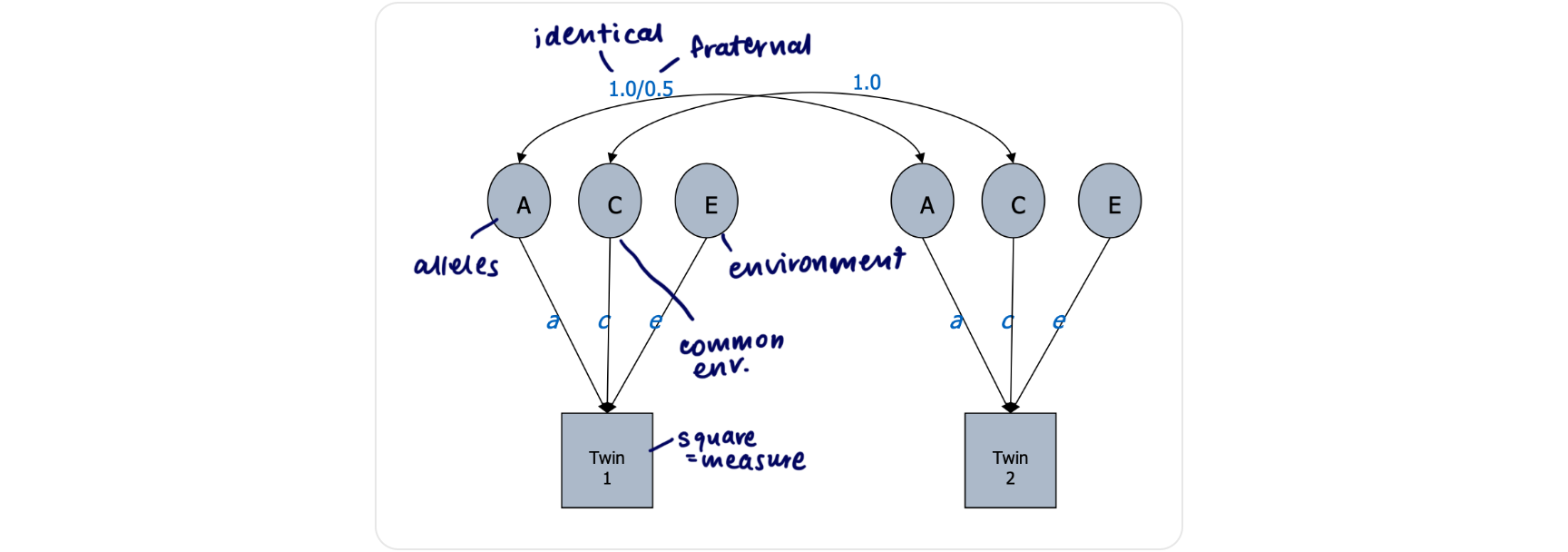
The ACE Model:
(A) Heritability: Genetic effects.
(C) Shared Environment: Familial influences.
(E) Non-shared Environment: Unique child experiences.
Partitioning the sources of variance in twins (MZ and DZ)
Genes/heritability: effects of alleles at all gene loci
Shared environment: environmental influences contributing to similarity (e.g., family environment)
Non-shared environment: environmental influences contributing to differences (e.g., child-specific event)
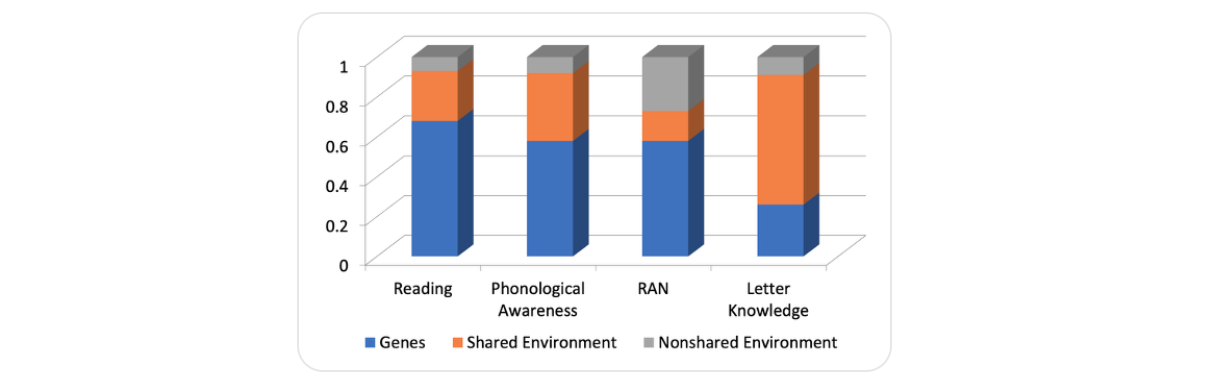
Heritability of reading & dyslexia (decoding side)
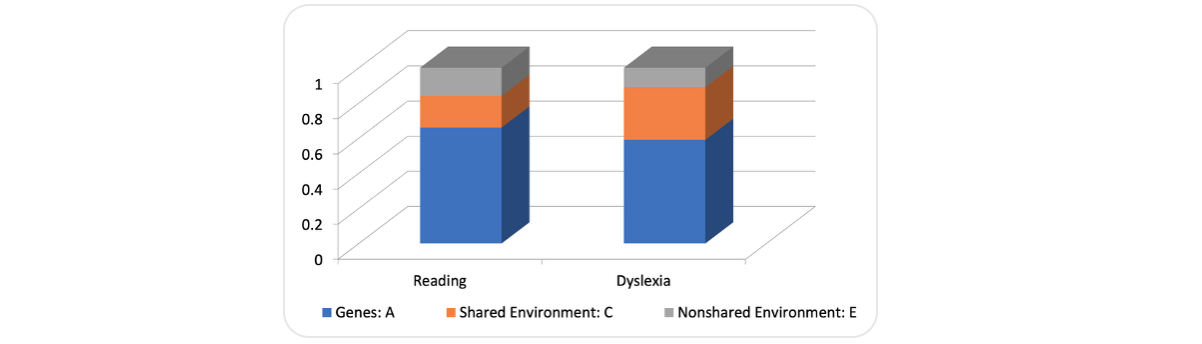
Heritability of reading & precursor skills (decoding side) — highly heritable
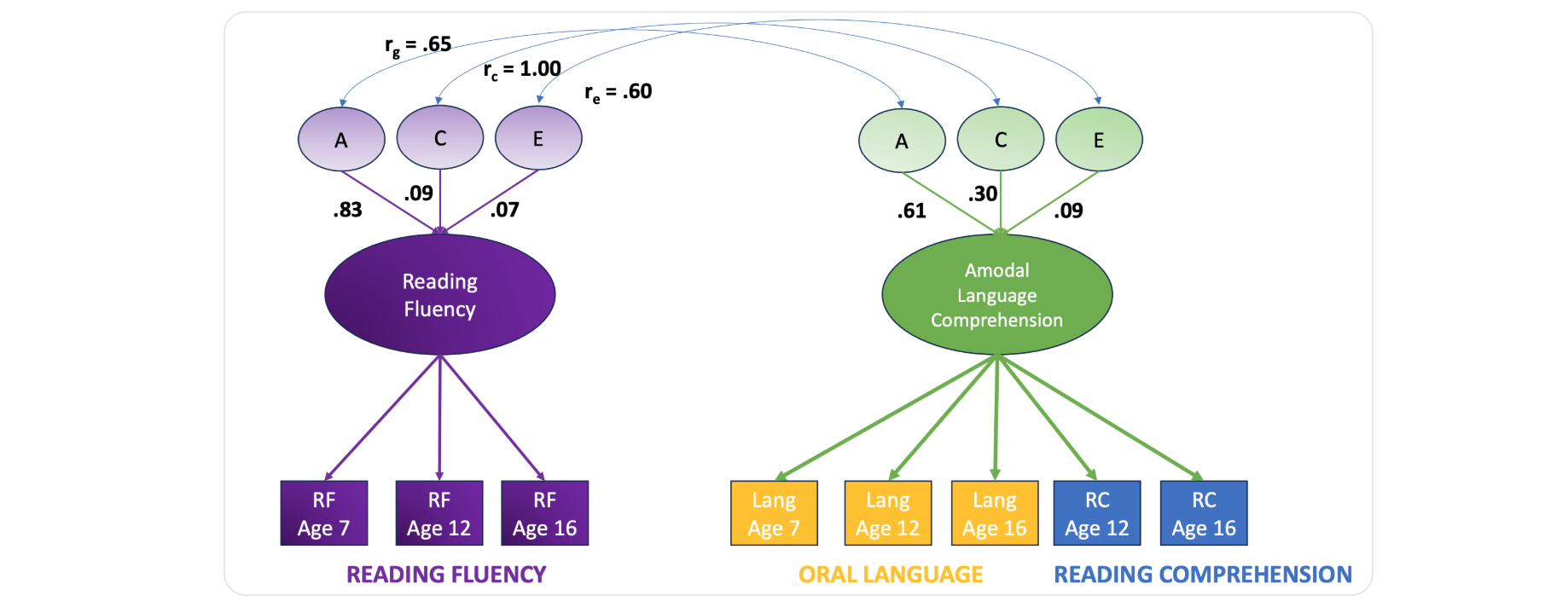
Etiology of the whole simple view of reading
Reading fluency has a high genetic factor (0.83).
Reading comprehension has a genetic factor (0.61) but involves more environmental variance.
The correlation between genes predicting reading fluency and genes predicting amodal language comprehension — .65, decent, but not 100% — means that they might be some genes special for reading fluency, some for amodal language comprehension, and some for both
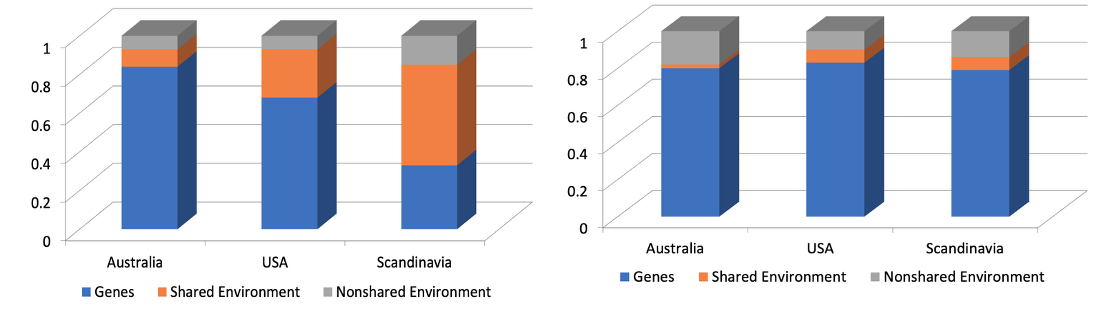
Gene-Environment (G x E) Interaction
Genetic potential is more likely reached in supportive environments. Uniform schooling reduces environmental variance, making genetic differences more apparent.
Heritability of reading in kindergarten (left) and after 1 year of reading instruction (right)
Heritability of reading depends on parental education
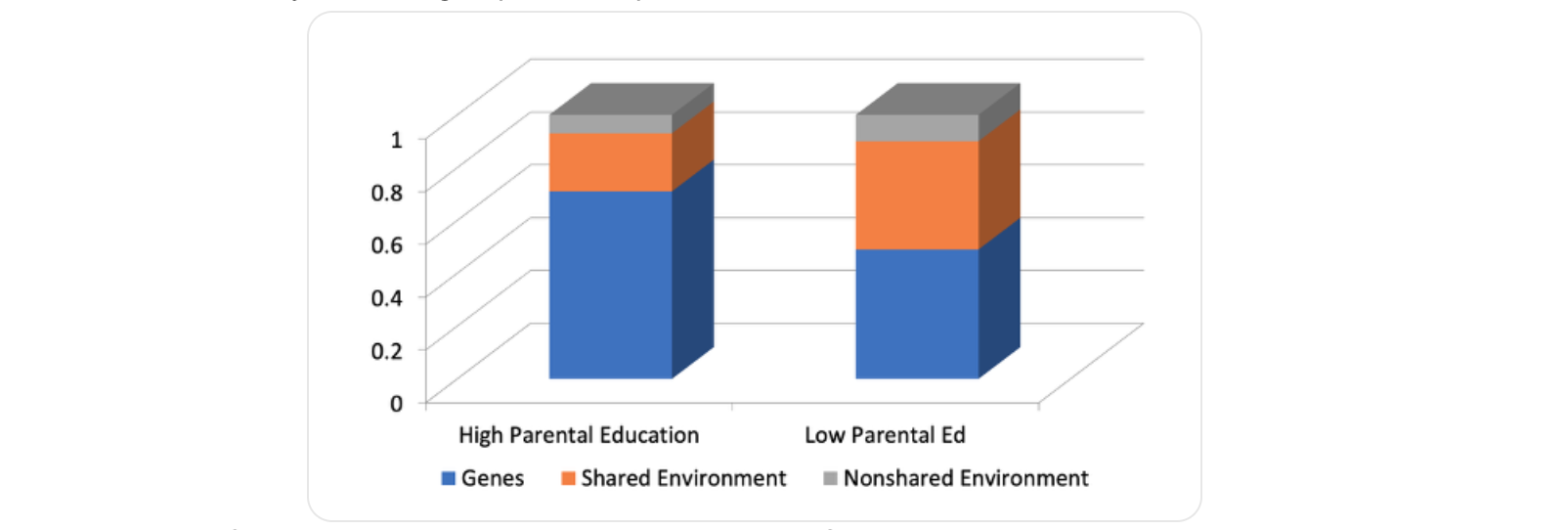
Children whose parents had higher levels of education showed higher levels of genetic influences on reading
Parents with higher levels of education are likely to provide a more supportive environment for reading
Bioecological model: actualization of genetic potential more likely in supportive environmental context
rGE (Gene-Environment Correlation)
Passive, active, evocative
Children with "reading genes" may seek out more books, creating a "virtuous circle" of development.
Genotype influences the type of environment you’re likely to experience
Children whose genes make it easier for them to read, will read more — virtuous circle creating better readers
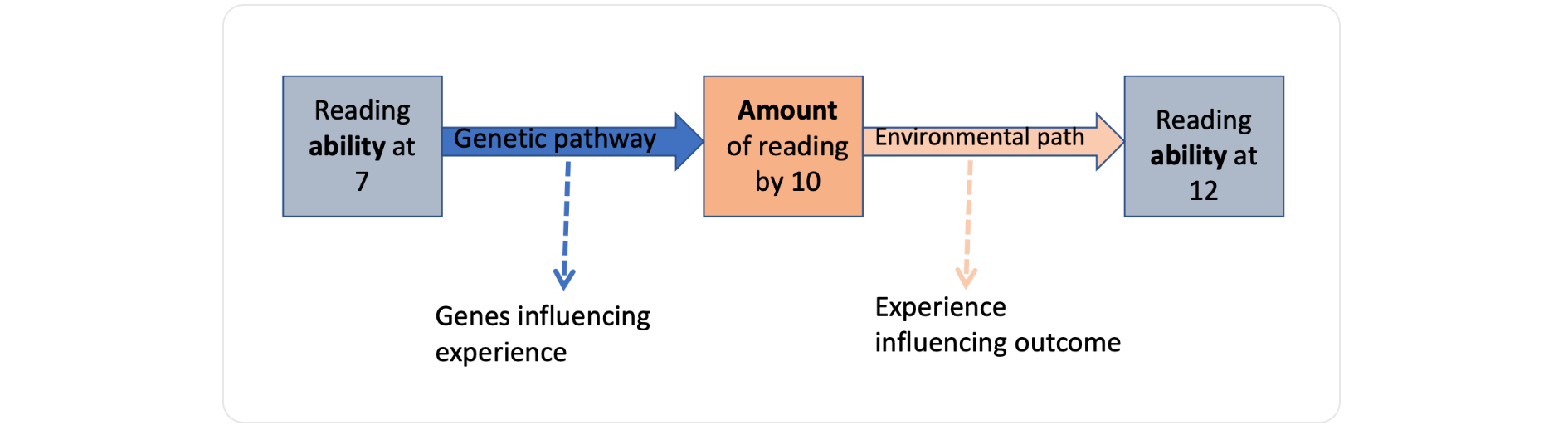
Behavioral Genomics
Polymorphisms: Small variations in base pairs.
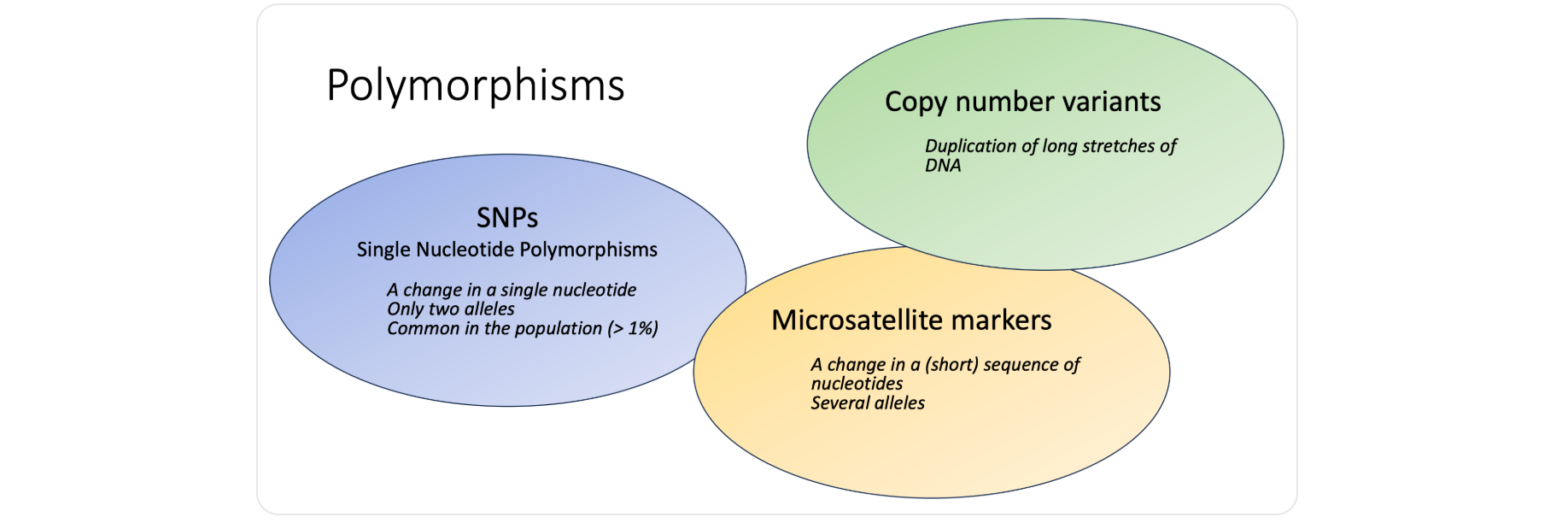
Genotyping — determining which genetic variant an individual has
DNA chips, microarrays
Genomewide Association Studies (GWAS): Uses DNA chips to find associations between specific alleles and phenotypes across large populations.
Key Milestones
Developmental Progression: Pre-readers (age 5) show no preference for words in the visual cortex, but by age 8, the brain becomes clearly selective for words over faces or other stimuli.
Neuronal Recycling: Through education, the brain recruits areas (like the Visual Word Form Area) that may have previously been weakly specialized for other categories, such as tools, to process text.
The Dorsal-Ventral Shift: Early reading relies heavily on the dorsal pathway for grapheme-phoneme mapping, while skilled reading eventually shifts toward the ventral pathway for direct, automatic word identification.
Assessment Paradigms
Triangle Model: This computational, connectionist model views reading as a system of adjusting connection strengths between units representing letters, sounds, and meaning.
The Simple View of Reading: Defined by the formula R = D \times C, where Reading (R) is the product of Decoding (D) and Linguistic Comprehension (C).
Predictors of Performance: Decoding is assessed through phoneme awareness and Rapid Automatized Naming (RAN), while Comprehension is predicted by vocabulary and grammar.
The ACE Model: Used to study heritability by partitioning sources of variance into Genetic impacts (A), Shared Environment (C), and Non-shared Environment (E).
Behavioral Genomics: Employs Genomewide Association Studies (GWAS) and DNA chips to identify associations between specific genetic polymorphisms and reading phenotypes.
Neural Substrates
Inferior Frontal Gyrus (Broca’s Area): Responsible for language production and functions as the "voice in our head" during both silent and oral reading.
Temporo-parietal Cortex (Wernicke’s Area): A core area for phonology and semantics, responsible for mapping graphemes to phonemes.
Visual Word Form Area (VWFA): An area in the occipito-temporal medial cortex specialized for word recognition that acts as an intermediary between vision and language.
Fusiform Gyrus: Located in the "what" visual pathway, it contains the VWFA and is responsible for holistic and automatic word processing.
White Matter Tracts: The Inferior Longitudinal Fasciculus distributes visual information, while the Arcuate Fasciculus connects visual areas to the classic language regions.