Visible Spectrum of Light
Visible light is the part of the electromagnetic spectrum that can be seen in the naked eye.
VISIBLE LIGHT
Visible light is the part of the electromagnetic spectrum that can be seen.
Within the visible spectrum of light:
Violet has the shortest wavelength
Red has the longest.
Green is neutral in the middle.
Wavelengths of light are measured in nanometers (nm). One nanometer is a billionth of a meter. Visible light has wavelengths ranging from 400 nanometers to 700 nanometers.
Natural sunlight is made up of three types of light:
Visible light = 35 percent
Invisible infrared light = 60 percent
Invisible ultraviolet light = 5 percent
Total invisible light = 65 percent
Although they are referred to as light, infrared light and ultraviolet light are not really light. Ultraviolet light and infrared light are also forms of electromagnetic energy but are invisible because their wavelengths are beyond the visible spectrum of light. Invisible light makes up 65 percent of natural sunlight
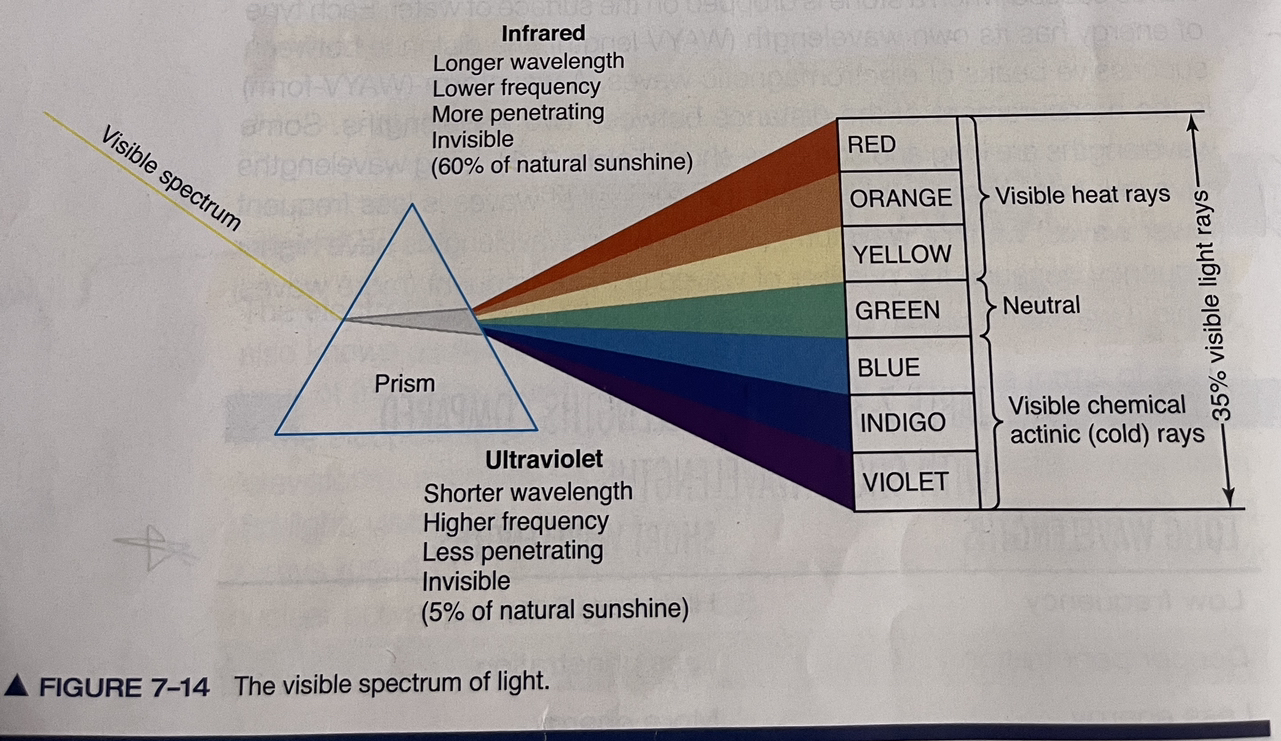
If light from the sun is passed through a glass prism (a glass or plastic prism usually resembles a pyramid shape after it is cut), it will appear in the seven different colors of the rainbow, in the following order:
Violet (the shortest wavelength), indigo, blue, green (neutral), yellow, orange, and red (the longest wavelength).
These colors, which are visible to the eye, constitute visible light.