01.01 Scarcity
Why Economics Is Necessary — Scarcity
Definition of Scarcity
Scarcity = the fundamental economic problem of limited resources and unlimited wants.
Because resources (time, money, labor, materials) are finite, choices must be made.
Every choice involves opportunity costs—the value of the next-best alternative you give up.
Example (Flight Decision):
Option | Airfare | Lost Wages | Extra Food | Total Cost |
|---|---|---|---|---|
Thursday | $275 | $120 | $45 | $440 |
Friday | $300 | $120 | $45 | $465 |
Saturday | $340 | $0 | $0 | $340 |
✅ Best option economically: Saturday, despite higher airfare, because total cost is lowest once opportunity cost is included.
💭 Economic Thinking
Economists look beyond sticker prices to include implicit and explicit costs.
Explicit cost: Direct payment (like airfare or food).
Implicit cost: Value of something sacrificed (like lost wages or time).
Key Idea: Rational decision-making involves comparing total costs (explicit + implicit) with total benefits.
💬 The Concept of “No Free Lunch”
Even “free” things have costs—someone pays, or you give up alternative uses of your time or resources.
Opportunity Cost: The value of the next-best alternative foregone when a choice is made.
Trade-offs: Choosing one thing means giving up others.
➡ AP Tip: Every question about decision-making can tie back to scarcity → choice → opportunity cost.
💵 What Is Economics?
Traditional Definition:
Economics is the study of the production and exchange of goods and services.
Key Ideas:
If you want something, you either:
Produce it yourself, or
Trade for it using something of value.
Economics studies:
What to produce
How to produce it
For whom it’s produced
Goods vs. Services:
Good: Tangible product (e.g., a souvenir).
Service: Intangible activity (e.g., street performance).
→ Economically equal if consumers value them equally.
🧍 Human Choices & Modern Economics
Modern economics extends to all human choices made under scarcity—not just money or production.
Example: Choosing less sleep (scarce time) for more work or entertainment.
Connects with behavioral economics (how psychology affects decisions).
🧩 Microeconomics vs. Macroeconomics
Field | Focus | Example |
|---|---|---|
Microeconomics | Individual decision-makers (consumers, firms, markets) | How Starbucks sets coffee prices |
Macroeconomics | Whole economy (national output, inflation, unemployment) | U.S. unemployment rate trends |
➡ AP Micro = small-scale decisions and market interactions.
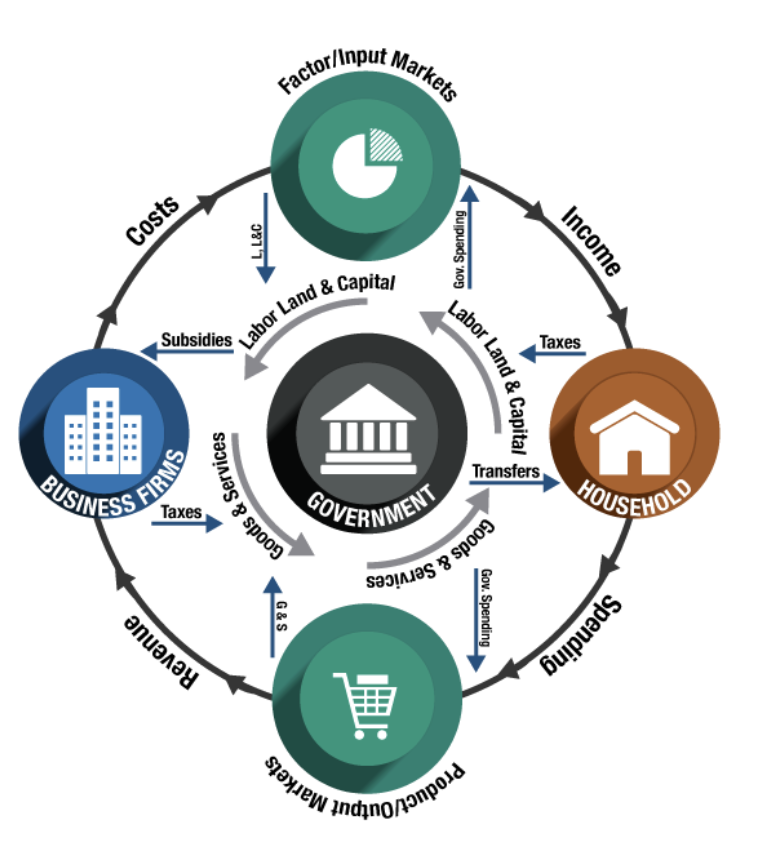
🔄 Circular Flow Diagram
Purpose: Shows how money, goods, and services continuously move through the economy.
Two main sectors:
Households — own factors of production (land, labor, capital) and consume goods/services.
Firms — produce goods/services and pay households for resources.
Two markets:
Product Market: Goods/services exchanged for money.
Factor Market: Resources (land, labor, capital) exchanged for income (rent, wages, interest, profit).
➡ AP Tip: Know the direction of flows (money vs. resources) and that every transaction has two sides—spending by one is income for another.
⚙ Factors of Production
Factor | Definition | Grocery Store Examples |
|---|---|---|
Land | Natural resources used in production | Land for the store, electricity, water, building materials, raw ingredients (e.g., tomatoes) |
Labor | Human effort (physical or mental) used to produce goods/services | Cashiers, stockers, bakers, managers, delivery drivers |
Capital | Man-made resources used to make other goods/services | Buildings, cash registers, delivery trucks, shelves, ovens |
Entrepreneurship (sometimes separate) | Organizing and risk-taking ability to combine other factors effectively | The store owner or manager who organizes production and pricing |
Key Distinction:
Land = natural/raw materials
Capital = man-made tools for production
AP Tip: Money is not a factor of production—it’s a medium of exchange, but capital goods are.
💡 Stretch Concept: Entrepreneurship
Involves risk-taking, innovation, and coordination.
Could be viewed as:
Part of labor (creative human input), or
Separate fourth factor (decision-making and leadership).
🧾 Positive vs. Normative Economics
Type | Definition | Example |
|---|---|---|
Positive Economics | Describes what is; fact-based, testable | “Professional athletes earn higher wages than nurses.” |
Normative Economics | Describes what should be; value-based, opinion | “Athletes should not earn more than nurses.” |
➡ AP Tip: Microeconomics focuses on positive analysis—explaining and predicting, not judging.
⚖ Rival vs. Non-Rival Goods
Type | Definition | Example |
|---|---|---|
Rival Good | One person’s use reduces availability for others | A berry, a phone, a sandwich |
Non-Rival Good | One person’s use doesn’t reduce availability | Sunshine, online videos (until bandwidth limits) |
➡ Used in later topics on public goods and market failure.
🧩 Summary — Key Takeaways for AP Microeconomics
Scarcity → Choice → Opportunity Cost: Foundation of economics.
Economics = Study of human choices under scarcity.
Microeconomics = Individual and firm-level decisions.
Circular Flow Diagram = How goods, services, and money circulate.
Factors of Production = Land, labor, capital (and possibly entrepreneurship).
Positive vs. Normative = Fact vs. opinion.
Rival vs. Non-Rival = Consumption type distinctions.
Economic reasoning means analyzing total cost and benefit, not just price.
The Circular Flow Model — Overview
🔹 Definition
The circular flow model shows how money, goods, services, and resources move continuously among the three main economic actors:
Households (Consumers)
Businesses (Firms)
Government
It helps visualize how markets connect producers and consumers and how resources and payments circulate throughout the economy.
👥 1. The Three Economic Actors
Actor | Also Called | Main Role |
|---|---|---|
Households | Consumers, Household Consumers | Own and sell factors of production (land, labor, capital) and buy goods/services |
Businesses | Firms, Producers | Buy resources in the factor market and produce goods/services for sale in the product market |
Government | Public Sector | Collects taxes, provides public goods/services, and participates in both markets |
➡ Key point: Everyone belongs to more than one group.
Example: A CEO (business) also pays taxes and buys groceries (household).
🏪 2. The Two Markets
Market | Description | Example |
|---|---|---|
Product Market (Output Market) | Where households buy goods and services produced by firms. Money flows from consumers to businesses. | You buy coffee from Starbucks → Starbucks earns revenue |
Factor Market (Input Market) | Where businesses buy resources (inputs) from households to produce goods/services. Money flows from businesses to households. | Starbucks pays wages to baristas, rent for land, and interest on capital |
➡ The government interacts with both:
Buys goods/services (product market) → e.g., military equipment.
Hires labor, rents land, uses capital (factor market).
💡 3. The Flow of Money and Resources
In the Product Market:
Households → Businesses: Money (spending/revenue)
Businesses → Households: Goods and services
In the Factor Market:
Households → Businesses: Resources (land, labor, capital)
Businesses → Households: Income (rent, wages, interest, profit)
So, money flows one way, and resources/goods flow the other way.
⚙ 4. The Factors of Production
Factor | Broad Definition | Coffee Shop Example |
|---|---|---|
Land | All natural resources or raw materials used in production | Property, coffee beans, sugar, paper, water, electricity |
Labor | Human effort (physical or mental) used to produce goods/services | Baristas, delivery drivers, roasters, managers |
Capital | Man-made goods used to produce other goods/services | Coffee machines, grinders, furniture, POS system |
Entrepreneurship (sometimes included) | Risk-taking and coordination of the other factors | The coffee shop owner who organizes production |
➡ If revenue from sales < cost of inputs → business fails.
🏛 5. The Role of Government in the Circular Flow
Function | Description | Example |
|---|---|---|
Taxes | Collected from households and businesses to fund public services | Income tax, sales tax, property tax |
Public Spending | Government buys goods/services (participates in product and factor markets) | Builds roads, pays postal workers, funds schools |
Subsidies | Payments from government to businesses to encourage certain behavior | Agricultural subsidies, renewable energy incentives |
Transfer Payments | Payments to individuals with no exchange of goods/services | Social Security, unemployment benefits, student aid |
➡ “Transfer payment” = money transferred among citizens through government redistribution.
☕ 6. Consumer Goods vs. Capital Goods
Type | Definition | Example |
|---|---|---|
Consumer Good | Final product bought for personal use | Coffee beans for a brunch party |
Capital Good | Product used to produce other goods/services | Same coffee beans bought by a café to brew coffee for sale |
➡ The distinction depends on how the good is used, not what it is.
🧾 7. Key Insights
Markets are conceptual, not physical locations.
The “product market” isn’t an actual store—it represents all transactions where consumers buy goods/services.
Master the vocabulary.
AP Economics questions often test whether you can distinguish between households vs. firms, product vs. factor market, and consumer vs. capital goods.
The circular flow never stops.
Income earned by households → spent in product markets → becomes revenue for firms → used to pay for resources → becomes household income again.
🔁 8. Simplified Flow Summary
Money Flow:
Households → Product Market → Firms → Factor Market → Households
Goods/Resources Flow:
Firms → Product Market → Households → Factor Market → Firms
Government’s Flow:
Collects taxes, injects spending, provides public goods, and redistributes income.