5. Client at Court and Trial Procedure
Court Room Etiquette and Questioning
Modes of Address:
Magistrates & District Judges → "Sir/Madam" or "Your Worship."
Circuit Judges and Recorders → "Your Honour."
Leading Questions: Suggestive questions directing a witness to a specific answer.
Not allowed in examination-in-chief on disputed facts.
Allowed in cross-examination.
Defense Solicitor Role
Funding Criminal Defense
If D cannot privately fund for legal aid, he must seek public funding/seek representation by the Court Duty Solicitor who will apply for a representation order funded by the Legal Aid Agency (LAA)
Eligibility for legal aid/representation order → must satisfy (i) means test + (ii) interests of justice test
(i) Financial Means Test
Assesses D’s income, savings, and assets - the following are eligible:
Those in receipt of state issued benefits are “passported” (automatically qualified for income)
Anyone under the age 18 is “passported”
If income is above a set threshold → must pay privately — Only the following are eligible for legal aid; those:
In receipt of less than £12,475 a year
With an income of less than £22,325 + disposable income of less than £3,398
With a household disposable income of less than £37,50 are eligible but may be required to pay a contribution commensurate with their means
(ii) Interest of Justice Test
Looks at the seriousness and complexity of the case
If case proven, is D likely to lose their liberty or livelihood or suffer serious damage to their reputation
Other Responsibilities
Obtaining Prosecution’s Case: must obtain disclosure of prosecution’s evidence
Obtaining Client’s Statement: must be signed by the client — contains personal details, offence details, family/medical issues, previous convictions, the client's response to the charge/evidence, and factors relevant to bail or mitigation
Bail: If the Crown Prosecution Service (CPS) objects to bail, the solicitor must make an application on D's behalf
Plea Advice: Advise the client on the Plea Before Venue (PBV) and court selection for either way offences.
Guilty Plea: If sentencing will exceed MC powers, D is sent to CC. Otherwise, CPS outlines facts and priors; D enters plea in mitigation. MC sentences then, later, or commits to CC for sentence.
"Newton Hearing" may occur if D's factual basis for the plea differs from the CPS
Not Guilty Plea: Court proceeds to "allocation" + D is informed of the right to give evidence at trial, that trial can proceed in their absence, and that failure to appear while on bail is an offence
Indication of Sentence: D can ask if a custodial or non-custodial sentence is likely if they plead guilty at that stage. If the court gives an indication and D pleads guilty, it is binding. If they go to trial, it is not.
Professional Conduct Conflict: If a client admits guilt to the solicitor but insists on a not guilty plea, the solicitor has conflicting duties (client's best interest/confidentiality vs. duty not to mislead the court).
The solicitor must advise on the benefits of a guilty plea and the limitations of proceeding with a not guilty plea (e.g., cannot lead false evidence).
If D insists on giving false evidence on the stand, the solicitor must withdraw for "professional reasons" without breaching confidentiality.
Laws of Evidence
D is innocent until proven guilty by the prosecution → Standard of proof must be beyond reasonable doubt
Prosecution must serve Initial Details of the Prosecution Case (IDPC) – this is usually in the form of witness statements, CCTV footage, and records of police interviews
D does not have to produce any evidence unless they are advancing a positive defense e.g. alibi, self-defense, reasonable justification
Evidence must be admissible and relevant
Witness Evidence
All witnesses must be competent and compellable
Competence Presumption: all witnesses are competent if they can understand questions and give intelligible answers.
All witnesses aged 14 or over are competent to give sworn evidence
All witnesses under the age of 14 are competent to give unsworn evidence
Where competency is challenged = court decides if witness is competent
All witnesses are compellable except for the defendant, co-defendant, and their spouses (Where a witness summons can be served = witness is compelled)
D is not compellable as a witness to the prosecution (but adverse inferences can be drawn)
Where a co-accused ceases to be a a co-accused, they then become compellable
Spouses/Civil Partners: Not compellable for the prosecution against the other spouse/partner to protect marital privacy and avoid pressuring spouses into betraying each other, except in certain cases:
Assault on spouse or civil partner
Assault on a child under 16
Sexual offences against a person under 16
Offense is either-way or indictable
Attempts, aiding, abetting, counseling or procuring those offences.
These are mainly domestic violence and child protection cases, where public interest in prosecution outweighs marital privilege.
Special Measures Directions for Vulnerable Witnesses
To reduce the trauma of giving evidence, CPS, D, or the court can apply for the witness to testify under a special measures direction.
Special measures will only be ordered where witness is either ‘vulnerable’ or ‘intimidated’ AND court is satisfied that such measures will maximize the quality of witness evidence without inhibiting the evidence from being effectively tested
a vulnerable witness automatically attracts special measures entitling them to a range of measures to assist them to give oral evidence
To be eligible for SMD as an intimidated witness, court must be satisfied that the quality of witness’ evidence would be diminished by their fear or distress in connection with testifying in the proceedings — court will consider:
The nature and facts of the alleged offense
Witness’ age, social/cultural bg, ethnic origin
Domestic and employment circumstances
Religious + political beliefs
Behavior of the accused and/or their family and/or their associates towards the witness
Types of special measures: screens, video link for remote testimonies, prerecorded evidence (evidence-in-chief or cross examination), removal of wigs and gowns, or use of an intermediary and communication aids
Turnbull Guidelines
Applies when prosecution depends wholly/substantially on ID or eye witness evidence that D disputes as mistaken
Turnbull guidelines are provided by the judge to the jury where they must:
Give a strong, specific warning to the jury about the dangers of relying on identification evidence, even if the witness is honest and convincing; and
Direct the jury to examine the circumstances in which the identification was made:
1. How long suspect was in view
2. Distance
3. Lighting conditions
4. Brief or prolonged incident
5. Was suspect alone or amongst others
6. Whether witness has seen the suspect before
7. Time delay between incident and identification
8. Any discrepancies in description and actual appearance
Jury must examine the circumstances of the case and look for supporting evidence. If there is no supporting evidence, then a judge can withdraw the case.
Admissibility of Evidence
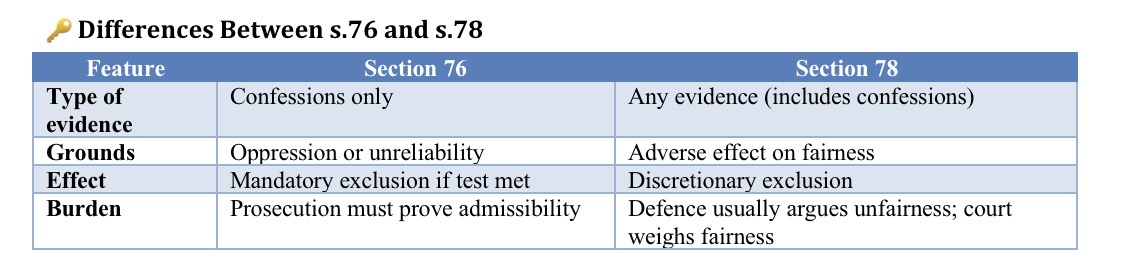
s78 PACE: All relevant evidence is admissible subject to exclusionary rules. Relevance means evidence helps prove/disprove a fact.
this is a discretionary power used if evidence would have an adverse effect on the fairness of proceedings, including how it was obtained (unlawfully).
Exclusory Rule Categories: Hearsay, bad character, confessions, and identification (ID) evidence.
Confessions (s76 PACE)
Narrower than s78 — confessions only admissible as evidence under s76 if:
relevant;
not excluded under s78; and
not obtained by opression or in circumstances (something else said or done) rendering it unreliable
Bad Character Evidence
This is evidence of D’s misconduct or disposition towards misconduct — usually inadmissable as evidence to prevent unfair prejudice
The Seven Gateways — Bad character can be admitted if one of the following applies:
Agreement by all parties as being admissible
D volunteers evidence: the bad character evidence is adduced (cited as evidence) by the defendant or is given in answer to a question asked by them in cross-examination
It is important explanatory evidence
Relevant to an important matter in issue between CPS and D, or between D and a Co-D
Helps jury understand the case in context (e.g., history of domestic abuse).
Corrects a false impression given by the defendant
Attacks another person’s character
⚖ Safeguards – Even if a gateway is satisfied, CJA 2003 allows exclusion where admission would have such an adverse effect on fairness that it ought not to be admitted.
Hearsay Evidence
Hearsay Is a statement made on an earlier out-of-court occasion which is being relied on in court to prove the truth of some fact asserted in the earlier out-of-court statement
Defining “statement” vs “matter stated” (essential for deciding whether something is hearsay):
Statement: Any representation of fact or opinion made by a person by whatever means, including oral statements, written documents, non-verbal conduct intended as communication i.e. nodding gestures)
Matter stated: A matter is “stated” if the purpose of the person making the statement was to cause another to believe it, or to act upon it, as true.
e.g. “do you have the gun” or “may I buy some drugs please”
If something is not a “statement” or not a “matter stated”, it never counts as hearsay, so no need to rely on exceptions.
Written witness statements may be used as hearsay evidence instead of live testimony, provided certain conditions are met:
All parties must agree on it
Must be in writing and signed by the maker
Must contain a declaration of truth, confirming the maker would be liable for prosecution if the statement is false
A copy must be served on the other parties before the hearing.
General rule is that hearsay is inadmissible unless:
It is allowed under CJA 2003 (applies to multiple hearsay);
It has been adduced by agreement of all parties (applies to multiple hearsay); or
Court is satisfied that it is in the interest of justice to do so (applies to multiple hearsay)
Statement maker is credible, statement has important probative value, and there is difficulty in challenging why statement maker cannot attend
CJA Exceptions/Gateways
Unavailable Witness — Admissible if witness cannot attend due to: Death, mental or physical unfittness, being missing or in fear, or being out of the country where it would be unreasonably practicable to secure their attendance
Business Documents and Statements — records created in the course of business are admissible, even if maker is not called
Previous Inconsistent Statements
Previous Witness Statements — To rebut fabrication or refresh memory
Common Law Exceptions
Res Gestae (Common Law Exceptions): allows certain spontaneous statements made at the time of an event to be admitted as evidence, even if the speaker doesn’t testify in court – also known as “excited utterance” rule:
Res gestae evidence can be adduced by proving the statement was made by a person “so emotionally overpowered by an event that the possibility of concoction or distortion can be disregarded”
Admissibility of such evidence is subject to court’s discretion
Confessions (as previously discussed)
Expert Evidence
Public Information (maps, registers, published works) and Character Reputation