basic psychology brain
The Cerebrum
Largest brain structure
In charge of most sensory, motor, and cognitive processes
Surrounded by cerebral cortex
Corpus Callosum bundle of nerves that allow cerebral hemispheres to communicate
Pituitary gland
master gland
Limbic system
HATCH
Hippocampus, Amygdala, Thalamus, Cerebellum, Hypothalamus
Hippocampus
Long term memory storage
Involved in processing and storage of memory
Responsible for storage of new information in memory
Amygdala
Responsible for
arousal
regulation of emotions
Initial emotional response to sensory information
Plays important role in
mediating anxiety
emotional memory
Involved in fear responses and volatile emotions like anger
Thalamus
Relay station
Relays information/sensory signals from different parts of the body to different parts of the brain for processing
All sensory inputs except olfactory
Regulate consciousness
Sleep
Alertness
Cerebellum
Motor coordination
Body posture
Attention
Language
Regulates movement and balance
Hypothalamus
Maintain body temperature
Regulate ANS
autonomic nervous system
Thirst and hunger
Role in aggression
Homeostasis
Control pituitary gland / endocrine system
The Brain stem/ Hindbrain
Pavlov’s Rabid And Surely Mad
Pons, Reticular Activating System, Medulla
We have no conscious or control over these.
Pons
Heartbeat
Blood pressure
Role in respiration
Cardiac functions
Sleep cycle
Dreaming
Reticular activating system
Arousal cortex
screens incoming information
Medulla
The base of the brain stem
Responsible for certain autonomic functions such as breathing and heart rate
Mid brain
Visual system
Auditory system
Eye movement
The neurons
Basic building blocks of the nervous system, responsible for transmitting information.
Neurotransmitters- can excite or low or inhibit, facilitate communication between neurons across synapses
Adrenaline/Epinephrine
neurotransmitter and a hormone
fight or flight response
Dopamine
low levels- Parkinson’s disease
High level- Schizophrenia
Serotonin
low levels- associated with depression
Endorphins
alleviate pain, lower stress
improve mood, enhance sense of well being
First neurotransmitter-Acetylcholine
Allow to contract muscles
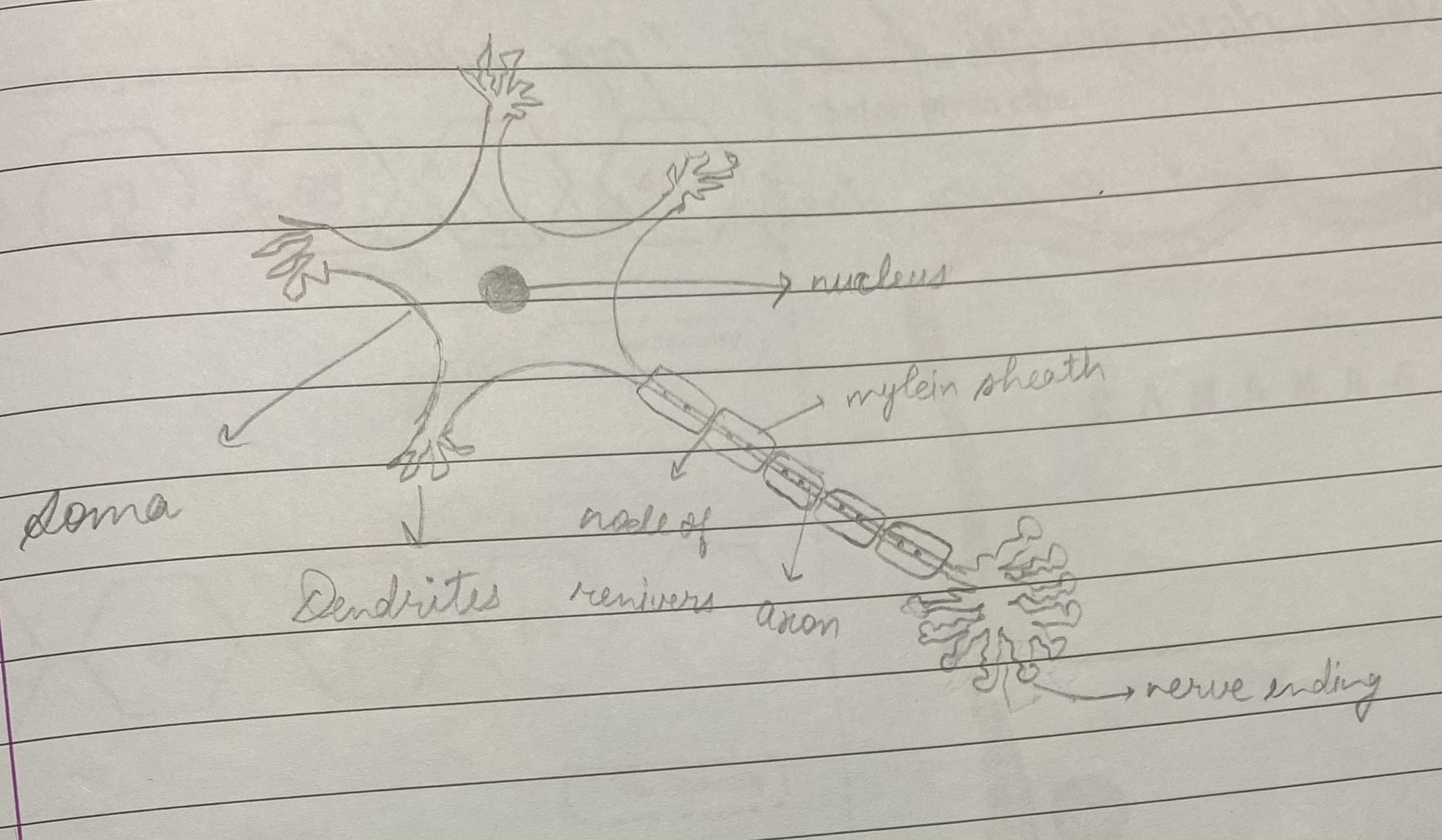
Damn! Skinner Ate Mice ?!? Not Very Smart
Dendrites - a neuron’s branching extensions that receive and integrate messages, conducting impulses toward the cell body.
Soma - Cell body of neuron
Axon - the neuron extension that passes messages through its branches to other neurons or to muscles or glands.
Myelin sheath - Electrical impulses travel quickly, Protects the axon
Nodes of Ranvier - help in jumping of signal, protect
Vesicles - At the end of the axon, contain neurotransmitters
Synapse - Space between one neuron and another or between a neuron and muscle
Threshold - The level of stimulation required to trigger a neural impulse
Glial cells - Cells in the nervous system that support, nourish, and protect neurons; they also play a role in learning, thinking, and memory
Depolarisation - Neurons reach excitatory threshold, making it depolarised. Na+ channels open and the charge across the membrane reverses
Autonomic nervous system
Central nervous system
brain
spine
Autonomic nervous system
sympathetic
Fight or flight
preparing the body for action in stressful situations
if it stays active for long period → burnout
Parasympathetic
Rest and digest
helping the body return to a state of calm
The Cerebrum
Largest brain structure
In charge of most sensory, motor, and cognitive processes
Surrounded by cerebral cortex
Corpus Callosum bundle of nerves that allow cerebral hemispheres to communicate
Hemispheres of the brain
Left hemisphere
Recall
verbal processing
Broca’s area - language production
Wernick’s area - language comprehension
associated with logical reasoning, mathematics and analytical thinking
Interpreting verbal instructions received
controls right side of the body
Right hemisphere
Emotional response
Creativity
Secretion of hormones
Pattern recognition
Comprehension of tone, sarcasm, irony, etc.
Controls left side of the body
The cerebral cortex
Made up of densely packed neurons called the gray matter
Wrinkles - fissures
Freud Took Off his Pants
Frontal lobe - front of brain
memory
higher cognitive thinking
Temporal lobe - centre of ears
hearing, interpretation of voice
balance
Occipital lobe - near nape of neck
vision
correlate memories and images
Parietal lobe - top of the brain
Language
touch
reason, perception, voluntary movement, thought processing, language development