AP Calc AB Review Guide
Algebra you should know
point slope form - y=m(x-x1)+y1
-Completing the square
-Polynomial long divison
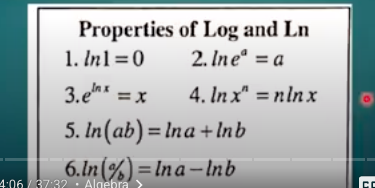
-log and natural log properties
Trig you need to know:
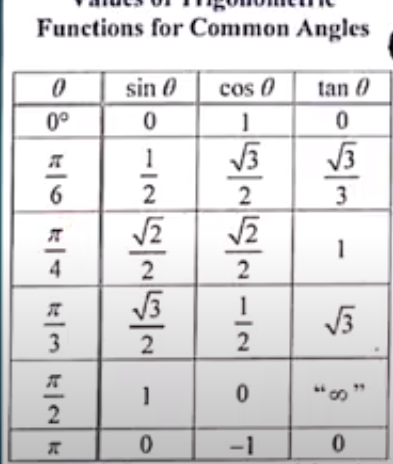
Unit circle values (I’ll put the most common ones below)
Trig derivatives
Special trig limits
trig intergrals
Limits and Continuity-Definition of limits
-Remember that limits show where values approach, not what values are equal to.
-So if I said as the limit of f(x) approaches 4=2, this does not mean that when f(x) approaches 4, the limit=2. This means that f(x) is getting close to 4, not that f(4)=2.
Strategies for solving limits
-L’hopitals rule (when you find the derivative of a function and then plug in the x-value the limit is approaching)
-Direct subsitution (either conjugates or limits)
-Factoring/Algebraic manipulation
Nonexistent limits
-If a limit is approaches from the left side and right side doesn’t equal the same value, the limit doesn’t exist. This is known as a jump discontinuity.
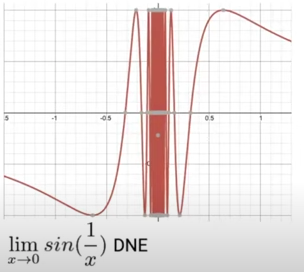
-If the graph osscilates frequently at infinity, the limit can’t exist. I’ll show an image below to clarify what this looks like.
-If a limit is unbounded, (this usually appears as when your asked to find the limit of a number as x approaches something, and theres an asymtope at that number.
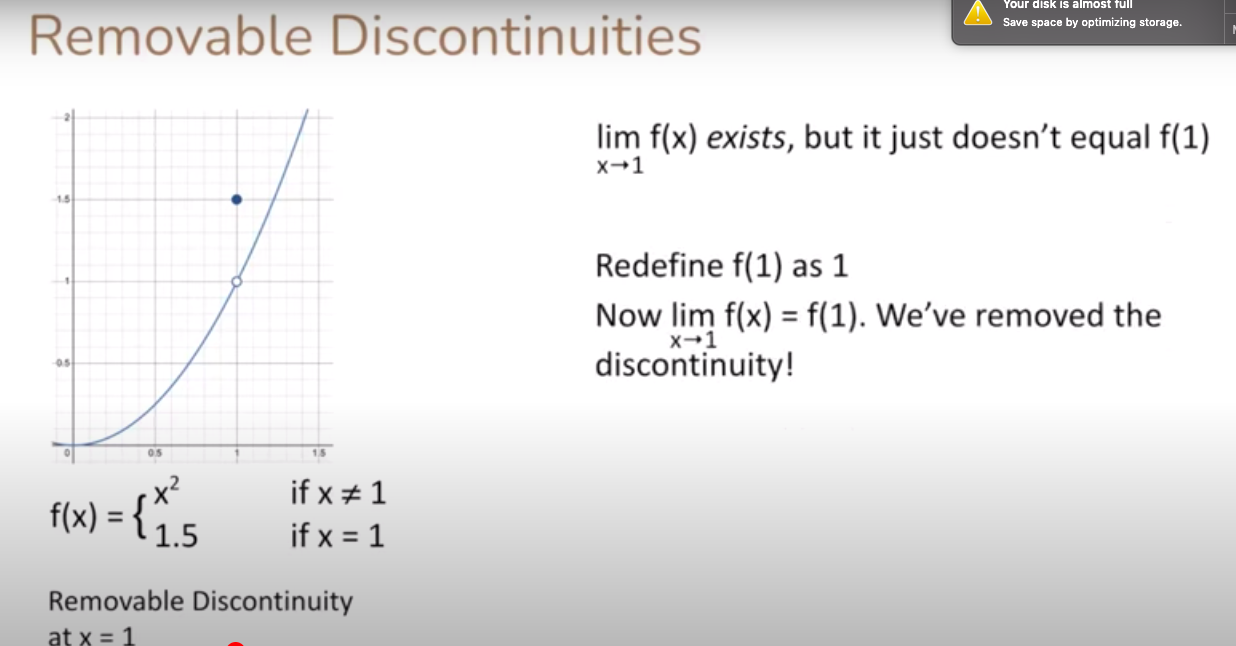
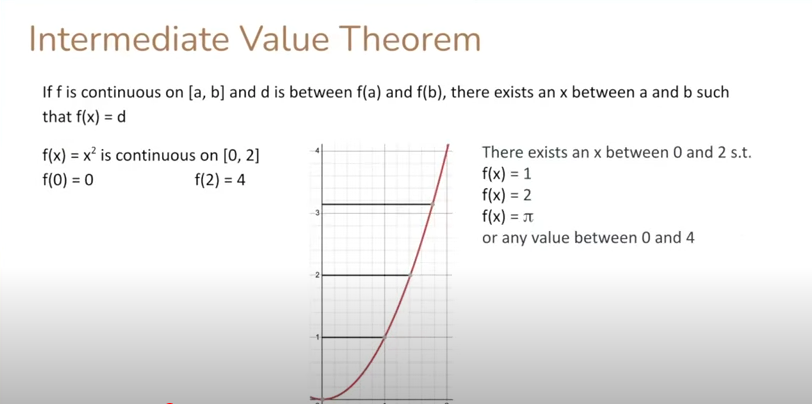
Intermediate value theorom:
Part 2: Derivatives
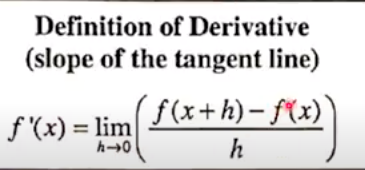
Definition of the derivative
Conditions for a function to be differentiable
-Must be continous at the point your looking at
-Function can’t have sharp turns
Differentiation via chain rule
-This is use to differentiate composite functions, or a function within a function
Step 1: Differentiate the outer part of the function, and don’t differentiate the inner part of the function
Step 2: Differentiate the inner function
Step 3: Multiply the value you got from step 1 by the value you got from step 3
Example problem
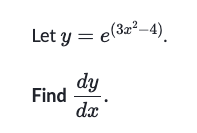
First step: Find the derivative of the outer function , which is e^x
-the derivative of e^x is e^x
Second step: Find the derivative of the inside function
the derivative of the inner function is 6x
Third step: writing answer
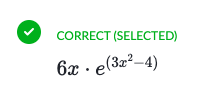
Therefore, the answer is
Implicit Differentiation
-Implicit differentiation refers to the process of differentiating an equation where y isn’t expressed in terms of x.
Example problem:
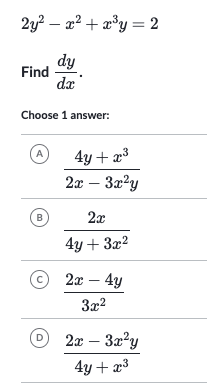
The first step of this problem is to differentiate this whole equation.
-When you do this, you should get 4ydy/dx-2x+3x²y+x³dy/dx=0
Then, you isolate the terms containing dy/dx.
-When you do this, you should get -4ydy/dx-x³dy/dx=-2x+3x²y
Then, you divide the coefficients of dy/dx to isolate dy/dx.
-At this point, you should get 2x-3x²y/4y+x³
Product rule
-This rule is applied when you are finding the derivative of a function which has parts that are multiplied to each other.
Example: Differentiate x² multiplied by sin(x)
-For these problems you take the derivative of one of the numbers being multiplied, and multiply it by the the other part of the function. Then you add this value to the derivative of the function you didn’t differentiate before multiplied by the function you differenetiated before.
Work:
2xsin(x) is the derivative of 2x multiplied by sin(x)
cos(x)x² is the derivative of sine(x) multiplied by x²
Therefore, the answer is 2xsinx+x²cosx
Quotient Rule
-This is used when finding the derivative of a function that is a quotient.
Formula for this: u’v-v’u/v²
Inverse function of the derivative rule
-the derivative of the inverse function at a point 'x' is the reciprocal of the derivative of the original function evaluated at the value of the inverse function at that point. In other words, (f⁻¹)'(x) = 1 / f'(f⁻¹(x)).
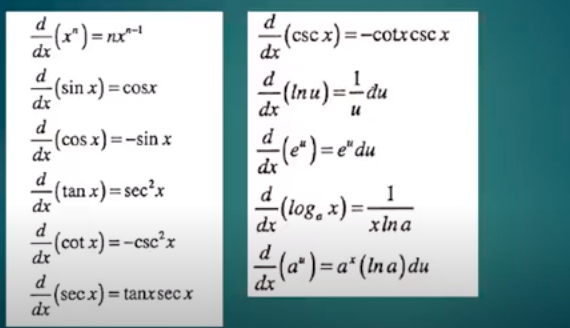
Derivatives to know
Example:
Related rates problem
-Related rates problems require using derivatives to analyze the rate at which one quantity is changing by relating it to other quantities.
The steps for all of these problems involves
-Picking which formula you will use to plug in values and differentiate. (This is pretty much the only procedure)
Example
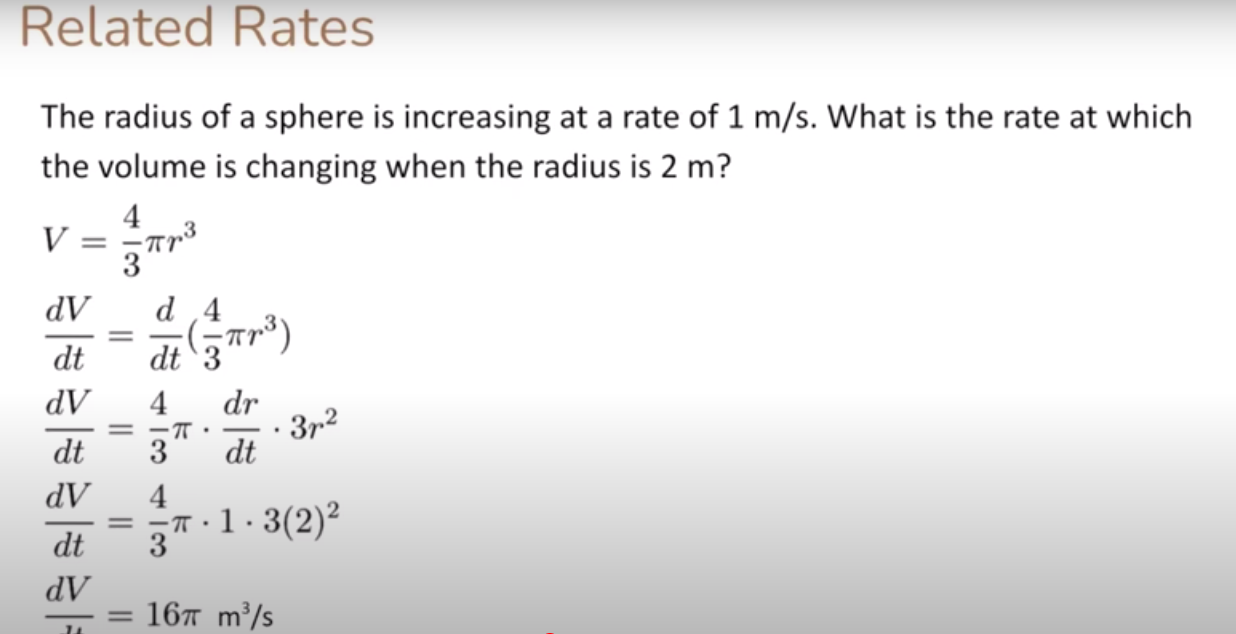
-This problem utilized implicit diffentiation and the formula for the volume of the sphere.
Analyzing graphs
If f(‘x)>0 the function is increasing, and vice versa. This is known was the first derivative test.
-If f’’(x)>0, the function is concave up.
-If f’’(x)<0, the function is concave down.
-Critical points are where the relative mins and maxes occur, f’(x)=0 at these points.
-Inflection points occur when the concavity changes. f’’(x) has to = 0 at these points.
-First derivative test: If f’(c) =0 or doesn’t exist and f’(x) changes from positive to negative or negative to positive at x=c, then c is a relative max or min.
-Second derivative test: If f’(c ) =0 or DNE and f’’(c ) is greater than 0, c is relative minimum
-If f’(c ) =0 or DNE and f’’(c ) is less than 0, c is relative maximum
-If f’ (c ) or DNE and f’’( c) this means that results can’t be obtained from the second derivative test. Use first derivative test.
Mean Value Theorom
f a function is continuous on a closed interval [a, b] and differentiable on the open interval (a, b), then there exists a point c in (a, b) where the instantaneous rate of change (derivative) of the function at that point equals the average rate of change of the function over the entire interval [a, b].
Example problem
-Let h(x)=x³-6x²-10x and let c be a number that satisfies the Mean Value Theorom for h on the interval [-4,5]. What is c?
First step: Find rate of change
f(5)-f(4)/5-4
=-75-120/9=5.
Second step: Find the derivative of H(x) and plug in 5 (the rate of change) into the equation and see which solution is between the numbers -4 and 5.
h’(x)=3x²-12x-10
3x²-12x-10=5
3x²-12x-15=0
3(x²-4x-5)=0
x=-1
x=5
x=-1 is the solution, as it’s within the interval [-4,5]
Second derivative test to test for look for maxima and minima
if f’’(x)>0, there is a minimum.
if f’’(x)<0. there is a maximum.
if f’’(x)=0, this is inconclusive.
Finding critical points
-To do this you find the derivative of f(x) and see what values cause it to equal to zero. Remember that if a value is undefined in the original function, it can’t be a critical point.
-Example problem: let f(x)=x³+x²+x. Find critical points, if there are any
First step: Differentiate f(x)
3x²+2x+1
Next step: Determine if any values would cause this function to equal 0. there aren’t any, so there are no critical points for this function.
First derivative test to determine where a function is increasing or decreasing
Steps to solve these problems
-Find the derivative of the function
-find the critical points
-graph these critical points on a number line to determine whether or not at those intervals are decreasing or increasing
Example problem:
-Let h(x) = 6x^5+15x^4+10x³. On what intervals is h decreasing?
First step: differentiate via power rule
30x^4+60x³+30x²
Second step: Find critical points
30x²(x²-2x+1 )
30x²(x-1)²
Third step-graph on number line and determine answer
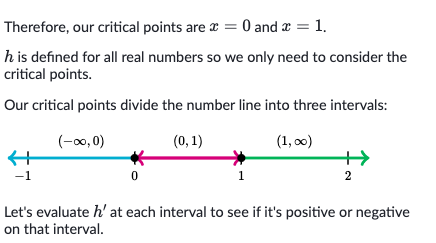
-The answer is h is increasing on the entire domain, or all real numbers.
Finding the absolute minima and maxima on closed intervals
Steps
- find derivative of original function you are given
-find critical points
-plug in the endpoints of the boundary your provided with and the critical point into the original function
-the smallest value for f(x) will indicate a minimum, and the largest will indicate a maximum.
Finding the absoute minima and maxima for the entire domain (also known as global max or mins)
-determine domain
-find derivative of equation
-find critical points
-analyze end behaivor of function (more on how to do that below)
1. Polynomial Functions (like f(x)=x2, g(x)=x3−2x+1, etc.):
Focus on the highest power of x (the leading term): For very large or very small values of x, the term with the highest power grows much faster than all the other terms. So, we mostly look at that term to see the end behavior.
Consider the degree (even or odd) and the sign of the leading coefficient (positive or negative):
Even Degree (like x2,x4,...):
If the leading coefficient is positive (like in x2), as x→∞, f(x)→∞ (goes way up), and as x→−∞, f(x)→∞ (also goes way up). Think of a U-shape.
If the leading coefficient is negative (like in −x2), as x→∞, f(x)→−∞ (goes way down), and as x→−∞, f(x)→−∞ (also goes way down). Think of an upside-down U-shape.
Odd Degree (like x3,x5,...):
If the leading coefficient is positive (like in x3), as x→∞, f(x)→∞ (goes way up), and as x→−∞, f(x)→−∞ (goes way down). Think of a shape that goes down on the left and up on the right.
If the leading coefficient is negative (like in −x3), as x→∞, f(x)→−∞ (goes way down), and as x→−∞, f(x)→∞ (goes way up). Think of a shape that goes up on the left and down on the right.
Example: For f(x)=−2x3+5x−1:
The highest power is x3 (odd degree).
The leading coefficient is -2 (negative).
So, as x→∞, f(x)→−∞.
And as x→−∞, f(x)→∞.
2. Rational Functions (fractions of polynomials, like f(x)=x−2x+1):
Compare the degrees of the numerator and the denominator:
Degree of numerator < Degree of denominator: The function will approach 0 as x→∞ and x→−∞. The horizontal asymptote is y=0.
Example: f(x)=x2+1x. As x gets very large, the x2 in the bottom dominates, making the fraction very small.
Degree of numerator = Degree of denominator: The function will approach the ratio of the leading coefficients as x→∞ and x→−∞. The horizontal asymptote is y=leading coefficient of denominatorleading coefficient of numerator.
Example: f(x)=5x2−12x2+3. As x gets very large, the x2 terms are the most important, and the function approaches 52.
Degree of numerator > Degree of denominator: The function will approach ∞ or −∞ as x→∞ and x→−∞. There is no horizontal asymptote (there might be a slant or oblique asymptote). We can use polynomial long division to understand the end behavior.
Example: f(x)=xx2+1. After division, f(x)=x+x1. As ∣x∣ gets large, x1 approaches 0, so f(x) behaves like y=x, which goes to ∞ as x→∞ and −∞ as x→−∞.
3. Other Functions (like exponentials, logarithms, trigonometric functions, etc.):
You need to know the basic shapes and behaviors of these functions as x gets very large or very small.
Exponential functions (like f(x)=ex): As x→∞, ex→∞. As x→−∞, ex→0.
Logarithmic functions (like f(x)=ln(x)): As x→∞, ln(x)→∞. ln(x) is not defined for x≤0. As x→0+, ln(x)→−∞.
Trigonometric functions (like f(x)=sin(x)): These functions oscillate between -1 and 1 as x→∞ and x→−∞. They don't approach a single value.
Putting it all together:
When you're looking for absolute extrema without a closed interval:
Find the critical points using the derivative f′(x).
Evaluate the function at these critical points.
Analyze the limits at infinity: Determine limx→∞f(x) and limx→−∞f(x).
Now, compare the values you found:
If one of the values at a critical point is greater than or equal to both limits at infinity and all other function values at critical points, then that's a candidate for the absolute maximum. If the function goes to ∞ at either end, there is no absolute maximum.
If one of the values at a critical point is less than or equal to both limits at infinity and all other function values at critical points, then that's a candidate for the absolute minimum. If the function goes to −∞ at either end, there is no absolute minimum.
Finding relative minima and maxima steps
-find derivative of function
-find critical points
-see if a point less than the critical point or greater than (depending on what you are solving for) causes the sign of the function to change
-determine answer
Steps for finding inflection points
-Find second derivative
-find where g’’=0.
-then plug in a value in between the critical points. (one that’s greater than and one thats less than your critical points.)
-If theres a sign change in the second derivative when you do step 3,, then you have yourself in an inflection point. WOOO!!!! (Calculus is about to make me crash out I swear)
Horizontal tangent to implicit curve
Steps to find these:
1)Find where the derivative of the function is equal to 0
2)Find what y is equal to when the derivative of the function is =0 (you do this by substituting in the x value into the equation and solving for y
3)If you get something with two solutions, you need to ensure that the one you pick is above the x-axis.
*you can also use a system of equations. For example, if you are looking for a the y coordinate of a tangent, you could make a system of equations where x=0. Then you could find what values are needed to get the whole equation to =0. Then take what value you get
Part 3: The Intergral
-Rienman sums: Allow us to find the area under the curve, or the area below a function.
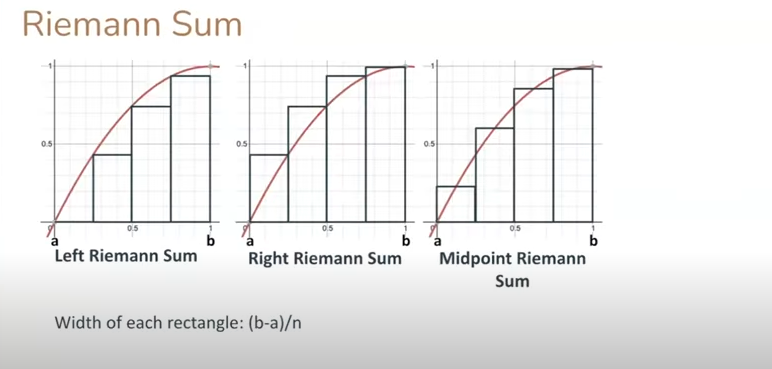
-This is what it looks like visually. I’ll attach a photo of practice problems that are worked out for these problems.
U-Subsitution
-This is helpful when you are trying to intergrate composite functions.
Example problem:
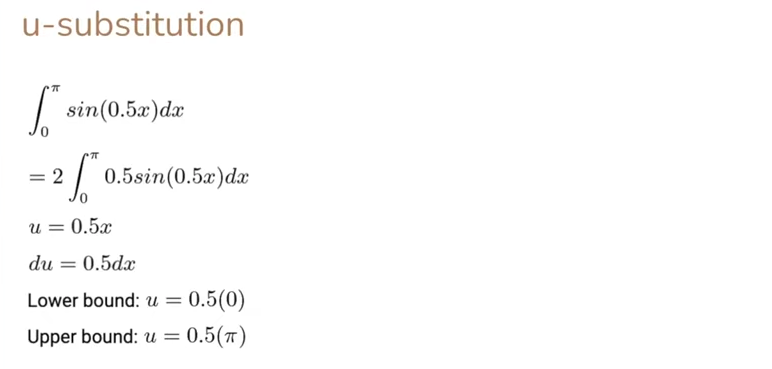
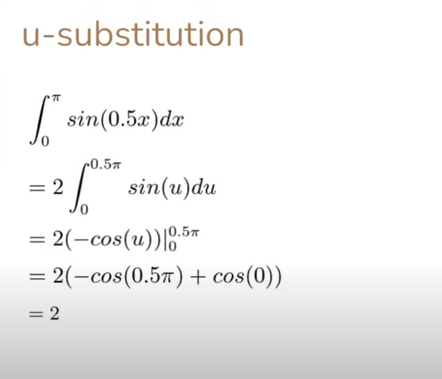
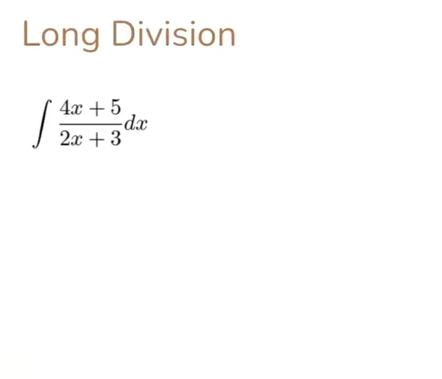
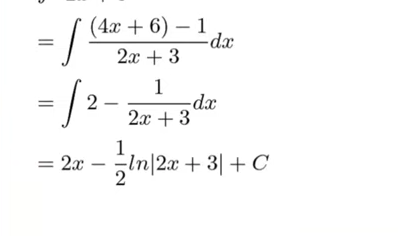
Intergrating a rational function can also be done through intergrating using long divison.
Example problem:
Rectilinear motion
-First know that displacement refers to change in posistion, distance is the total amount moved, and speed is the absolute value of velocity.
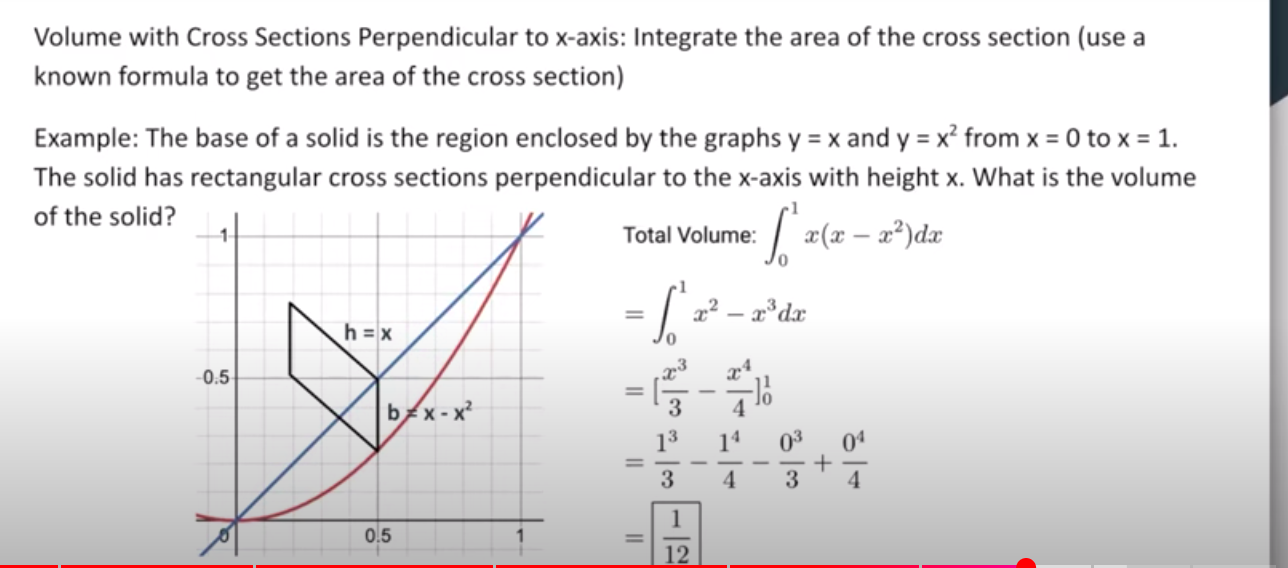
Volume with cross sections
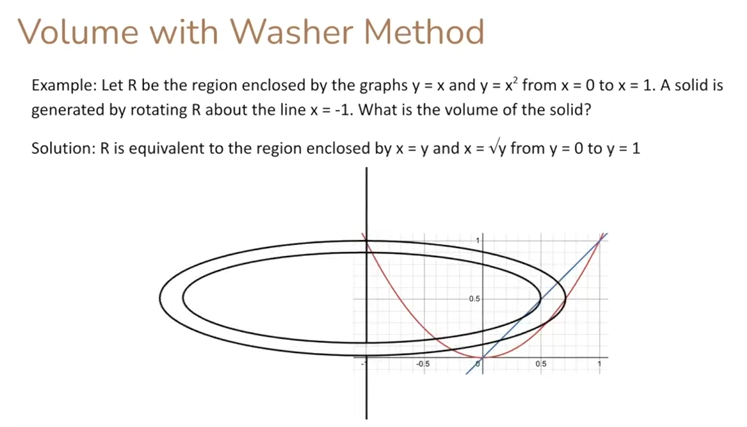
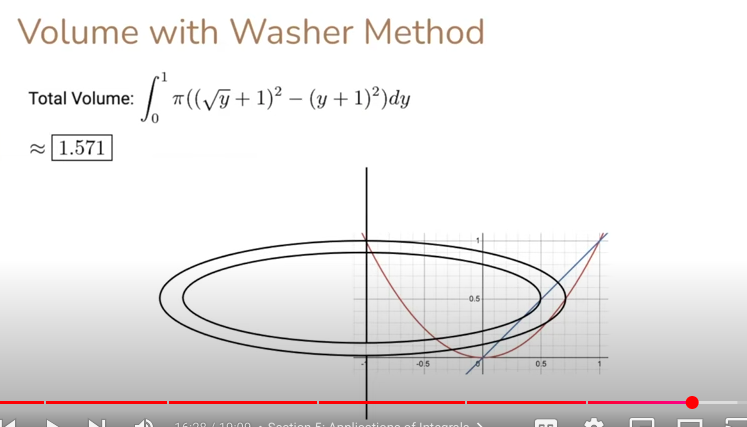
Washer method to calculate volume
Differential Equations
-These related a function and it’s derivative.
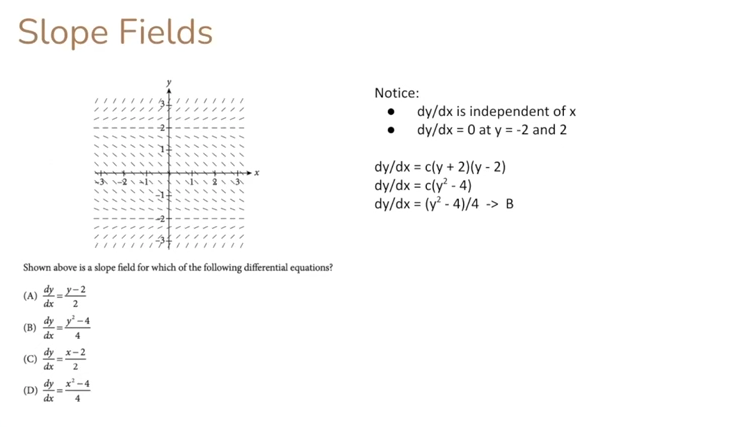
=the answer is b
Seperation of variables