Introduction to Contemporary Art
WHAT IS ART?
- Art is ==from Latin word artem== which means =="work of art; practical skill; a business, craft."==
- Art is everywhere –from the simplest design objects we use, to the spaces and structures we inhabit.
- Art enriches our lives with meanings that we often overlook.
- Art responds to our human desire to experience beauty and explore the unknown.
- We shape art. Art shapes our being and makes us human.
Definition of Contemporary Art
- Art is everywhere - from the simplest designed objects we use, to the spaces and structures we inhabit. Art enriches our lives with meanings that we often overlook. Art responds to our human desire to experience beauty and explore the unknown. We shape art. Art shapes our being. Art makes us human.
- Contemporary art refers to art being created NOW. “Contemporary” is derived from the Latin prefix con, which means “together” or “with,” plus tempus, which means “time.”
- The expression, "contemporary art" has gained much currency in recent decades. Since the 1990's there are two main applications of this term in the discourse of art.
- The chronological view defines contemporary art as art related to this current period in art history, and an art that is new, recent, modern, or pertains to the present moment.
- The historical usage, meanwhile, regards contemporary art as a specific episode or stage in the story of evolution of art, referring to a specific location in space and time.
History of Contemporary Art in the Philippines
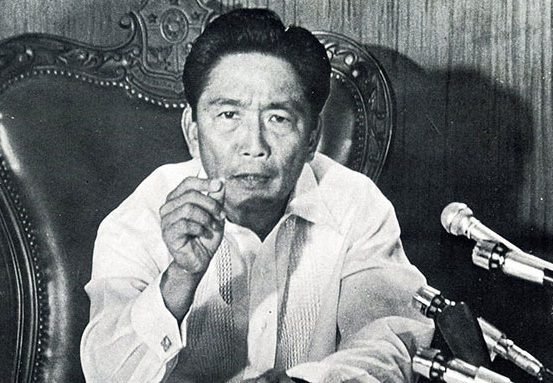
Contemporary art emerged in the Philippines in reaction to social and cultural realities during the 1970’s, the period of repression and censorship of artistic expressions by the power of the former President Ferdinand Marcos through the imposition of Martial law.
Art also became a means to oppose the regime, and the political art of social realism flourished at this time.
Social realism is an art movement which sought to expose the real condition of Philippine society and used art to transform it. Progressive art as a whole, whether in the visual arts, music, theater, dance or literature in Manila and in the countryside, developed a culture that would convey the authentic aspirations of the Filipino people.
The end of Martial Law in the wake of the EDSA People Power Revolution in 1986 brought the Philippines into the contemporary period, and the art produced in this period is regarded as contemporary art. Contemporary arty in the Philippines emerged due to three factors:
- the return of democracy under the Aquino government;
- the improved economic and political government in the country, particularly in the regions; and
- the advent of new technologies and free access to media.
- The return of the democracy to the Philippines also ushered in improvements in the political and economic environment throughout the country, which encouraged art production in the regions. Contemporary artists felt the need to redefine our social and racial identity in the post-EDSA social context, and were thus drawn to explore the ideological base and social underbelly of Philippine life as a subject matter. The works of artists and craftspeople, which combined elements from fine arts, indigenous living traditions, and designs for the market, contributed to forging the identity of contemporary Philippine art.
Aspects of Contemporary Art
CONTEMPORARY ART AS A BREAKING OF NORMS
Contemporary art can be as a transgression of established norm and rules. It does not fall prey to the authority of established institutions nor strictly adhere to long-standing tradition and history. Established art forms are scrutinized and contemporary reworks them to see them with fresh eyes. Contemporary art is ruled by the cult of the new, endeavoring to create works of art are “radical” and “interdisciplinary.” Contemporary art sets itself apart from the past and of the late. To be new is to be modern; the new is progressive.
Appropriation is an important preoccupation in the world of contemporary art. It is the practice of creating a new work by taking a pre-existing image or work from another context – art history, media, advertising and combining the borrowed image with new ones. Consider the montage painting of Santiago Bose’s Carnivore of Session Road (2002). 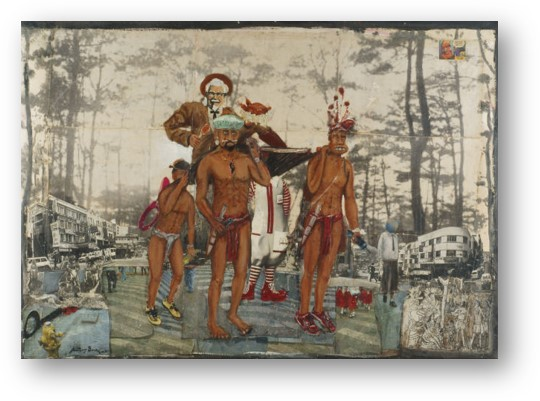
CONTEMPORARY ART AND LOCAL HERITAGE
Contemporary professes an awareness of local heritage. Heritage is something that can be passed from one generation to the next, can be conserved or inherited, and has historic or cultural value. These are physical objects and places of heritage (old buildings, paintings, public art, etc.) and the various practices of heritage (oral traditions, dance, fiestas, etc.) unique to the region or locality that are conserved or handed down from one generation to the next.
For example, abandoned heritage structures are given new life through modern interventions of contemporary architectural approaches like adaptive reuse. In the town of Baclayon in Bohol, an old sabungan or cockpit arena is repurposed to become a community theater in 2015. This is the Teatro Porvenir, Bohol courtesy of Lutgardo Abad and Dulang Sining. 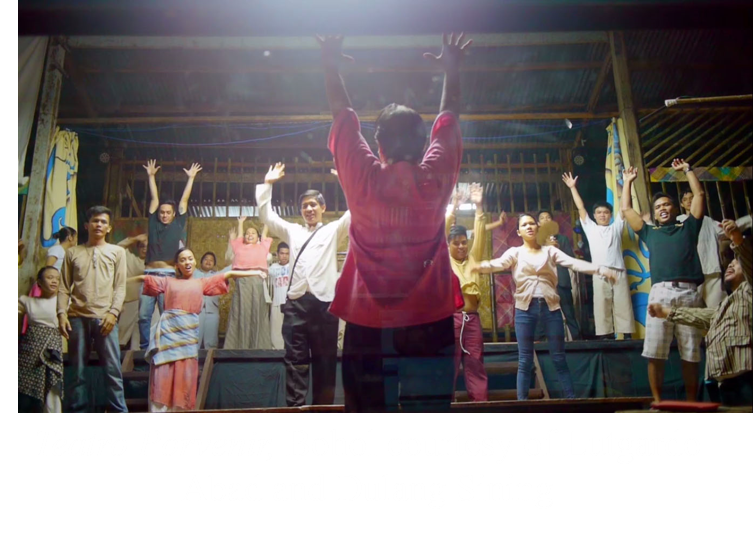 The carabao, which is integral in traditional Central Luzon agriculture, becomes the focal point of art making in the Mandala Art Festival held every May since 2012 in Pulian, Bulacan. The festival is gathering of visual artists from all over Central Luzon and takes off from the tradition of the carabao kneeling festival, which honors the carabao in a competition on the making of painted, miniature, papier mache carabaos, carabao painting, and wall mural painting.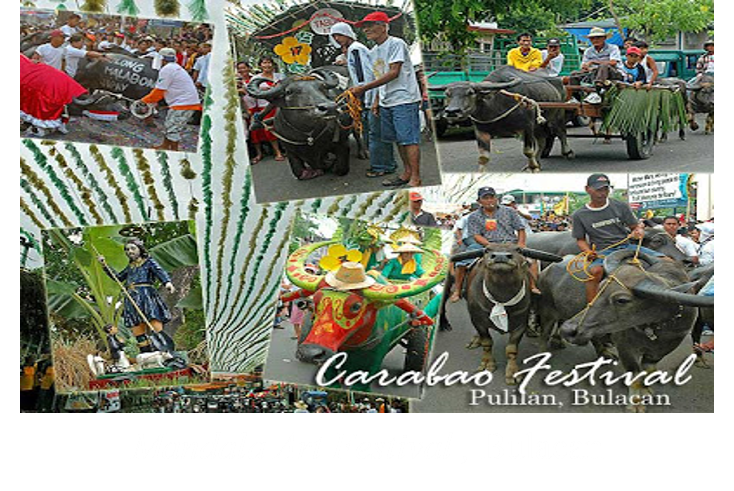
CONTEMPORARY ART AS A CRITIQUE OF SOCIETY
Everyday life and the concerns of the day are also articulated in the medium of contemporary art, posing questions and critiques of contemporary society. The growing speed of technology, the transfer of ideas, capital, information, and culture around the globe provide the backdrop for the dizzying diversity and rapid transformations in contemporary art, thereby loosening many boundaries and distinctions within art itself and the crossing over art forms. Venues for contemporary art are no longer confined within the strict boundaries of the museums and gallery spaces. Creative exhibition spaces are carved from existing public spaces like parks, market places, or even abandoned buildings.
For one, The Ax(is) Art Project initiated by Baguio-based artist Kawayan de Guia in 2011, had for its goal the communal sewing of a big tent, the Ukay-ukay Dome, an eye-catching temporary patchwork architecture of used clothing assembled by over a hundred student volunteers, and installed in the Rose Garden of Burnham Park. 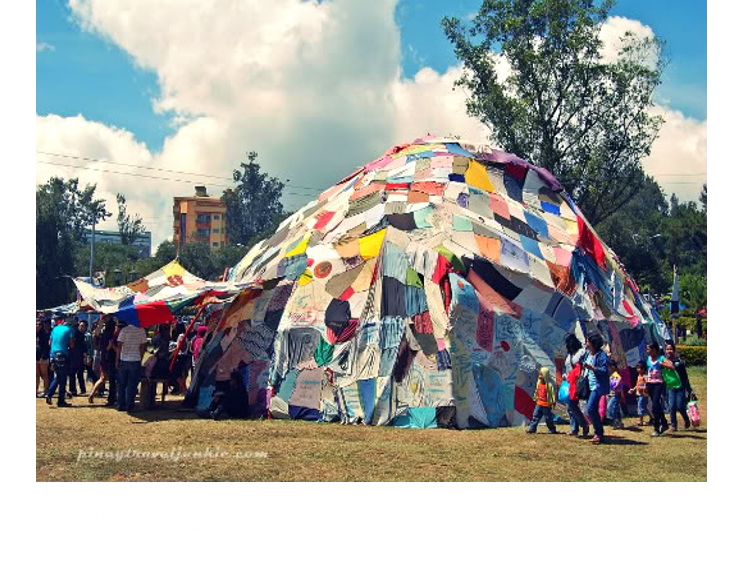
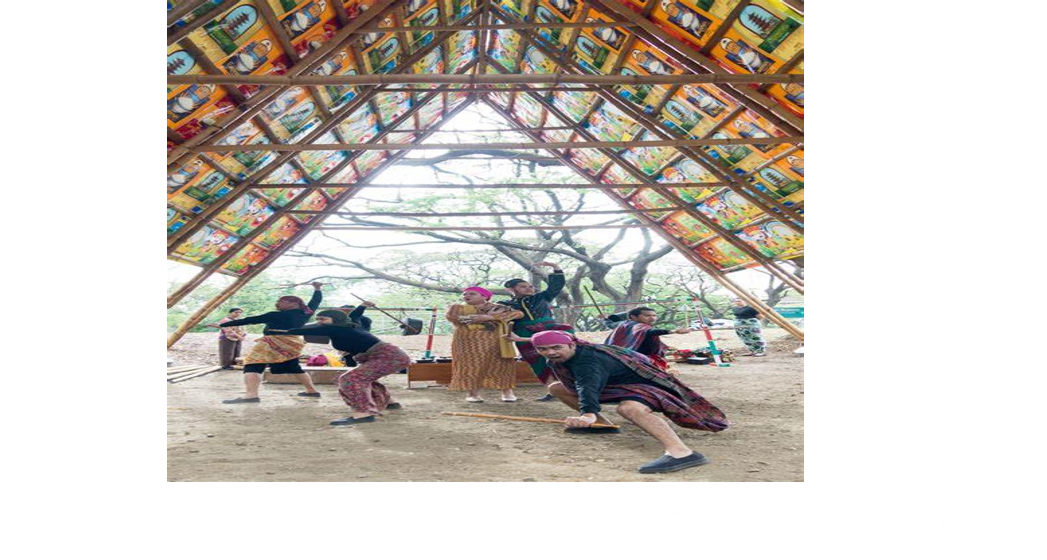
In 2017, the Bamboo Theater, an installation art by Architect Rosario Encarnation Tan Fuminori Nousako, created an alternative open space for art and performance at the front lawn of the Vargas Museum. The structure consisted of a bamboo framework roofed with colorful commercial rice sacks.
Functions of Contemporary Art
Contemporary art is a form of response to the world – a way of making sense of the realities of the day. It is an attempt to capture as an aspect of the contemporary world and draw attention to it, comment on it, present a surprising or fresh angle on it, or enjoy and celebrate it. The provocative and multi-faceted nature of contemporary art gives rise to several questions that audiences often ponder. Is contemporary art created merely for the sake of the artist to feed his vanity or his curiosity, or do the artworks created by contemporary artists have a greater intellectual and societal impact? Does contemporary art exist chiefly for its own sake? Does it exist in order to teach, to urge a moral point, to entertain, to distract, to amuse, to serve beauty, to support revolution, to disgust, to challenge, to stimulate, or to cheer?
CONTEMPORARY ART for Pleasure – art can provide escape from everyday concerns and satisfy the yearning for pleasurable experiences.
CONTEMPORARY ART as Profession – artists earn a living through their art.
CONTEMPORARY ART as Commentary – art has often been used to answer our need for information.
CONTEMPORARY ART in Spirituality – artists may create art to express spiritual beliefs about the destiny of life controlled by the force of a higher power.
CONTEMPORARY ART as Remembrance – art can commemorate important events and people that have shaped our history and show reverence for those who have gone before us.
CONTEMPORARY ART for Persuasion – art is used to spur political change or modify the behavior and thinking of large groups of people have political and persuasive functions.
CONTEMPORARY ART as Self- Expression – art can fulfills an expressive function when an artists conveys information about his or her personality, feelings, or worldview.
Characteristics of Contemporary Art
In 2012, the exhibition “Art Now For Everyone,” held at the SM Mall of Asia. Curator Patrick Flores concisely describe the general characteristics and tendencies of contemporary arts as he explained what it means to be present and what is art now.
Patrick Flores 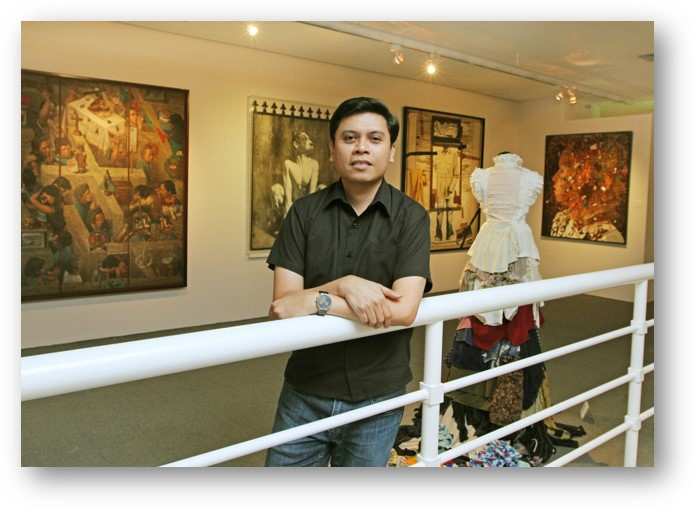
- Art Now is part of global culture.
- Art Now reflects upon historical conditions that have shaped our present situation.
- Art Now is animated by the busy traffic of images in society.
- Art Now explores a wide range of media, techniques, styles, and technologies.
- Art Now expresses hope about the future.
- Art Now facilitates interaction among its audience.
- Art Now renews our ties to a changing world.
- Art Now encourages us to be different, to be skeptical of sameness.
- Art Now initiates us to a horizon of chances.
The importance of Art
Learning through and about the arts enriches the experience of studying while at school as well as preparing students for life after school.
Arts subjects encourage self-expression and creativity and can build confidence as well as a sense of individual identity.
Creativity can also help with wellbeing and improving health and happiness – many students in the TALE study commented that arts lessons acted as an outlet for releasing the pressures of studying as well as those of everyday life.
Studying arts subjects also help to develop critical thinking and the ability to interpret the world around us.
Studying art teaches you to distinguish and understand individual differences. It make us more sensitive.
Studying and creating art help develop our decision and problem solving skills.
Is art important?
All art, good and bad, made by an individual or a team, brings the perspective of an artist to others. It is so important to have art, to teach art, and to allow ourselves and our children to live with a national tradition of art, because the arts give us the tools and means for communicating about the way we see the world.
It help us realize that there are many ways of dealing and solving obstacle.
It help us appreciate that there are more than one correct solution to a problem.
It nurtures imagination and promotes original and innovative concept which is a skill valued in utmost all businesses today.
“The arts matter because art is meant to move people either on an intellectual or emotional level. Whether this is a book that stays with you days later, or a performance that moves you spiritually or a song that makes you look at the world around you in a different way. The purpose of art is to cause a reaction and with this purpose it can create a synergy of change; change in attitudes, perceptions, and thoughts.” – Catherine Brookes