Environmental Science
Ch1: Science, sustainability and environment
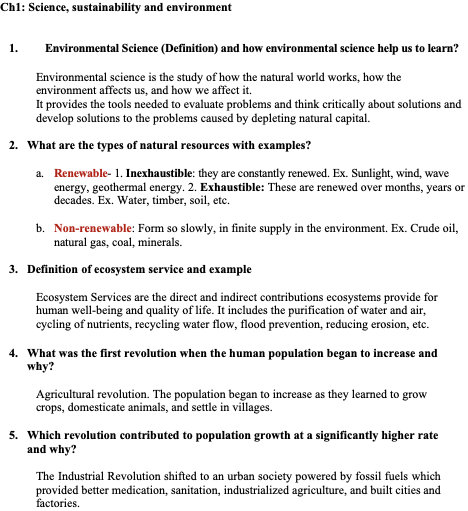
1. Environmental Science (Definition) and how environmental science help us to learn?
Environmental science is the study of how the natural world works, how the environment affects us, and how we affect it.
It provides the tools needed to evaluate problems and think critically about solutions and develop solutions to the problems caused by depleting natural capital.
2. What are the types of natural resources with examples?
a. Renewable- 1. Inexhaustible: they are constantly renewed. Ex. Sunlight, wind, wave
energy, geothermal energy. 2. Exhaustible: These are renewed over months, years or decades. Ex. Water, timber, soil, etc.
b. Non-renewable: Form so slowly, in finite supply in the environment. Ex. Crude oil, natural gas, coal, minerals.
3. Definition of ecosystem service and example
Ecosystem Services are the direct and indirect contributions ecosystems provide for human well-being and quality of life. It includes the purification of water and air, cycling of nutrients, recycling water flow, flood prevention, reducing erosion, etc.
4. What was the first revolution when the human population began to increase and why?
Agricultural revolution. The population began to increase as they learned to grow crops, domesticate animals, and settle in villages.
5. Which revolution contributed to population growth at a significantly higher rate and why?
The Industrial Revolution shifted to an urban society powered by fossil fuels which provided better medication, sanitation, industrialized agriculture, and built cities and factories.
6. What does ecological footprint express? How ecological footprint of a person increase?
An ecological footprint expresses this consumption by the area of land and water needed to provide the resources a person consumes or the waste they generate.
If you own multiple cars or multiple houses, get so many ecological services, it will increase your footprint.
7. What is Overshoot?
Overshooting occurs when you use more resources than are sustainably available for you. We are estimated to be using 64% more of the planet’s renewable resources than are sustainably available.
8. Definition of sustainability, what are some sustainable choices and how can we create a sustainable future?
Sustainability is a way of living so that Earth’s resources can sustain us well into the future.
Some sustainable choices include using renewable energy sources, recycling, using energy-efficient materials, bringing advancement in agriculture, improving waste management, reducing gh gas emissions etc.
• Conserving resources so they are available for future generations
• Developing long-term solutions to environmental problems
• Maintaining fully functional ecological systems
9. Definition of Science and scientific research.
A way for us to explain how the natural world works. Methodical, logical process for gaining knowledge about natural phenomena.
In order to answer questions about the natural world, scientists seek evidence, often in the form of data that they can measure in some way – this seeking of evidence is referred to as ‘scientific research.’
10. Definition of descriptive science and hypothesis-driven science
Descriptive science, where scientists gather basic information about organisms, materials, or systems.
Hypothesis-driven science is used to construct explanations of how certain phenomena work and why they occur.
11. Scientific method and order of steps of Scientific method?
Experiments test hypotheses within a framework called the scientific method.
Observation>Question>Hypothesis>Predictions>Test>Results
12. Definition of hypothesis.
Scientifically educated guess. Tentative and testable explanation for a phenomenon in the natural world. It cannot be too broad as it is difficult to test many variables at once.
13. What are independent, dependent, and control variables?
The independent variable is the cause, its value is independent of other variables in your study, and it is what we expect will influence or change other variables. In experiments – the independent variable is the variable that we change to measure the effect on the dependent variable.
The dependent variable is the effect, its value depends on changes in the independent variable, and what happens as a result of the independent variable.
A control variable is an experimental condition or element that is kept the same throughout the experiment, and it is not of primary concern in the experiment, nor will it influence the outcome of the experiment. It can be more than one in an experiment.
14. Try to identify all of the variable in an experiment. See the lecture slides.
15. How to design a good scientific experiment?
These following features must be included in an scientific experiment:
• One Independent Variable
• Randomization
• Replication
• Constant Conditions/environment
• Control group
• Reproducibility
• Accurate data collection
16. How do scientists interpret and report on results?
Using different types of graphs such as line, bar, pie chart. Additionally, the statistical analysis test reports such as data dispersion, variance and p value can be expressed in the title of the graph.
17. When does peer review occur?
After the author or researcher writes and submits the manuscript to a journal.
18. When do paradigm shifts occur?
A dominant scientific view is called a paradigm. A paradigm shift occurs when one of these views changes as a result of new ideas and evidence.
19 Questions to ask when evaluating resources?
Ch 2. Geology
1. Definition of Geology? What are the roles of the geological processes? Geology is the study of Earth’s physical features, processes, and history.
These processes shape the landscape, lay the foundation of environmental systems, and provide resources like metals and fossil fuels.
2. How many layers of earth? Three. What are those? Core, Mantle and Crust.
3. What is the innermost and outermost layer of the earth? Core and Crust.
4. Which layer we are living in? Continental crust.
5. What is the difference in composition of core and mantle?
Core is made of dense solid iron where mantle is made of less dense elastic rock.
6. What is the thinnest and low-dense layer of earth? Crust
7. What is plate tectonic? Roles and how it works?
A scientific theory which shapes earth geography and explain how major landforms are created.
Heat from the earth drives and cycles materials upward and downward which moves large plates 2-15 cm every year.
8. What is Pangaea?
A single large continental land mass with the current continents fitted together, also known as supercontinent. This continent exists 65-100 million years and began to break 200 million years ago.
9. Roles of plate tectonic movements? o Builds mountains
o Shapes the oceans, islands, and continents o Creates topography.
o Influences climate and the distribution of biomes. o Gives rise to earthquakes and volcanoes.
10. How many types of plate boundaries?
Three and these are divergent, transform, and convergent.
11. What happens in each type of plate boundary? Divergent:
o Plates move apart
o Draw magma to the surface and cools
Transform:
o Plates move side to side
o plates slip and grind alongside each other
Convergent:
o Subduction- where Oceanic crust and continental crust collided. Oceanic crust goes downward as it is denser. Create trenches in ocean.
o Continental collision: Where both continental crust crush, bend and buckle and create mountain ranges.
12. What is rock? How many types of rocks and how they are formed? A rock is any solid aggregation of minerals.
Three types.
Igneous: Forms by cooling of magma slowly or quickly. These slow or quick process make two types of igneous rocks.
a. Intrusive- Slow cooling which allows minerals to crystalize and create multicolor grainy appearance,
b. Extrusive- Quick cooling which create smoother rock.
Sedimentary:
o Sediment layers accumulate over time
o They are buried and compacted
Metamorphic
o These rock’s physical properties are changed by this heat and pressure
13. What are minerals?
Any naturally occurring solid element or inorganic compound with a crystal structure, distinct chemical composition, and physical properties.
14. What are the two energies that can transform igneous and sedimentary rock into metamorphic rock?
Heat and pressure
15. How many processes are responsible for turning every type of rock into sediment and what are those?
Four. Weathering, erosion, transport, and deposition.
16. What is geologic history known as? Deep time or geologic time
17. How geologic timescales are divided?
By studying the strata or layers and by studying sedimentary rock
18. When does Earth form? 4.6 billion years ago.
19. Why are we focusing on the history of only 543 million years ago? Because those are well-studied and evident in many sources.
20. How many eras, periods, and epochs are present in these 543 million years? 3 eras, 11 periods, and 18 epochs
21. What is the current period?
Quaternary period which began 1.8 million years ago.
22. What is the current epoch? Holocene
23. What are some scientists suggesting about the new epoch?
Some scientists have called for the naming of a new epoch, called the Anthropocene. As in last 200 years, soil erosion, atmospheric carbon dioxide, and the human population have all grown exponentially.
Amphibians and wastewater
1. What are amphibians and why they are unique?
The word Amphibian comes from a Greek word meaning “double life.” They spend part of their lives in water and part on land, which is how they earned their name, amphibian. They typically start their lives in water as larvae with gills, then undergo metamorphosis to develop lungs and live on land as adults. That is why they are unique.
2. What makes them important indicators of ecosystem health?
They live in both aquatic and terrestrial environments. They are sensitive to environmental changes and pollutants partly because they absorb water and oxygen directly through the skin.
3. What are the impacts of wastewater on Amphibians?
Wastewater Interfere with their breathing ability, disrupt their skin's protective functions, and potentially lead to deformities or diseases.
4. Which disease is responsible for their number decline globally? Chytridiomycosis (a fungal disease)
5. What are the other causes of their number declines?
Their body part such as skin secretion is used to produce potent neurotoxins, In traditional medicine in South America, some of their enzymes are used as antimicrobial, analgesic, and anti-inflammatory drugs.
Ch 6: Ethics, economic and environment
1. Definition of Ethics and economics
Ethics is a set of moral principles or values used to determine right and wrong. Making ethical judgments is grounded in certain values, such as promoting human welfare, protecting individual freedom, or minimizing suffering.
Economics is the study of how people use potentially scarce resources to provide goods and services.
2. How are our decisions influenced?
• Our decision is influenced by ethical standards which help to differentiate right from wrong. People of different cultures or worldviews differ in their values and disagree about ethical standards.
3. Definition of Relativists and universalists
Relativists believe that ethics vary depending on the context of the problem. Universalists define objective notions of right and wrong that hold across many cultures and contexts.
4. What is Instrumental value and intrinsic value?
Instrumental value refers to the usefulness or functionality of something. This value is often associated with external factors such as money, power, or status.
Such as Timber from forests and drinking water from the water cycle.
Intrinsic value refers to the inherent worth or significance of something, independent of any external factors. It goes beyond materialistic measures and delves into personal fulfillment and happiness.
Such as Truth, Beauty, Goodness, Temperance, Courage, etc. are considered as intrinsic values.
5. Anthropocentrism, Bio centrism and ecocentrism
Anthropocentrism is a human-centered view; nonhuman things are given little or no intrinsic value. The costs and benefits of actions are evaluated solely on the positive and negative impacts on people.
Biocentrism ascribes intrinsic value to both human and nonhuman life. Such as bio centrists may oppose clearing a forest, even if it would increase food production for people.
Ecocentrism judges actions based on their effects on ecological systems, including nonliving elements.
6. How are the economy and environment related?
Economies receive inputs from the environment, process them, and discharge outputs back into the environment.
7. What does Cost-benefit analysis do?
A cost-benefit analysis will compare the estimated costs of a proposed action with its benefits. It offers the highest surplus of advantages compared to expenses.
8. Environmental economics and Ecological economics
Environmental economics is a model where the environment is integrated into the economic system. It aims to attain sustainability within our economic systems. Ecological economics is a subset of economics that is based on seeing the human economy as a subsystem of the global ecological system. It aims to insert the environment into economics and prioritize its management, in an area where it has been traditionally neglected.
9. What are other non-market values?
Use value, Existence value, Option, Aesthetic, scientific, education and cultural.
10. How many types of sustainability are available?
Weak sustainability is the idea that natural capital can be depleted as long as human-made capital increases to compensate.
Strong sustainability means that natural capital cannot be allowed to diminish because human capital cannot replace it.
11. Triple bottom line of sustainable development
Economic advancement, environmental protection, and social equity
• Ch 7: Environmental Policy: Making Decisions
1. Policy, Public policy, and environmental policy
A policy is a formal set of plans and principles intended to solve problems and aid decision-making.
• Public policy includes laws, regulations, orders, incentives, and practices enacted by the various levels of government.
• Environmental policy specifically addresses our interactions with the environment.
2. What is the process of making policies to solve environmental problems?
Making an effective policy requires input from science, ethics, and economics. People from science, the Govt sector, and civilian have to contribute to make policy and solve any environmental problem.
3. What is tragedy of the commons?
When the resource will be overexploited, and the service or production will be collapsed.
4. External costs
External costs are harmful impacts suffered by people who are not involved in the actions that created them.
• Island-dwelling people, for example, are likely to bear the brunt of climate change’s impacts as the sea level rises.
5. Free rider
A free rider is a person who benefits from something without expending effort or paying for it. In other words, free riders are those who utilize goods without paying for their use.
6. Major U.S. Environmental Protection Laws, 1963–1980
Clean Air Act, Endangered Species Act, Resource Conservation and Recovery Act, Clean Water Act, Safe Drinking Water Act, Toxic Substances, Control Act, Soil and Water Conservation Act, C E R C L A (“Superfund”)