Oscillations
the periodic motion of an object about its equilibrium position

For a pendulum system:
The horizontal component of weight causes the oscillation → The Force responsible for the oscillation is called the restoring force.
The direction of the restoring force is always towards the equilibrium position
The net force causing acceleration is the Restoring Force:
The force acts in the opposite direction to the displacement in the direction
For a mass-spring system:
The weight acting downwards causes the extension of the spring to its equilibrium position
At the equilibrium position Tension Weight
When the mass is pulled down, the spring pulls upwards so the restoring force is upwards
When the mass is pulled back up past the equilibrium position, the spring is pushing downwards
Tension and is the force of the spring on the mass
The Restoring Force ,
The generic equation is:
The direction of the restoring force is always towards the equilibrium position
The force acts in the opposite direction to the displacement
For time period: →
The amplitude, of an oscillation is equal to the maximum value of the displacement,
Frequency, in hertz is equal to the number of complete oscillations per second.
Angular frequency,, is the rate of change of angular position in radians per second is given by:
Simple Harmonic Motion
the oscillating motion for when the acceleration of a body is proportional to its displacement, in the opposite direction
Many oscillating systems undergo a pattern of oscillation that is known as Simple Harmonic Motion
Examples:
a mass hanging from a spring
molecular oscillations
a pendulum or swing
The pattern of SHM is the same as the side view of an object moving at a constant speed around a circular path
The amplitude of the oscillation is equal to the radius of the circle
The object moves quickest as it passes through the central equilibrium position
The time period of the oscillation is equal to the time taken for the object to complete the circular path
The acceleration is maximum at the top and the bottom of the oscillation because the acceleration and the force are directly proportional
When an object is performing SHM:
Its acceleration is proportional to its displacement from the equilibrium position
Its acceleration is directed towards the equilibrium position
The general equation for SHM is:
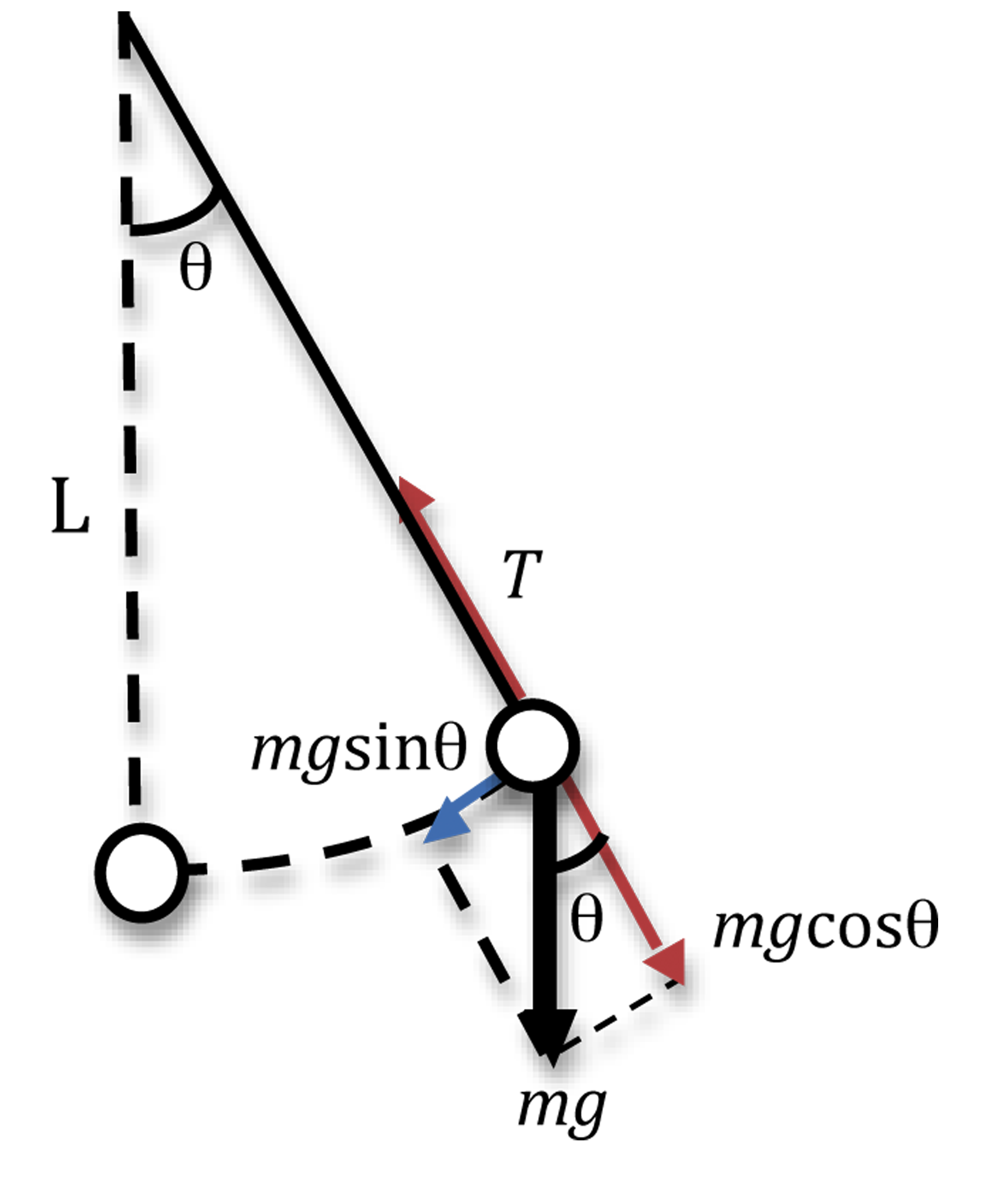
The restoring force is horizontal component of weight,
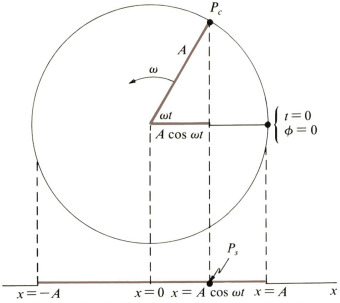
The gradient of the displacement / time graph graph gives velocity,
Acceleration is equal to change in velocity / the time elapsed: =

Energy in SHM
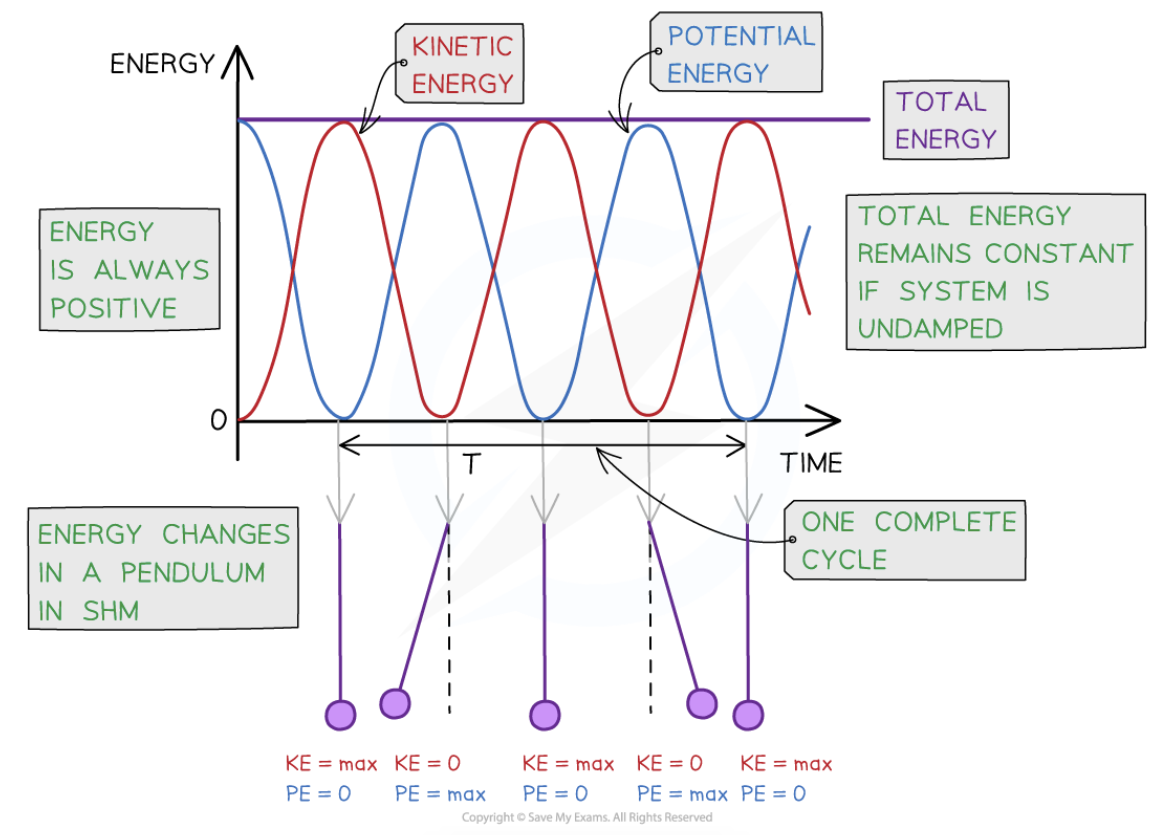
A free oscillation is one in which amplitude stays constant; no energy is lost from the motion
This occurs when there are no frictional forces acting on the object such as air resistance
Position 1: Maximum displacement
All energy is potential energy,
Position 3: Equilibrium
All energy is kinetic energy,
Position 5: Maximum displacement
All energy is potential energy,
question: a simply pendulum consist of a mass of 50g attached to the end of the thread length 60cm. Calculate: (a) the period of the pendulum and (b) the maximum height reached by the mass is the mass’s maximum speed is
answer:
(a)
(b)
maximum heigh occurs when
so
The strain potential energy is given by:
Therefore the maximum potential energy of an oscillating spring system is:
so is given by
Energy / Displacement Graph

Energy / Time Graph
question: The total energy of a mechanical oscillator is 1.6 J.
( a ) State the maximum values of its kinetic and potential energy
( b ) The oscillator has mass 0.120 kg. Calculate its speed when the potential energy of the oscillator is 1.0 J
answer
( a ): the maximum values of the kinetic and potential energies is 1.6 J each
( b ): its speed is
question: A simply pendulum has a mass of 50g. It is initially released from its amplitude of 0.050m and has frequency 0.40 Hz. Calculate its kinetic energy 2.8s after release
answer:
Forced Oscillation
A forced oscillation is an oscillation in which a periodic external force is applied to sustain oscillation. The frequency of the force being applied is called the driving frequency. In a forced oscillation, the frequency of the system is always equal to the driving frequency.
The frequency of a free oscillation is called the Natural Frequency and it depends on the length
For a simply pendulum, the natural frequency is given by:
For a loaded spring, the natural frequency is given by:
For a forced oscillation:
The amplitude of oscillation gradually increases
At equilibrium:
the rate of energy from the driving force is equal to the rate of energy dissipated by the damping force
the amplitude becomes constant
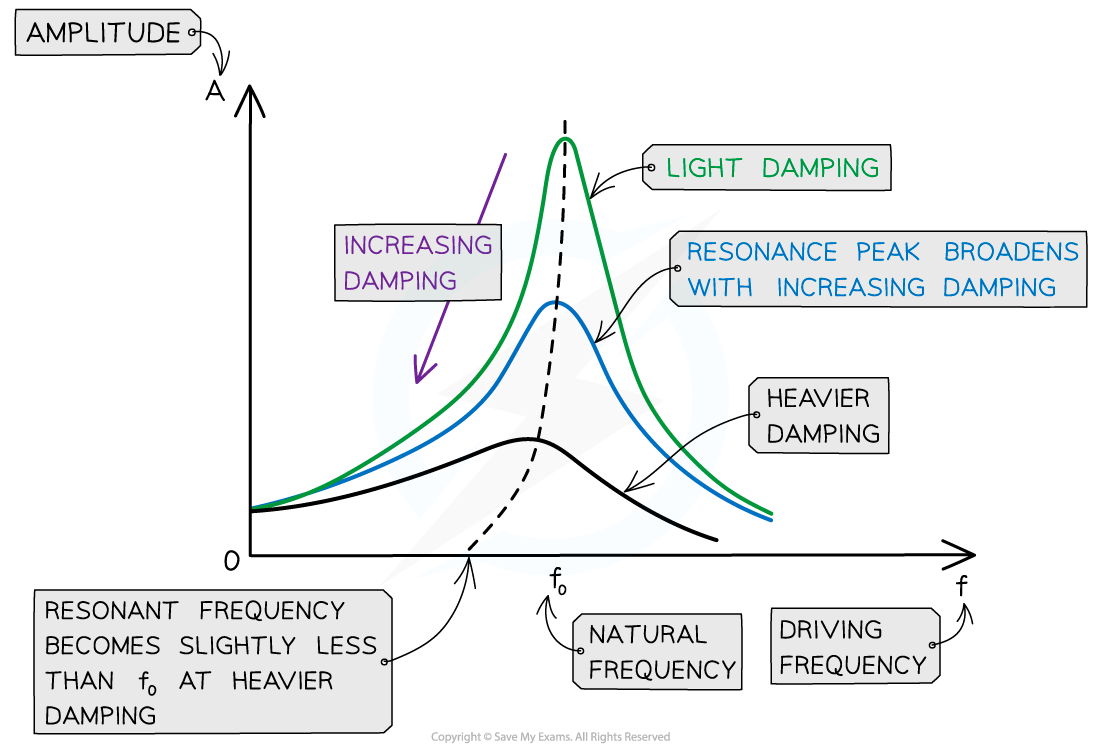
When the driving frequency, , is equal to the natural frequency, , then resonance occurs.
Resonance
Resonance is the phenomenon in which a system vibrates with maximum amplitude when an external periodic force is applied at a frequency equal to or very close to its natural frequency

frequency of the driving force = the natural frequency of oscillating system
maximum energy is transferred to the system
amplitude becomes the largest
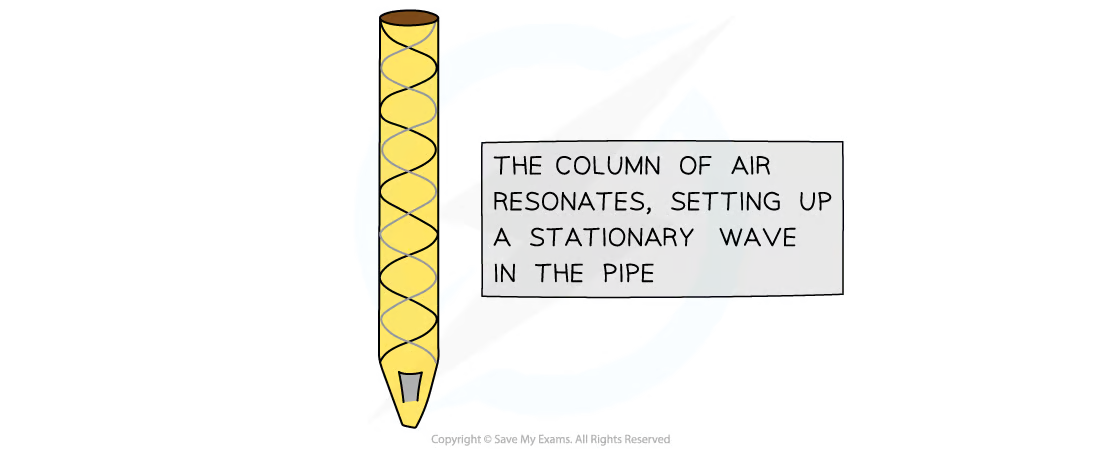
Resonance is reached as the natural frequency of the air inside the column is the same as the driving (sound) frequency of the tuning fork onto the air particles in the column.
No damping
amplitude increases without limit
With damping
amplitude depends on degree of damping ( energy transfer reaches dynamic equilibrium )
Experiments for forced oscillations and resonance

The light pendulum, C will have the same natural frequency as the heavy pendulum, X
Light pendulum, C will have the largest amplitude as the driving frequency of X will be the same as the natural frequency for C, and so resonance will occur. C also has a phase difference of
You can tie the pendulum bob to the string and set up a pendulum system. If you allow for a free oscillation of the bob and ensure the angle is less than , you can measure the period by using . The initial period can be measured using the initial length; then you can change the length of the pendulum to see how it affects the period. A graph of
against , , where is a constant.
find 10 oscillations then divide to find the period
Length (m) | Average (m) | Average² | |||
1.58 | 1.57 | 1.57 | 1.57 | ||
1.44 | 1.43 | 1.43 | 1.43 | ||
1.29 | 1.30 | 1.29 | 1.29 | ||
1.15 | 1.15 | 1.14 | 1.15 | ||
1.08 | 0.98 | 1.05 | 1.03 | ||
0.77 | 0.78 | 0.79 | 0.78 |
Sources of error:
Human reaction time with the stopwatch
Measuring from the centre of mass of the bob to the top of the string
A large angle could mean the pendulum stops swinging in the same plane and doesn’t follow SHM
Perception of when an oscillation is complete — can use a fiducial marker ( a fixed reference point placed within an experimental field of view to indicate original position ); reducing timing and parallax error
a) 0.77 Hz
b)