[LEC] Lec 5.1 - Neuroana 1.docx
NEUROANATOMY
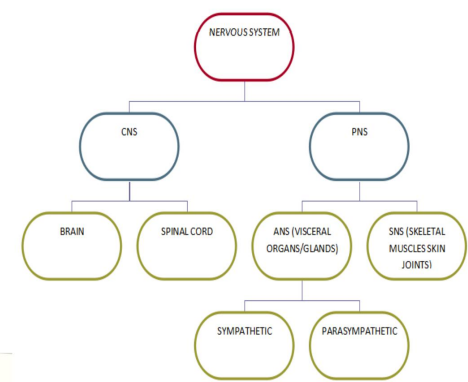
Central Nervous System
- Upper motor lesion
- Hypertonia
- Most common type of cerebral palsy: Spastic diplegia
- Babinski sign
- Brain
- CVA
- L CVA 🡪 R Hemiplegia 🡪 Aphasia
- Dt affectation of the left side of the brain
- TBI
- Multiple sclerosis
- F > M (MS = Miss)
- Glasgow Coma Scale
- 15: adult and child
- 4: spontaneous eye opening
- 5: mouth
- 6: others
- Rancho Los Amigos
- 4: agitated
- 7: robot-like
- Spinal Cord
- SCI
| Q1: Not part of the brain:CerebrumCerebellumBrainstemBasal gangliaQ2: What level of SCI can use a universal cuff?C4 - shoulder shrugC5 – elbow flexionC6C7 – elbow extensionQ3: Above what SCI level would need artificial ventilation?A: C4 (C1-C3 affected) |
|---|
Peripheral Nervous System
- Lower motor lesion
- Hypotonia
- 4 parts:
- Ganglia
- DRG: 1st order neuron
- No VRG
- 31 pairs of Spinal nerves
- Spinal nerve below will exit what vertebral column
- Ex. C4C5 🡪 C5
- 12 pairs of Cranial nerves
- Plexuses and their largest nerves
- Cervical: Phrenic N. (C3 C4 C5 – diaphragm)
- *Brachial: Radial / Musculospiral N. (C5 – T1)
- located posteriorly
- Lumbar: Femoral / Ant. Crural N. (L2 L3 L4)
- Sacral: Sciatic N. (L4 L5 S1 S2 S3)
- Entrapment: Piriformis Syndrome, Fat wallet, Injection Palsy
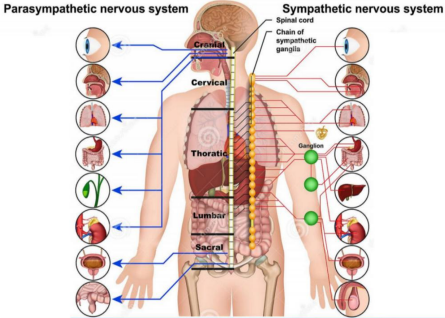
- Autonomic Nervous System
- Visceral organs: involuntary
- Subdivided into Parasympathetic and Sympathetic
- Splanchnic: inside the cavity only
- Somatic Nervous System
- voluntary
- Skeletal muscles: voluntary, striated, efferent
- skin: afferent
- joints
Other terminologies
- Ganglion: Outside the CNS
- Nucleus: Inside the CNS
- Basal ganglia → Basal nuclei
- Sympathomimetic medicine: mimics action
- Epinephrine
- Sympatholytic medicine: opposite action
- Beta blockers
AUTONOMIC NERVOUS SYSTEM
- Regulated by hypothalamus
- Maintains homeostasis (balance)
- 2 neuron hook-up
- Sympathetic: diffused, mass discharge
| Sympathetic | Parasympathetic |
|---|---|
| Thoracolumbar: T1 – L3 | CraniosacralSN: S2 – S4 (urinary bladder)CN: 1973 (10, 9, 7, 3)10: dorsal motorHeart → Lungs 🡪 GITLongest 9: Inf. Salivatory (Parotid)7: Sup. Salivatory (ant.)3: Edinger WestphalPERRLA: Pupils equally round reactive to light & accommodation (near/far)Anisocoria: unequal size of pupils |
| Fight / Flight (Stress) | Rest & Digest (PAhinga) |
| Emergency | Conservation |
| Adrenergic Response | Cholinergic Response |
| Predominantly using Norepinephrine / Epinephrine | Predominantly using Acetylcholine |
| Excitement, Exercise, Hypervigilance, Tachycardia | Vagal stimulation (Bagal)Bradycardia |
| Salivary glandsParotid: CN 9Parotiditis / Mumps (Beke): viral thru dropletsSublingual: CN 7Submandibular: CN 7Q1: Px has excessive drooling. What CN is damaged?A: CN 9 (Cannot swallow saliva)If CN 7: no saliva |
|---|
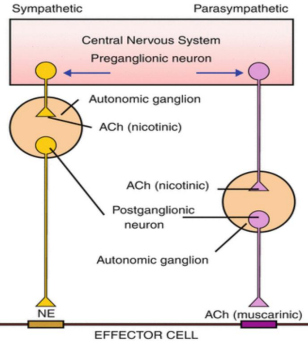
Rules about neurotransmission
- All autonomic preganglionic are cholinergic.
- All parasympathetic postganglionic are cholinergic.
- Almost all sympathetic postganglionic are adrenergic
- Except for sweat glands & piloerector muscles 🡪 cholinergic
EFFECTS OF ANS STIMULATION
| Sympathetic | Parasympathetic | |
|---|---|---|
| Heart | ↑ HR↑ CO↑ SV↑ ForceLahat ng ↑ heart sympa | ↓ HR |
| GIT | Constipation↓Peristalsis | ↑ Motility↑ Digestion↑ Gastric Juice Secretion↑ Pancreatic Ax ↑ Salivation↑ Defecation ↑Peristalsis(CN7&9)Lahat ng ↑ sa tiyan para |
| BP | ↑ Peripheral Vasoconstriction [BV away fr ♥]↑ Coronary Artery Dilation | ↓ Peripheral Vasoconstriction↓ Coronary Artery Dilation |
| Resp | BronchodilationDilaShunsalbutamol: dilate | BronchospasmSParasymp |
| Eyes | Mydriasis (P. Dilate) | Miosis (P. Constrict) |
| Gut | ↓ Urinary Output (UB Relaxation + Sphincter Constriction)ssssssss | ↑ Urinary Output (UB Contraction + Sphincter Relaxation)PpsspsspDetrusor ms |
| Repro | Psychogenic Erection L1, L2, L3Ejaculation | Reflexogenic Erection S2, S4 |
| DysparemiaDifficulty in coitusDry vagina; lack of lubricationdifficult in intercourseVaginismusVaginal spasmlockPriapismpainful ejection of penisCauda EquinaHorsetail (cut)(+) psychogenic erection (-) Reflexogenic Ejection |
|---|
| CLINICAL CORRELATION:Horner’s Syndrome: may result from sympathetic damagePtosis: drooping of eyelids (partial)Muller’s ms (20%)levator palpebrae superioris (CN3) 80%Miosis: pupils constrictedDoes not belong: Pupils Dilated: T1Anhydrosis: no sweating Enophthalmos: sunken eyesDoes not belong: Exophthalmos: bulge eyes |
|---|
SPINAL NERVES
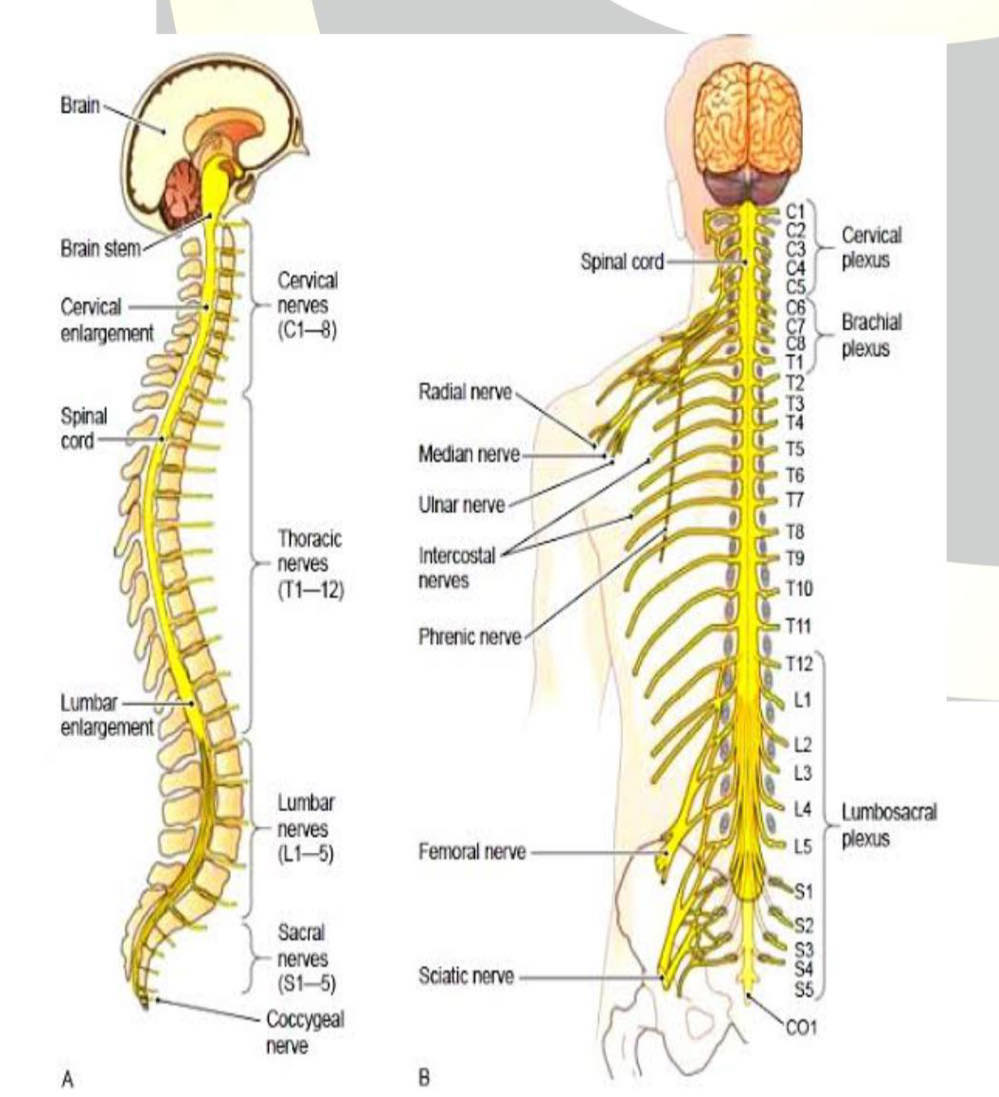
- 31 PAIRS
- Cervical: 8 pairs (horizontal)
- Thoracic: 12 pairs
- Lumbar: 5 pairs
- Sacral: 5 pairs
- Coccygeal: 1 pair (horsetail)
- Termination of spinal cord: L1 L2 Vertebral levels
- Best site for lumbar puncture: L4-L5
- Common for meningitis
- Fetal position in sidelying
- up to 3 months of gestation: magkatapat sc and sn. pagtumanda: mas long vert column
- Tip on Spinal cord
- Adult: end at lower border of L1
- Children: end at L3
- L2 vertebral fracture: No SCI (+) PNI → good prognosis
Components of Spinal Nerves
- Grey matter
- White Matter
- Dorsal Root - sensory; dermatome
- Ventral Root - myotome
- Spinal Nerve
- Gray Ramus
- White Ramus
- Dorsal Ramus - supplies dorsal aspect of trunk, skin, & ms
- Ventral Ramus - supplies anterior trunk, skin, & ms
- Dorsal Root Ganglion - round cells with 1 process leaving the body
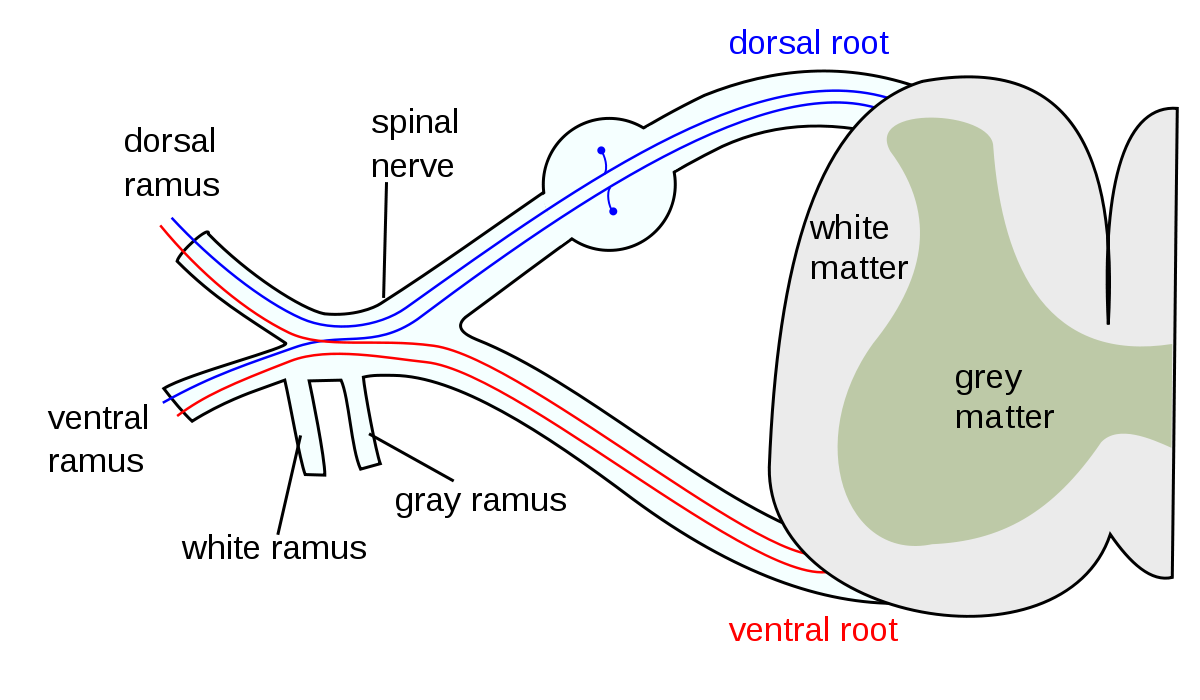
| Brachial plexus supplies?Ans: Ventral RamiBell Magendie LawDorsal root of the spinal cord is sensory in function while the ventral root is motor functions |
|---|
DERMATOMES
- A strip of skin supplied by a single root
- Dorsal root
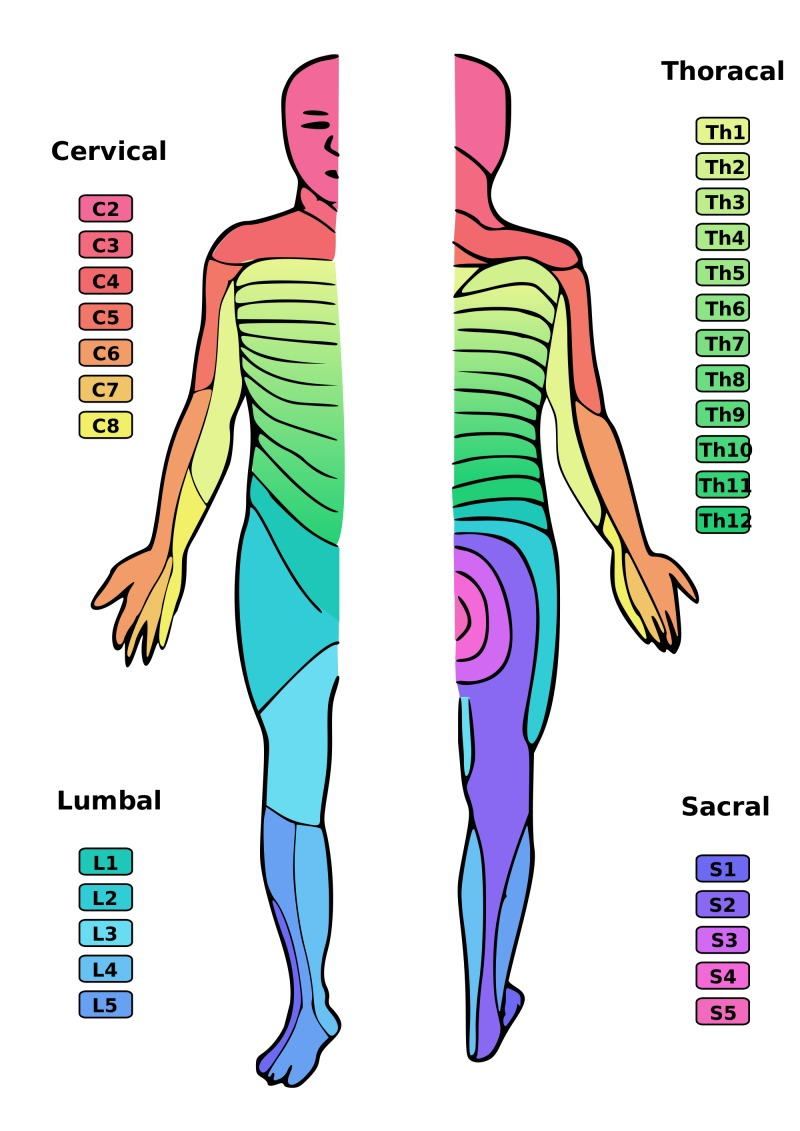
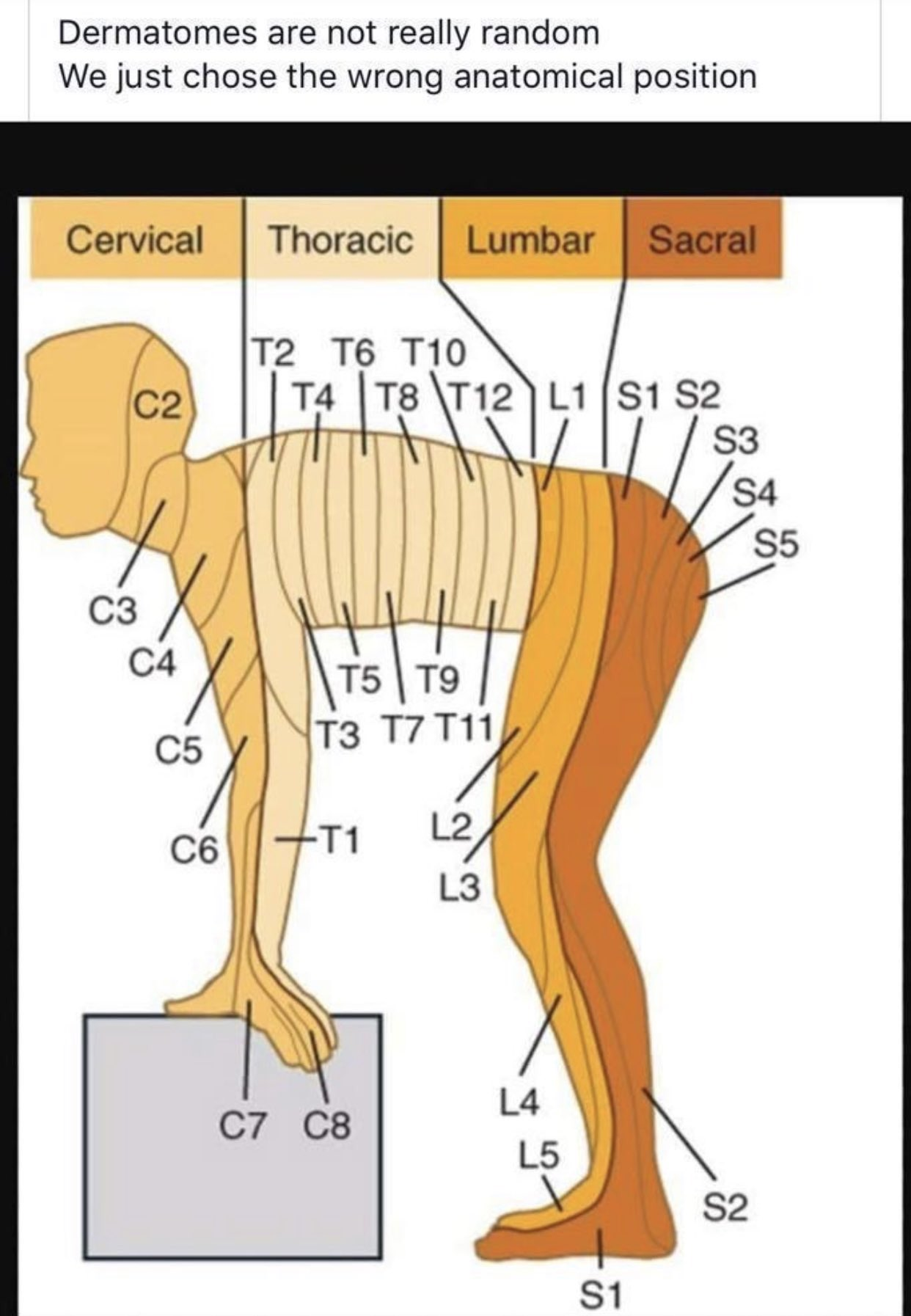
28 Key Sensory Areas
- No C1 Dermatome
- No coccygeal
- S4-S5 Combined (one level)
| SCI px, Upon evaluation, it was noted that there is a partial sensation below xiphoid process 1 inch above umbilical partial sensationAns: T6The skin just above the patella: L3L5 dermabig toe (L5 myotome)3rd MTP |
|---|
| Dermatomes |
|---|
| C2 |
| C3 |
| C4 |
| C5 |
| C6 |
| C7 |
| C8 |
| L1 |
| L2 |
| L3 |
| L4 |
| L5 |
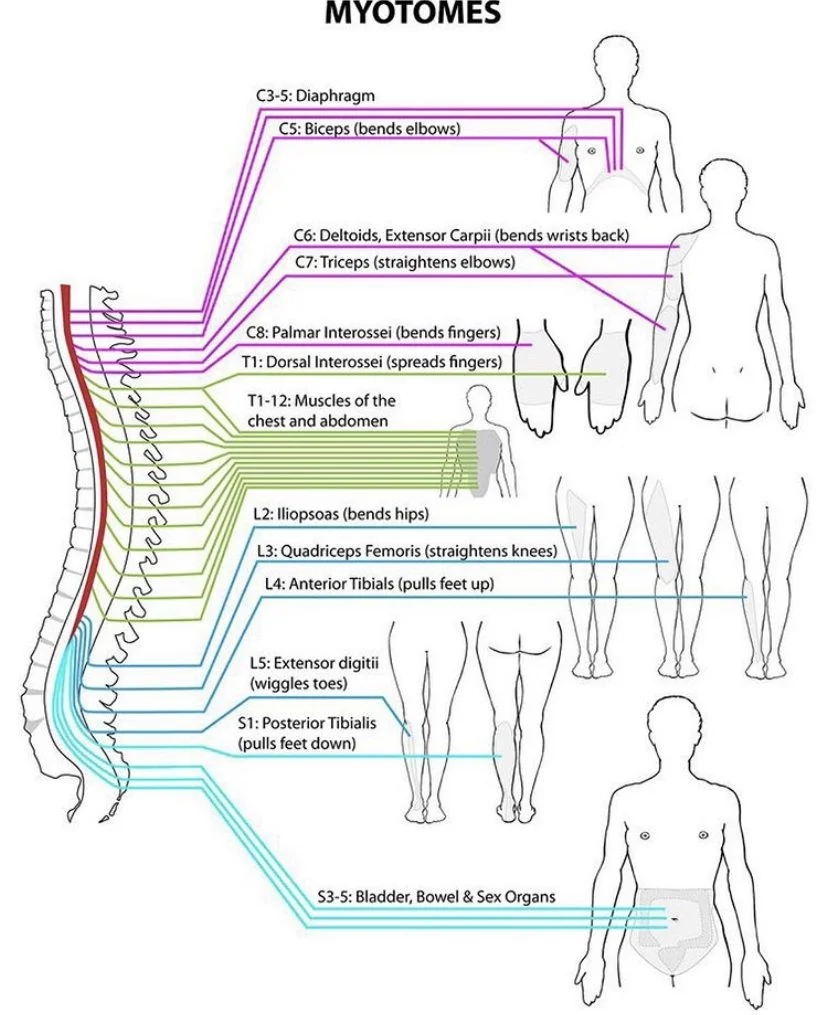
MYOTOMES
- A ms of group of ms supplied by a single root
- Ventral root
- ASIA = 10 myotomes
- start with C5
- most common level of SCI (admitted)
- most common Quadri (incomplete)
- Paraplegia - T1
- Above T1 - quadriplegia
| DTR NEUROLOGIC LEVELS | |
|---|---|
| \n C5, C6 | C5 Biceps Reflex |
| C6 Brachioradialis Reflex | |
| C7, C8 | C7 Triceps Reflex |
| L3, L4 | L4 Patellar Reflex |
| \n S1, S2 | S1 Achilles Reflex |
| Lateral Hamstring Reflex BF | |
| L5, S1 | Medial Hamstring Reflex ST SM |
| L4, L5 | Tibialis Posterior Reflex behind med. malleolus |
| CN 5 | Jaw Jerk |
\n
| AMBULATION | ||
|---|---|---|
| SO | ↑ T2 | Standing |
| TA | T3-T11 | Therapeutic |
| HA | T12-L2 | Household |
| CA | ↓ L3 | Community |