1.2.6 Government Intervention
Government Policies to Deal with Externalities - Syllabus 1.2.6 (a)
Government intervention = Where the government becomes involved in a situation to help deal with a problem
STRFP acronym
Subsidies = Money paid by government to producers to encourage production of a good/service
Taxation = Fee charged by government on a good/service, income, or economic activity
Regulation = Establishing legislations, standards, and legal controls
Fines = Money that must be paid as a punishment for not obeying a rule/law
Pollution permits = Government-issued document allowing firms to discharge a certain amount of polluting material to the environment
Subsidies for encouraging activities producing positive externalities; taxation, regulation, fines, and pollution permits for discouraging activities producing negative externalities
Advantages & Disadvantages of Each Government Policy - Syllabus 1.2.6 (b)
Subsidies
Encourages firms to produce goods in a way that is less environmentally-harmful
Opportunity cost for the government because subsidies could be used elsewhere
May cause producers to be inefficient as they have no incentive to lower production cost
Depends on:
whether firms take subsidy as extra profit rather than invest in alternatives
whether government has correct information about what types of firms to subsidize
government’s priorities to invest in a long or short term goal by providing subsidies
Taxation
Contributes to government revenue
Incentivizes firms to change production methods and reduce negative externalities
Difficult to measure true external costs and how much to tax
Depends on:
PED, inelastic demand may minimize tax’s impacts
tax is large enough to encourage firms to change in the long-run
Regulation
Creates clearly defined goals and ensures pollution levels are reduced rather than just market-based incentives
Ambiguity about how it will be achieved so taxes are still required to reduce pollution
Depends on how well regulations are monitored and enforced
Fines
Incentivizes firms to make changes to their operations and production techniques
One-time, may not cause long-term change if firms have enough revenue and if costs are passed onto consumers as higher prices
Depends on:
size of fine; if it’s too small compared to the firm’s revenue, they may not be incentivized to make changes to their production techniques to reduce negative externalities
Pollution permits
Incentivizes firms to produce goods in a way that is less environmentally harmful (pollution permits are tradable and can be sold to other firms if unused for maximized revenue, which encourages more efficient, eco-friendly production techniques and operational methods)
Difficult to measure amount of pollution created, which may give firms an incentive to firms for cheating/hiding the true amount
Depends on:
number of permits government gives (too generous → little pollution reduction)
administration/monitoring of pollution permits; less strict → less effective
whether firms pass on increased production costs from pollution permits, fines from polluting more than the permitted amount, etc, to consumers in the form of higher prices
Government Regulation of Competition - Syllabus 1.2.6 (c)
Need for government regulation:
Firms will exploit customers using anticompetitive practices such as:
Restricting consumer choices (manufactures might only supply to retailers if they do not stock rival products, reducing consumer choice and variety of goods/services)
Raising barriers to entry (dominant firms may lower its prices when new entrants join the market, after driving out new entrants, dominant firms may raise their prices)
Market sharing
Collusion; few large firms may collude to collective raise prices and share teh market
Purpose of government regulation:
Promote competition and preventing anti-competitive practices
Anticompetitive practices = Attempts by firms to prevent or restrict competition
LIE acronym
Low barriers to entry
Less legal barriers → more firms can join market → more firms, suppliers, and buyers → more competition
Introduce anti-competitive legislation
Legislation exists to prevent anti-competitive practices
E.g. CCI (Competition Commission of India) acts as a regulator to eliminate practices that reduce competition, promote/sustain market competition, protect consumer interests, and ensure freedom of trade
Encourage growth of small firms
More small firms encouraged to join markets → more firms, suppliers, and buyers → more competition
start-up schemes used to fund/subsidize new entrants, business services provide information and advice on running businesses + obtaining finance to encourage market entry
Limit monopoly power
Careful monitoring of monopolies to prevent consumer exploitation
Some countries appoint a body to oversee monopoly firms
Some countries have an entire industry being dominated by a monopoly firm or few firms so need to be monitored by watchdogs
Protect consumer interests
Consumers can be exploited by:
Being charged high prices
Price fixing
Restricted consumer choice
Firms raising barriers to entry by investing heavily in advertising and promotion which smaller firms cannot afford
The Office of Fair Trading (UK) and Federal Trade Commission (US) are government departments/agencies that ensure consumers’ interests are protected by:
Monitoring marketplace for anti-competitive behaviors
Breaking up monopolies and preventing their establishment through mergers and takeovers
Establishing legislation to protect consumer exploitation, prevent businesses from making false claims about product quality, ensure firms sell goods that are fit for purpose, and incentivizes firms to not break these legislations or they will face fines and have to compensate consumers for any loss
Fit for purpose = Usable by a consumer for its intended purpose
Control mergers and takeovers
Mergers =
Takeovers =
Mergers and takeovers reduce market competition because multiple firms join to form a single entity, which reduces the number of firms in a market and therefore lowers competition
Larger mergers and takeovers are monitored/investigated by the government
Government Intervention to the Labour Market - Syllabus 1.2.6 (d)
Minimum wage = Minimum amount per hour which most workers are legally entitled to be paid
Reasons for minimum wage:
Raise low-paid workers’ income
Benefit disadvantaged workers (e.g. women, ethnic minorities, low-income families) → reduces inequality + increases fairness + reduces income disparity between rich and poor
Increases low-income workers’ living quality → amount of welfare benefit entitled to claim will fall → less opportunity cost for government and saves money for government as fundings spent on welfare benefits can be invested in other purposes
Workers’ income increases due to rise in minimum wage → workers can pay more tax to the government → maximizes government revenue
Higher wages can motivate workers and consequently cause them to increase their productivity
Minimum wage advantages and disadvantages:
Workers:
Low-paid workers have higher income and enhanced living quality
Better motivation due to higher wages
Firms:
Increased production costs
Motivated employees → higher productivity → increased output, lowered average cost (fixed costs divided over larger output), and increased revenue (if extra output produced is sold)
Governments:
Minimum wage ensures better financial security so incentivizes/attracts people to enter the labour market and find a job → ↑ labour supply
Minimum wage raises workers’ incomes → workers are taxed more → increased government revenue from taxes which can be invested in infrastructure or healthcare systems
Minimum wage → higher income and enhanced living quality → decreased reliance on welfare benefits
Rise in minimum wage → higher wage rates → ↓ labour demand as firms want to minimize labour and production costs → ↑ unemployment (due to greater difference between ↑ labour supply and ↓ labour demand) → increased welfare benefits required to facilitate larger unemployed population
Impact of minimum wage on employment:
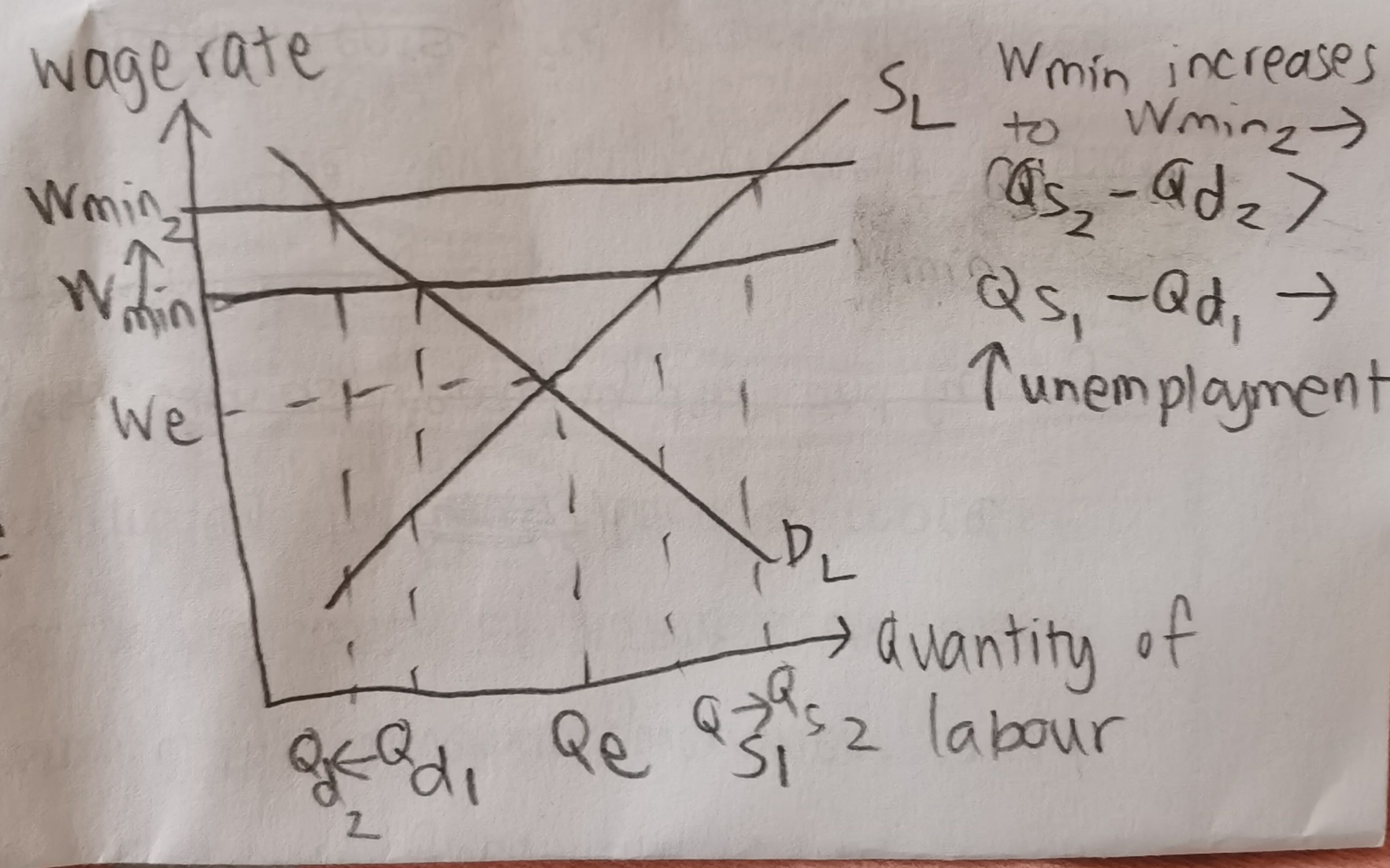
↑ minimum wage → ↑ difference between supply and demand of labour → ↑ unemployment
Factors influencing whether minimum wage causes job losses:
Size of minimum wage increase (too little increase → too little of an impact which is not worth the increased unemployment, especially if there are regional imbalances)
May not affect firms’ labour demand if increased wage costs are offset by increased worker productivity due to their higher motivation from increased wages (lowers average cost as wage costs are divided over greater outputs)
Producers may not have less labour demand if they can pass on increases in wage costs to consumers as increased prices (this will be feasible if PED is inelastic, e.g. increased costs for necessities like toilet paper)