POP quiz
Ch.1
Karl Taylor - is a professional commercial photographer with more than 20 years of experience in the industry
Light, Subject : Composition THE SIX ESSENTIAL STEPS
Light - is an essential part of an image, and there are many different types of light. Each of these can be used to create different moods or feelings in an image
Light - Essential for us to record an image.
Subject : Composition - is what we photograph and how we arrange elements within the frame
Subject: What we photograph and how we compose the image.
Camera Optics: lenses - are what focus the available light so that it can be recorded by the medium.
Optics - Lenses that focus the light to capture an image.
Aperture: Depth of field - The aperture refers to a hole in the lens that light passes through before reaching the recording medium.
F - Symbolized by the letter, the aperture controls how much light is recorded and the depth of field.
Aperture - A hole in the lens that controls how much light gets into the camera.
Time: Shutter speed - refers to how long the shutter remains open and is recorded in seconds, tenths or hundredths of a second.
The slower the shutter speed, the more light that is recorded (and vice versa).
Time (Shutter) - How long it takes to record an image.
Recording Medium: sensor - Once light passes through the lens, aperture and shutter, it reaches the recording medium, which records the image.
Medium - What records the image.
CH.2 EXPOSURE
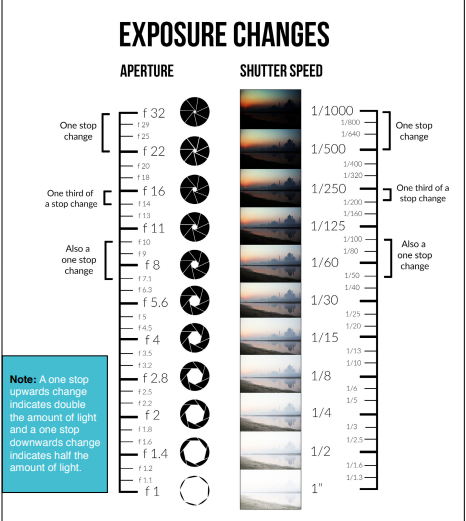
Exposure - simply refers to the brightness or darkness level of an image. One of the ways we can control how bright or dark an image is is by adjusting the shutter speed.
This means that larger apertures (e.g. f2.8) can be a good choice when shooting in low light conditions as they allow more light to reach the sensor, while smaller apertures can be used in bright conditions where it may be necessary to limit the amount of light reaching the sensor.
A key thing to remember with apertures is that smaller f-stop numbers (e.g. f1.4) refer to larger apertures, or larger openings in the lens. On a given lens, f1.8 may be the largest aperture, allowing the most light to enter the lens, while f32 may be the smallest aperture, allowing the least amount of light to enter the lens.
Ch.3 - Shutter Speed
Shutter speed - is the length of time that the shutter remains open to allow the medium to record light
Frozen Action, Panning, Motion Blur - Shooting techniques for creative effect
Frozen Action - In this example the subject appears frozen in the frame while the background is blurred
Panning - When you follow the movement of the subject as you take the image with a fairly slow shutter speed. This results in a relatively frozen subject and motion blurred background.
Motion Blur - Can only be successful when there is no camera shake, therefore a tripod is essential.
Ch. 4 - Camera Focus
Focus - is an important concept to understand in photography as it can make or break an image.
Manual focus - it is simply a case of rotating the focus ring on the lens until the area you want in focus becomes sharp.
Autofocus - is a great option for those still getting to grips with their camera as it is a quick and easy method of focusing.
Focus points - can be selected automatically or manually, and where these are in an image can have a great bearing on how the final image looks
Focus mode - keeps the focus point once the shutter is half pressed, even if you reframe the image.